








This Bitcoin fanatic really became Argentina's president
TechFlow Selected TechFlow Selected
This Bitcoin fanatic really became Argentina's president
"I know how to eliminate the cancer of inflation," Javier Milei declared in last Sunday's final presidential debate.
 Navigating Web3 tides with focused insights
By Jaleel
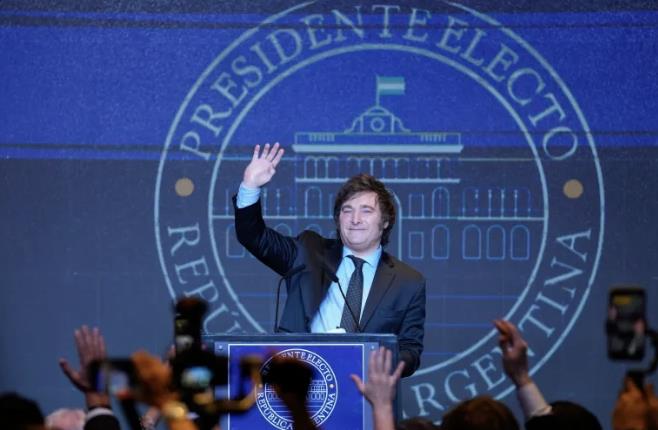
Javier Milei, the presidential candidate who once threatened to blow up his country's central bank, has officially been elected President of Argentina. "Argentinians have chosen a different path," conceded Sergio Massa, Milei’s defeated opponent, who announced his retirement from frontline politics.
In the second-round election held on November 19, Javier Milei secured 55.7% of the vote compared to Massa’s 44.2%. Having defeated his final rival, Milei will assume office on December 10. "Today, the rebuilding of Argentina begins. This is a historic night for Argentina," Milei told jubilant supporters at his campaign headquarters in Buenos Aires.

Throughout his campaign, Milei repeatedly pledged to abolish Argentina’s central bank and peso, replacing them with the U.S. dollar as legal tender to combat an inflation crisis that has plunged 40% of Argentina’s 45 million citizens into poverty and driven inflation above 140%.
In his vision, after shutting down the central bank, Bitcoin would also play a key role as a remedy against inflation. Prior to the presidential race, Milei frequently appeared on talk shows promoting the benefits of Bitcoin and cryptocurrencies. "Bitcoin can make central banks obsolete," Milei declared.
Following Milei’s victory, Bitcoin surged past $37,000, currently trading at $37,356, marking a 2.3% gain over the past 24 hours.
An Austrian School President for Argentina
"I know how to eradicate the cancer of inflation," Javier Milei proclaimed during Sunday’s final presidential debate.
According to Milei, Argentina’s troubles began with the establishment of its central bank in 1935. Before that, Argentina was among the world’s wealthiest nations, experiencing an average annual inflation rate of just 0.9% between 1880 and 1935. The creation of the central bank in 1935 deceived the entire population: average annual inflation jumped to 6%. After the central bank was nationalized in 1946, inflation soared further, averaging 250% annually by 1991—an outright disaster.
An economist and financial analyst by training, Milei adheres to the Austrian School of economics and is a staunch advocate of laissez-faire capitalism. He describes himself as a “short-term anarchist” and “long-term anarcho-capitalist.”

The Austrian School is no stranger to the blockchain space. The school’s founders argued that “money is not an invention of the state.” One essential reading among crypto enthusiasts influenced by this school is Friedrich Hayek’s *Denationalisation of Money*, which explicitly calls for a complete separation between government and monetary systems. Considered radical when published in 1974, Hayek’s ideas appeared prophetic after Bitcoin emerged in 2009. Many believe this book directly inspired Satoshi Nakamoto, who was very likely a libertarian grounded in Austrian economic thought.
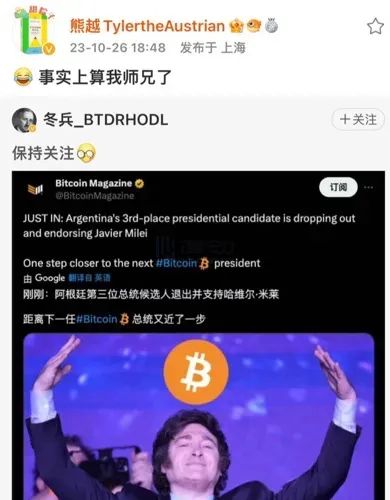
Xiong Yue, one of China’s earliest Bitcoin advocates and a seasoned scholar of Austrian economics, closely followed Milei’s campaign: “He’s practically my senior—I suggest searching ‘Milei Huerta de Soto’ on YouTube. Javier Milei is heavily influenced by Huerta de Soto and even contributed an article to a commemorative volume honoring him. Very much rooted in the Austrian School.”
Argentines Have Chosen a New Path
“Due to current conditions, we are temporarily unable to display prices on shelves. Please inquire at checkout. All cash promotions are suspended until further notice. Thank you for your understanding.” This sign posted outside a small market in Argentina vividly reflects the country’s recent economic chaos.

Nathan, a journalist, returned to Argentina’s capital this past April for the first time in ten years and experienced this firsthand. Like everyone else, Nathan’s first task upon arrival was currency exchange—but rates varied dramatically depending on where and how pesos were obtained.
The official exchange rate stood at 220 pesos per dollar; however, after visiting several Western Union outlets, he was repeatedly told they had no cash available. Guided by a local friend, Nathan eventually found the so-called “cuevas”—black-market exchange spots—on a backstreet, where the rate approached 400 pesos per dollar.
But Nathan then faced another major issue: the largest banknote in circulation is worth 1,000 pesos—less than $2.04. After exchanging money, he was left carrying stacks of bulky notes stuffed into wallets and pockets. Carrying a backpack full of pesos for daily spending felt extremely conspicuous and anxiety-inducing.
It’s hard to imagine this is the same Argentina that ranked among the top ten economies in the world in the early 20th century. In recent years, affected by global financial trends, the pandemic, and domestic mismanagement, Argentina’s economic growth has slowed significantly while inflation has exceeded 100%. The peso continues to depreciate relentlessly, making it arguably the weakest currency globally this year. Bank of America forecasts the official peso-to-dollar rate could fall to 545 by year-end and plummet to 1,193 by the end of next year.
Given this complex economic backdrop, many viewed Argentina’s presidential election as the best opportunity for transformative change. Milei’s unconventional positions resonated widely, especially among tech-savvy younger voters.
Zocaro, spokesperson for Bitcoin Argentina, noted that cryptocurrency adoption in Argentina has been growing since around 2020, with increasing numbers of people buying Bitcoin and stablecoins. Amid strict international financial restrictions, more Argentinians are turning to crypto to send money abroad or purchase foreign goods. For citizens who find that money sufficient to buy bacon in the morning might only afford bread by evening, cryptocurrencies offer a way to preserve value.
Unlike the shadowy “cuevas,” Zocaro emphasized, “cryptocurrencies are fully legal in Argentina. People are increasingly aware of dollar inflation and view Bitcoin as a potential alternative. Most young Argentinians prefer Bitcoin, Ethereum, and stablecoins. Some provinces, like Mendoza, have already implemented measures allowing tax payments in cryptocurrency.”
According to a survey conducted in April 2022 by Americas Market Intelligence, nearly 51% of Argentine consumers have purchased cryptocurrency—up sharply from about 12% in a similar survey at the end of 2021. The study also found that as many as 27% of Argentine consumers regularly buy digital assets, primarily for investment, inflation hedging, and avoiding government control.
While many older Argentinians still prefer holding physical U.S. dollars, an increasing number of younger residents are favoring USD-pegged stablecoins. “They don’t need to handle cash—they can transact entirely via mobile phones,” said representatives from platforms serving Argentine users, noting that two-thirds of their user base are under 35 years old.
Milei’s proposal to adopt the U.S. dollar as Argentina’s official currency was met with applause from supporters, echoing concerns raised by numerous economists about Argentina’s ongoing financial collapse.
Regardless, in a country where annual inflation exceeds 140% and two-fifths of the population live in poverty, Milei’s victory demonstrates that Argentinians have grown weary of traditional politics and economic failure. The people are ready to try something new—they’ve chosen a different path.
Join TechFlow official community to stay tuned
Telegram:https://t.me/TechFlowDaily
X (Twitter):https://x.com/TechFlowPost
X (Twitter) EN:https://x.com/BlockFlow_News
 BlockBeats









