OKX Researcher: Learning from Cycles: The Knowledge and Actions of Leading Crypto Institutions
TechFlow Selected TechFlow Selected
OKX Researcher: Learning from Cycles: The Knowledge and Actions of Leading Crypto Institutions
This article aims to understand the market from the perspectives of leading industry projects and institutions—dappOS, Taiko, Celestia, and OKX Ventures—that have successfully navigated this bear market cycle, exploring their "knowledge" and "actions" during the downturn.
 Navigating Web3 tides with focused insights
By OKX
The U.S. federal funds rate remains at its highest level since 2022—between 5.25% and 5.50%. However, boosted by the Federal Reserve's pause on rate hikes and growing expectations around the approval of spot Bitcoin ETFs, both on-chain and off-chain capital have jointly propelled Bitcoin back into an upward trajectory. By the end of October this year, BTC surged over 26% month-on-month, breaking through the long-standing resistance level of $30,000 that had held for nearly half a year, leading a broad rebound across the crypto market.
Yet this recovery has not come easily. After BTC reached a new all-time high of $69,000 in 2021, the industry entered a prolonged bear market lasting over two years. By early October this year, key crypto sector metrics had plunged to "rock bottom" levels: NFT market trading hit a two-year low, the ETH/BTC exchange rate fell to a 15-month low, total Q3 crypto company fundraising dropped to its lowest since Q4 2020, DEX trading volume reached its lowest since January 2021, and exchange Bitcoin balances hit a near five-year low. With capital continuously fleeing, the market was filled with despair.
At this "darkest hour," sparks of revival began to emerge—most notably the rise of Bitcoin Ordinals—and on-chain Bitcoin addresses hit record highs. Bullish forces within the market started taking active positions, marking a turning point in sentiment. Soon after, the inflow of 900 million dollars' worth of stablecoins swept away the gloom, triggering a major market reversal. Projects and institutions that had strategically positioned themselves during the bear market began reaping their rewards.
This article aims to explore how the market is perceived through conversations with leading projects and institutions—including dappOS, Taiko, Celestia, and OKX Ventures—that successfully navigated this bear cycle. We examine their insights and actions during the downturn, seeking to uncover key drivers for future industry development. This piece does not constitute investment advice.
Reviewing the Past Three Market Cycles
Over the past decade-plus, the crypto industry has evolved comprehensively through technological innovation, application upgrades, and regulatory exploration, rapidly deepening its integration with traditional financial markets and the real world. Looking back at the three previous bull-bear cycles, it becomes clear that only when new capital, compelling narratives, and breakthrough technologies converge can a true bull market emerge. Below is a summary of the three historical cycles based on narrative evolution:
2009–2015: The First Bull-Bear Cycle – Experimental Innovation, Opening a New World
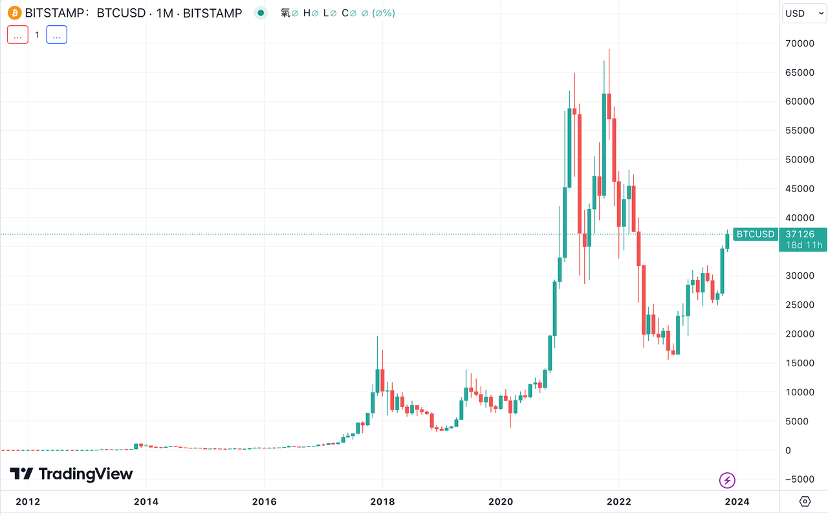
On January 3, 2009, at 6:15 PM, the Bitcoin genesis block was mined on a small server in Helsinki, Finland, marking the official birth of Bitcoin. At this stage, Bitcoin remained a niche experiment among developers and early adopters, focused primarily on spreading the concept and forming initial consensus. Infrastructure began to take shape, and with the launch of early exchanges like Mt. Gox, Bitcoin entered the trading era, sparking speculative interest. Its initial price was $0.0008, peaking at $1,202 during this bull run in 2013 before entering a downtrend and completing its bottoming process by 2015.
2015–2018: The Second Bull Cycle – The ICO Era, Building Foundations
After market recovery, a new cycle began, set up by the influx of speculative capital, growing developer participation, iterative technological advances, and the narrative of Bitcoin halving. Meanwhile, adjacent industries such as crypto media, mining hardware and farms, data tools, and crypto funds began to form. In 2017, fueled by the explosive popularity of the ICO model and the emergence of second-generation public blockchains like Ethereum, speculation soared. Stories of instant wealth became common headlines, and Bitcoin hit a new all-time high of $19,800 on December 17. The crypto industry gained widespread attention. Subsequently, it entered another bear market marked by black swan events and regulatory crackdowns, with BTC falling to around $3,000 in 2018, struggling forward amid skepticism.
2018–2022: The Third Bull Cycle – Maturing Infrastructure, On-Chain Application Boom
After three years of stagnation, blockchain technology transitioned from hype to practical application, driven by continuous upgrades to the Ethereum network. In 2020, DeFi, NFTs, DAOs, GameFi, and IEOs built on Ethereum exploded in popularity, attracting massive institutional investment and new capital. The vast potential of the crypto industry also drew in numerous developers who, through continuous technical innovation, helped shift the space from speculation toward real utility. Infrastructure matured significantly. Fueled by these positive developments, Bitcoin reached an all-time high of $69,000 on November 10, 2021, before plunging into a bear market lasting over two years.
2022–Present: The Fourth Bull Cycle – Compliance and Real-World Adoption Take Center Stage
Despite suffering major setbacks from various black swan events, the industry continues to innovate and gradually shift toward rationality and value-based investing. Emerging narratives such as evolving regulatory frameworks, anticipated approval of BlackRock’s spot Bitcoin ETF, Web3 + AI convergence, and the rise of the Bitcoin ecosystem are now setting the stage for a new bull market.
Bitcoin has repeatedly rebounded from bear market lows to set new all-time highs, demonstrating remarkable resilience. As of November 3, Bitcoin’s market cap reached $726 billion, surpassing Tesla to rank 11th globally—evidence of strong liquidity support and global recognition. Yet as the depth and breadth of crypto market liquidity grow, the market is expected to become more rational and mature, potentially reducing Bitcoin’s volatility. As an emerging financial paradigm, the crypto industry is expanding into multiple narratives beyond the simple Bitcoin halving story, actively exploring future directions and creating new possibilities. But this journey is fraught with challenges and twists; only those with unwavering conviction will endure.
Insights and Actions from Leading Institutions
During multi-year bear markets, even faith can falter under pressure. Through discussions with top-tier projects and institutions—dappOS, Taiko, Celestia, and OKX Ventures—that successfully weathered this cycle, we explore their perspectives on macroeconomics, bear market strategies, and key focus areas to better understand how they interpret the market.
Daniel Wang from Layer2 project Taiko emphasized that the crypto market cannot exist independently of the broader macroeconomic cycle: “Currently, virtual asset prices are highly correlated with the real economy and Wall Street. So if the real economy struggles, crypto is unlikely to see an independent bull run. Unless there are more geopolitical conflicts, loss of confidence in U.S. dollars and Treasuries by major economies, or approval of spot Bitcoin ETFs—which could decouple certain regions from this correlation—a minor bull market might emerge. But I think a major bull run will require more patience. For strategic long-term investors, dollar-cost averaging works well. There’s no need to obsess over short-term market cycles. Never invest money you may urgently need. Mindset is crucial.”
Daniel Wang is a firm believer in long-term investing—a philosophy reflected in Taiko’s strategy, aligning his “knowledge” with “action.” According to Wang, Taiko has launched five testnets, experimenting with different Layer2 protocol designs, economic models, proof systems, and multi-hop cross-chain bridges. They are now patiently awaiting the rollout of EIP-4844, after which one or two more testnets will precede mainnet launch. As an Ethereum-equivalent ZK-Rollup designed to scale Ethereum by supporting all EVM opcodes within a decentralized, permissionless, and secure Layer2 architecture, Taiko is widely regarded as a rising star in the Layer2 space.
The lead behind the first modular blockchain, Celestia, expressed even greater conviction in their niche: “We believe in modular blockchains—the category that will drive the next decade of crypto innovation.”
Kiwi, a researcher at OKX Ventures, remains optimistic about the second half of the year. He noted that despite volatile global macroeconomic conditions, people may increasingly turn to holding and using cryptocurrencies as traditional financial systems become more unstable. On-chain activity continues to rise, with steady growth in addresses and users across chains—Bitcoin has accumulated nearly 1.2 billion addresses with about 1 million active ones. The on-chain application ecosystem is thriving, Ethereum has completed the Shanghai upgrade with the Cancun upgrade upcoming, and infrastructure development is accelerating—all signs pointing to a healthier industry. Moreover, the combined catalyst of Bitcoin halving expectations and potential approval of spot Bitcoin ETFs could spark massive institutional demand.
Kiwi added that on-chain transaction volume, active addresses, and miner fees reflect the intensity of market activity and participant behavior—these fundamental metrics are invaluable for identifying promising projects, spotting trends, and making informed decisions. Beyond standard metrics like volume, active addresses, fees, hash rate, and token supply, he places particular emphasis on developer activity data—such as code commits and new releases—as indicators of a project’s vitality and long-term potential.
The head of dappOS stated: “As inflation becomes more apparent, younger generations will increasingly turn to cryptocurrency. In the future, Web3 and blockchain applications will become part of everyday life. dappOS is an intent-centric operating protocol designed to make dApps as user-friendly as mobile apps. I remain forever optimistic about the crypto industry. Those who benefit most during bull markets are precisely those who stood firm at the bear market bottom. Patience and discipline are the two keys to surviving a bear market. Additionally, continuous learning is vital. The Web3 space evolves daily—ask questions, read articles, listen to experts and KOLs, track on-chain data, and begin forming your own views. This will help you spot market trends ahead of others.”
Through conversations with these high-quality projects and institutions, two core themes emerge clearly: “optimism” and “long-term thinking.” They remain committed to deep work, continuous learning, and being friends with time. In the future, young people of the new generation will be the driving force behind widespread adoption of crypto applications.
Conclusion
No matter what challenges arise, the trend of Bitcoin and the crypto market remains upward, fueling endless innovation—advancing financial democratization, awakening personal sovereignty, returning data ownership, enhancing privacy protection, transforming trust mechanisms, and even reshaping the direction of the internet. That alone is already cool enough! All we need to do is “participate deeply, and freedom will follow.”
Join TechFlow official community to stay tuned
Telegram:https://t.me/TechFlowDaily
X (Twitter):https://x.com/TechFlowPost
X (Twitter) EN:https://x.com/BlockFlow_News
 OKX
OKX