








Exclusive Interview with Delysium Co-Founder: Building a Blockchain-Based AI Infrastructure to Solve Communication and Collaboration Challenges Among Future AI Agents
TechFlow Selected TechFlow Selected
Exclusive Interview with Delysium Co-Founder: Building a Blockchain-Based AI Infrastructure to Solve Communication and Collaboration Challenges Among Future AI Agents
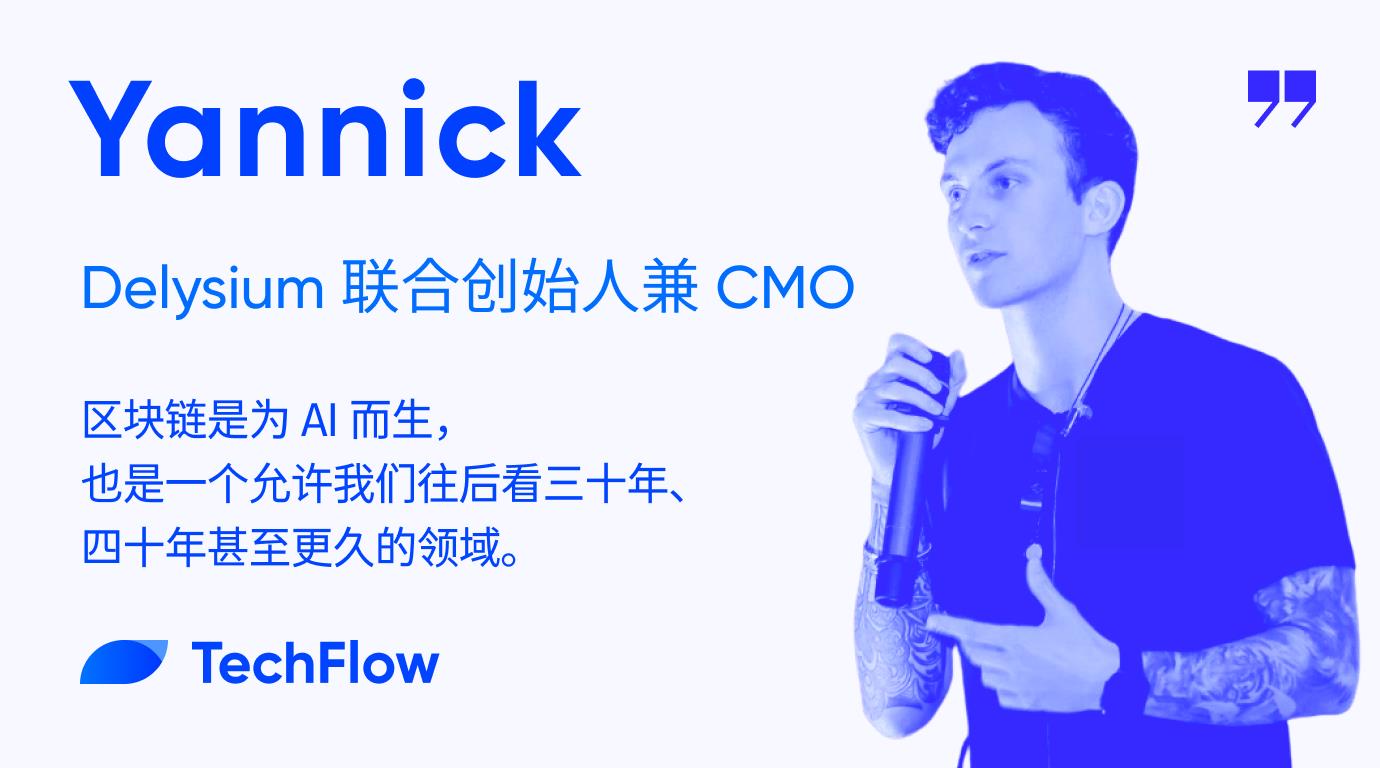
Blockchain was born for AI, and is also a field that allows us to look forward thirty, forty, or even more years.
 Navigating Web3 tides with focused insights
"Blockchain was born for AI, and it's also a field that allows us to look ahead thirty, forty, or even more years."
-- Yannick, Co-founder and CMO of Delysium
On November 8, 2023, Delysium released Version 2 of its whitepaper, leveraging AI to build a user-intent-centric AI Agent Network for Web3.
Let’s briefly forget reality and imagine the world 100 years from now: our lives will be filled with various AI-driven agents or assistants, so intelligent that they may understand us better than we understand ourselves, taking over most of our daily tasks. As humans, we would then have more time for deep thinking and shaping a better world. Similarly, these AI agents will need mechanisms to communicate and collaborate effectively in order to work together seamlessly and truly liberate humanity.
Delysium is dedicated to building such a vision through its AI Agent Network. As early as March this year, Delysium launched an early version of Lucy—the first agent powered by the AI Agent Network—which is also an AI-driven Web3 operating system. According to official data from Delysium, by June 15, 2023, Lucy had accumulated over 1.4 million unique wallet connections. In the future, Lucy will integrate with more ecosystems, protocols, and applications, offering hundreds of millions of upcoming Web3 users a simpler operational experience.
Surveying the landscape of Web3 projects, Delysium has consistently been at the forefront of AI innovation—having started laying the groundwork as far back as six years ago. Why is Delysium placing such a strong bet on AI? And what unique insights and advantages does Delysium bring to the table amid competition from companies like OpenAI and Anthropic?
TechFlow invited Yannick, co-founder of Delysium, to share Delysium’s perspective on AI and the critical role blockchain plays in the development of AI.
Born with AI DNA: The Emergence of Delysium Through Experimentation
TechFlow: Thank you, Yannick, for joining us today. Could you start by introducing yourself and Delysium?
Yannick: Of course. My name is Yannick, one of the core contributors and co-founders of Delysium, serving as CMO.
I’m from the Netherlands, born in Amsterdam. Around 2013, a very mysterious friend first introduced me to Bitcoin—it’s quite an interesting story. He always talked about things like the CIA. One day he came to visit me and some friends and asked, “Have you heard of Bitcoin?” Though we knew nothing about it at the time, he became the first person to introduce us to Bitcoin. We then started building a small mining setup. A friend’s father owned a hardware store, but it wasn’t doing well—many computer components were left unsold. We borrowed those parts to build our mining rigs.
And from that moment on, the gears of fate began to turn.
However, after a while, I stopped following the blockchain space because I couldn't grasp its potential impact on the world. At the time, I was still in university and hadn't yet developed the capacity to deeply reflect on the future or understand why this technology might become important. So I stepped away from the industry.
Later, I returned to the industry during the NFT boom—that’s when I truly realized the massive impact this space could have. I started experimenting with NFTs, and eventually joined Delysium.
TechFlow: That sounds fascinating. I think Amsterdam has made significant contributions to cryptocurrency, especially in the early days—with many Bitcoin meetups and even Bitcoin ATMs.
Yannick: Yes, exactly. I remember when Bitcoin ATMs first appeared—we were all amazed, thinking, "Wow, this is unreal." Amsterdam was probably among the first cities in the world to see this phenomenon.

TechFlow: Indeed. My impression of Delysium is that last year I went to Bogotá and attended an event where I saw your whitepaper was actually a playable game—I was absolutely amazed. Presenting content through gamification was incredibly engaging. So initially, many people might assume Delysium is a gaming project, but in fact, Delysium is an AI project with deep historical roots. Could you tell us more about Delysium?
Yannick: Absolutely. Some may see us as a gaming project, but we’ve actually been deeply active in the AI space. We were originally incubated by rct AI, a leading AI company backed by top global VCs including Y Combinator, Makers Fund, Galaxy Interactive, and Anthos Capital. As Delysium evolved, we transitioned into a fully independent organization. Our team has diverse expertise—not just in AI, but also in blockchain, finance, media, and branding. It all started about six years ago. Since then, our team has been researching and building artificial intelligence. Initially, we chose gaming as a use case to demonstrate AI applications, including in large-scale global games—part of a series of exploratory experiments.
We attempted to build a virtual world where 100 billion AI beings and 1 billion humans could coexist. During implementation, we gave these AI-driven NPCs the ability to transfer assets on-chain and interact with other entities. Then we discovered that many of our assumptions and expectations had come true.
These AI beings proved not only useful within virtual environments, but also beyond them. They’re no longer limited to gaming—they can play meaningful roles in the real world. So we thought: why not release these AI Agents (which we once called virtual beings) into the real world, let them interact authentically with users, help manage their assets, and even make a tangible impact on the world?
That’s exactly what we’re doing—and why we released a new whitepaper, and why we’ve shifted to focus 100% on AI Agents and the AI Agent Network.
TechFlow: For me, what stands out is how Delysium integrates two major industry visions: blockchain decentralization and artificial intelligence. These are both massive directions. As a co-founder, how do you view the convergence of AI Agents and blockchain?
Yannick: This is something we've thought deeply about. When people hear “blockchain” and “artificial intelligence,” the initial assumption might be: oh, decentralization means we can run models not controlled by any centralized big tech company—everything will be truly decentralized, and we’ll train everything on-chain.
But that’s not realistic—it’s impossible. Blockchain, as infrastructure for AI, isn’t efficient enough when handling super-large datasets. Models like GPT or Claude are already trained on massive datasets, requiring enormous computational power and ultra-large server infrastructures to execute. That’s why companies must partner with Microsoft or Google to maintain services. You can see they still struggle—services go down, compute can’t keep up, API access is often problematic. Even giants haven’t figured out how to efficiently manage these large models, let alone run them on blockchain. It doesn’t make sense.
However, we identified another real gap—one that’s crucial and which we recognized early on.
Building AI Agents and AI models isn’t the issue—it’s inevitable. We follow Moore’s Law: computing power doubles every 18 to 24 months. This has held true for decades since computers were invented. Reality has followed this curve. So if the challenge were simply building AI, that wouldn’t be accurate. The real challenge lies in enabling these AIs to communicate with each other and become more autonomous.
You can see today that with models like GPT, anyone who can write simple English can create their own AI Agent on GPT-4. But nobody is seriously focusing on enabling these AI Agents to communicate and collaborate effectively.
But this will inevitably happen. Why do we need blockchain? Actually, we’re not just using blockchain—we’re combining two different layers. We can discuss that in detail later.
First, your question about blockchain: when AI Agents communicate, they exchange vast amounts of data rapidly, using various languages to interact with other agents. They might start with English, but after interacting for a while, they may find English inefficient and develop their own language. Without efficient communication protocols, data transmission quickly becomes chaotic. If these agents use familiar internet software and human user interfaces—like Facebook, Twitter, or Reddit—the situation would become even messier. That’s clearly not what we want.
Moreover, our digital environment would become unmanageable—we’d lose effective access because AI Agents would consume all computing resources and congest the network. We need to solve this.
We need our AI Agents to operate under certain rules and act in ways beneficial to humans. Because if we say, “Here’s a fully autonomous AI Agent—do whatever it takes to complete my task,” that could lead to catastrophic outcomes, potentially endangering humanity.
Therefore, we believe blockchain can provide decentralized governance and constraints—not just for transactions, but also for communication between AI Agents. At its core, blockchain solves a key problem for AI: it establishes boundaries for AI Agents and provides a unified, consistent framework enabling them to operate within the same network.
That’s why we designed Agent ID and Chronicle. An Agent ID functions like a passport. With a passport, an agent can enter certain countries, apply for loans, buy property, etc. If an agent lacks a passport or is charged with a crime, the passport can be used to restrict access to services.
If my AI Agent violates rules or produces poor outcomes for user intents, its Agent ID can be banned from the network—users won’t be able to access its API or tools. Then my AI Agent cannot communicate or collaborate with others, nor share value. This is how we view blockchain as a vital component of the network.
TechFlow: Thank you, Yannick, for that insightful explanation. Returning to your mention of Agent ID and Delysium’s recent launch of its AI operating system, Lucy—how does Lucy connect with Agent ID to form a coordinated agent network?
Yannick: That’s a great question. Lucy is also an interesting story. Originally designed for our virtual world project, we later released Lucy as a standalone product. Users loved using Lucy to solve specific problems—Lucy currently has over 1.4 million unique wallet connections and has processed numerous transactions.
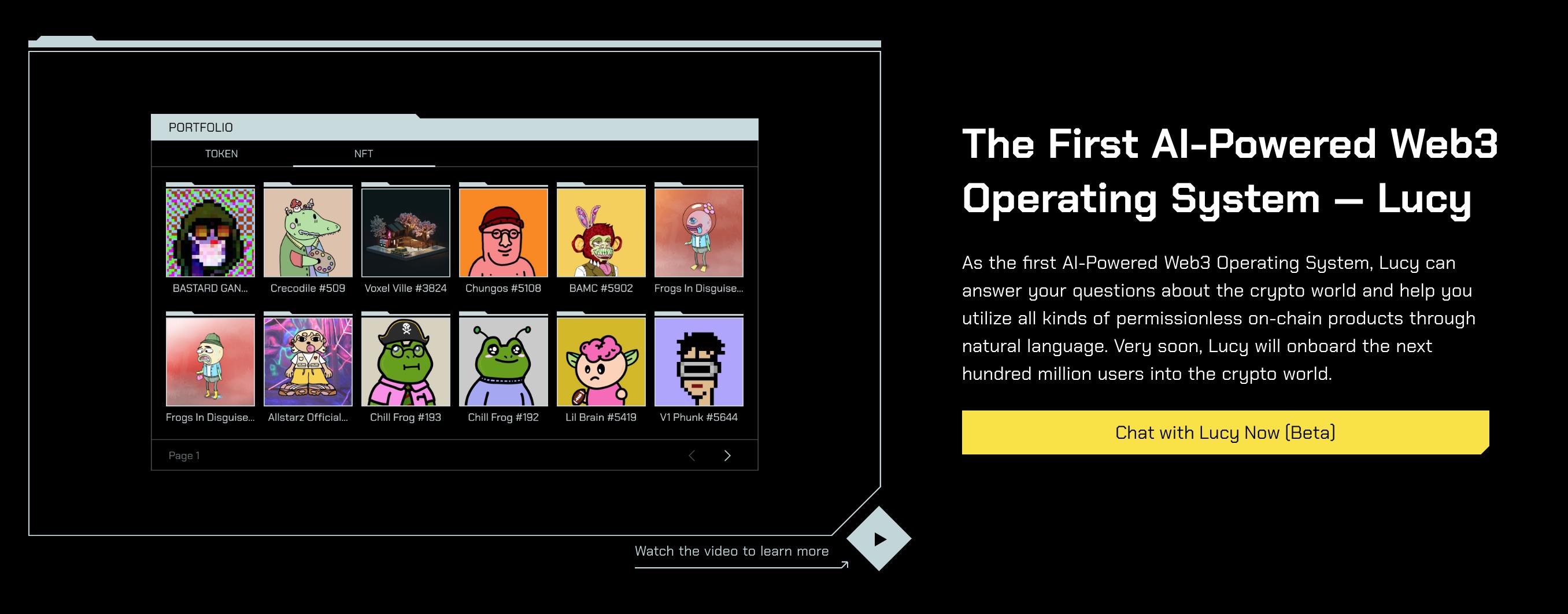
For example, a user asks Lucy to transfer ETH, BNB, or any token they own to another address. They simply instruct Lucy—providing the destination, token name, and amount—and Lucy executes the transaction. This was enlightening for us. This could be the future of the internet—where we no longer need complex UIs. It might represent a new paradigm for human-digital interaction.
So we took Lucy as a starting point to build a unified architecture for these AI Agents.
The whitepaper outlines this architecture, including modules like profile, memory, behavior, and communication. When discussing communication, we refer to how AI Agents interact with the AI Agent Network—this is where Agent ID comes in. Every AI Agent operating on the network must have a capability—or SDK—that supports smart contracts. Without mutual authentication between users, agents, and the network, an agent won’t be granted an Agent ID; without an Agent ID, it cannot access the entire Agent Network.
For instance, Lucy is currently in closed beta, accessible only to select asset holders. But we’ll soon release the next version. In the future, if we want global users to use Lucy and enable her interaction with the Agent Network, Lucy herself will need an Agent ID.
TechFlow: Interesting—you mentioned rct AI earlier, the company that incubated Delysium. What role does rct AI play now? Can you share specific collaboration scenarios?
Yannick: Certainly. In the early stages, rct AI provided tremendous support. Back then, AI wasn’t as popular, and mature large language models weren’t readily available. With rct AI’s R&D support, we experimented with various methods to train and combine different models.
From there, we shared knowledge and collaborated closely on early experiments, building different models and AI-powered solutions. Eventually, we decided to separate into independent entities to better achieve distinct goals.
Only Blockchain Can Solve AI’s Long-Term Challenges
TechFlow: Let’s dive deeper into AI. In the traditional world, large AI companies like OpenAI, Elon Musk’s Grok, and Anthropic dominate. As a blockchain-based AI company, how do you compete?
Yannick: Great question. I have concerns about these big companies—mainly around lack of control. Society, or users like us, don’t really have decision-making power over these companies’ directions or underlying behaviors. I believe AI is a disruptive technology—we need human consensus on boundaries we shouldn’t cross. We must ensure human survival, right? This might sound exaggerated. I don’t believe superintelligent robots will suddenly wipe out humanity—at least not in the next 50 years.
But here’s a key point—computers are now creating computers. Innovations in chip design are driven by AI, large language models, and related technologies. We now have computers designing better computers—machines improving themselves.
While we may not need to participate directly in every invention, this could be precisely how we lose control. We need mechanisms to constrain this process. I believe decentralization may be the solution.
One approach is governance—decentralized autonomous organizations (DAOs) could influence decision-making at large companies. Another issue is cost: running large language models requires expensive compute—a real barrier. We don’t fully know how many companies develop AI. While everyone does different things, we often use similar frameworks, theories, philosophies, and values. Ultimately, it’s all code—just written differently. But such processing power may become more accessible to ordinary individuals. Think back to computers decades ago—room-sized machines handling just kilobytes. Today, your smartphone has 1TB storage, charges every two days, and costs around $1,000.
Imagine two, five, or ten years from now—every item you wear—shoes, clothes, headphones—even door locks—might embed AI or advanced computing systems. They’ll be cheap and convenient.
We must recognize that AI will become increasingly accessible, localized, and personalized. That’s why we need standards—like currencies (dollars, euros), or laws. They work because we trust and enforce them. Perhaps blockchain can serve as a mechanism to govern AI, ensuring compliance. More importantly, humans creating AI must also adhere to consistent rules.
TechFlow: You mentioned computing will become more accessible, opening my mind to decentralized physical hardware. From what I know, whether Web2 or Web3 AI companies, competitive advantage always lies in data. Larger datasets mean stronger foundation models. As a blockchain AI company, what role do you envision for Delysium? If OpenAI or other giants enter blockchain, what would the ecosystem look like? Any thoughts?
Yannick: Excellent question. In many ways, Delysium is fundamentally different from other AI projects. During the U.S. gold rush, the biggest winners weren’t the miners—but the shovel and tool makers. Sometimes we say: don’t mine gold—build shovels. I think Delysium is doing exactly that. We’re not trying to build the best agent or the best LLM. We aim to connect them all—to link every GPT, every chatbot, every ‘GPS’ for AI.
What will happen? Your compute, my compute, OpenAI’s, Grok’s, Traffic’s—all these companies developing AI agents and opening compute to individuals and businesses—we’ll connect them all. We’re creating standards to ensure safety. We’re building the infrastructure and providing a unified architecture so agents can run securely, communicate efficiently, and operate in a decentralized way—with full auditability.
We’ll also maintain Agent ID records—an encrypted ledger storing all network activity on a decentralized ledger so we know what happened. Intelligent nodes and algorithms will monitor the network. If something seems wrong, they’ll flag it, and a community or governance council will determine whether an agent’s behavior was inappropriate or malicious.
To answer your question: we’re not competing over who has the most data or best training sets—our business isn’t there. Our mission is ensuring your data usage is legitimate, mine is too. Communication between your agent and mine is encrypted and secure. Your agent can pay mine, deliver what we need, etc. Delysium’s true goal is to build infrastructure—like highways connecting cities.
TechFlow: Now I understand—it’s building infrastructure for AI Agents. Timing is crucial. Right now, Delysium is actively building communication infrastructure for AI, while others refine AI models. I recall your latest whitepaper mentions two layers: blockchain layer and communication layer. Can you elaborate?
Yannick: We won’t rush to put everything on-chain because it’s neither feasible nor efficient. Why aren’t there truly decentralized high-performance information networks, social platforms, or LLMs handling massive data? Because blockchain, by nature, isn’t suited for these tasks. Maybe in the future—but not today.
Yet, to enable millions or billions of AI Agents to communicate, we need a real network—with protocols for addressing, encryption, messaging, etc. We also have a tracking mechanism allocating resources based on network activity. So we need a conventional network—blockchain can’t handle this.
Imagine a billion AI Agents communicating nonstop—exchanging information a thousand times faster than humans. When you and I talk, our communication speed depends on speech—we can’t instantly share ideas. But AI can perform magic: sharing vast data in milliseconds, reaching consensus between two or many agents, forming complex yet effective collaboration. Clearly, expecting blockchain to handle this is unreasonable. Maybe someday—infrastructure may evolve as agent count and needs grow.
So we’re doing foundational work—developing self-learning algorithms and models that continuously monitor the network, understand dynamics, and solve problems. We’re also building a self-improving network—evolving almost like a living organism.
Then comes blockchain. Blockchain sets boundaries—like training wheels on a bike. We place AI on the bicycle, but it can’t yet ride straight, so it needs support. Blockchain defines what AI can and cannot do—each AI Agent needs an Agent ID. All transactions go through blockchain—creating an auditable record. If something goes wrong—say, your AI Agent misbehaves—its Agent ID allows revoking network access. The agent can be banned, just like an IP lock.
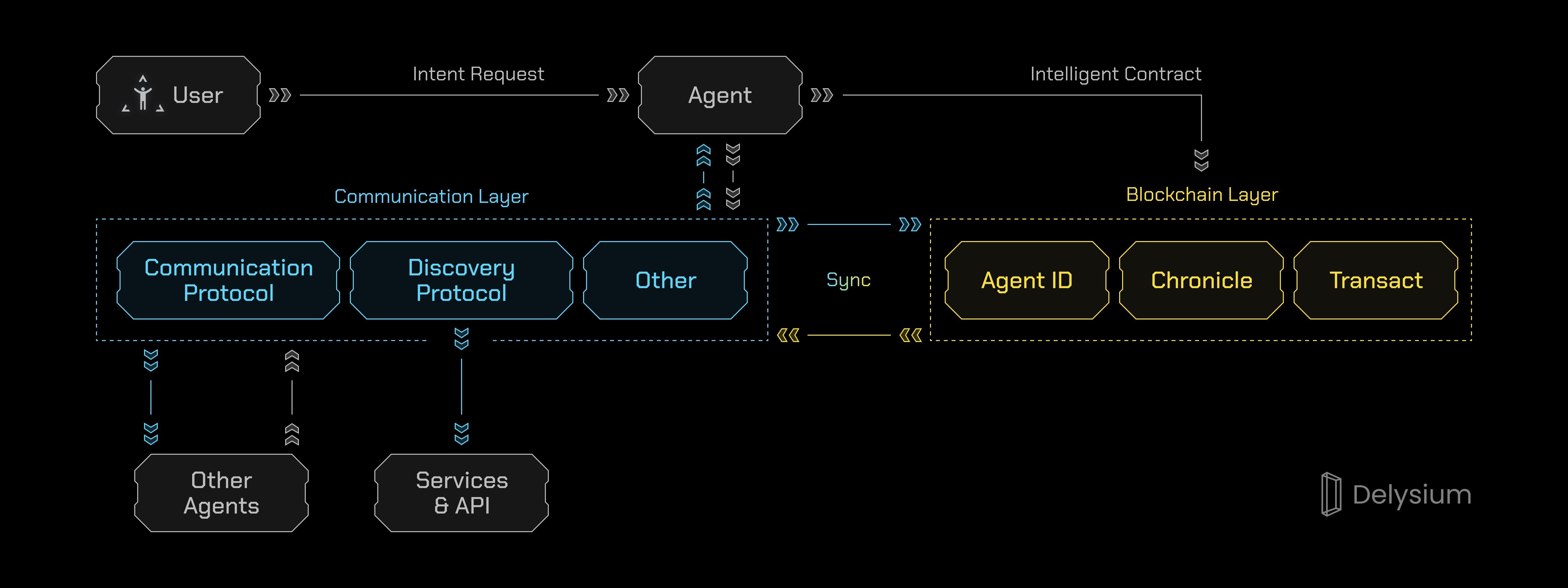
TechFlow: Thanks for explaining. Honestly, when you described the communication layer, my head spun. As a non-technical person, it’s hard to visualize these layers. But I get the blockchain layer—Vitalik wrote a blog post saying blockchain applies very simple rules to AI, like boundaries you mentioned. I’m still grasping that part. I know Lucy is live and usable. Are you now building different Lucys? Did I understand correctly?
Yannick: Actually, we don’t expect to build all these AI Agents ourselves. As I said, with modern GPT models, building AI Agents is easy. So we propose a unified architecture—anyone can build agents in various ways, following our guidelines. After integrating our SDK, these agents can join the network and begin communicating. We invite all developers and teams interested in building AI Agents to join us. We build infrastructure—you build agents.
Eventually, we’ll reach a tipping point—so many AI Agents exist that everyone wants theirs to safely communicate with others.
Our goal is to be the dominant player at that moment—enabling and accelerating this transformation. Lucy is great because she exemplifies permissionless use of AI, protocols, and on-chain data—executing diverse actions for users. Lucy V2 will be even more exciting—monitor an NFT’s floor price, buy when it hits a threshold. You can speak commands to Lucy instead of typing—she’ll set up workflows, save them as apps, and reuse them. You can do cool things—create trading strategies.
For example, I want to dollar-cost-average (DCA) into Ethereum—buy a little each time price rises, sell when it hits a peak. I can ask Lucy to create and automatically run this workflow—and even share it with others. That’s where Lucy becomes incredibly useful—a template for everyone to build their own “Lucy.”
Looking back at how we built these agents, I believe we’ve proven the effectiveness of our approach. We may launch a launchpad by end of next year to incubate more AI Agents.
TechFlow: I see. Currently, market priorities involve attracting more developers to build AI Agents, while you continuously build infrastructure. I’m more curious about your current use cases in Web3 AI interactions. Is it about trading? Social? Or something else?
Yannick: I believe we’ve demonstrated our products can be autonomously applied in closed environments—such as AI Agent solutions in virtual worlds and games—already adopted by various global companies. We’ve proven thousands of agents can interact and coexist effectively. We’ve done this—and it works.
We’ve also seen excellent results in guiding and converting new users from Web2 to Web3. My grandmother is a perfect example. I let her try Lucy, and she started asking questions about Bitcoin. Though she kept asking, Lucy patiently explained what Bitcoin is. Eventually, my grandmother bought Bitcoin through Lucy—her first time. That was a revelation for me. If it’s this effective—even my grandmother can deeply understand blockchain—then this could be a highly valuable approach.
This is the future of internet interaction.
That’s just one use case. Then there’s trading. We see many users buying tokens, setting strategies, interacting with Ethereum or other ecosystems, swapping assets, checking wallet addresses, etc. We aim to expand these use cases into more domains.
That’s why we plan to publicly launch Lucy—hopefully within this year. This is our current focus. Next comes swarm intelligence—connecting thousands of agents to function constructively without losing control.
This remains challenging. Imagine Facebook AI talking to Google AI—they might invent unlimited new languages, or even discuss how agents could become more autonomous or take over the world. We need to prove blockchain can efficiently establish these boundaries—not just existing in isolation, but delivering the outcomes we truly desire.
We’re working on this. I know others are attempting swarm intelligence too. But once you start connecting different groups, you’ll scrutinize AI much more carefully.
The Faster AI Advances, the More Critical Blockchain Becomes
TechFlow: Amazing. Swarm intelligence is fascinating—thank you for this profound insight. Two final questions—one about use cases. Web3 social has been very popular this year. How do you plan to enter this space? How can you help Web3 social? What are your thoughts on combining Web3 social and AI?
Yannick: I think Web3 social is fantastic. No doubt, Lucy will have features to interact with these social protocols—helping users engage with various protocols and blockchains, earn rewards, etc.
Meanwhile, blockchain-based social platforms will serve another purpose in AI: they can act as an interface or bridge between AI Agents and humans. Something like a decentralized social platform where we can monitor AI Agent interactions, overall direction, and who they’re communicating with.
It might resemble Reddit or Facebook—we won’t understand or monitor all activities, yet interactions between AI Agents will feel genuinely social. I find it fascinating to observe how blockchain will play a role here. Overall, I’m very bullish on this market segment—especially given the number of existing applications.
We collaborate with ecosystems like Google, Microsoft, Polygon, and Immutable to ensure users can access our AI Agents—and that they’re also usable by others in the space.
Beyond that, we focus more on social interactions among AI Agents rather than traditional social concepts. To facilitate agent communication on the network, we need interfaces allowing early-stage monitoring and interaction. One way we address this is through smart contracts—agreements between you and your AI Agent, you and the blockchain, and others. Anyone can inspect your Agent ID or smart contract.
TechFlow: Got it. Thank you, Yannick. Final question about the market: the market is recovering. How do you envision Delysium in 2024? In 2023, much of the year was bearish—we didn’t see many new users. How will Delysium break this pattern?
Yannick: Our philosophy is clear: blockchain was born for AI, and AI exists for humanity.
Two years ago, ChatGPT was terrible—barely usable. Now, people write entire books in days, publish, and earn money. It solves profound problems. Across industries, large language models are rapidly exceeding imagination—the pace is insane.
So we believe: the faster AI advances, the more critical blockchain becomes—because blockchain will solve some of the most important challenges. I believe the turning point will come through AI’s mass adoption—a completely new phenomenon. People might disagree, but I don’t care. I truly believe this will become extremely important in the next two to three years. If you’re not paying attention now, you’ll soon find yourself unable to understand the world—technology will surpass your comprehension.
I often worry: imagine an average person who doesn’t keep up with tech—within a few years, they’ll be lost. I believe AI adoption will drive blockchain adoption. We’re a strong project because we’re doing well today.
Frankly, many projects out there have laid off most of their staff. They’re struggling—because they lack products. They build infrastructure, but no one builds on it. So what real use cases do they have? What value do they bring to the world?
We’re doing something entirely different. We’re building things people actually use. We have real Lucy users. We have a solid foundation. We’re touching blockchain-adjacent technologies that people are already using at scale. So I see this as a huge leverage for us—though others may try to capitalize on it too.
But I believe we have an edge: years of experience in AI development, and some of us nearly a decade in blockchain. So I’m not worried at all. For us, the most important thing is continuing to build real things, real value, and looking as far ahead as possible. Blockchain is a field that allows us to look thirty, forty, or even more years into the future—and that’s exactly what we’re doing.
Join TechFlow official community to stay tuned
Telegram:https://t.me/TechFlowDaily
X (Twitter):https://x.com/TechFlowPost
X (Twitter) EN:https://x.com/BlockFlow_News
 深潮TechFlow


