









The "Death Tide" is Coming: Seven Ways Web3 Projects Meet Their End
TechFlow Selected TechFlow Selected
The "Death Tide" is Coming: Seven Ways Web3 Projects Meet Their End
For most projects declared dead, insufficient funding is the primary and most direct reason, while other causes include lack of product-market fit, tightening regulatory policies, etc.
 Navigating Web3 tides with focused insights
Author: Gu Yu, ChainCatcher
On October 31, cryptocurrency wallet Linen Wallet announced it will shut down its application, stating, "Interest in our product has declined, as has overall activity among individual crypto investors seeking advanced self-custody solutions." Previously, in September 2019, the project received investment from institutions including Polychain and Coinbase Ventures.
On October 17, Web3 security solution Stelo announced it would cease development of all its products. In February this year, the project had announced a $6 million seed round led by a16z.
On October 23, Web3 creator platform Async Art announced it would cease operations. Earlier, in February 2021, the project raised $2 million in funding, with participants including Lemniscap, Galaxy Interactive, and Collab+Currency.
On October 3, fixed-rate lending protocol Yield Protocol announced it would cease operations. In June 2021, Yield Protocol completed a $10 million Series A round backed by Paradigm, Framework Ventures, and others.
On September 20, stablecoin yield aggregator GRO Protocol announced it would cease operations. In March 2021, GRO Protocol raised $7.1 million in a seed round involving Galaxy Digital, Framework Ventures, Nascent, Variant Fund, and others.
On September 13, DeFi liquidity management protocol xToken announced it would cease operations. In November 2021, the project raised $2 million in funding, with Lattice Capital among the investors.
…………
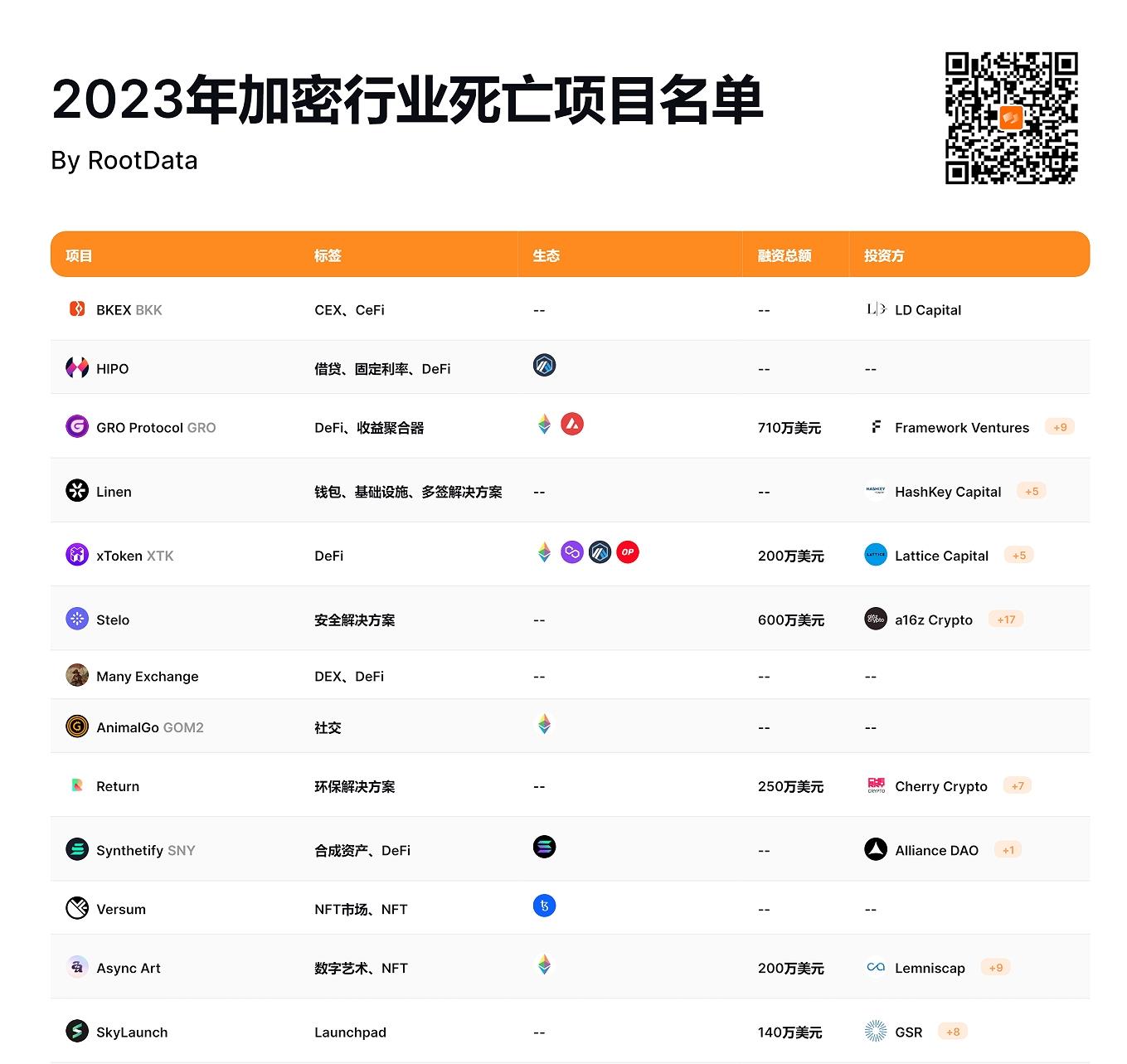
Source: “List of Dead Crypto Projects in 2023”
In recent months, the Web3 industry has experienced a small wave of project failures, with high-profile projects such as Stelo and Yield Protocol successively announcing shutdowns. According to ChainCatchers' statistics, at least 16 Web3 projects have publicly announced cessation of operations in the past three months, while the number of projects dying quietly through slow decline is even higher.
Survival of the fittest and high mortality rates are normal for startups, especially in the highly cyclical crypto industry. Based on the final statements of these failed projects, ChainCatcher has identified five main causes. For most of these failed projects, insufficient funding was the primary and most direct reason, followed by other factors such as lack of product-market fit and tightening regulatory policies.
Below are the details:
Insufficient Funding
Most of these projects that announced shutdowns last raised funds in the first half of 2021—over two years ago. Given that blockchain products typically require high development and operational costs, their financing has largely been exhausted by now. Meanwhile, the crypto primary fundraising market has continued to decline over the past two years, making it difficult for existing projects to regain investor interest or secure new funding, forcing them to shut down.
The vast majority of projects failed due to lack of funding, particularly when unable to close another funding round. That said, several projects indicated they still held some remaining capital and planned to distribute it back to investors, including Superdao and Linen Wallet.
Lack of Product-Market Fit
Many projects launched ambitious product plans expecting significant market adoption, but ultimately failed to gain widespread traction. This indicates serious misjudgments in product positioning, making long-term sustainability and meaningful returns unlikely, leading some teams to voluntarily shut down. These projects spanned areas such as DAO solutions and NFTs (including NFT rentals, video NFTs, etc.).
For example, DAO platform Superdao stated that in 2022 it began building growth and analytics tools for established Web3 projects. It clearly observed that the crypto industry itself had become much smaller than its original ambition of being the “new internet,” and providing specialized tools for crypto companies was unlikely to generate venture-scale returns.
Stelo, an a16z-backed security solution, noted that during initial development, the team believed the most urgent issue was preventing users from scams or phishing attacks. However, they later found users were primarily focused on gambling and speculative activities. The team also identified three flawed assumptions: “transaction security benefits from data network effects,” “every crypto user uses a separate wallet,” and “consumer adoption of crypto is imminent.”
“AAA crypto games or decentralized social platforms may soon bring explosive growth, but Stelo’s product suite doesn’t offer much value to those users nor benefit from such growth. Crucially, we don’t believe our current user base represents the wave of new users expected with broader adoption,” Stelo reflected.
Hacker Attacks
Hackers have remained highly active over the past two years, causing many projects to suffer major losses—ranging from hundreds of thousands to tens of millions of dollars—in treasury funds or user assets. Such incidents undermine a project's ability to sustain itself and erode user trust, making continuity difficult.
Hotbit cited repeated cyberattacks and vulnerabilities exploited by malicious actors as one of three key reasons for its shutdown. Decentralized lending protocol Hundred Finance also ceased operations primarily due to a hack that stole over $7 million in April this year. Saddle Finance, a decentralized exchange protocol that announced its dissolution, likewise lost millions of dollars in a hacking incident.
Abandoned by Parent Company
Some project closures were beyond the teams’ control, as parent companies decided to discontinue support for various strategic reasons.
In May, DCG announced it would shut down its institutional trading platform TradeBlock, citing macroeconomic conditions, prolonged crypto winter, and a challenging U.S. regulatory environment for digital assets.
In September, IoT blockchain IOTA announced it would halt development of its public chain Assembly, arguing that further complexity would create a potentially competing solution, diluting value from IOTA and the $IOTA token and fragmenting market attention. Assembly had previously raised $18 million.
Poor Management
Operational capability is one of the most critical factors affecting a project’s long-term viability. Some projects, despite ample funding and large market potential, ultimately fail due to poor management and a series of wrong decisions.
A prominent example is Prime Trust, a cryptocurrency custodian that raised hundreds of millions of dollars in funding. It was later revealed that since 2021, the company had been misappropriating client funds and engaging in significant business dealings with collapsed entities like FTX, eventually becoming insolvent and declaring bankruptcy.
Tightening Regulatory Policies
Following the collapses of major crypto firms like FTX and rising money laundering risks, regulators worldwide have significantly increased oversight of the crypto industry over the past year. The SEC has even brought securities-related charges against projects such as Ripple, greatly increasing compliance pressure for U.S.-based crypto ventures.
A spokesperson for Yield Protocol stated that insufficient demand and uncertain regulatory conditions were key drivers behind its decision to shut down. Web3 livestreaming platform Xeenon said on social media that the U.S. regulatory environment made innovation difficult, prompting the team to decide to close the platform.
Core Team Disappearance
Unlike regulatory challenges, multiple crypto projects this year have been forced to cease operations after their core team members were taken into police custody due to suspected involvement in money laundering. Notable cases include Multichain, BKEX, and CNHC Group, all of which saw reports mid-year of core team members being detained. In Multichain’s case, over $100 million in user assets remain unaccounted for.
Join TechFlow official community to stay tuned
Telegram:https://t.me/TechFlowDaily
X (Twitter):https://x.com/TechFlowPost
X (Twitter) EN:https://x.com/BlockFlow_News
 ChainCatcher 链捕手









