









RWA Data Report: The Driving Force Behind Blockchain Adoption
TechFlow Selected TechFlow Selected
RWA Data Report: The Driving Force Behind Blockchain Adoption
The main challenge facing RWAs is navigating the current global regulatory landscape—either regulatory laws become more accommodating toward crypto assets, or protocols have no choice but to comply.
 Navigating Web3 tides with focused insights
Author: Jose Oramas
Compiled by: TechFlow
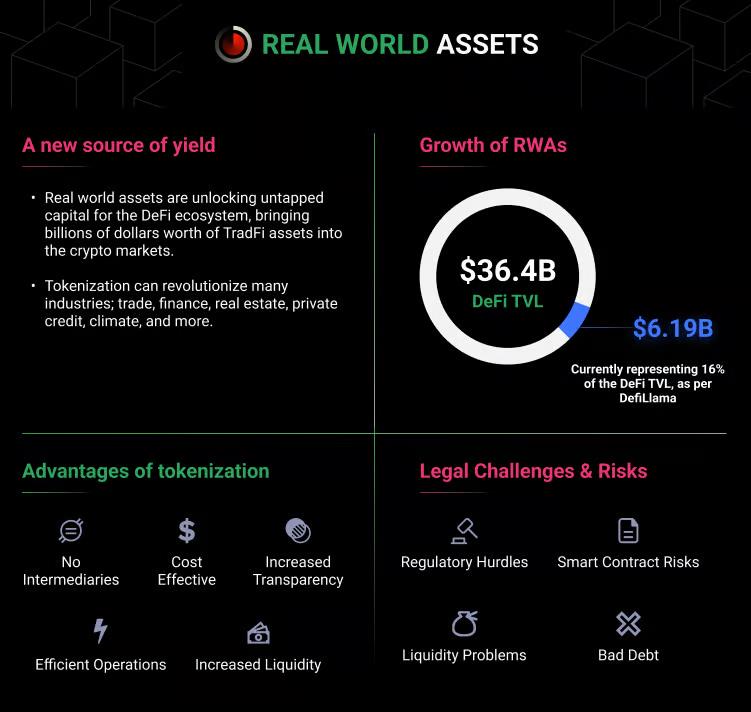
Real-world assets (RWAs) are expected to become one of the dominant forces in blockchain over the next few years. This year alone, the total value locked (TVL) in RWAs has more than doubled, rising from $1.25 billion to over $6 billion, making it one of the fastest-growing segments in DeFi.
This explosive growth is primarily attributed to the emergence of new yield sources, including tokenized U.S. Treasuries, corporate bonds, ETFs, and the rise of on-chain credit in emerging markets. RWAs have also attracted a wave of new institutional capital into DeFi; according to Boston Consulting Group, 97% of institutional investors believe tokenization can revolutionize asset management and could become a $16 trillion opportunity by 2030.
In this report, we will review these new yield sources, current market leaders, and the benefits of tokenization. We will also discuss future legal challenges and projected market size for tokenized assets by the end of the decade.
Current Growth: Where Do We Stand?
This section reviews the major RWA categories experiencing growth, including on-chain credit, tokenized treasuries and bonds, and real estate—areas showing the most significant expansion in both dollar volume and user activity.
The Resurgence of On-Chain Credit
On-chain credit grew by 84% this year, increasing by approximately $210 million between January 1 and September 30. Centrifuge accounted for 70% of this growth.
Several on-chain credit protocols that were market leaders a year ago have largely faded in 2023, such as Maple, which once claimed nearly $1 billion in TVL. However, Maple was the second-largest contributor to on-chain credit growth, adding around $60 million in outstanding loan value by Q3.
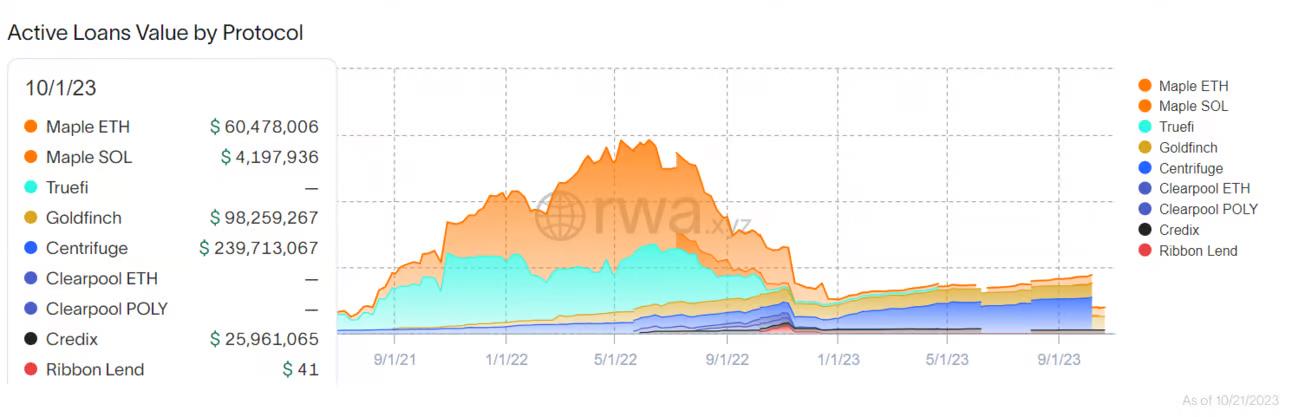
But competition has intensified; new market leaders now offer borrowers and lenders higher yields and broader investment options. Centrifuge’s TVL is now close to $250 million, up 60% since May.
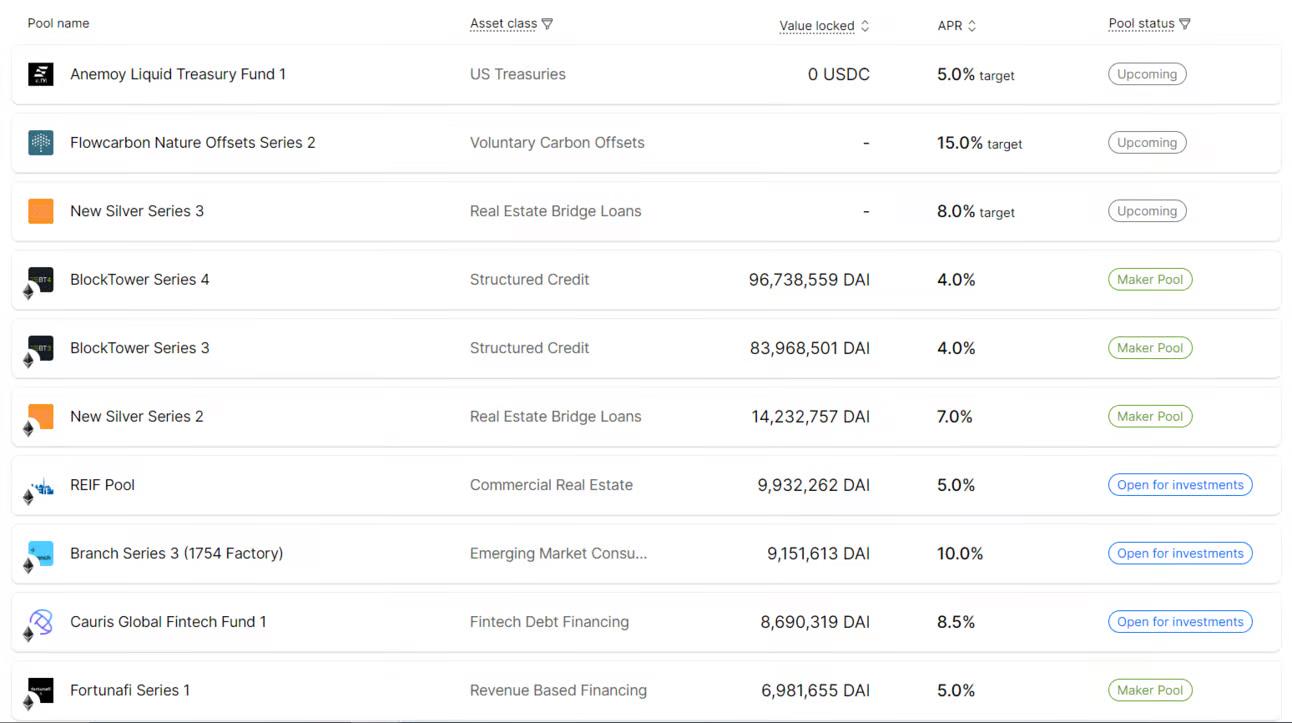
In Centrifuge, various RWA pools track real estate, carbon credits, government bonds, and emerging markets, offering returns from 7% to 10%. Some even reach 15%. By comparison, average APYs in DeFi are below 4%, and in protocols like Aave, often dip below 3%–4%.
Regarding exposure to private credit loans, Africa and Asia are currently the most active borrowers in on-chain credit. Kenya leads with loan volumes of about $73 million, followed by Nigeria ($70 million), the Philippines ($53 million), and India ($40 million).
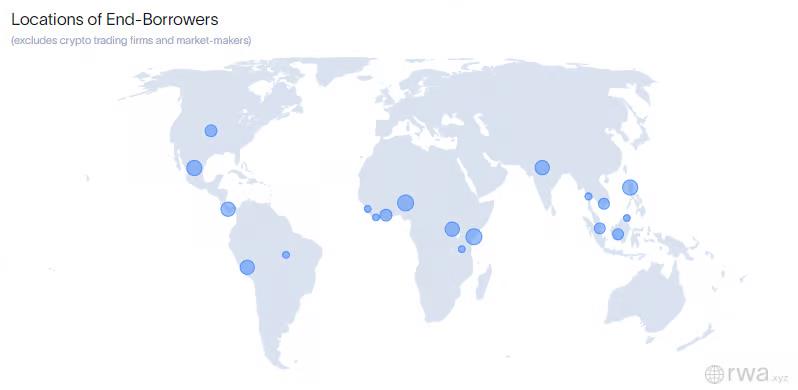
Most of these countries are considered emerging economies, where the majority of citizens and small businesses are underbanked. Due to underdeveloped financial infrastructure, access to traditional loans remains difficult.
Protocols like Goldfinch and Credix incentivize users to deposit stablecoins such as USDC, which are then lent to enterprises in emerging markets. For example, most of Goldfinch’s transactions are with fintech initiatives in Southeast Asia and Africa. All revenue supports additional funding for startups seeking to provide financial services to millions of underbanked individuals and businesses.
In such deals, fixed APYs typically exceed 10%, far surpassing what most current DeFi lenders can offer. This is because returns come from real-world assets whose portfolios are strategically collateralized off-chain.
What to Expect from On-Chain Private Credit?
On-chain credit resembles Lido’s dominance in liquid staking. Protocols like Goldfinch have seen little year-on-year growth, with Credix being an exception. Thus, Centrifuge and Maple were the largest contributors to the $210 million growth and are likely to remain leaders over the next 12 months.
However, compared to last year’s all-time highs, on-chain private credit has declined by 70%. According to RWA.xyz, there is currently $561 million in outstanding loans, significantly lower than the $1.54 billion in May 2022.
The accelerated interest rate hikes at the beginning of 2023 likely dampened demand for on-chain lending, as private credit protocols rely on both liquid and illiquid real-world assets.
That said, the next 12–24 months will be critical for on-chain credit protocols. Although the Federal Reserve has taken a more dovish stance, if the U.S. reports stronger economic data and a tighter labor market, it may shift its monetary policy—impacting the on-chain credit sector, as we saw last year.
Treasuries and Bonds
RWA-backed U.S. Treasuries and corporate bonds have seen explosive growth in value this year, adding nearly $700 million so far. Most of this is distributed across Ethereum ($339 million), Stellar ($323 million), and Polygon ($230 million), with the remainder spread across L1s like Solana.
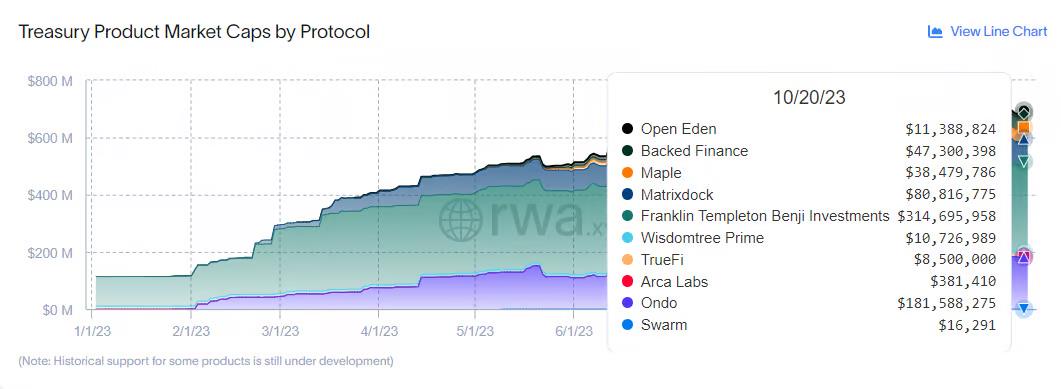
Ondo Finance, Franklin Templeton, and Matrixdock are market leaders, accounting for nearly 90% of all tokenized U.S. Treasuries.
Why are Treasuries so attractive to crypto users? Consider the following:
-
Throughout 2023, the median APY in DeFi has remained below 3%
-
The number of active developers and projects in crypto is at a three-year low
-
Overall, the total value locked in DeFi has declined by 30% year-over-year.
Crypto users are seeking higher yields. Liquid markets like bonds and Treasuries offer better returns, so it's no surprise that RWA growth is driven by protocols tokenizing and tracking U.S. Treasuries, corporate bonds, and indices.
Let’s review some of the leading Treasury issuers in the RWA space:
-
Ondo Finance currently has a market cap of around $160 million. Its flagship product is USDY, a tokenized dollar backed by U.S. Treasuries and on-demand deposits, allowing users to earn yield on Treasuries, money markets, ETFs, and high-yield corporate bonds.
-
Franklin Templeton, a traditional financial firm, became an advocate for crypto after experimenting with tokenization, joining ranks with WisdomTree. In January, the issuer started with around $100 million in assets. Now, that figure stands at $310 million.
-
stUSDT is another prominent Treasury issuer. However, it faces criticism due to suspicious on-chain activity and Justin Sun’s centralized control, raising concerns about its long-term sustainability.
Real Estate
On-chain real estate increased by $90 million this year, though growth slowed in Q3 compared to earlier quarters.
RealT is currently the market leader, growing its TVL from $62.5 million to $89 million so far—an increase of 30%.
RealT is an Ethereum-based protocol offering decentralized real estate investment with broad accessibility and choice. It now holds over 50% of the market share.
However, Tangible was previously the market leader but saw its TVL drop from $60 million to $39 million after USDR lost its peg in October 2023.
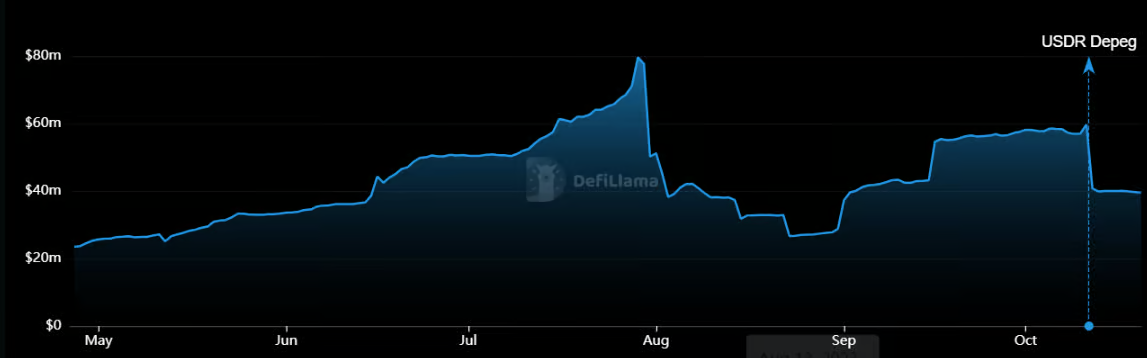
Tangible relied on USDR, a stablecoin tied to the RWA narrative, supposedly backed primarily by real estate investments. These assets are considered illiquid, rendering them ineffective during bank runs. When it collapsed, it was too late to recover.
Outlook: How Big Can the Tokenized Market Grow?
Industry reports suggest that even under the worst-case scenario—a prolonged bear market—the tokenized market could reach $3.5 trillion, according to 21.co, and up to $9 trillion in a bull market scenario.
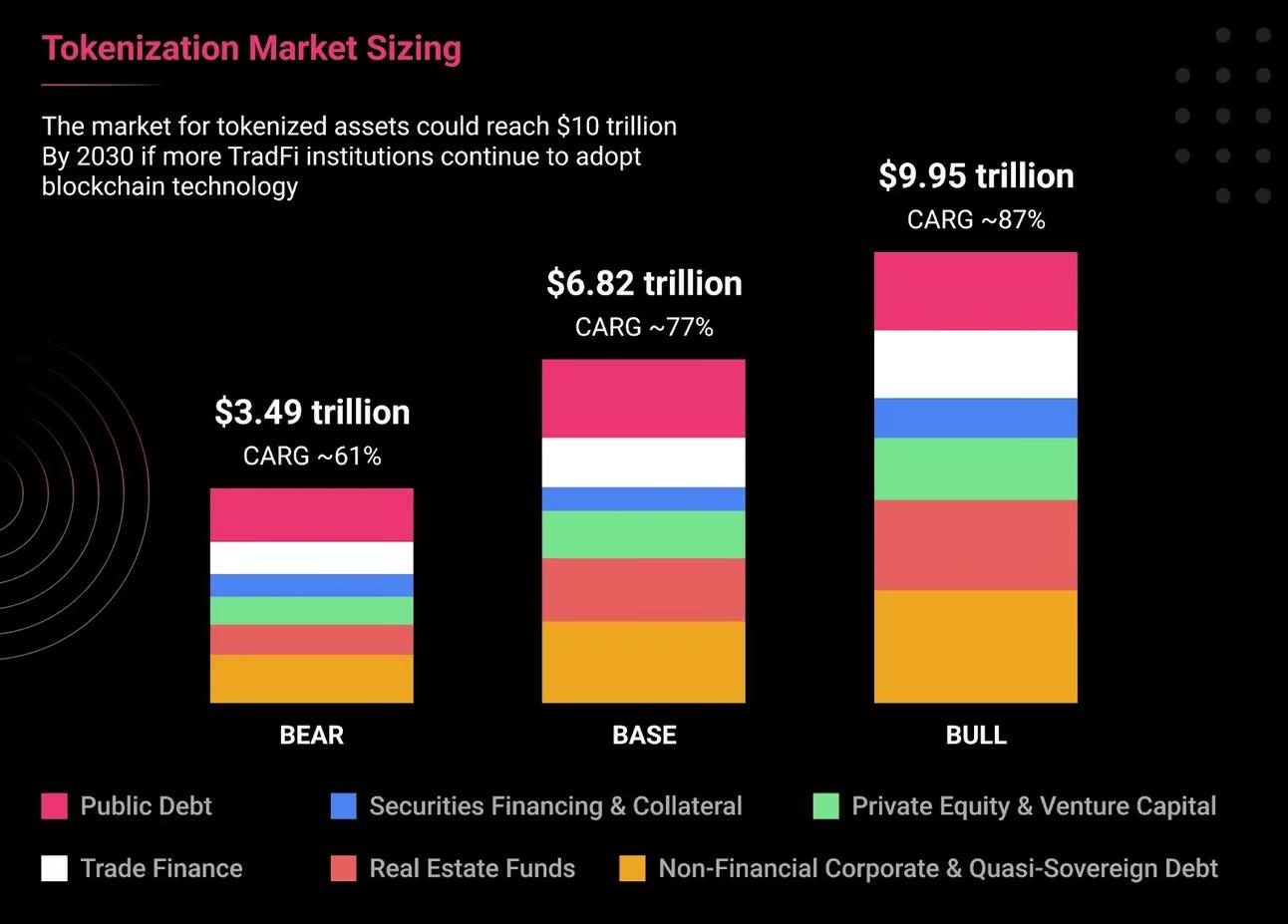
Meanwhile, Boston Consulting Group estimates that tokenization of illiquid assets could become a $16 trillion business opportunity, representing 10% of global GDP.
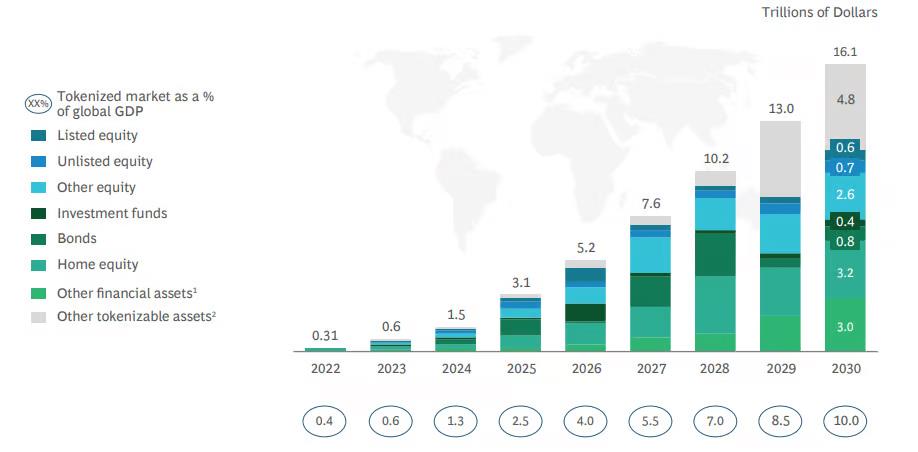
As of October, the total valuation of global asset markets is approximately $9 quadrillion, led by sectors such as real estate ($330 trillion), bonds ($300 trillion), and equities ($120 trillion). As of October 20, the total market cap of the crypto market is estimated at $1.2 trillion. If RWA protocols capture just 1% of this market, the DeFi sector would gain roughly $9 trillion in capital and liquidity—nearly nine times the current market cap of the entire crypto industry.
That said, the tokenized market remains a tiny fraction of the global asset market. The recent growth in tokenized assets and RWA protocols can be seen as evidence of blockchain’s potential for large-scale adoption. We’re seeing increasing interest from top-tier institutional investors and international financial entities. On October 13, members of the International Monetary Fund, bankers, and fintech executives discussed the legal challenges and potential applications of tokenization.
Why Are Traditional Financial Institutions So Interested in Tokenization?
Tokenization can lower barriers and address many operational inefficiencies faced by industries today. Key advantages of tokenization and blockchain technology include:
-
Greater accessibility and liquidity
-
Lower transaction costs by reducing intermediaries
-
Increased transparency
-
Programmability enables new features and operational options for issuers.
As noted, Treasuries and real estate represent the largest shares of total global asset value. However, these income-generating assets lack comparable liquidity advantages—real estate, for instance, is considered highly illiquid due to limited affordability, regulatory hurdles, and information asymmetry. Tokenization can help overcome these issues:
-
Tokenization removes intermediaries; placing assets on-chain enables 24/7 transferability
-
It is fully transparent, with all information stored on the blockchain and publicly verifiable
-
It enables fractional ownership with improved accessibility and operational frameworks.
As evidence of ongoing institutional interest, DTCC, a U.S. post-trade financial services company with over $40 billion in total assets, is collaborating with Chainlink on Swift’s blockchain interoperability project.
Who Are the Main Users of RWA Protocols?
One of the main drivers behind RWA growth is native crypto users seeking better yield opportunities than simply staking governance tokens in protocols. Thus, much of the demand for RWAs comes from crypto-native users.
It’s worth noting that WisdomTree and Franklin Templeton have achieved considerable success in RWAs. As veterans of traditional finance, their involvement signals the potential influx of new users—such as institutional clients or retail investors. The key point is that yields in RWAs are easier to understand compared to those in traditional DeFi ecosystems, reinforcing trust and simplicity in users’ minds.
Risks and Legal Challenges of RWAs
Investment opportunities in RWAs depend on asset tokenization and distribution. Platforms enabling RWA infrastructure—such as compliance protocols (which will play an increasingly important role due to existing regulations across jurisdictions) and asset providers—will dominate the RWA narrative. This brings new challenges but also opens opportunities for a broader investor base.
However, there may be nuances when it comes to adoption. The success of RWAs will largely depend on how well these protocols navigate and adapt to current regulations, assuming laws remain unchanged. So far, Switzerland is the only country with established crypto legislation. Therefore, compliance protocols and infrastructure will become more critical than ever on the path to mass adoption.
With the rise of RWAs, compliance protocols, auditors, custodians, and on-chain oracles will take center stage. Audits will be crucial in verifying on-chain assets and rebuilding investor trust. Meanwhile, on-chain oracles must feed off-chain data into protocols. Additionally, platforms like Tokeny are providing legal guidance and infrastructure for seamless onboarding and asset management operations.
Another example is Quadrata, a platform offering a technology called Web3 Passport, allowing businesses and investors to link their wallets to verified identity passports.
Final Thoughts: The Role of RWAs in Blockchain Adoption
We’ve analyzed how RWAs can bring billions—or even trillions in favorable scenarios—of capital into DeFi, and how tokenization can strengthen multiple industries such as housing, supply chains, finance, and banking.
RWAs are targeting massive markets requiring substantial liquidity. This liquidity can be sourced from large institutions. However, institutions won’t enter DeFi unless they are confident they are operating within legal boundaries. Another risk lies in smart contract vulnerabilities, which is why auditors and infrastructure protocols will play an even greater role in this ecosystem.
Nevertheless, the strong open interest from investors and traditional financial institutions indicates significant potential for the RWA sector.
The main challenge facing RWAs is navigating current global regulations. Either regulatory frameworks become more crypto-friendly, or protocols must adapt to existing rules and find ways to work within them. So far, Switzerland stands out as one of the few countries that has successfully created a supportive environment for crypto assets.
Join TechFlow official community to stay tuned
Telegram:https://t.me/TechFlowDaily
X (Twitter):https://x.com/TechFlowPost
X (Twitter) EN:https://x.com/BlockFlow_News
 @cryptoprag






