









"Alibaba's Strategist" Zeng Ming's Latest Speech: How Should Corporate Strategy Keep Pace with a Decade-long Vision?
TechFlow Selected TechFlow Selected
"Alibaba's Strategist" Zeng Ming's Latest Speech: How Should Corporate Strategy Keep Pace with a Decade-long Vision?
Strategy should be continuously refined based on rapid iteration and feedback between vision and action.
 Navigating Web3 tides with focused insights
Author: Zeng Ming, Chairman of the Academic Committee of Alibaba Group and Dean of Hupan Entrepreneurship Research Center.
Source: On October 12, Professor Zeng Ming delivered his second "Visioning Ten Years" public lecture at Hupan Entrepreneurship Research Center.
Introduction
On October 12, Professor Zeng Ming delivered his second "Visioning Ten Years" public lecture at Hupan Entrepreneurship Research Center.
In this public speech six years in the making, Professor Zeng posed a series of new questions about business transformation: "How does technological change drive shifts in business paradigms? How should corporate strategy adapt to long-term visions? What are our fundamental judgments about commercial changes over the next decade?"
"The essence of AI is solving decision-making efficiency and cost—whether machines can replace humans, whether they can assist human decisions. Its core value lies in creating new supply."
"Looking ahead, machines or artificial intelligence will further liberate people from tedious, creative, and boring mental labor. People can spend most of their time developing their creativity and doing things they are truly passionate about."
"In principle, there will be no product companies in the future—only service companies. Products will merely serve as tools and carriers for meeting demands within specific scenarios."
"Strategy must continuously evolve through rapid iteration and feedback between vision and action. Proactively experiment with various approaches to understand and test whether your imagination of the future is correct, then refine that vision based on feedback. This is extremely important."
"At the individual level, we see an enormous demand for creative talent. Future talent needs both multidimensional perspectives and unique expertise. Especially with the emergence of GPT, so-called professional roles will almost entirely disappear."
"Traditional strategy aims to reduce uncertainty by making relatively certain plans and executing them efficiently. But uncertainty itself represents possibility—the very space for creation. Today, strategy's essence is creation and innovation. In this sense, strategy is no longer just for executives—it is deeply intertwined with products and technology."
Below is an edited compilation of Professor Zeng’s full speech:
Back in 2017, I suddenly felt compelled to teach a strategic course titled "Visioning Ten Years." At the time, two major factors influenced me strongly.
First, since 1993, I've studied, taught, and practiced strategy within companies.
During that period, the internet and mobile internet were rapidly evolving. So I wanted to share some different insights about how strategy should actually be done.
Second, starting from 1991, I grew alongside the development of the internet.
After witnessing more than twenty years of internet evolution, I had many speculations about the future I wanted to share. That led to the 2017 public lecture. The session covered two main themes.
The first theme was redefining strategy.
In an environment marked by rapid change, complexity, and high uncertainty, leveraging momentum through broader trends becomes the primary goal of strategy—a critical point.
We talk about "visioning ten years"—'visioning' itself has become increasingly important. The harder times get, the more diligently we must look ahead. Not only do we need the determination to "vision ten years," but we also need to gradually cultivate the ability to do so. This vision determines your scale and potential.
Strategy is the iterative process between Vision and Action. I’ve repeated this phrase over the past five or six years, and today I’ll offer an upgraded version, sharing deeper insights gained in recent years.
The second theme was the grand transformation of intelligent business.
Online integration, networking, and intelligence have defined enterprise development over the past decade. Back then, I mapped out seven companies according to size and progress across various dimensions. Most remain among the world’s leading firms today.
These were the three key directions discussed: online integration, networking, and intelligence.
I mentioned back then that intelligent business has two core components, which I call the DNA double helix.
One is network collaboration.
This means large-scale, multi-decision, real-time interaction—where higher collaborative efficiency generates greater value.
The second is data intelligence—the essence being machine replacement of human decision-making.
It leverages cloud computing, big data, and algorithms, forming data intelligence through rapid iteration. Thus, the two core pillars of intelligent business are network collaboration and data intelligence.
Back then, I made two predictions: one, that the initial phase of intelligent business格局 would soon be established; two, that the future would be an intelligent era characterized by the connection between human brains and machine intelligence. I'm somewhat relieved these predictions turned out mostly right—otherwise, I wouldn’t feel comfortable standing here today.
Most importantly, after these six years, I’ve developed many new thoughts and insights based on those initial judgments. So today’s talk will delve deeper into these two themes.
We’ll break it down into three parts.
First, the three core technologies of the intelligent era. We now possess AGI (Artificial General Intelligence), which brings revolutionary capabilities; blockchain and crypto have undergone nearly 15 years of incubation and are poised for takeoff; XR and the metaverse. These three are the most fundamental technologies, and we’ll focus on discussing them today.
Second, I’ll share a methodology: understanding the actual pace of technology-driven business transformation. With this framework, you can anticipate what’s most likely to emerge in the next three to five years—an essential milestone in strategic decision-making.
You need to know: beyond the long-term vision, how exactly should three-to-five-year goals be set? This requires mid-term judgment. So in the second section, I’ll explain how to make such mid-term assessments.
Third, I’ll discuss new thinking around intelligent business.
1. Three Core Technologies of the Intelligent Era
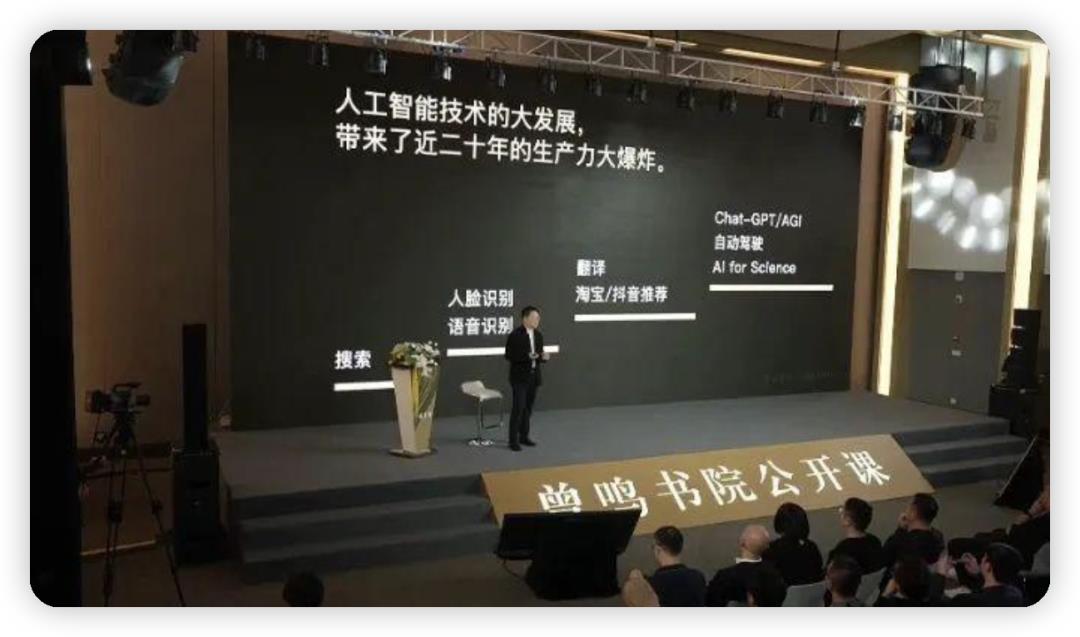
Many of you may be familiar with this chart, illustrating the broad development of AI over the past 20 years.
Initially during the search phase, we called it big data—AI wasn't yet a recognized term. After ChatGPT went viral last year, China saw over 100 startup teams focused on large models—what people now call the "hundred-model battle."
Actually, facial recognition in the second phase marked deep learning’s first large-scale application in visual domains. As early as 2014, hundreds of vision startups emerged. Facial recognition is now ubiquitous—from TikTok recommendation engines powered by AI to everyday authentication systems. This wave represented the first large-scale deployment of AI using deep learning methods.
Now consider large language models (LLMs). Why is this considered a revolution in general AI? It relies on a surprisingly simple algorithm: predicting the most likely next word following a given word.
Despite its simplicity, this algorithm achieves sufficient accuracy and usefulness.
In effect, it appears to have mastered language. As noted in *Sapiens*, language is humanity’s greatest invention.
Language enables communication, and inherently carries human wisdom. Humanity’s vast knowledge accumulated over roughly 10,000 years has been digitized over the past two decades through text, audio, and video. Mastering language means accessing virtually all of human knowledge up to this point.
Today, we still don’t fully understand the internal mechanisms of large language models. They may not think like humans, but in certain domains, they demonstrate human-like logical reasoning abilities—something that will fundamentally reshape our future.
Over the past thirty years—from internet to wireless internet, sensors, digital transformation, big data computing—software capabilities have steadily expanded. But these were additive improvements, layer upon layer.
AGI, however, integrates all these layers, dramatically enhancing software adaptability and autonomy—transitioning from quantitative accumulation to qualitative leap. For example, AGI-enabled automatic programming drastically boosts software capability—a true qualitative shift.
In this sense, many believe large language models represent the first iPhone-like moment in the AI era—an inflection point signaling massive transformation.
From another perspective, the age of general intelligence could also be seen as the robotics era—because AI acts as the brain, and when combined with hardware, forms various robots. Autonomous vehicles, for instance, are essentially robots. Future Robotaxi companies will fundamentally function as technical outsourcing service providers. Viewing technology through this lens gives us deeper insight into its commercial implications.
When people think of robots, they often imagine Boston Dynamics’ flashy creations. Yet after nearly 30 years of development, Boston Dynamics may be outpaced by Tesla’s humanoid robot advancements in just the past couple of years. This reflects AI-driven breakthroughs in hardware, showing how robotics will accelerate across environments.
Beyond ChatGPT, two other AI/AGI development tracks deserve attention. One is autonomous driving, which differs from ChatGPT in requiring guaranteed safety and focusing on human interaction with the physical world.
ChatGPT primarily mimics human cognitive behavior.Autonomous driving solves human-physical world interactions—that’s why Tesla has accumulated extensive robotics expertise, rooted in external environment perception. Another crucial frontier is AI for Science, potentially even more transformative. Current AGI applies existing human knowledge but doesn’t create new knowledge.
But applying AI to scientific discovery could unlock entirely new paradigms—possibly discovering novel chemical equations or even new physical laws—propelling AI forward by leaps.
Even today, innovations like DeepMind’s AlphaFold in protein analysis and synthetic biology—emerging fields driven by AI—have achieved significant progress, albeit less publicly known. These accumulations will fuel further breakthroughs. The above provides context you may have heard elsewhere. Now, the next two slides are among the most important of today’s presentation.
As we transition from the internet era to the intelligent era, what fundamentally distinguishes internet from AI?
The internet fundamentally handles massive data, improving information flow and matching efficiency—enabling seamless circulation while minimizing friction caused by information asymmetry.
Core value: solving information asymmetry.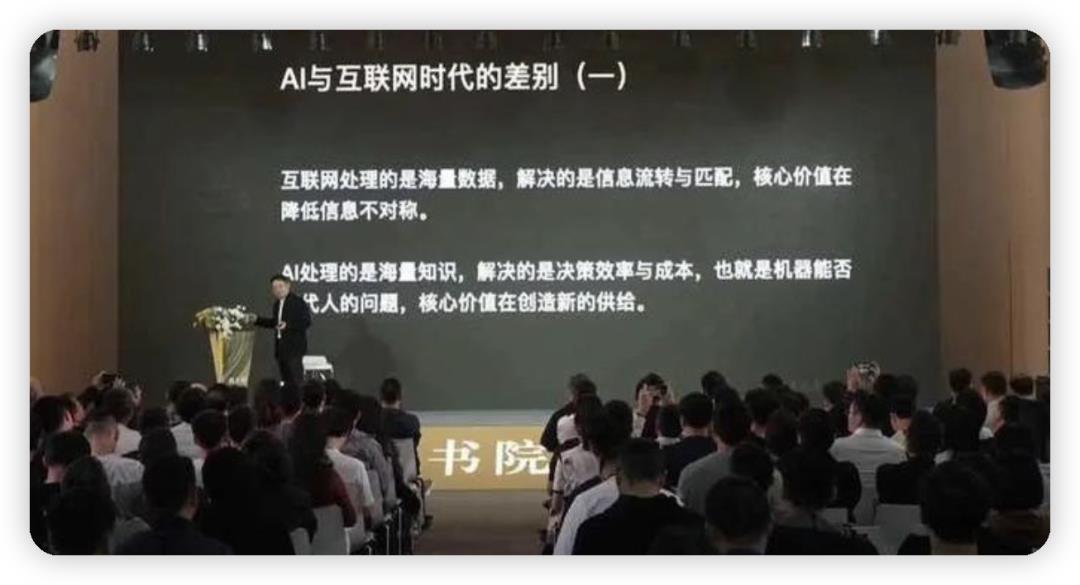
Take online education as a simple example. Past efforts aimed to use the internet to improve teacher efficiency—a classic internet case that achieved considerable progress.
But AI-era online education offers unlimited high-quality teachers tailored to personalized learning needs. Every student should ideally have their own teacher—and only AI teachers can meet this demand.
Likewise, one of the world’s biggest problems today is excessive medical costs and insufficient doctor availability. With AI doctors, human health could experience a qualitative leap.
Thus, AI essentially solves supply shortages.Why have digital transformation, industrial internet, and online initiatives been so difficult over the past five years? The root cause: these industries suffer not from information asymmetry, but from supply insufficiency.
For example, all attempts at internet healthcare and medical service transformation deliver limited value because they fail to solve the core bottleneck: the scarcity of quality doctors. No matter how well you match information, the bottleneck remains. This is where the AI era presents a completely new opportunity—creating new supply. Massive supply will generate new demand.
However, AI’s core challenge involves processing vast amounts of knowledge—not just data or information. By processing data and information into knowledge, then combining it with existing knowledge to solve practical problems, AI addresses decision-making efficiency and cost—essentially whether machines can replace humans.
So far, all decisions have been made by humans. If machines can take over decision-making, it marks an intelligence leap—whose core value is creating new supply.
Therefore, the most critical capability in the AI era is building decision models for specific scenarios. The concept of "scenario" is crucial because all decisions are scenario-based.
Human decisions are often subconscious or implicit. Translating them into explicit logic for machines poses a fundamental challenge.
The difficulty lies precisely here. For AI application enterprises and cutting-edge large model companies, while algorithms remain a bottleneck, the core challenge is modeling—understanding real-world decision-making scenarios. This is especially hard because AGI’s decision-making method differs from humans’, requiring translation.
What makes these models interesting is that once established and forming a closed loop, they can self-iterate, optimize, and grow—an "alive" AI system.
In this sense, all previous developments belonged to the machine age—even the most complex mechanical systems were simple, deterministic executors. But even the simplest cognitive systems are complex. AGI today resembles a biologically organic, self-growing system—representing a fundamental shift.
How do we embrace systems possessing certain capabilities, inclinations, and self-learning, self-developing traits? This is AGI’s essence—fundamentally different from the internet era. While the internet solved relatively deterministic information-matching problems, the AI era focuses on building cognitive systems. This is my first key point today.
To summarize: building on the 2017 lecture, I elevate "intelligence" to a higher status—as the defining driver of this era.
The internet era was characterized by online integration, software adoption, and networking. The combination of online and software elements fueled the rise of SaaS over the past 20 years. Networking evolved from PC internet to mobile internet to IoT—forming the infrastructure enabling network collaboration.
Each new era builds upon the last. As internet infrastructure continues improving, we can identify new drivers of the intelligent era: one is intelligence itself—our main topic today, particularly general-purpose AI, growing ever stronger. We don’t know how powerful it will ultimately become, only that it keeps advancing.
Supporting the intelligent era are two foundational platform technologies:
1. Continuously improving human-machine interaction, which leads directly into our discussion of XR.
2. Blockchain and Crypto, enhancing global collaborative capabilities.
1. XR: Human-Machine Interaction
AR, VR, and XR collectively represent the evolution of human-machine interaction.
Since the PC era began, Microsoft and Apple—two of today’s most influential companies—built their foundations on GUI (Graphical User Interface), sparking the entire internet revolution.
From personal computers to mice and keyboards—essentially keyboard input—to Microsoft’s full software suite. Then came the mobile internet era, dominated by touchscreens and partial voice input.
The third path began developing over the past decade.
① Virtual RealityOculus was founded in 2012, acquired by Meta in 2014—launching VR headsets. Google Glass appeared in 2014, releasing products in 2015. 2016 marked the "Year One" of virtual reality, featuring the debut of Oculus Rift, Sony’s VR headset, Microsoft’s HoloLens, and the game Pokémon Go.
That first VR gaming craze quickly faded. High-tech trajectories often include temporary cliffs.
In 2018, Magic Leap stood out as a highly promising startup, backed by Google, Alibaba, and others.
In 2018, I visited Magic Leap to preview their upcoming product. I was profoundly shocked—not by realism, but by the inability to distinguish reality from illusion.
Their technology perfectly deceives the eye because it uses real light sources—eyes cannot discern whether what they see is real or simulated. The formed images send signals directly to the brain.
Second, Magic Leap’s founder emphasized: “We’re not building glasses—we’re building the future of human-machine interaction.” Imagine controlling computers just by looking—they’d respond instantly, faster and easier.
Unfortunately, they couldn’t overcome final technical hurdles. Magic Leap pivoted to B2B, failing to achieve explosive consumer growth.
This year brought two重磅releases: Apple Vision Pro, Apple’s first official entry into this field, setting new standards and raising expectations.
Second, Meta recently launched Quest 3, targeting the mid-to-low end, while Apple targets premium. Both chose similar technical paths, indicating emerging industry standards—with options across price tiers.
Incidentally, Meta also released AiGlass—though not a VR device, it highlights renewed industry focus on visual interaction.
② Human-Machine InteractionReturning to hardware—what is its core purpose?
Hardware aims to enable new forms of human-machine interaction. Early PC computing relied on keyboards. Mobile computing used touchscreens. In the so-called spatial computing era, the emphasis shifts to vision and perception. Definitions vary—we needn’t debate details.
Let me summarize: Why is XR critical for everyone here? What is its underlying technological essence? This represents a qualitative leap in human-machine interaction. Previously, interacting with machines—including AI—required active human input.
But in the future, machines will proactively respond to humans. We may not need to do anything—the system senses our intentions naturally. When brain-computer interfaces mature, machines might even detect subconscious thoughts and act accordingly. The future interface will be machines perceiving humans and taking initiative—a completely different era.
We’ll see increasing numbers of machines directly connecting human senses to the digital world. Starting with AR/VR glasses and wearable devices—including clothing-like skins—devices will move from distant to skin-touching, eventually becoming implanted. Chips and similar implants will inevitably arrive within ten to twenty years. This is a major long-term trend.
What is the commercial significance of this trend? Starting with XR/VR glasses, we begin digitizing human perception and attention—humans themselves are no longer separate from the digital world.
③ MetaverseWhy did the metaverse excite so many? Because it’s a pure digital world unbound by physical laws, enabling extreme personalization, rich biometrics, diverse scenarios, and infinite services.
That’s why the metaverse seemed so promising—an eagerly anticipated future.
But XR-like devices require not just hardware advances—they also demand software and computing power improvements. Edge computing and algorithm miniaturization will ensure each edge device undergoes a qualitative leap in sensing, computation, cognition, and decision-making.
These technologies complement AI perfectly—providing infinitely expansive scenarios for broader AI applications. Conversely, AI progress will further advance XR, as deeper, more complex, real-time requirements depend on advanced AI. These are mutually reinforcing technologies.
2. Blockchain and Crypto
① Two Phases of BlockchainBuilt on continuous blockchain advancement, Crypto (cryptocurrency) has similarly evolved—divided broadly into two phases.
Phase One: From Bitcoin to Ethereum
In 2008, Satoshi Nakamoto’s white paper launched the mining industry and created Bitcoin. Blockchain technology emerged from Bitcoin, later enabling Ethereum.
Phase Two: Ethereum Expands Smart Contract Adoption
In 2017, the first wave brought ICOs (Initial Coin Offerings)—token launches.
Token issuance was the first smart contract application, establishing rules and systems—Ethereum’s first killer app.
In summer 2020, DeFi (Decentralized Finance) emerged—decentralized financial services built on blockchain and over-collateralization concepts, recreating basic financial services under controllable risk.
In 2021, GameFi (gaming + finance) arose from DeFi foundations.
StepN’s running shoes, blending tokens, games, and exercise, exemplify GameFi.
Finally came NFT (Non-Fungible Token) images.
Each product rests on a specific type of smart contract.
These applications fueled successive waves of Ethereum development.
Ethereum itself has pursued scalability and layered architecture (Layer 1, Layer 2).
② Blockchain Benefits, Challenges, and OutlookBlockchain benefits:
1. The internet is an information network; blockchain is a value network—enabling more efficient digital asset circulation.
2. Online token issuance has become simple and reliable. Through tokens, a series of innovative incentive mechanisms emerge.
Blockchain challenges:
1. It is not inherently a productivity tool.
Blockchain lacks direct consumer experience improvements, resulting in few compelling applications and insufficient users. Blockchain applications struggle to gain traction.
2. Value creation remains limited.
Blockchain’s efficiency gains haven’t generated substantial value, preventing deep integration with traditional assets and finance. Without new digital assets, having a value network to lower circulation costs becomes meaningless.
Blockchain outlook:
1. Promoting inclusive finance.
Bitcoin will continue gaining consensus, playing a larger role in payments. Leveraging payment networks can advance inclusive finance.
2. Continuous emergence of new applications.
Recent years have accumulated innovations in GameFi and SocialFi (social finance). In the coming half to one year, we may see initial results.
3. AIGC: Productivity Breakthrough
① The Creator Economy ArrivesI believe the most valuable breakthrough is AGI generating massive new digital assets. AGI’s first breakthrough domain is AIGC—deep AI creating vast content. Next year, powerful text-to-speech-to-video tools will surely emerge. Creation barriers across text, speech, images, and video will plummet, while opportunities to generate new digital assets will soar.
Just as we envision virtual worlds becoming mainstream, these future digital assets will grow in importance. Once valued, people will care about their circulation and trading. On this foundation, new digital assets will naturally adopt new value-network platforms.
Additionally, as mentioned earlier, Ethereum’s core is smart contracts. But future machine-to-machine collaborations will differ fundamentally from human interactions. They’ll require more automated, efficient, intelligent contracts operating directly. In this domain, blockchain and crypto have vast potential—making them integral components of the AGI-driven intelligent era.
Whether considering crypto’s calls for a creator economy or AGI’s value creation, I believe we’re entering a creator economy era.
On one hand, the trend is clear: AGI will gradually replace structured human knowledge, becoming increasingly intelligent.
On the other hand, humans, empowered by machine intelligence, will have unprecedented opportunities to enhance creativity. Just as early industrial revolution workers feared losing physical-value relevance, the past century saw rise of white-collar workers, knowledge workers, and software engineers whose mental labor drove prosperity.
A hopeful scenario emerges: machines or AI liberate humans from tedious, repetitive, boring mental labor. People can dedicate most of their time to developing creativity—doing things they’re truly passionate about and uniquely capable of. These are two fundamental drivers.
This foundation raises higher demands for human-human, human-machine, and machine-machine collaboration. In the internet era, machine collaboration relied on APIs—agreed protocols between applications. But with AGI development, all future services will interact via natural language.
Join TechFlow official community to stay tuned Telegram:https://t.me/TechFlowDaily X (Twitter):https://x.com/TechFlowPost X (Twitter) EN:https://x.com/BlockFlow_News










