Pudgy Penguins Founder on His Entrepreneurial Journey: From Dropping Out and Working Jobs to Building a Top NFT Brand
TechFlow Selected TechFlow Selected
Pudgy Penguins Founder on His Entrepreneurial Journey: From Dropping Out and Working Jobs to Building a Top NFT Brand
Luca Netz is firmly convinced that a company must be built the right way.
 Navigating Web3 tides with focused insights
Author: Luca Netz, Founder of Pudgy Penguins
Translation: TechFlow
On October 7, Twitter user Horlomite Research accused Luca Netz, founder of the NFT project Pudgy Penguins, of having used funds entirely derived from four different rug-pull projects to acquire Pudgy Penguins.
Shortly afterward, Luca Netz shared his eight-year entrepreneurial journey since high school graduation on social media—an apparent response to Horlomite Research’s allegations.
TechFlow has compiled and translated the content below.
Dropping Out of High School, Forging His Own Path
Luca was deeply disillusioned with academics and faced a difficult family environment. In high school, he decided to drop out and start making a living—marking the beginning of his entrepreneurial journey. He organized underground rap shows in Los Angeles, achieving initial success. However, he soon realized that running live events involved too many risks, and it might be better to find a stable job instead.
First Job: Packing at Ring
Luca sent out countless resumes and eventually landed his first job packing boxes at Ring, the smart doorbell company. This simple manual labor job opened the door for him to earn a living and begin building a business.
After several months at Ring, Luca was promoted to the QA (Quality Assurance) and RMA (Return Merchandise Authorization) departments—focused on ensuring product quality and delivering satisfactory post-sales service to customers. At the time, Ring was expanding rapidly, but Luca realized his personal growth potential there was limited. This realization pushed him to consider a career shift.
Venturing into E-commerce
Luca began purchasing various online courses and ultimately chose cross-border e-commerce. He quickly found product-market fit in the jewelry niche, achieving explosive growth.
He refined his business model by stocking inventory in the U.S., enabling 90% domestic fulfillment, while still drop-shipping 10% of orders. Later, he successfully sold this e-commerce business to its then-largest competitor. This first successful exit launched his investment career.
Building Influencer IPs
Using the knowledge he gained, Luca began monetizing social influence, becoming the driving force behind numerous influencer-led brands.
Collaborating with influencers, he built direct-to-consumer brands around their likenesses. He handled product management, order fulfillment, customer service, and website development, while the influencers determined what products to sell and shaped branding and marketing strategies.
The business proved highly successful, inspiring him to establish Netz Capital for venture investments, as he believed this would create the greatest impact.
Investing in Startups, Then Hit Hard by the Pandemic
In 2019, he invested $3 million across 15 different companies, spanning a sneaker retailer (CNK), SaaS products (SSB), and other direct-to-consumer brands (unhappy).
However, during the COVID-19 pandemic, many of these companies faced significant challenges—one being CNK, which operated physical stores. To support them, he provided CNK with a loan to help them survive the crisis.
When the CNK team later decided to launch an NFT project, the loan was repaid through that initiative.
Inspired by NFTs, Focusing on Brand Building
This experience marked Luca’s introduction to NFTs. He also realized that influencer economies lacked sustainable business value and decided to focus on brand building instead.
His first attempt was revitalizing the Von Dutch brand in early 2020. After a second deal with Von Dutch fell through amid the COVID-19 crisis, Luca decided to create an online course about everything he had learned so far.
He believed online courses could transform lives and wanted to offer others the same opportunities he had benefited from. Today, he confidently says hundreds of people have changed their lives because of it.
Following this, Luca Netz became the largest investor and Chief Marketing Officer at Gel Blaster, embarking on the journey of building one of North America’s fastest-growing toy companies. During his time at Gel Blaster, he became passionate about collecting and studying NFTs, acquiring his first 1/1 artworks and PFPs.
Spooky Boys and the Conflict
During the NFT boom, a friend reached out to Luca asking for help operating the NFT project Spooky Boys, as he had tried for a month without progress.
Luca agreed to assist on the condition that, if successful, his costs plus a percentage fee would be paid. The project succeeded, and Luca fell in love with the industry. After weeks of back-and-forth discussions, he saw great potential and wanted to become a partner. Despite repeated disagreements, no agreement was reached. Luca eventually proposed buying the project outright, leading to further arguments and ultimately straining their friendship—the project remained with his friend. Eventually, the community took over, and Luca rejoined as an advisor—a role he still holds today.
Luca said the best part of the experience was meeting Lomel, the project’s developer, whom he will always be grateful to.
Capitalizing on the NFT Media Advertising Boom, Successfully Profiting
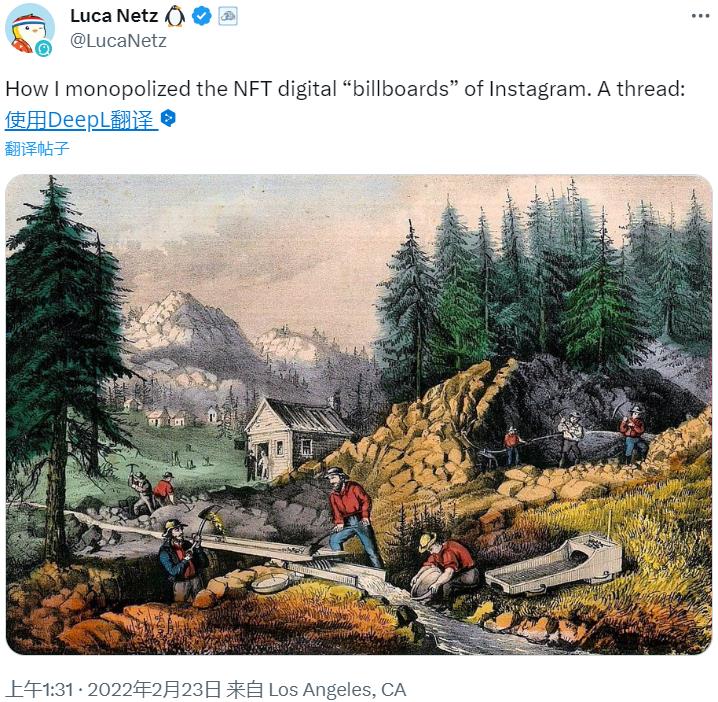
From this experience, Luca identified an arbitrage opportunity in Instagram advertising. At the time, prices for Instagram posts were rising daily, driven up by course sellers, info-product gurus, and emerging NFT projects competing for ad space.
Luca saw this as an opportunity—buying as many Instagram ad slots as possible and reselling them as prices climbed. He became a gatekeeper for these platforms; once sold, he facilitated negotiations between buyers and page owners regarding creative content and posting details. This business was run by two members of Luca’s alpha group, and he largely automated the entire operation, generating millions of dollars within months. More details can be found in his tweets. (Link)
Acquiring Pudgy Penguins, Aiming to Build Web3's First Mass-Market Brand
A few months later, Luca Netz saw an opportunity to buy Pudgy. He stated that Pudgy was his first truly high-return transaction as an NFT trader—he had always recognized its potential. Clearly, Pudgy possessed all the elements needed to become an ambassadorial NFT project.
Three months later, he embarked on creating the first mass-market brand in the Web3 space. After a year of relentless effort, he successfully raised capital.
He firmly believes in building companies the right way. Having personally witnessed how negligence and exploitation harm communities, they arrived with a vision to build a Web3 IP, setting their North Star as the benchmark for responsible Web3 IP development—ensuring the company’s growth benefits rather than harms the community.
Join TechFlow official community to stay tuned
Telegram:https://t.me/TechFlowDaily
X (Twitter):https://x.com/TechFlowPost
X (Twitter) EN:https://x.com/BlockFlow_News
 @LucaNetz