Logarithm Finance: Could LPDFi be the next new narrative?
TechFlow Selected TechFlow Selected
Logarithm Finance: Could LPDFi be the next new narrative?
After LSDFI, the next major narrative will be LPDFi (Liquidity Provider Derivatives Finance), and Logarithm Finance is pioneering this space.
 Navigating Web3 tides with focused insights
Writer: THE DEFI SAINT
Compiled by: TechFlow
To maximize gains in the crypto market, you must get ahead of the narrative:
-
$GMX dominated the derivatives narrative;
-
$LDO dominated the LSD narrative;
-
$LBR dominated the LSDFI narrative.
After LSDFI, the next big narrative will be LPDFi (Liquidity Provider Derivatives Finance), and Logarithm Finance is pioneering this space. Are we early on this narrative?
Very early—because Logarithm Finance doesn't have a token yet, but its token has already been confirmed as $LOG.
Here’s everything you need to know about the LPDFi narrative and Logarithm:
LPDFI (Liquidity Provider Derivatives Finance) extracts maximum value from LPD just as LSDFI extracted maximum value from LSD.
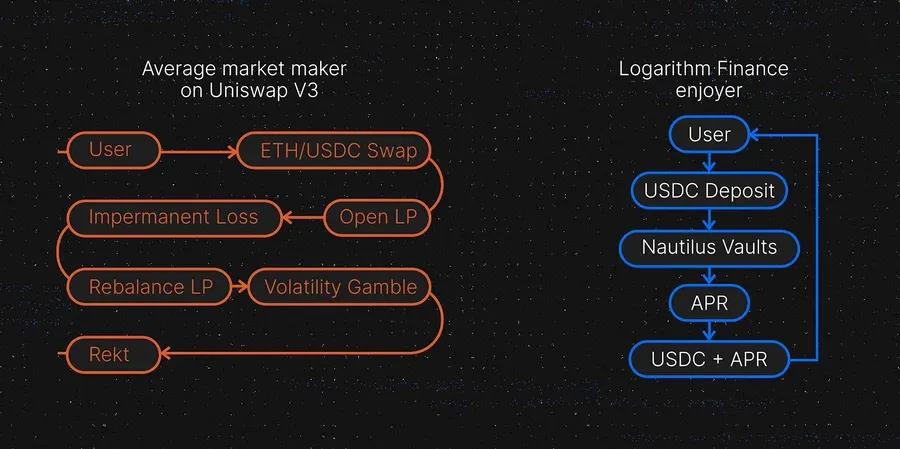
LPD leverages users’ LP positions to build products on top of them (options, yield, perpetuals, etc.). It unlocks entirely new opportunities for users' LP positions on Uniswap V3 (or similar AMMs), rather than leaving those LP positions idle.
In short, Gamma Strategies is to LP what Logarithm Finance is to users’ LP positions. Delving deeper into Logarithm’s approach to LPDFI reveals that Logarithm Finance aims to become the liquidity hub for LPD.
It intends to achieve this by leveraging delta-neutral strategies, minimizing volatility for these LPs while maximizing returns.
Logarithm Finance routes LP tokens through other LPDFI protocols to capture enhanced yields and bootstrap liquidity for those protocols. The Logarithm Finance Liquidity Shell is making this possible.
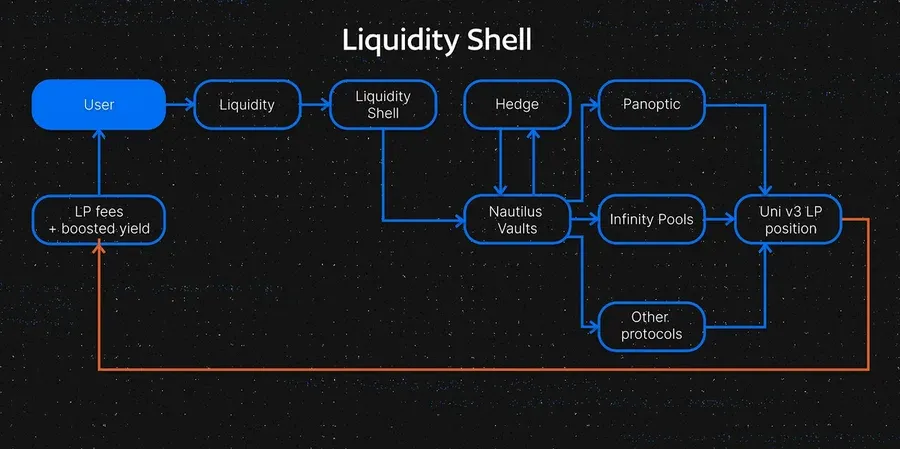
Much like a yield aggregator, Logarithm Finance captures value from various LPDFI protocols to maximize user returns, while simultaneously enabling seamless liquidity access for these LPDFI protocols and Uniswap V3.
These LPDFI protocols include:
-
Panoptic;
-
Smilee;
-
Infinity Pool;
-
Limitless.
Let’s take a closer look at Nautilus Vault, the core product of Logarithm Finance and one of the functionalities within its Liquidity Shell, enhancing its vision of providing Market Making as a Service (MMaaS).
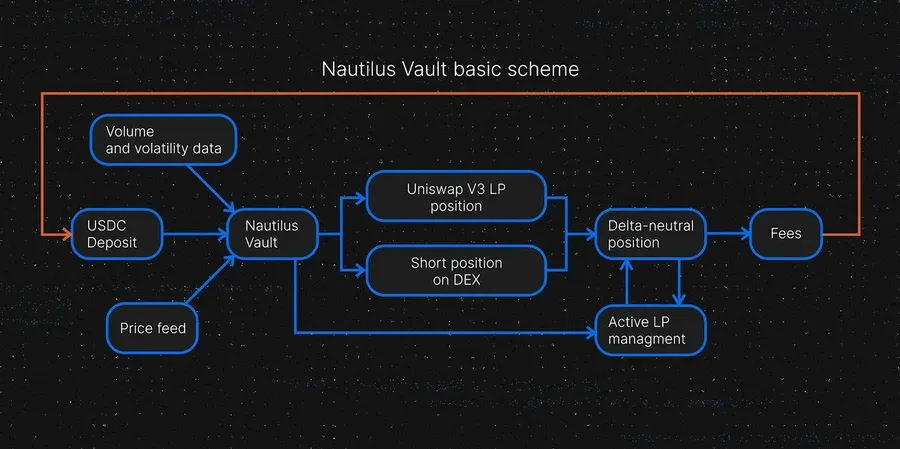
The Nautilus Vault manages Uni V3 CL positions and opens short positions on perpetual DEXs (like GMX) to hedge volatile assets, ensuring no impermanent loss while earning fees.
From an LP perspective, Logarithm Finance also fits into LAAS (Liquidity as a Service), similar to CLMs like Gamma Strategies, Dyson, and DeFi Edge.
In the future, Nautilus Vault will expand to other concentrated liquidity AMM DEXs such as Chronos, and will also extend to other chains. Regarding how Logarithm Finance delivers real yield to users, it's crucial to understand where these yields originate:
-
LP fees from Uniswap V3;
-
LP fees from LPDFI protocols;
-
Logarithm incentives paid to LPs in $LOG;
-
Token emissions from LPDFI projects.
Logarithm Finance has already demonstrated the authenticity of these yields through backtesting, achieving an annualized return of 11.8%.

Notably, the beta version of Logarithm Finance has been announced and is即将 launching.
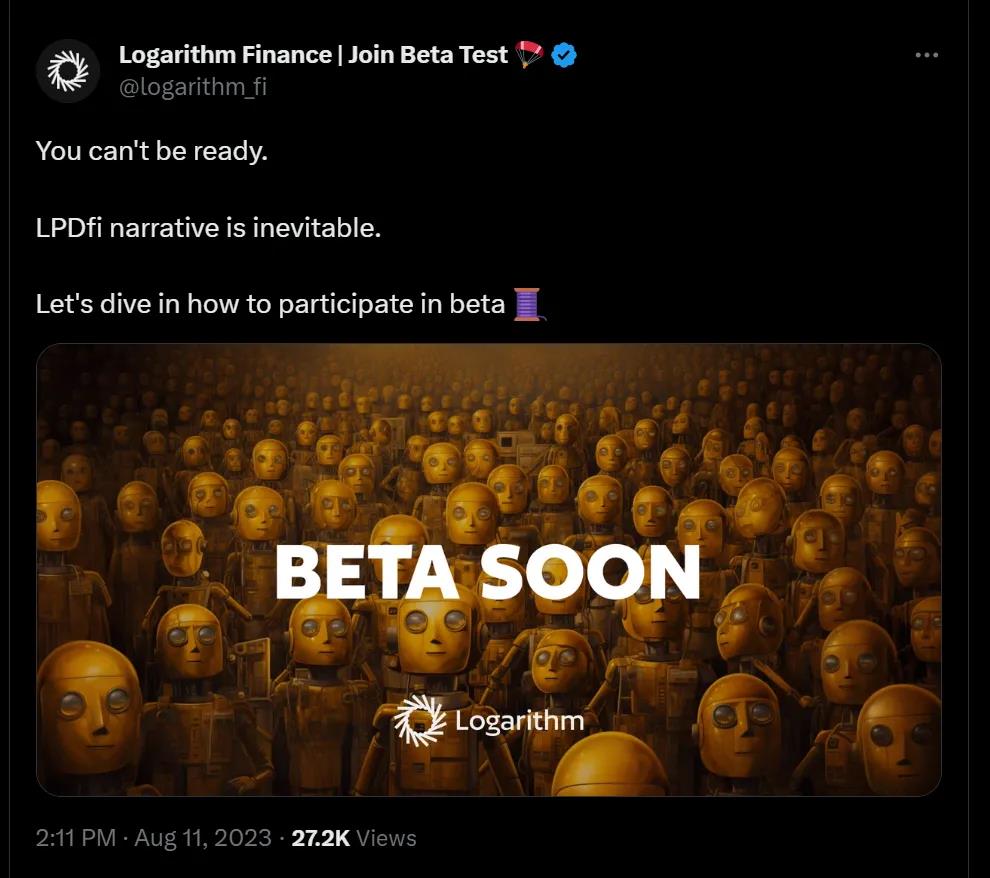
The Logarithm Finance token $LOG has also been confirmed. Although details on token distribution economics are still scarce, Logarithm Finance will conduct a private sale for its token.
So why is Logarithm Finance worth watching? Because it genuinely aligns with multiple narratives:
-
LPDFI;
-
MMaaS (Market Making as a Service);
-
LaaS (Liquidity as a Service).
Join TechFlow official community to stay tuned
Telegram:https://t.me/TechFlowDaily
X (Twitter):https://x.com/TechFlowPost
X (Twitter) EN:https://x.com/BlockFlow_News
 @TheDeFISaint