Following Merkle Tree proofs, Huobi HTX announces the launch of its ZK-based Proof of Reserves, comprehensively upgrading its asset verification approach.
TechFlow Selected TechFlow Selected
Following Merkle Tree proofs, Huobi HTX announces the launch of its ZK-based Proof of Reserves, comprehensively upgrading its asset verification approach.
As a globally leading cryptocurrency exchange, it is particularly important for Huobi HTX to ensure users trust that their funds are secure and fully redeemable.
 Navigating Web3 tides with focused insights
According to official announcements, Huobi HTX has announced an upgrade to its 100% Proof of Reserves mechanism by adopting zero-knowledge proof technology, enabling users to verify asset security without exposing sensitive information.
As a leading global cryptocurrency exchange, it is particularly important for Huobi HTX to ensure users that their funds are secure and fully redeemable. To this end, the "Proof of Reserves (PoR)" mechanism emerged as a widely recognized method to boost investor confidence.
As one of the earliest industry platforms to implement Proof of Reserves, Huobi HTX has been conducting monthly Merkle tree-based reserve audits since late 2022 and publicly disclosing the results, ensuring users can deposit and withdraw assets securely and in full at any time. Recently, following its implementation of Merkle tree-based Proof of Reserves, Huobi HTX has upgraded to a new version using ZK (zero-knowledge) technology, creating a more secure and privacy-preserving environment for digital asset trading.
What is Proof of Reserves (PoR)?
PoR: Proof of Reserves, like Proof of Work, is a consensus mechanism. Under this mechanism, users or third parties execute PoR to verify whether assets truly exist, thereby providing detailed data on where customer assets are located.
PoR also demonstrates to customers that their assets remain in their accounts and have not been lent out. In simple terms, user-level consensus trust relies on the following three points:
1. On-chain wallet assets: centralized account assets ≥ 1:1;
2. User assets are included within the exchange's reporting scope;
3. The addresses holding on-chain wallet assets are controlled by the exchange;
Following its initial Merkle tree-based PoR approach, Huobi HTX has now upgraded to a ZK (zero-knowledge proof)-based version. Zero-Knowledge Proof is an innovative cryptographic protocol that allows one party to prove possession of certain information without revealing the information itself.
Zero-Knowledge Proof protects privacy better than Merkle Tree proofs
In a zero-knowledge proof system, there are two roles: the Prover and the Verifier. The Prover possesses a secret piece of information and wants to convince the Verifier of this fact without revealing the actual content. The Prover generates a proof based on the secret, which does not contain the secret itself.
This proof is typically constructed through mathematical operations and can demonstrate that the Prover indeed holds the secret. Upon receiving the proof, the Verifier uses a predefined verification algorithm to check its validity but cannot extract the original secret from the proof. If the proof passes verification, the Verifier becomes convinced that the Prover possesses the secret—without learning any details about it. This property is known as "zero-knowledge."
As blockchain exchange trading volumes grow, users need assurance that exchanges hold sufficient reserves to support withdrawals. However, detailed user asset data and exact reserve amounts are sensitive and often not disclosed. Zero-knowledge proofs enable exchanges to prove they hold adequate reserves and have sufficient solvency without revealing specific figures. Carefully designed proof circuits ensure that final proofs result from rigorous computational processes, eliminating the possibility of falsified claims.
Using this advanced cryptographic technique significantly enhances user trust in exchanges while improving financial transparency and helping prevent financial risks. Compared to traditional third-party audits, zero-knowledge proofs eliminate the need to hand over full reserve data to external auditors, greatly reducing operational costs and fund exposure. This makes Proof of Reserves a routine process that can be conducted frequently and disclosed regularly.
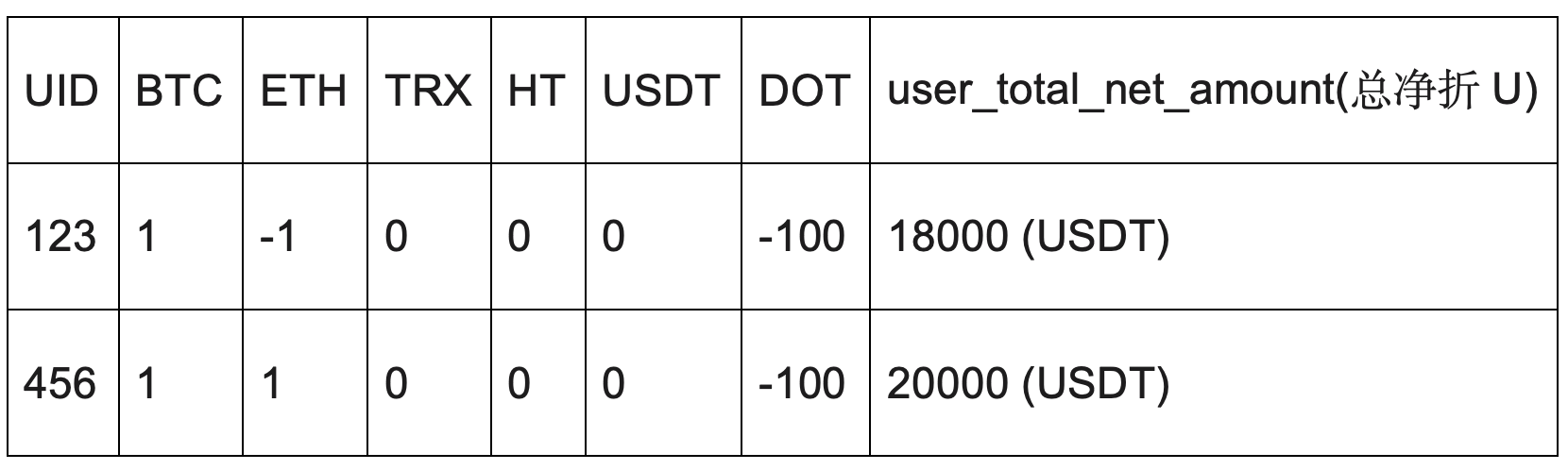
For example, consider user data such as:
uid, btc, eth, trx, ht, usdt, dot (expanded), user_total_net_amount (total net value in USDT)
A: 123, 1, -1, 0, 0, 0, -100, 18000 (usdt)
B: 456, 1, 1, 0, 0, 0, -100, 20000 (usdt)
For example, with user data:
Three key constraints must be satisfied:
Constraint 1: Each user’s total net asset balance (in USDT) must not be negative:
assert(!neg(user_total_net_amount[x]));
Constraint 2: The exchange’s total net asset value (in USDT) must equal the sum of all individual user leaf nodes’ net values during Merkle tree construction:
CEX_total_net_amount = user_total_net_amount[0] + ... + user_total_net_amount[len - 1];
Constraint 3: Constraints on the Merkle tree construction process (hashing steps).
merkle_root_hash = hash(user_leaf_node, merkle_proof_path_node...)
These constraints are public. Any user who meets the reserve reporting criteria (typically non-zero asset holders) can verify the proofs provided by Huobi HTX and thus cryptographically trust that the exchange’s reserve calculations are valid and truthful.
Huobi HTX leads industry transparency with cutting-edge technology and strict financial standards
According to official statements, from the end of 2022 to present, Huobi HTX has regularly updated its latest Merkle tree-based asset proof data on the first day of each month, ensuring customer funds are backed by at least a 1:1 reserve ratio.
The latest audit results as of September 1 show that Huobi HTX’s current platform asset reserve ratios exceed 100%. Going forward, after upgrading to the zero-knowledge proof version of Proof of Reserves, Huobi HTX will continue to publish monthly reserve proof results on schedule, further emphasizing user privacy and information security while demonstrating its solvency.
It is reported that in addition to consistently maintaining reserve ratios above 100%, Huobi HTX is also among the few exchanges implementing open-source verifications for Merkle trees, wallet address ownership, and on-chain assets. Since December last year, Huobi HTX has released PoR reports monthly, continuously leading the industry toward greater transparency.
Join TechFlow official community to stay tuned
Telegram:https://t.me/TechFlowDaily
X (Twitter):https://x.com/TechFlowPost
X (Twitter) EN:https://x.com/BlockFlow_News