








The Future of MEV Is the Future of Cryptocurrency—Is the Importance of the MEV Sector Underestimated?
TechFlow Selected TechFlow Selected
The Future of MEV Is the Future of Cryptocurrency—Is the Importance of the MEV Sector Underestimated?
Overall, the value and future of the MEV market are tied to more complex trading scenarios and market volatility, which will bring more opportunities for traders.
 Navigating Web3 tides with focused insights
Author: Yilan, LD Capital
1. Understanding MEV
When Ethereum still used the PoW mechanism, MEV stood for "Miner Extractable Value." Under the PoS mechanism, miners have been replaced by validators, and MEV now stands for "Maximal Extractable Value." Unlike in PoW, where a few opaque mining pool operators controlled transaction ordering and profited from it, under PoS, the right to arbitrage transaction ordering within blocks is open to anyone through participating in an open market for block-space arbitrage by taking on different roles. Paradigm’s GP Dan categorizes MEV into EIP-1559 burn, hedging, rebalance loss, and price changes before and after trades. At its core, MEV refers to any value captured—partially or fully—through transaction ordering privileges on-chain. Therefore, on-chain arbitrage activities are sometimes collectively referred to as MEV, which is also seen as a byproduct of blockchain systems and a permissionless incentive mechanism, available to users on a first-come, first-served basis.
For example, suppose User A sells 100 ETH on an AMM. Due to the AMM algorithm, each unit sold slightly lowers the price. Selling large amounts can cause the asset's price to drop below the current market rate—resulting in slippage. An MEV searcher noticing this trade could buy ETH at the new lower price and immediately sell it at the prevailing market price to complete arbitrage. In this scenario, the searcher’s transaction must be the very next one executed after User A’s to succeed. This illustrates intense competition among MEV searchers, where being the first transaction before or after a target transaction typically depends on paying higher priority fees to ensure inclusion in the next block. To get their transactions promptly packed by validators, MEV searchers participate in gas fee auctions, driving up costs significantly due to fierce competition.
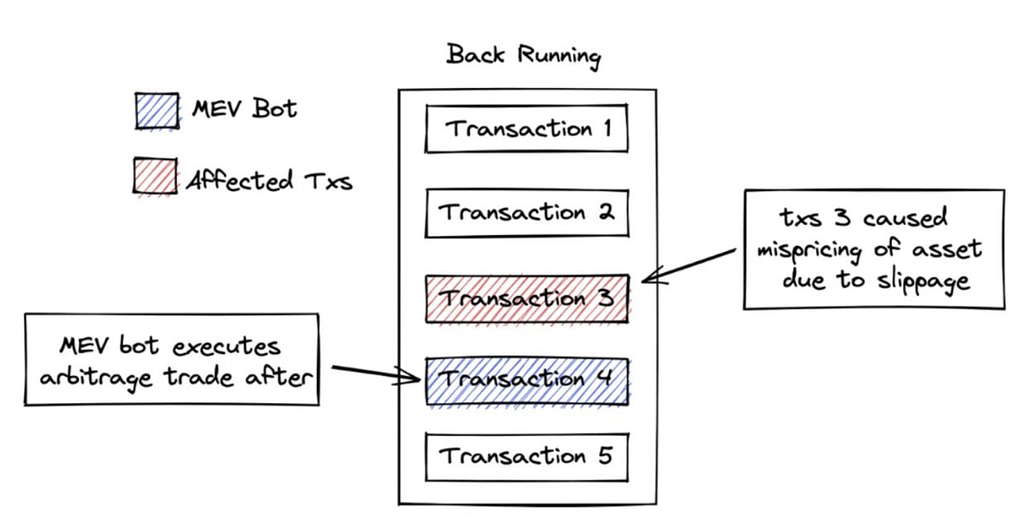
A more traditional explanation is that on the Ethereum blockchain, all new transactions must first wait in the public memory pool (mempool) before being included in a block and added to the chain. In the past PoW era, miners decided which transactions to include and in what order, often simply choosing those with the highest fees without much concern for sequencing. However, amid Ethereum’s rapidly growing transaction ecosystem, MEV searchers quickly realized they could profit by reordering, censoring, or creating new transactions based on existing ones in the mempool—these profits constitute MEV. While searchers initiate MEV opportunities, most of the profits are often distributed further down the value chain to participants such as validators rather than staying with the searchers themselves.
From the perspective of user experience and ecosystem sustainability, MEV activities fall roughly into two categories: beneficial MEV such as arbitrage that aids price discovery and liquidations, and harmful MEV like simple front-running or more complex sandwich attacks (placing two orders around a legitimate buy order, buying the target token at a higher price and selling afterward). Front-running and sandwich attacks result in worse execution prices for ordinary DEX traders.
2. MEV Landscape Overview
1. Sector Characteristics
The MEV sector is foundational and closely tied to all areas involving on-chain transaction activity. It features high revenue potential, benefits from increasingly complex and diverse trading scenarios, carries relatively low risk, and grows alongside the expansion of multiple L1 ecosystems.
2. Sector Development
(1) Addressing MEV is a key part of Ethereum’s roadmap. On November 5 last year, Ethereum co-founder Vitalik Buterin (Vitalik) released an updated development roadmap including three major changes, one of which was adding a new phase—"The Scourge"—aimed at ensuring reliable, fair, and trustlessly neutral transactions and solving MEV issues. This indicates growing attention toward protocols addressing MEV centralization, leading to increased interest in this sector.
(2) Future MEV development should focus on cross-chain MEV capture, minimizing value leakage, reducing potential negative impacts of MEV on real protocol users, and ensuring fair distribution among participants.
3. Market Size
The revenue scale of this sector evolves almost in tandem with overall crypto trading volume. Two main factors influence MEV size: a positive correlation between arbitrage frequency and price volatility, and another positive correlation between arbitrage volume and total trading volume.
According to Flashbots data, total gross extracted profits amount to $713.95 million—considered “good MEV” that positively contributes to price discovery, core DeFi functionality, and DEX trading volumes. Sandwich attack revenues reached $1.206 billion—classified as “bad MEV,” which most MEV-protected DEXs aim to control and democratize.
Using the top three DEXs by cumulative fee income—Uniswap, Pancakeswap, and Sushi—as benchmarks, their combined fees total ($3.24 + $1.2 + $0.77) billion = $5.21 billion. Roughly estimating, MEV captured via Flashbots accounts for about 37%. In reality, significant MEV revenue also arises from other dApps on Ethereum, alt-L1s, and L2s. Estimating the full value chain requires analyzing how MEV profits are distributed across participants.
According to Eigenphi data, in January and February 2023, MEV searchers earned $48.3 million from user transactions via wallets and RPCs, of which $34.7 million flowed to builders. Builders then passed $30.3 million to validators.
Profit distribution: Searchers — $7.3 million (17.4%); Builders — $4.4 million (10.5%); Validators — $30.3 million (72.1%). (Roles described below.) Clearly, the downstream validators capture the majority (72%) of profits.
Of the $48.3 million, $6.3 million went toward EIP-1559 burns. Priority fees for regular transactions sent from wallets/RPCs to builders, then to validators, totaled $32.554 million. Regular transactions from wallets/RPCs contributed $227.2 million to EIP-1559 burns.
During the 2021 bull market, the total revenue ceiling hit $476 million. Using a conservative 10x PS ratio, the total sector size approaches $4.76 billion. Based on share estimates, the searcher segment exceeds $1 billion, while validators surpass $3.5 billion—though these figures remain rough approximations.
However, bots profiting from on-chain trading may still incur costs from failed transactions and off-chain hedging not accounted for here. Additionally, only direct participant revenues are considered, excluding indirect market participants. The actual sector size likely far exceeds these numbers.
4. Two Perspectives on the MEV Landscape
(1) Value Chain
Upstream (RPC Providers): Upstream refers to service providers offering on-chain transaction information and data—typically Ethereum node operators or Remote Procedure Call (RPC) services. These providers offer essential data interfaces enabling midstream and downstream participants to access transaction and block information, facilitating better engagement in MEV-related activities. For instance, Uniswap sends user-initiated transactions (TXs) via RPC calls into the Ethereum mempool.
Midstream (Tools & Infrastructure): Midstream includes various tools, platforms, and infrastructure connecting upstream and downstream players to facilitate MEV value allocation. These may include search engines, transaction builders, relays, etc., helping searchers, builders, and block producers discover, execute, and distribute MEV opportunities more efficiently.
Downstream (MEV Profit Recipients): Downstream encompasses entities actually benefiting from MEV value, including validators and others receiving MEV profits. Validators in Proof-of-Stake (PoS) networks validate and propose blocks, earning rewards from transaction fees and staking yields—rewards enabled by upstream and midstream activities. Downstream validators include centralized exchanges (CEX), liquid staking platforms, institutional stakers, and individual stakers.
(2) Direct vs. Indirect Participants
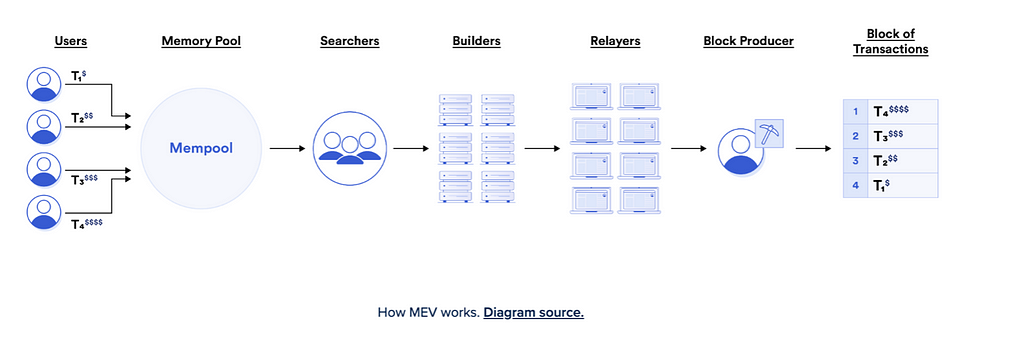
MEV Value Chain Flow
Direct participants include Searchers, Builders, Relayers, and Block Producers (Validators), who together form the MEV supply chain structure. Tools serving these direct participants—such as infrastructure designed to address MEV challenges—include Flashbots, which recently raised $60 million at a $1 billion valuation to develop its platform SUAVE.
SUAVE (Single Unified Auction for Value Expression) is infrastructure aimed at solving MEV-related challenges, envisioning itself as a shared ordering layer across chains. SUAVE focuses on separating the roles of mempool and block generation from existing blockchains to create an independent network (an ordering layer) that acts as a plug-and-play mempool and decentralized block builder for any blockchain—essentially serving as the mempool and builder for other chains. SUAVE aims to provide a more decentralized and fair ecosystem for users, block builders, validators, and other MEV-related actors. By decoupling mempools and builders across chains from other components, enabling specialized management, it enhances efficiency across chains and creates win-win outcomes: greater decentralization for blockchains, higher validator income, larger potential earnings and customizable preferences for searchers/builders, and cheaper, private transactions for users.
-
Searchers write code, often powered by proprietary complex algorithms, to identify MEV opportunities in the mempool. They monitor both public and Flashbots’ private transaction pools, competing to submit response “bundles” to builders along with gas bids indicating their maximum willingness to pay (priority fee).
-
Block Builders are professional providers competing in real-time markets to build blocks on behalf of validators. Anyone downloading MEV-Boost can become a block builder. Builders receive transactions from searchers, select the most profitable combinations, and send resulting blocks via MEV-Boost to relayers.
-
Relayers act as intermediaries between block builders and block proposers, allowing validators to lease their block space to builders. Some relayers have processed transactions previously routed through Tornado Cash, while others exclude or “censor” them. MEV relayers are controversial due to censorship concerns. In August 2022, Tornado Cash was blacklisted by the U.S. Treasury’s Office of Foreign Assets Control (OFAC), making it illegal for U.S. persons, residents, and companies to send or receive funds via the protocol. Since then, validators must carefully choose which relayer to use for MEV income, deciding whether to adopt OFAC-compliant relayers. Given the high number of Ethereum nodes in the U.S., many American validators likely opt for compliance to avoid regulatory risks—contradicting anti-censorship principles. Flashbots’ own relay was the first MEV-Boost relay and chose to censor non-compliant transactions, explaining early dominance of OFAC-compliant blocks on Ethereum. As more relayers—including non-censoring ones—became available, this trend reversed; now fewer than half of blocks are OFAC-compliant. Flashbots’ relay market share has declined to 23%.
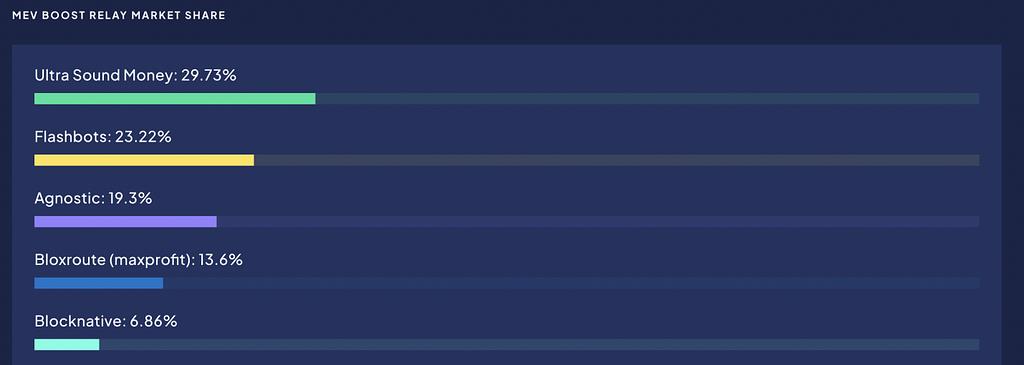
MEV Boost Relay Market Share
-
Block Producers / Validators are entities responsible for validating and proposing blocks to be added to the PoS blockchain. They often capture the largest share of MEV收益. Under PoS, any user can stake 32 ETH to become a validator. Currently, Lido operates the largest validator set. Validators using MEV-Boost can select the most profitable block proposal from multiple relayers and collect the priority fee. Among many validators, one is randomly selected as the Proposer to submit the final block.
Indirect participants include nearly all underlying L1s, L2s, and application-layer projects. Application layers include DEXs, lending protocols, LSDs (where MEV spans the entire DeFi ecosystem, increasing fees, aiding liquidations, boosting APY for validators, etc.), and protocols helping users avoid MEV in specific trading contexts (including tool providers and beneficiary protocols) such as Unibot and other Telegram bot protocols.
Leading Projects Across Different Participants
Lido
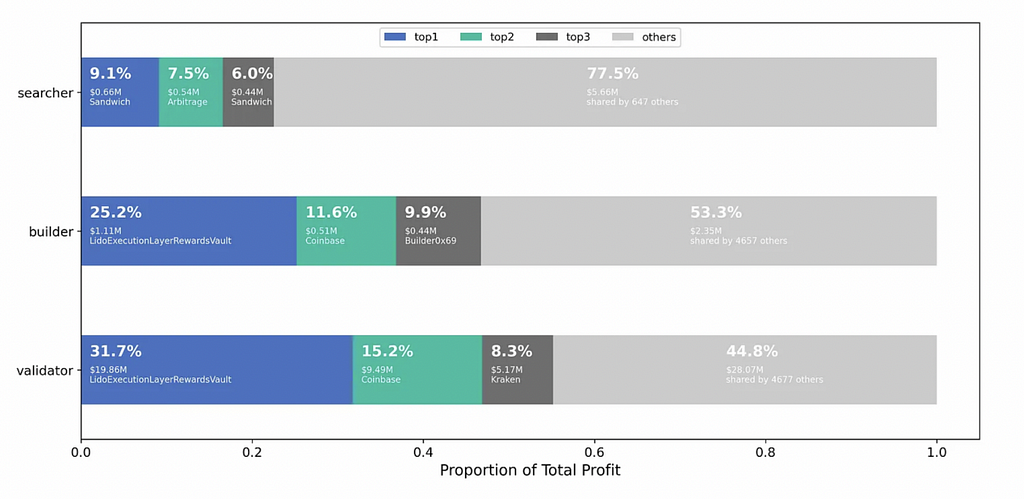
MEV remains crucial to Ethereum’s economy, accounting for over 15% of all Ethereum transactions and increasing staker and validator reward rates by 25%. As the largest downstream validator beneficiary, Lido captures 31.7% of all validator earnings—$19.86 million (data from Jan–Feb this year). Taking Lido DAO’s execution-layer APR as an example, MEV income dominates, comprising about one-third of stETH’s total revenue. During periods of high on-chain activity, this share can reach nearly 70%. Therefore, during bull markets, MEV income could still account for 70% of total staking income, suggesting a strong positive correlation between MEV and LSD sector growth.
Uniswap
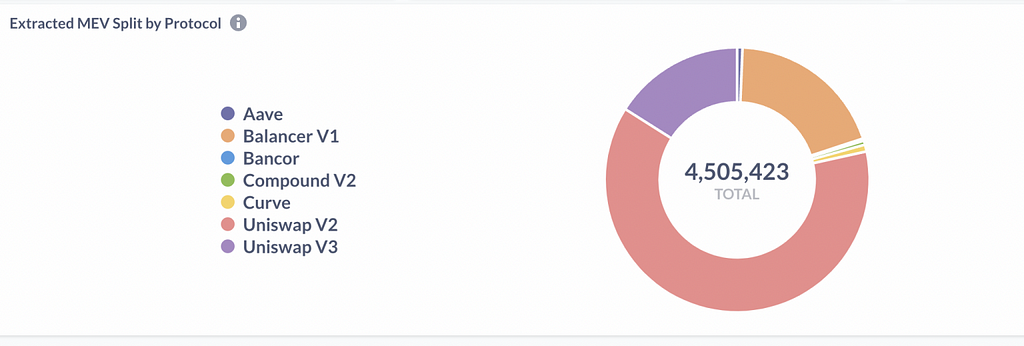
MEV Revenue Share Across DEX Protocols
MEV-related profits on Uniswap amount to $252 million. In 2022 alone, arbitrage bots extracted at least $85 million from price asymmetries in Uniswap V3 liquidity pools; sandwich bots extracted at least $47 million from swap users in Uniswap V3 pools; JIT bots captured $6 million from Uniswap V3’s swap fee revenue.
The total extracted value from these three types already exceeds 25% of supplier income—$540 million.
For real Uniswap users, future integration of MEV revenue via UniswapX will significantly benefit swappers. UniswapX’s aggregator and RFQ off-chain order matching mechanisms represent major progress against MEV (albeit at the cost of some decentralization). For cross-chain MEV capture, UniswapX’s planned cross-chain technology will serve as critical infrastructure.
Unibot
The current total market cap of the Telegram bot sector is under $200 million, with leader Unibot capturing about 75% market share.
Considering Telegram’s 800 million users, Unibot aims to open a massive traffic gateway through feature consolidation. Though robot functionality is still early-stage, offering one-stop trading within a traffic pool represents a distinct user acquisition strategy compared to most DeFi apps—even if most trades ultimately occur on Uniswap.
Currently, Unibot’s daily active users surged from ~400 to a peak of 1,700 within two weeks in July—objectively showing substantial growth potential. However, this user base is unique, typically active during meme coin rallies. The overall market cap remains small, but the business model holds merit, featuring a reasonable tokenomics design (40% revenue sharing to holders) and high growth ceilings. Long-term, only price-insensitive users will use Unibot, given the additional 5% tax compared to direct Uniswap trading. Such protocols also face clear drawbacks: though robots allow users to create dedicated wallets or connect existing ones, either way they require access to private keys—adding an extra layer of risk for users.
Valuation Analysis
-
Unibot peak Vol/FDV = $12 million / $182 million = 0.06
-
Uniswap: Vol/FDV = $429 million / $6.193 billion = 0.069
-
Velo: Vol/FDV = $7.5 million / $100 million = 0.075
Judging by the Vol/FDV metric, the market has priced Unibot within a reasonable valuation range. However, as meme hype fades, Unibot’s trading volume will inevitably decline accordingly.
Beyond the Ethereum ecosystem, MEV opportunities exist in other ecosystems too. Moreover, increasingly complex cross-chain transaction scenarios will significantly amplify MEV activity.
3. Dynamic Balance Between MEV and the DEX Ecosystem
There is a positive correlation between MEV transaction volume and total transaction volume. Eigenphi data shows a correlation coefficient of 0.6 between total trading volume (excluding arbitrage) and arbitrage volume, and 0.62 between total volume (excluding sandwich trades) and sandwich trade volume. Thus, the larger the total trading volume, the greater the MEV volume. More DEXs are increasing their TVL across multiple chains, forming liquidity pools for identical assets across channels—but with varying depth and volume—creating new opportunities for trading and MEV.
Other factors affecting MEV activity include gas fees (lower fees increase potential profitability, though searchers might still inflate network-wide gas for large trades) and market volatility (higher volatility increases sandwich arbitrage opportunities).
AMMs are where most MEV is extracted. With Uniswap V3 introducing concentrated liquidity ranges, traders can operate within tighter price bands, reducing price discrepancies and shrinking certain MEV profit margins. Additionally, Uni V3’s finer price-setting mechanism generally results in less slippage than earlier versions, theoretically reducing some MEV profit opportunities and curbing certain MEV activities. Simply put, deeper concentrated liquidity at specific price points and reduced slippage due to precise pricing lead to significantly lower MEV arbitrage profits.
Emerging anti-MEV DEXs protect ordinary users through the following mechanisms:
(1) Order Transparency and Predictability – DEXs can publicly disclose order details before submission, using auction-like or off-chain order book matching mechanisms to reduce front-running risks. Pre-disclosure allows traders to better anticipate market moves, lowering attack probabilities.
(2) Time-Locked Transactions – Implement time locks restricting execution until after a specified block. This mitigates flash loan attacks, as attackers cannot execute multiple transactions within the same block.
(3) Batched Transactions – DEXs can allow users to submit multiple transactions processed as a single batch. This increases privacy and reduces attackers’ ability to analyze individual trades.
How do these anti-MEV measures affect trading volume? For anti-MEV DEXs, this benefit shifts to end users. Although reduced sandwiching—or its transformation into non-fee-generating forms—may reduce trading volume, maintaining a healthy trading environment remains vital for any exchange system’s long-term sustainability.
MEV affects traders, liquidity providers, and miners/validators differently. For traders, MEV—especially harmful MEV—increases trading costs. Traders must pay higher fees to ensure priority confirmation, raising costs particularly during network congestion.
Second, information asymmetry: MEV enables certain parties to exploit their control over transaction ordering to gain unfair informational advantages, exposing others to asymmetric risks.
For LPs, providing liquidity becomes riskier. They face sandwich attack risks—where their provided liquidity is exploited by others causing losses—and suffer impaired cost-efficiency, needing to weigh higher gas costs and risks against returns.
For miners/validators, MEV may drive optimization of mining strategies to maximize transaction fees and rewards. But this intensifies competition, pushing up gas prices and worsening network congestion.
4. Solutions to Prevent Harmful MEV
Solutions to prevent harmful MEV exist across consensus, execution, app, L2, and MEV tool layers.
At the consensus layer, Ethereum’s “The Scourge” phase focuses on ensuring reliable, fair, trustlessly neutral transactions and resolving MEV issues. At the execution layer, peer-to-peer and gasless transactions help prevent harmful MEV. P2P transactions occur directly between counterparties, reducing intermediary interference and malicious behavior. Gasless transactions and separation from the mempool reduce opportunities for adversaries to gain advantage via gas bidding. Furthermore, innovative experiments offer new ideas. For example, EigenLayer explores introducing MEV-boost and partial block auctions in certain blocks, paving the way for modular MEV stack designs.
On Layer 2, Taiko takes a radically different approach—outsourcing block creation to L1—potentially leveraging Ethereum’s base layer capabilities to tackle L2 MEV complexity.
At the app layer, dex aggregators (whose anti-MEV role is often overlooked) minimize MEV exposure by routing orders across multiple channels, reducing slippage impact from point-in-time pricing. Backrunning services, off-chain order matching, auctions, and batch processing (which uses uniform internal pricing to eliminate sandwich attacks by enabling direct peer-to-peer matching) all help minimize harm to users.
In MEV tools, Flashbots aims to mitigate MEV’s negative impacts across the ecosystem, such as network congestion. Flashbots offers several products: Flashbots Auction (including Flashbots Relay), Flashbots Protect RPC, MEV-Inspect, MEV-Explore, and MEV-Boost. The upcoming SUAVE platform, serving as a cross-chain ordering layer, shifts focus toward user preferences and optimized transaction routing, building the most efficient paths based on searcher intent.
5. Conclusion
From a sector importance standpoint, MEV is a byproduct of block production—so much so that MEV’s future could be said to mirror the future of crypto itself. Its strong cash flow characteristics mean roles like Searcher, Builder, Relayer, and Validator—and the tool products optimizing these roles—continue to generate robust revenue. However, since few protocols tokenize true MEV-income capture (via searcher or validator roles), secondary market investment opportunities remain limited. Yet, some application-layer projects can gain an edge by entering the MEV space. Tool projects offer promising early-stage investment opportunities, though they must consider how to capture value for their own protocol rather than merely enhancing already-profitable participants.
While harmful MEV negatively impacts users, proper utilization of MEV brings many positive effects: arbitrageurs maintain price consistency across AMMs, support stablecoin pegs, enable smooth DeFi loan liquidations, and incentivize block proposers—enhancing blockchain security via higher execution-layer rewards.
In summary, the MEV sector’s development focuses on several key directions: cross-chain MEV capture, minimizing value leakage, reducing potential negative impacts of MEV on real users, democratizing revenue, promoting sequencer decentralization, and ensuring fair distribution among participants. We currently observe that UniswapX’s cross-chain technology plays a pivotal infrastructural role in enabling cross-chain MEV capture. Overall, the value of the MEV market correlates with increasingly complex transaction scenarios and market volatility, presenting more opportunities for traders. Potential negative impacts of MEV on real users can be mitigated through consensus-level fairness and privacy protections, and protocol-level mechanisms like off-chain order matching and reduced point-in-time slippage. Moreover, the stacking and decentralization of MEV participants remain critical components of Ethereum’s roadmap, contributing to a more robust and secure MEV ecosystem.
Significant room remains for exploration in democratizing MEV收益. For anti-MEV, de-sandwiching DEXs, part of the originally searcher-captured gains transfers to their users. While anti-MEV designs may reduce or transform sandwiching behaviors—possibly decreasing transaction volume linked to bad MEV—maintaining a healthy trading environment remains essential for sustainable development of any trading system. Over time, such positive MEV outcomes gradually contribute to the overall health of the on-chain trading ecosystem.
A fair competitive environment nurtures innovation, while efficient profit-sharing mechanisms and decentralized architectures form the foundation for achieving this goal. Searcher and block-building technologies themselves are neutral—their impact on the trading environment depends entirely on how humans choose to use them.
Join TechFlow official community to stay tuned
Telegram:https://t.me/TechFlowDaily
X (Twitter):https://x.com/TechFlowPost
X (Twitter) EN:https://x.com/BlockFlow_News
 Cycle Capital Research






