









The market is not necessarily only about L2s—new public blockchains cannot be ignored
TechFlow Selected TechFlow Selected
The market is not necessarily only about L2s—new public blockchains cannot be ignored
Is there really a need to continue developing new public blockchains?
 Navigating Web3 tides with focused insights
Author: Ray
The Environment for New Public Blockchains
If there were a law of universal gravitation in the blockchain world, Bitcoin and Ethereum would be like the two brightest stars illuminating this brilliant cosmos. Their prominence among countless others stems from their pioneering technological implementations—Bitcoin with blockchain itself, and Ethereum with smart contract platforms—combined with years of continuous iteration and upgrades. These efforts have accumulated massive market capitalization, thriving ecosystems, and vibrant communities.
Between 2017 and 2021, during that crypto cycle, we often heard the term "Ethereum killer." Numerous new public blockchains aimed to surpass Ethereum by proposing novel architectures and solutions. Examples include Solana with its Proof of History (PoH), Avalanche leveraging the Avalanche consensus and subnet functionality, NEAR focusing on sharding technology, Flow separating consensus from computation, EOS enabling parallel processing and asynchronous communication, IOTA adopting a DAG-based transaction structure, and Polkadot and Cosmos natively supporting multi-chain interoperability. Undeniably, these projects achieved notable success in metrics such as daily active users, DApp development, and Total Value Locked (TVL) during specific periods. However, due to various reasons—including team stagnation and investor collapse—and the gradual rollout of Ethereum's Rollup-based Layer 2 solutions, the landscape began shifting. Most notably, Arbitrum and Optimism surpassed most alternative Layer 1s (Alt-L1s) on DeFiLlama’s TVL rankings. Furthermore, innovative projects started migrating to Layer 2 networks; a prime example is GMX, a derivatives platform that moved from Avalanche to Arbitrum.
Today, the steady growth of Bitcoin and Ethereum, along with the rapid expansion of Layer 2 networks, is clearly squeezing the once-bustling Alt-L1 market. Many Alt-L1 projects appear stuck in a "stagnant" bottleneck phase, signaling a less-than-optimistic future for new public blockchains. Take the recent Move-based chains Aptos and Sui as examples—the shift in market sentiment has been dramatic. Before mainnet launch, enthusiasts deeply analyzed their whitepapers and technical designs, developers eagerly learned the new Move language, and DApp teams raced to claim early ecosystem positions. Yet after mainnet launches—especially post-token distribution—with underwhelming DApp activity and stagnant TVL figures, much of that initial excitement faded.
PS: Privacy-focused blockchains emphasize anonymity and user data protection, while storage blockchains prioritize decentralized data storage. Given their distinct design philosophies and technical paths compared to general-purpose blockchains, we will temporarily exclude privacy and storage blockchains from this discussion to maintain focus.
The Necessity of Developing New Public Blockchains
It's undeniable that launching a new public blockchain today to challenge giants like Bitcoin and Ethereum—or even emerging Layer 2 networks—is an immensely challenging endeavor. This raises a critical question: Is there still a need to develop new public blockchains?
The answer is yes. From the perspective of mass adoption, Web3 has evolved significantly since 2020 with the emergence of DeFi, NFTs, Metaverse, and other innovative use cases, reaching millions, even tens of millions, of users. Still, compared to technologies that have already achieved mass adoption—such as search engines and instant messaging—Web3 remains in its infancy. If we compare public blockchain infrastructure to traditional cloud computing, blockchain services are still in a rapid growth phase and far from maturity in terms of application scale and user penetration. The future market is vast, demand is evolving quickly, and there will be room for high-performance, responsive blockchains to emerge. While Bitcoin and Ethereum currently lead in recognition and market share, this doesn't mean alternative or new L1s lack survival space or opportunities to leapfrog in niche domains. This is precisely why institutions continue to invest heavily—not merely for financial returns, but based on strategic bets on the future of Web3 and the foundational importance of public blockchains.
Hard Power and Soft Power
When analyzing public blockchains, we can assess them through two lenses: hard power and soft power. Hard power refers to technological innovation—P2P networking, consensus mechanisms, block data structures, smart contract languages and virtual machines, token economics—and the ability to adapt technical roadmaps to changing conditions. Soft power encompasses business execution, ecosystem development, and capital coordination. Both are essential for a blockchain’s research, deployment, and long-term success. A project strong in hard power but weak in soft power risks becoming isolated and irrelevant; conversely, one strong in soft power but lacking technical depth will not endure.
Regarding hard power, Alt-L1s often suffer from technical rigidity—a key reason we emphasize the adaptability of technical roadmaps to real-world conditions. After Satoshi created Bitcoin, the network and community evolved organically, leading to slow and conservative progress on major upgrades. Yet even Bitcoin now adapts to trends, as seen with the rise of the Ordinals protocol. Ethereum once explored Plasma as a scaling solution before fully embracing Rollups. Its latest roadmap prioritizes PoS security and decentralization, data sharding integrated with Rollups, while earlier goals like eWASM and state sharding have been deprioritized or replaced.
Exploring Innovative Technologies
When Ethereum launched its Frontier phase in 2015, it provided a minimally viable network featuring PoW consensus, transactions, account models, and the core EVM smart contract platform. Since then, Ethereum has continuously upgraded: Homestead in 2016 brought stability and efficiency; Metropolis Byzantium in 2017 introduced ZK-Snarks via precompiled contracts; the Beacon Chain in 2020 enabled PoS; the London Hard Fork in 2021 implemented EIP-1559’s fee market; and the Paris Upgrade (ETH Merge) in 2022 officially transitioned to PoS. Guided by the spirit of open and decentralized innovation, Ethereum has demonstrated how a public blockchain can persistently evolve through repeated upgrades and technical exploration.
Precisely because of this, whether examining new, pre-launch blockchains in the primary market or established chains in the secondary market, those actively exploring cutting-edge technologies deserve our attention and study.
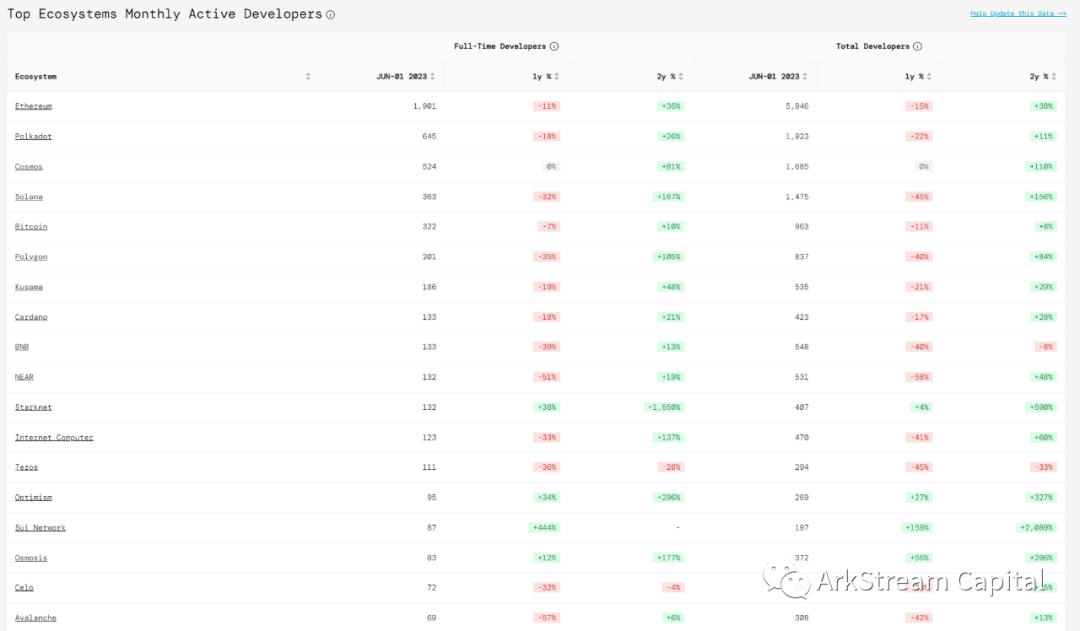
Next, setting aside considerations of tokenomics and market performance, we’ll examine select non-Ethereum blockchains—using Electric Capital’s open-source developer data—as case studies to explore their unique or signature technological innovations.
Polkadot - Substrate
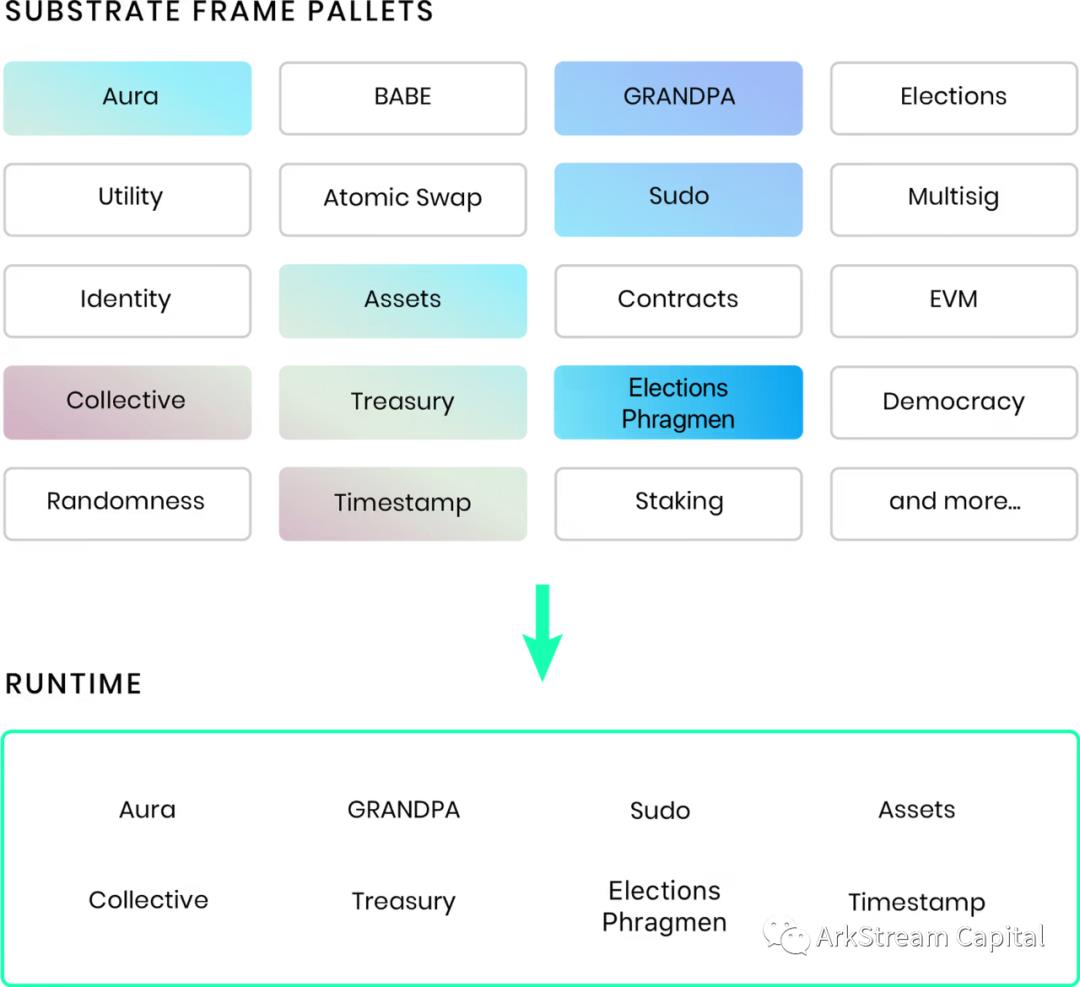
Polkadot introduced the concepts of relay chains and parachains using blockchain parallelization, enabling shared security and cross-chain communication via the XCMP protocol. The technical framework powering these features is Substrate. Substrate provides minimal development units called Pallets, which abstract functional modules such as assets, staking, and EVM compatibility. Built atop Pallets are the Frame development framework and customizable blockchain Runtime. With a unique asynchronous model and parachain sharding, Substrate enables high-throughput transaction processing. It also supports pluggable consensus mechanisms, allowing developers to choose suitable algorithms. Substrate natively integrates both EVM and WASM runtimes, easing migration for Ethereum-based applications. Finally, it supports on-chain hot upgrades, enabling network updates without downtime.
Cosmos - Tendermint / Sovereign Chain / App Chain / IBC
Tendermint was among the first Byzantine Fault-Tolerant PoS consensus algorithms and inspired Ethereum’s own PoS design. The concepts of Sovereign Chains and App Chains embody Cosmos’ decentralized multi-chain vision—allowing independent chains to control their own consensus, tokenomics, and governance, while enabling specific apps or services to deploy lightweight app-specific chains on the Cosmos network. These chains interoperate seamlessly via IBC, forming what Cosmos envisions as the “Internet of Blockchains.”
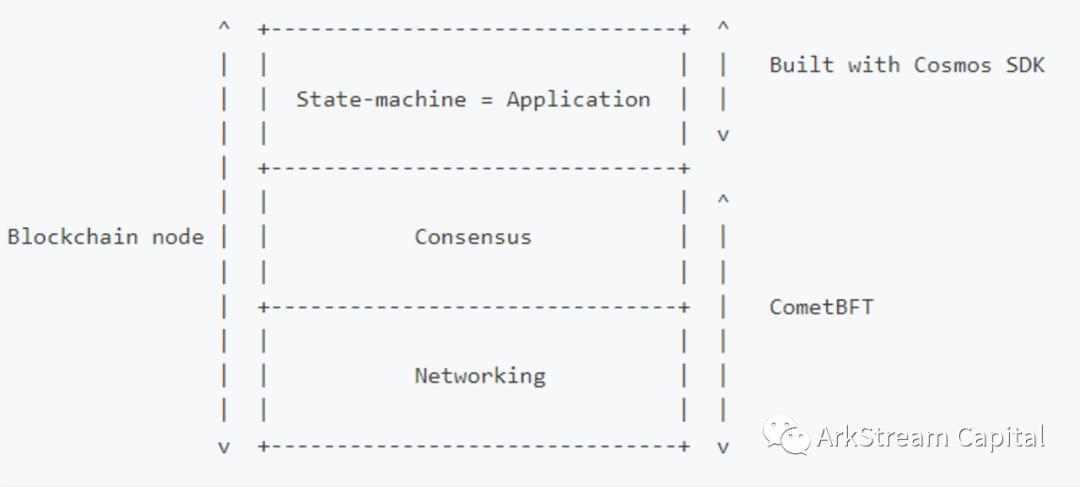
Cosmos’ two core development kits are CometBFT (the successor to Tendermint Core), which implements the Tendermint consensus and defines the ABCI interface, and the Cosmos SDK, which supports IBC and CosmWasm. The resulting ecosystem consists of the central Cosmos Hub and interconnected Zones. Since Cosmos’ mainnet launch in 2019, IBC has evolved from basic Zone-to-Zone connectivity to advanced features like Interchain Accounts (ICA) and Interchain Security (ICS). In September 2022, the Cosmos Hub marked a pivotal turning point, transitioning from its Initiation phase to the Integration phase.
Sei Network - Trading-Optimized Architecture
As a recently launched Cosmos-based app chain, Sei features an embedded order-matching engine, sub-second settlement, parallelized order processing, and single-block order execution—all implemented at the base layer. These optimizations are made possible through ABCI++, an upcoming upgrade to Cosmos’ ABCI that enables programmable consensus steps.
Solana - Proof of History
Proof of History (PoH) is an innovative timekeeping mechanism, akin to a global clock in a distributed system, coordinating node operations and transaction ordering. By embedding timestamps into each block, PoH establishes a globally shared sequence of events, enabling nodes to easily verify transaction timing and sequence. This enhances throughput and performance while effectively preventing tampering and replay attacks.
NEAR - Nightshade Sharding / Beacon Chain
Inspired by Ethereum’s early sharding ideas and inheriting the beacon chain concept, NEAR optimizes shard block producers and validators. Each shard has its own set of block producers responsible for creating blocks and packaging transaction and state data. Since shards operate independently, block producers only need to focus on their respective shards, eliminating cross-shard coordination. Validators similarly verify only transactions within their assigned shard, reducing overall computational load. This improves block production and validation efficiency, enabling higher transaction throughput.
Avalanche - Avalanche Consensus
The Avalanche protocol uses a voting mechanism inspired by avalanche dynamics, enabling nodes to rapidly converge on consensus and form a consistent decision sequence. Through iterative rounds of voting and feedback, nodes gradually reach agreement. Because nodes vote in parallel, the system achieves high concurrency. Additionally, the protocol supports dynamic node participation and adjustable voting parameters, ensuring flexible scalability.
Flow - Multi-Node Architecture
Flow employs a pipelined multi-node architecture. Execution nodes handle transaction execution, enabling massive computational throughput. Verification nodes monitor and validate results from execution nodes, ensuring compliance with rules and correctness of computations. Consensus nodes manage transaction ordering and block creation, securing the network. This separation of roles mirrors the modular blockchain paradigm—execution, data availability, settlement, and consensus layers—implemented directly at the L1 level.
Monad - Asynchronous Concurrent Transactions
Monad is an EVM-compatible Layer 1 where transactions are EVM-equivalent. To boost TPS, Monad identifies and marks mutually independent transactions, eliminating shared dependencies, then executes them asynchronously to achieve high-concurrency performance.
Diem/Libra - Move
Facebook/Meta’s Diem (formerly Libra) attracted global attention—both within and outside the crypto world—not only due to regulatory scrutiny but also skepticism from the native Web3 community. Diem’s original vision was to provide billions worldwide access to financial services comparable to traditional banking systems. To this end, it designed high-performance validator nodes and developed the Move programming language and Move Virtual Machine, balancing asset security with efficient smart contract execution. However, due to regulatory and policy hurdles, Diem never launched its mainnet. Instead, the team spun off its technical legacy into three distinct blockchain projects: Sui Network, Aptos, and Linera.
Sui Network - Causal Order / Object Model
Sui processes transactions using a DAG-like approach, combined with a unique object model and version-numbering mechanism resembling snapshots. This allows transactions to be ordered causally rather than strictly sequentially, enabling massive parallel execution. This capability is underpinned by Sui’s optimized implementation of the Move language’s object system, enhanced with numerous Web3-native asset features.
Aptos - Block-STM
Aptos’ Block-STM parallel execution engine introduces optimistic concurrency control—a technique similar to optimistic rollups—directly at Layer 1. While optimistic locking is widely used in traditional databases, it typically suffers from high conflict and retry rates in write-heavy environments, making it less ideal than pessimistic locking for high-frequency scenarios. Aptos mitigates this through preprocessing and transaction splitting optimizations.
Linera - Microchains
While Sui and Aptos leverage Diem’s Move language innovations, Linera inherits Diem’s consensus mechanism. Tracing further back, Linera’s architecture originates from Facebook’s early FastPay project—an antecedent to Diem/Libra—that laid out detailed technical blueprints for fast, secure, low-latency large-scale payments.
Linera explores architectural scalability primarily through Microchains—user-maintained chains forming a multi-chain network. Microchains can be public or private, communicating via asynchronous messages. The entire network shares a common validator set and uses DPoS consensus for security and execution. Validators handle message routing and state synchronization, and also operate and maintain public Microchains.
In many ways, Linera’s architecture resembles modern cloud-native systems: Microchains correspond to containerized instances, and apps map to running containers. Like cloud-native infrastructures, this design excels in elasticity and fault tolerance. However, securely and efficiently managing communication and synchronization across Microchains remains a core challenge unique to Linera as a public blockchain.

Just as cloud-native architectures have gradually displaced traditional application frameworks over the past decade, achieving dominance through superior flexibility and resilience, we believe Linera—building on the mature foundations of Diem/FastPay while introducing novel innovations—will one day surpass Ethereum in certain application scenarios.
Conclusion
Perhaps it's not just an illusion: revisiting these blockchain innovations, one notices striking similarities between today’s popular Rollup-as-a-Service frameworks (like Optimism’s OP Stack, Arbitrum’s Orbit, Polygon’s zkSupernet, Starknet’s Appchains, and zkSync’s Hyperchains) and earlier toolkits such as Cosmos SDK and Polkadot’s Substrate. Even newer narratives like restaking echo concepts from Polkadot’s DOT staking for slot auctions and Cosmos 2.0’s Interchain Security (ICS).
While Layer 2 growth is tightly linked to Ethereum’s strength, the exploration pursued by new public blockchains is equally—if not more—important. Breakthroughs in technology and architecture from these innovators will significantly raise the ceiling for Web3’s foundational capabilities.
As past blockchains accumulate more mature experience, the赛道 becomes increasingly fertile for breakthrough innovations. Just as Satoshi Nakamoto creatively combined proof-of-work, UTXO, public-key cryptography, P2P networking, and chained blocks to create Bitcoin, we now have every reason to believe that future blockchains—drawing on the best of existing innovations—will emerge to fulfill the mission of mass adoption. Notably, Cosmos-based chains (like Sei Network) and Diem/Move-inspired projects (exemplified by Linera) will continue pushing the boundaries of blockchain across multiple dimensions, challenging Ethereum’s dominance and expanding the very limits of what public blockchains can achieve!
Join TechFlow official community to stay tuned
Telegram:https://t.me/TechFlowDaily
X (Twitter):https://x.com/TechFlowPost
X (Twitter) EN:https://x.com/BlockFlow_News
 Arkstream Capital









