








Vitalik Reveals Every Layer2 Has a "Backdoor"—Is Security Better Than Decentralization?
TechFlow Selected TechFlow Selected
Vitalik Reveals Every Layer2 Has a "Backdoor"—Is Security Better Than Decentralization?
Security is better with centralization.
 Navigating Web3 tides with focused insights
Author: TechFlow Butcher
In a leaked video, Ethereum co-founder Vitalik Buterin made a startling statement—every Layer 2 and Rollup (scaling solution) on Ethereum has a backdoor, allowing developers to step in and make changes when necessary.
Vitalik said he had spoken with the upgrade team, who told him, "What they want to do next year is start removing the training wheels."
Public reaction to this remark has split into two camps.
One side argues that the existence of such "backdoors" is not a secret and is understandable and acceptable.
This practice has existed since The DAO was hacked in 2016, as smart contract vulnerabilities can lead to devastating consequences.
Most L2s currently running on Ethereum have only been live for a few months. For such new protocols, bugs are expected, so smart contract developers typically implement mechanisms to freeze contracts, upgrade them, or even reverse changes under certain circumstances.
Launching a new Dapp or protocol without some kind of fail-safe mechanism is simply too risky, as audits cannot guarantee the absence of vulnerabilities.
Therefore, it's no surprise that these L2s also have such mechanisms. They are currently centralized in other aspects as well—for example, sequencers—but the ultimate goal remains decentralization. This transition takes time, and many understand that.
However, others remain unconvinced, arguing that Ethereum’s decentralization is nothing but a lie.
For instance, in response to Vitalik’s comments, Cardano community leader Chris O took to Twitter, stating that Vitalik’s remarks exposed Ethereum as not truly immutable, permissionless, or censorship-resistant as people believe, using the moment to praise ADA.
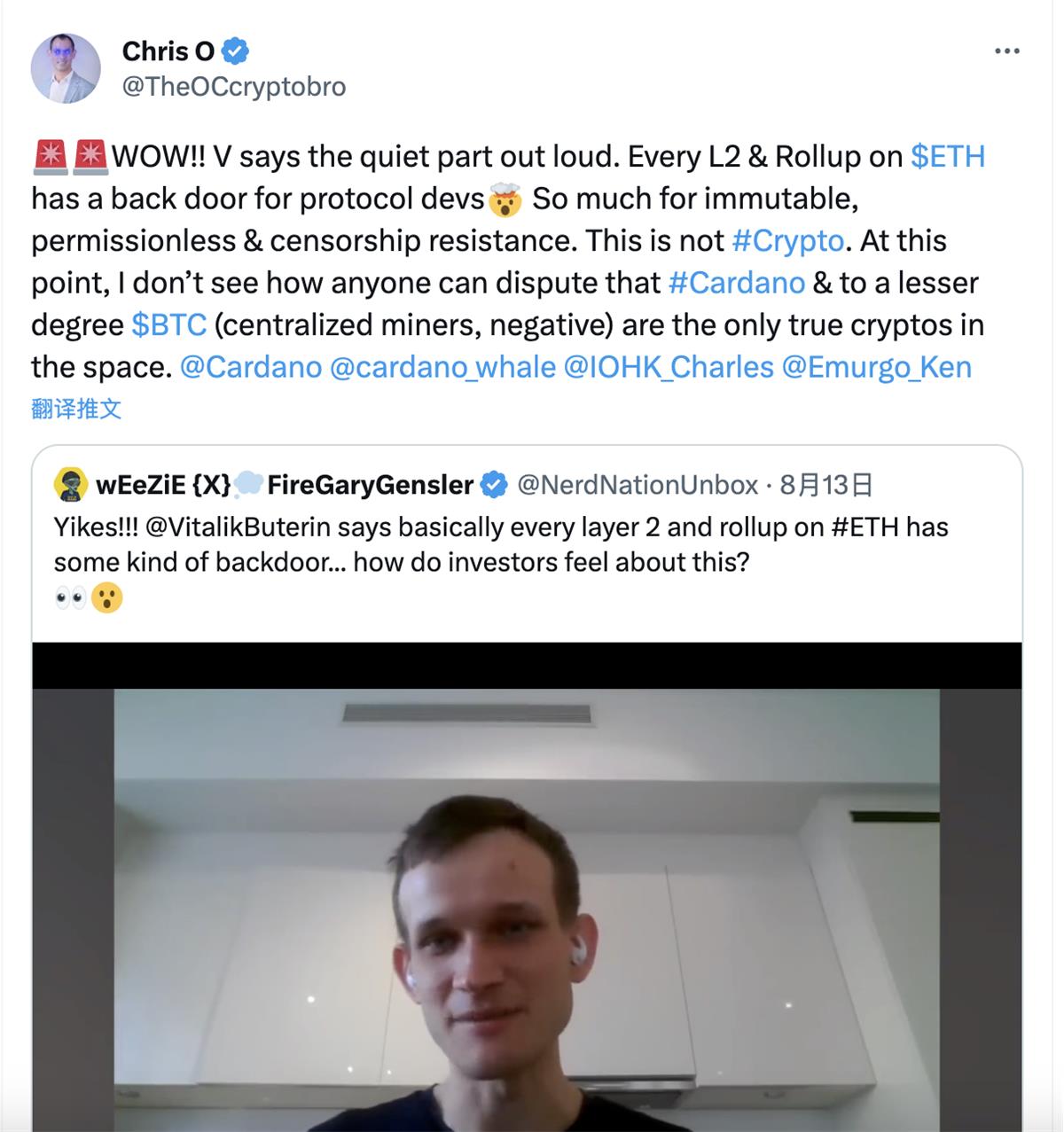
"Ethereum isn't real cryptocurrency. At this point, I don't think anyone can dispute that Cardano and Bitcoin (which are less centralized) are the only true cryptocurrencies in the space."
In Ethereum’s past practices, there has been a mechanism to upgrade via forking in response to security issues. However, such upgrades were conducted in a decentralized manner—nodes could choose whether to upgrade—and an upgrade could not proceed without majority consensus from forkers and node operators.
But on Layer 2s, such a decentralized forking and upgrade mechanism does not exist, creating a dilemma: removing these "backdoors" without an alternative upgrade path would be too risky, yet their existence clearly contradicts the principle of decentralization.
Much like how Tether and Circle—the companies behind USDT and USDC—can freeze tokens during major security incidents to recover stolen assets, project teams likely wish to retain control over the final fate of their L2s.
"After all, security works better when it's centralized."
Join TechFlow official community to stay tuned
Telegram:https://t.me/TechFlowDaily
X (Twitter):https://x.com/TechFlowPost
X (Twitter) EN:https://x.com/BlockFlow_News
 深潮TechFlow






