








EigenLayer's Potential Use Cases and Challenges: Rethinking Ethereum's Consensus Mechanism
TechFlow Selected TechFlow Selected
EigenLayer's Potential Use Cases and Challenges: Rethinking Ethereum's Consensus Mechanism
What is the logic behind investing in EigenLayer?
 Navigating Web3 tides with focused insights
Author: Sullivan
EigenLayer is developed by EigenLabs, a lab led by CEO Sreeram Kannan. Sreeram has an academic background and is an associate professor at the University of Washington. They recently launched on testnet and raised $50 million in a Series A funding round led by Blockchain Capital. Zonff Partners is pleased to participate as an investor in this round for EigenLayer.
The concept behind EigenLayer isn't complicated: through restaking, ETH staked in Ethereum's validator network can be reused to secure middleware, thereby elevating the Economic Security of these services to the same level as Ethereum’s.
The entire EigenLayer protocol can be divided into two sides—supply and demand:
Demand side: New consensus-based sidechains, data availability (DA) layers, new virtual machines, oracles, and trusted execution environments—essentially any Actively Validated Service (AVS)—that require low-cost access to Ethereum-level security.
Supply side: Individual ETH holders (who stake ETH or stETH with staking providers who assign node operators to participate in EigenLayer), and validators (who either join EigenLayer directly or delegate management to other operators).
Suppliers bear relatively small operational costs and the risk of ETH slashing to provide node services to AVSs. In return, they receive compensation from the demand side—such as project tokens, transaction fees, etc. Some service types may also offer implicit rewards (e.g., MEV income for sequencers).
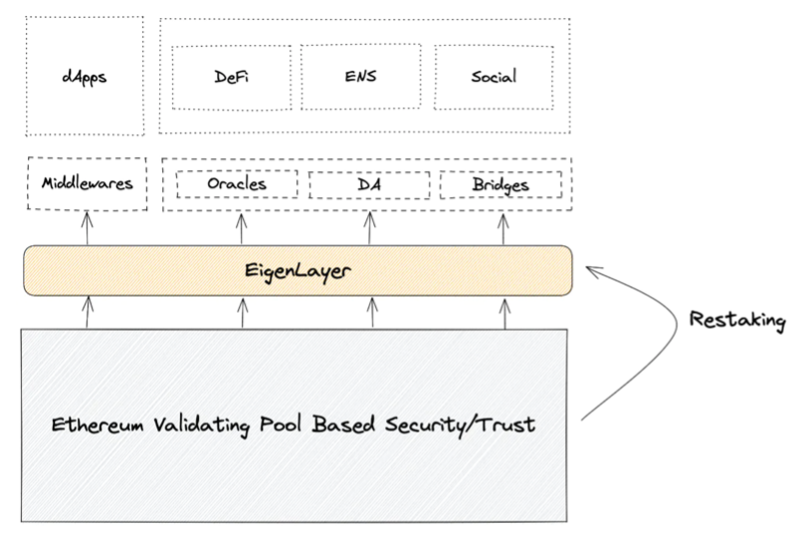
Image source: IOSG Ventures
The restaking service provided by EigenLayer allows capital already staked as Ethereum validators to simultaneously back trust networks for other middleware via EigenLayer. For stakers, this means earning dual yields from a single capital deposit. For middleware, it drastically lowers the barrier to establishing a secure decentralized network, leveraging Ethereum's own staking base to guarantee the security of their AVS.
Current Market Problems
Restaking is the core innovation of EigenLayer. To understand the market pain points EigenLayer solves through restaking, we must first clarify several key terms:
Middlewares – Certain services require more than just blockchain transaction data (which can be secured via Ethereum) to verify their integrity. These services—like oracles, cross-chain bridges, etc.—must build their own separate trust (decentralized) networks, collectively referred to as middlewares.
Actively Validated Services (AVS) – To ensure middleware security, mechanisms are needed to guarantee data correctness and prevent malicious tampering. This validation framework is known as an Actively Validated Service (AVS).
Any module not deployed or proven within the EVM cannot leverage Ethereum’s underlying trust and security. Examples include sidechains based on new consensus protocols, data availability (DA) layers, new virtual machines, oracles, and trusted execution environments. Typically, such systems must build their own independent AVS and assume responsibility for their own security. The current AVS ecosystem faces several challenges:
-
Building a new AVS requires creating an entirely new trust network—a non-trivial task;
-
Users must pay additional AVS fees on top of Ethereum interaction costs, leading to value leakage;
-
For validators, joining a new verification system entails opportunity cost and increased risk exposure;
-
For many DApps, security is weakened under the current AVS model. Their safety depends on both Ethereum and the middleware’s trust assumptions, but attacking the middleware is cheaper, increasing overall risk.
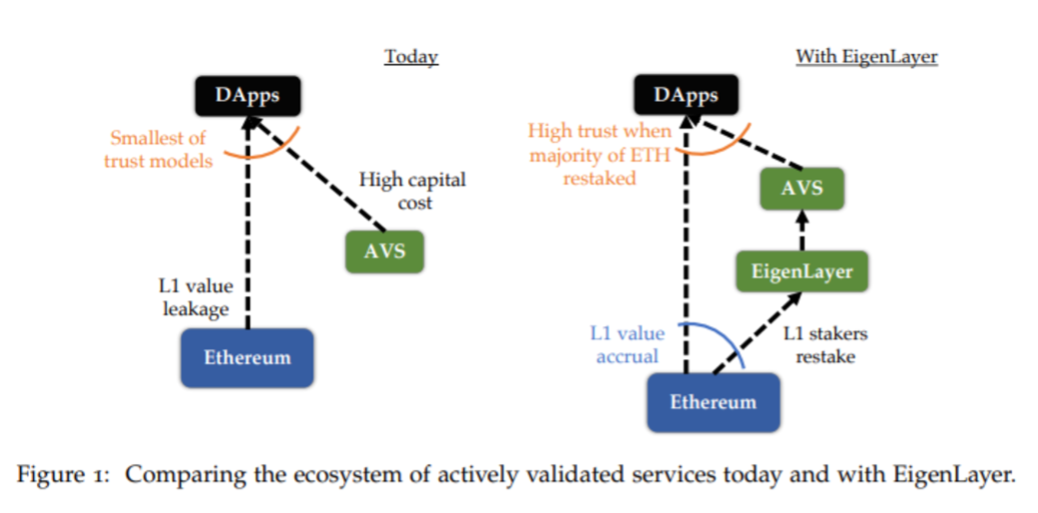
Image source: EigenLayer
EigenLayer Project Mechanism
EigenLayer introduces two key concepts—restaking and free-market governance—to extend Ethereum’s security to other systems and improve governance efficiency.
Restaking – EigenLayer enables users to re-stake ETH already staked on Ethereum onto the EigenLayer protocol. This restaked capital can then secure services like data availability layers, oracles, middleware, and Layer 2 solutions. Validators earn rewards by providing security and validation services.
Free-Market Governance – Validators can freely choose which modules to participate in based on their risk preferences, but they only earn profits if they maintain security. This governance model offers two advantages: First, it integrates the robustness of the base layer with speed and agility. Second, the opt-in validator model allows new modules to compete for validator resources, better balancing security and performance.
AVSs on EigenLayer can rent security services from Ethereum validators, offering the following benefits:
-
A new AVS can enhance its economic security using Ethereum’s validator set
-
The overall cost of enhanced security via Ethereum is minimized
-
EigenLayer increases the cost of compromising the system
-
Value accrual: ETH stakers can capture yield from AVSs
Thus, protocols can avoid relying on tokenization as a security mechanism, which should improve tokenomics and reduce mercenary capital issues. Since protocols are protected by the base layer, the cost of corruption rises significantly:
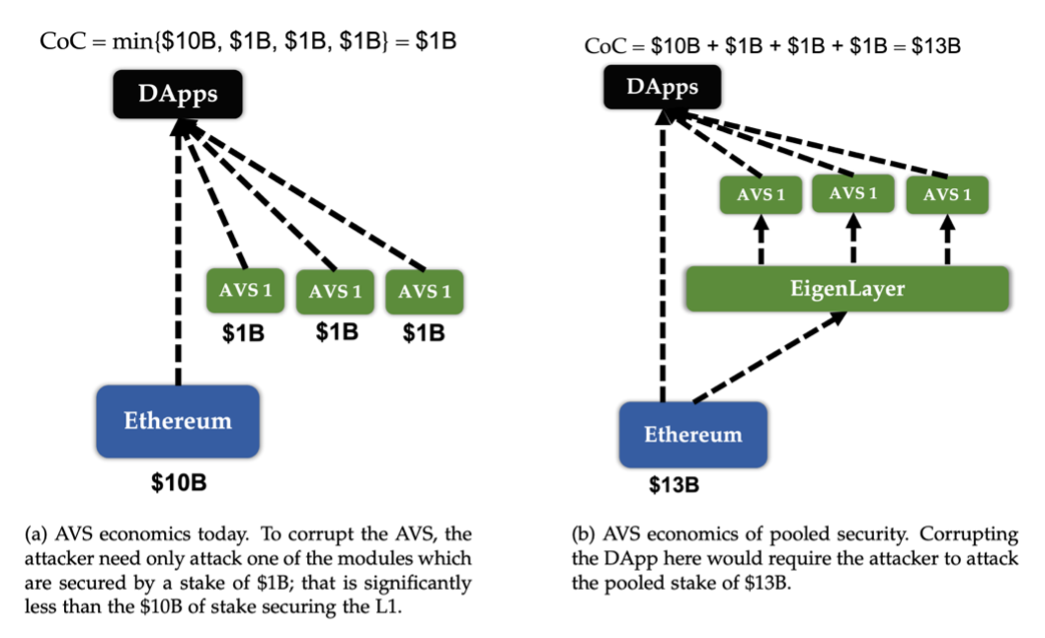
Image source: EigenLayer
Unlike merged mining in PoW, PoS validators must stake ETH on Ethereum to earn rewards—and misbehavior leads to slashing of their stake. Similarly, after restaking, validators earn additional yield from middleware networks, but misbehavior results in slashing of their original ETH deposits.
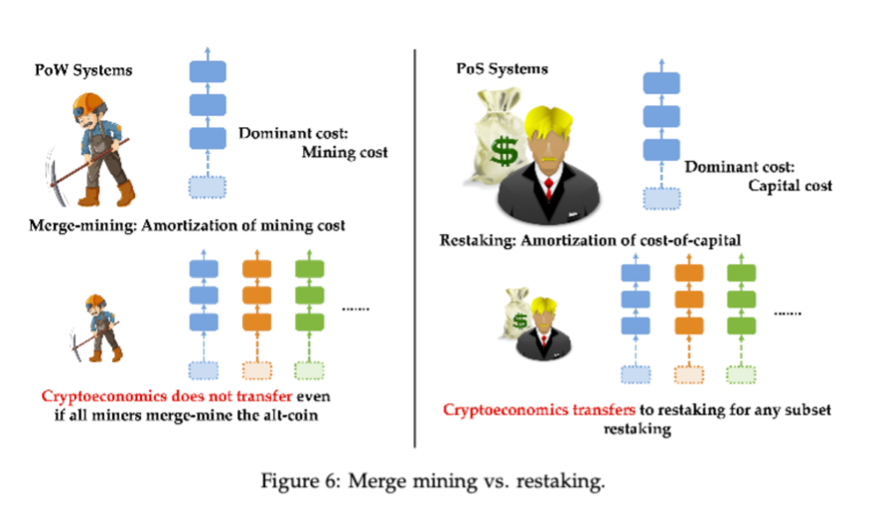
Image source: EigenLayer Whitepaper
The specific implementation of restaking involves setting the withdrawal address on Ethereum to point to EigenLayer’s smart contract—thereby granting it slashing authority.
Regarding staking assets, EigenLayer supports multiple staking methods similar to Lido’s liquid staking and superfluid staking. Superfluid staking even allows staking of LP tokens. Specifically:
-
Direct staking: ETH staked on Ethereum is directly restaked on EigenLayer
-
LSD staking: Assets already staked via Lido or Rocket Pool are restaked on EigenLayer
-
ETH LP staking: LP tokens from DeFi protocols are restaked on EigenLayer
-
LSD LP staking: For example, stETH-ETH LP tokens from Curve are restaked on EigenLayer
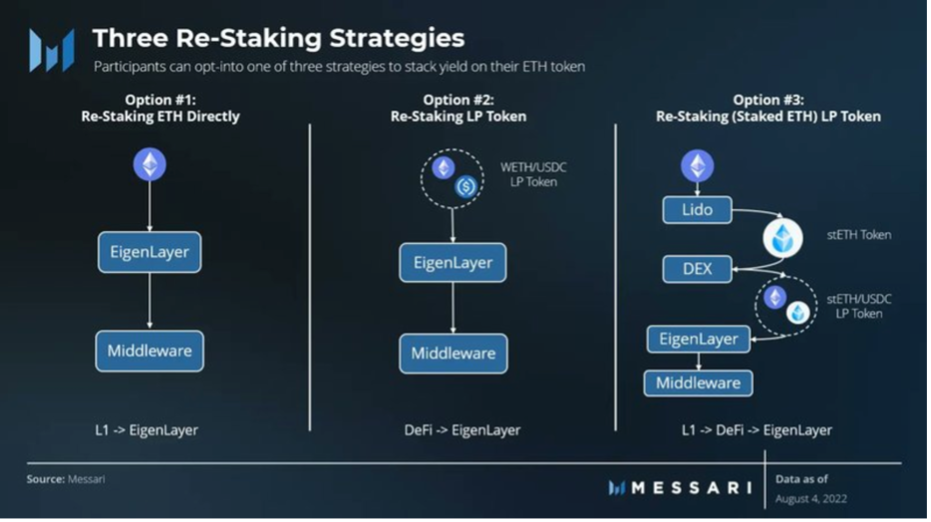
Image source: Messari
Use Cases of EigenLayer
One of EigenLayer’s most prominent use cases is EigenDA, a decentralized data availability layer secured by Ethereum. EigenDA is a general-purpose DA solution, comparable to Celestia. However, there are architectural differences between EigenDA and Celestia.
On Celestia, Data Blobs propagate via P2P networks and achieve consensus using Tendermint. Every full node must download the entire Data Blob. Because Celestia operates as a Layer 1, it must broadcast and reach consensus on Data Blobs—placing high demands on nodes (128 MB/s download and 12.5 MB/s upload), while throughput remains limited (~1.4 MB/s).
In contrast, EigenLayer adopts a different architecture—one that does not require consensus or a P2P network.
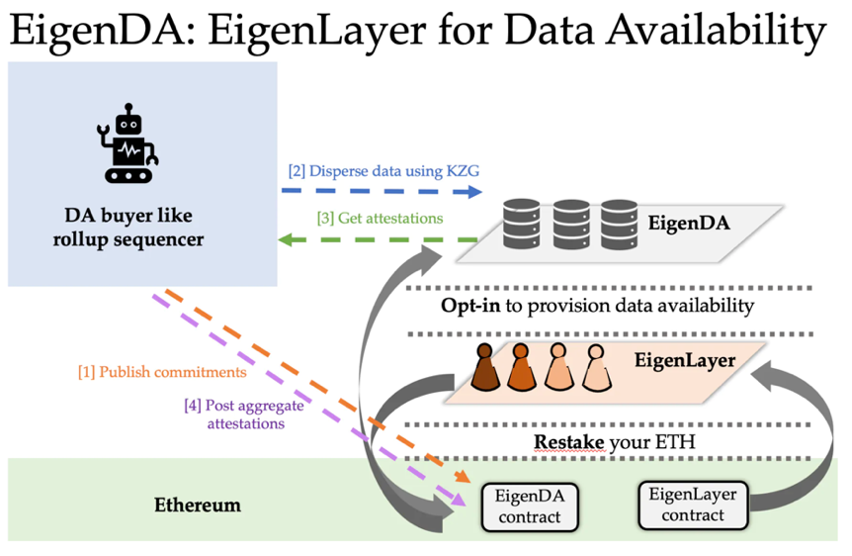
Image source: EigenLayer
Celestia follows the traditional Layer 1 model: "Everybody talks to everybody" (consensus) and "Everybody sends everyone else everything" (broadcast), except that consensus and broadcast apply specifically to Data Blobs—ensuring only data availability.
EigenDA instead uses "Everybody talks to Disperser" (the DA requester, e.g., a Rollup, called a Disperser) (i.e., step [3] in the diagram where the Disperser receives Attestations) and "Disperser sends each node a unique share" (i.e., step [2] where the Disperser distributes data to EigenDA nodes), effectively decoupling data availability from consensus.
EigenDA doesn’t need consensus or a P2P network because it essentially “rides on Ethereum’s coattails”: Commitments and aggregated attestations are published by the Disperser to a smart contract on Ethereum, and the verification of aggregated signatures occurs on Ethereum, leveraging Ethereum’s consensus. Thus, EigenDA avoids the throughput bottlenecks inherent in standalone consensus and P2P networks. This translates into lower node requirements and higher potential throughput.
EigenDA’s security fundamentally relies on Ethereum’s validator set, inheriting Ethereum’s slashing primitives to provide Economic Security guarantees for the DA layer. The more restakers participating in EigenDA, the greater the security. Lower node requirements also help enhance decentralization.
Beyond EigenDA, potential use cases for EigenLayer include:
-
Decentralized sequencers: Sequencers for Rollups can be built on EigenLayer using ETH stakers.
-
Light-client bridges: Bridges within the Ethereum ecosystem can be constructed using EigenLayer, enabling off-chain verification.
-
Fast-bridging for Rollups: Participants on EigenLayer can perform off-chain verification of ZK rollup proofs, enabling faster confirmation guarantees.
-
Oracles: Price feeds or other data services can be built on EigenLayer using restaked ETH.
-
Ultra-low-latency settlement chains: Restaked sidechains on EigenLayer could enable fast and economically efficient settlements.
Criticisms Facing EigenLayer
EigenLayer’s whitepaper presents a grand and idealistic vision, but there are valid market concerns about several key aspects:
Supply-Demand Mismatch – Currently, most nodes on PoS public chains are operated by project teams and their affiliates. The tokens staked in these nodes are effectively locked up, supporting price stability and utility. As a result, both new and established projects have little incentive to adopt EigenLayer. This suggests a potential supply-demand imbalance in EigenLayer’s future ecosystem, with supply far exceeding demand.
However, this concern circles back to security. To capture value, validators are often required to stake native middleware tokens. While this locking supports price and utility, price volatility introduces uncertainty into the middleware’s overall risk profile.
Moreover, middleware security depends on the total value of staked tokens; if the token crashes, the cost of attacking the network drops, potentially triggering security incidents—especially evident in protocols with weak market caps.
To preserve native token value capture, middleware can maintain native token staking requirements alongside EigenLayer integration—deriving Economic Security from both native tokens and Ethereum—thus avoiding a “death spiral” triggered by a single token crash. Therefore, demand for EigenLayer from both new and existing projects remains significant.
Limited Yield Advantage – Without issuing its own token to incentivize restaking, EigenLayer’s restaking yields may struggle to compete with DeFi strategies. Current leveraged lending strategies yield roughly 4–5% more than simple staking. It remains uncertain whether EigenLayer can deliver an additional 4–5% yield on top of existing ETH staking returns.
EigenLayer is not designed as a DeFi yield product but as a tool to help middleware access Ethereum-level security at low cost. Yield generation for suppliers is secondary. Therefore, directly comparing EigenLayer’s returns to DeFi leveraged yields is inappropriate.
Additionally, although many yield-enhancing DeFi products exist—including the popular LSD sector—large capital still flows primarily to mainstream platforms like Compound and Aave, largely due to security considerations. Even products offering over 20% APY require constant monitoring, as demonstrated by UST’s collapse within just three days despite its billion-dollar valuation.
Security Is Not Fully Shared – The security of projects using EigenLayer depends only on the subset of Ethereum validators participating in a given AVS. To fully inherit Ethereum’s network-wide security, every validator would need to join the AVS—which is clearly impractical.
Indeed, EigenLayer does not currently share the full security of Ethereum’s network. However, it significantly reduces the risk exposure caused by native token volatility (as discussed earlier). Ethereum’s trust is technically extended upward. While EigenLayer cannot achieve absolute security immediately, enhancing partial security is a strong foundation for long-term development.
Beyond these critiques, Vitalik has expressed concerns about consensus overload on Ethereum—warning against exploiting Ethereum’s social consensus for purposes beyond securing its own network:
“Restaking, used by protocols including EigenLayer, allows Ethereum stakers to double-stake their deposits across other protocols. In some cases, misbehavior according to those protocols’ rules can lead to slashing. While dual-use of staked ETH carries some risks, it is fundamentally acceptable. But attempting to 'recruit' Ethereum’s social consensus for application-specific purposes is another matter.”
Vitalik’s concern is valid. ETH is widely accepted as a neutral, decentralized smart contract platform due to its technical transparency and lack of external bias. If external applications excessively rely on Ethereum’s social consensus, internal conflicts of interest may arise, potentially leading to forks. For instance, if a successful Layer 2 operator assumes their chain is so critical that community intervention (via fork or rollback) is inevitable in case of a breach, it undermines Ethereum’s principles. Protocols should be designed so that failures are contained—the losses borne solely by participating validators and users. Conversely, if founders expect Ethereum’s broader social consensus to bail them out via forks, that creates systemic risk. Vitalik strongly opposes any attempt to foster such expectations.
EigenLayer founder Sreeram Kannan described Vitalik’s critique as “excellent analysis,” advocating that users only engage in “low-risk” activities with the protocol.
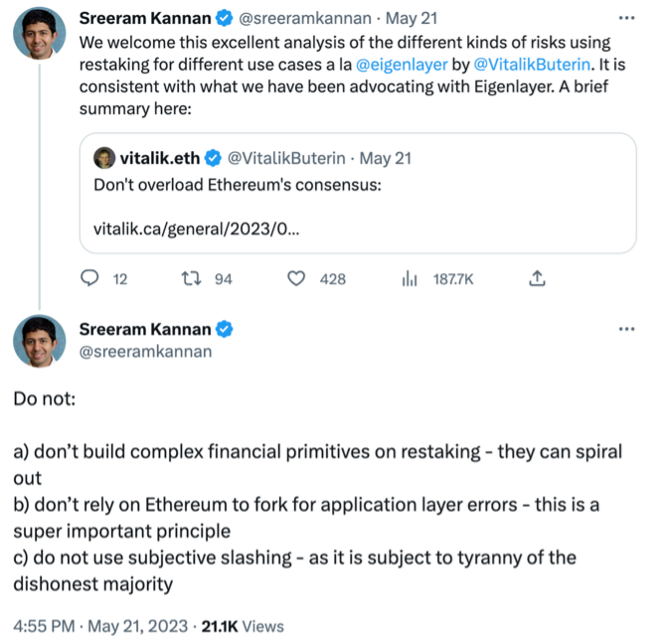
Image source: EigenLayer Founder Sreeram Kannan’s Twitter
Sreeram suggests several key considerations for building on EigenLayer, believing that, with proper risk management, EigenLayer can still deliver long-term value to the ETH ecosystem:
-
Avoid building complex financial architectures during restaking—they may trigger cascading effects
-
Do not rely on Ethereum forks to resolve application-layer errors—this is a critical principle
-
Do not use slashing based on subjective human judgment—it risks tyranny of the dishonest majority
Social consensus in blockchain communities is fragile. It’s necessary—for upgrades, error recovery, and handling 51% attacks—but due to the high risk of chain splits, it should be used cautiously, especially in mature ecosystems.
Pay attention to EigenLayer :)
Join TechFlow official community to stay tuned
Telegram:https://t.me/TechFlowDaily
X (Twitter):https://x.com/TechFlowPost
X (Twitter) EN:https://x.com/BlockFlow_News
 @ZonffPartners






