









AI + Web3: The Best Attempt at a Decentralized AI Marketplace
TechFlow Selected TechFlow Selected
AI + Web3: The Best Attempt at a Decentralized AI Marketplace
What is the best approach to an AI Marketplace?
 Navigating Web3 tides with focused insights
Author: Ian@Foresight Ventures
TL;DR
-
A successful decentralized AI marketplace must tightly integrate the advantages of AI and Web3—leveraging decentralization, asset ownership, revenue distribution, and decentralized computing power—to lower the barrier for AI applications, encourage developers to upload and share models, protect users' data privacy, and build a developer-friendly platform that meets user needs for trading and sharing AI resources.
-
AI marketplaces based on data have greater potential. Model-centric marketplaces require a large number of high-quality models, but early-stage platforms often lack sufficient user base and quality resources, making it hard to incentivize top model providers. In contrast, data-driven marketplaces can accumulate vast amounts of valuable data—including private or domain-specific datasets—through decentralized collection, incentive layer design, and guaranteed data ownership. However, such markets must also address data privacy challenges, potentially through flexible privacy settings that allow users to customize their preferred privacy levels.
-
The success of a decentralized AI marketplace depends on accumulating user resources and achieving strong network effects—where users and developers gain more value from the platform than they could outside it. In the early stages, focus should be on gathering high-quality models to attract and retain users. Once a robust model library and data moat are established, the focus shifts to attracting and retaining end users. A great AI marketplace must balance the interests of all parties and effectively manage data ownership, model quality, user privacy, computing power, and incentive algorithms.
1. Web3’s AI Marketplace
1.1 AI in Web3: A Retrospective
Let’s first revisit the two main directions I previously discussed for combining AI and crypto: ZKML and decentralized compute networks.
ZKML
ZKML makes AI models transparent + verifiable, ensuring that model architecture, parameters, weights, and inputs can be validated across the network. The significance of ZKML lies in enabling web3 to create next-generation value without sacrificing decentralization or trustlessness, unlocking broader applications and new possibilities.
Compute Networks
Computing power will be the next decade's battleground, with investment in high-performance computing infrastructure expected to grow exponentially. Decentralized compute has two primary use cases: model inference and model training. Demand is highest for large-scale model training, though this also presents significant technical hurdles—such as complex data synchronization and network optimization. Model inference, however, offers more immediate opportunities and substantial future growth potential.
1.2 What Is an AI Marketplace?
The concept of an AI marketplace isn’t new. Hugging Face is arguably the most successful example (albeit without formal transaction or pricing mechanisms). In the NLP space, Hugging Face provides a vital and active community platform where developers and users can share and utilize various pre-trained models.
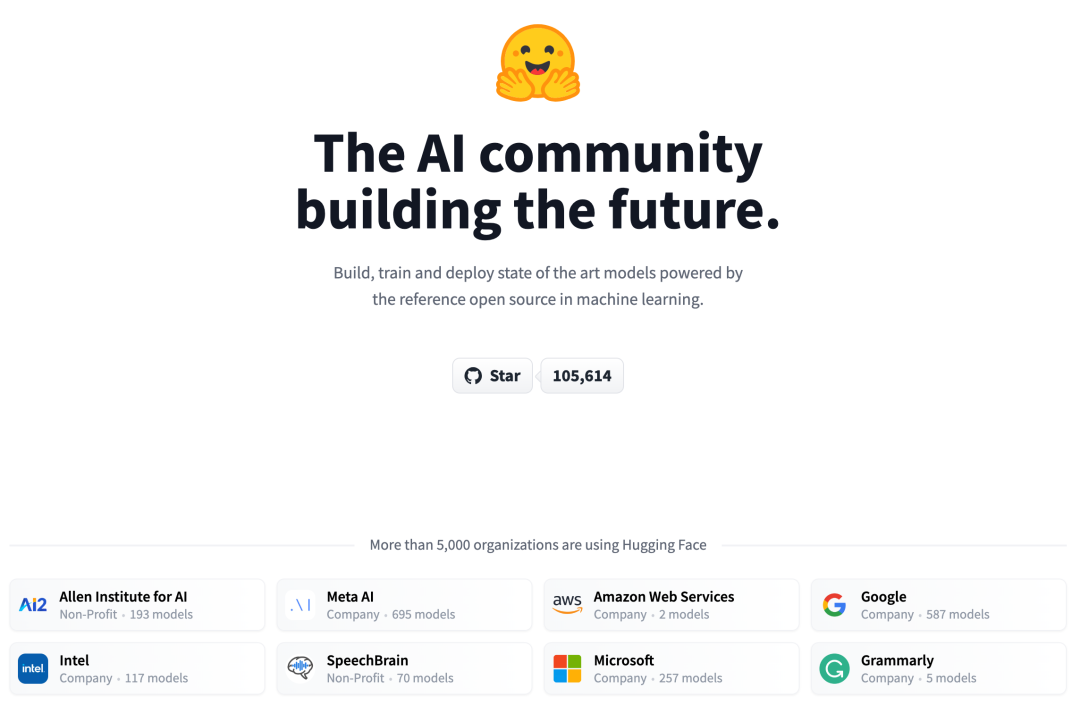
From Hugging Face’s success, we can identify key elements of a thriving AI marketplace:
a. Model Resources
Hugging Face offers a vast array of pre-trained models covering diverse NLP tasks. This richness attracts users and forms the foundation of an active community and user accumulation.
b. Open-Source Spirit + Sharing Culture
Hugging Face encourages developers to upload and share their models. This culture of openness enhances community vitality and accelerates the adoption of cutting-edge research by a broad user base, speeding up validation and dissemination of innovations.
c. Developer-Friendly + Usability
Hugging Face provides easy-to-use APIs and documentation, enabling developers to quickly understand and deploy models. This lowers the entry barrier, improves user experience, and draws more developers.
Although Hugging Face lacks a formal transaction mechanism, it still serves as a critical platform for sharing and using AI models. This shows that AI marketplaces can become invaluable industry assets.
In short: Decentralized AI Marketplaces
Building on these principles, a decentralized AI marketplace leverages blockchain technology to ensure users own their data and model assets. Web3 adds value through incentives and transaction mechanisms, allowing users to freely select—or be matched via system—to suitable models, while also monetizing their own trained models.
Users maintain full ownership over their AI assets, and the marketplace itself does not control data or models. Instead, its growth relies on user base expansion and the resulting accumulation of models and data—a long-term process that gradually builds product defensibility. The platform’s strength lies in the quantity and quality of users, models, and data contributed by the community.
1.3 Why Focus on Web3 AI Marketplaces?
1.3.1 Alignment with Compute Trends
Due to communication overhead, decentralized compute may struggle to support base model training, but fine-tuning imposes much less strain—making it one of the most viable near-term applications for decentralized compute networks.
AI model training consists of pretraining and fine-tuning. Pretraining involves massive data and computation—refer to my previous analysis. Fine-tuning adjusts a base model using task-specific data to improve performance on specific tasks. It requires far fewer computational resources for two main reasons:
-
Data Volume: Pretraining uses massive datasets to learn general language representations. For example, BERT was pretrained on Wikipedia and BookCorpus containing billions of words. Fine-tuning typically uses small, task-specific datasets—for instance, sentiment analysis might only need thousands to tens of thousands of reviews.
-
Training Steps: Pretraining may take millions or even billions of steps, whereas fine-tuning usually requires only thousands to tens of thousands. This is because pretraining learns fundamental linguistic structures, while fine-tuning only tweaks part of the model for a specific task.
For example, GPT-3 used 45TB of text data during pretraining, but only about 5GB for fine-tuning. Pretraining can take weeks or months, while fine-tuning may take just hours or days.
1.3.2 Starting Point for AI-Crypto Convergence
When evaluating a Web3 project, a key question is whether it truly leverages Web3 meaningfully or simply uses crypto for the sake of it. Does the project maximize the unique value Web3 brings? Clearly, Web3 adds irreplaceable value to AI marketplaces—enabling provable ownership, fair revenue distribution, and decentralized compute.
I believe the best Web3 AI marketplaces deeply integrate AI and crypto. The ideal synergy isn't about what AI can bring to Web3, but what Web3 can offer AI. For example, users can own their AI models and data (e.g., tokenized as NFTs) and trade them as commodities—effectively leveraging Web3’s core strengths. This not only incentivizes AI developers and data contributors but also broadens AI adoption. If a model is highly useful, owners have stronger motivation to share it.
Additionally, decentralized AI marketplaces could introduce novel business models such as model/data sales and rentals, crowdsourced tasks, etc.
1.3.3 Lowering AI Application Barriers
Everyone should—and will—have the ability to train their own AI models. This requires accessible platforms providing essential resources like base models, tools, data, and compute.
1.3.4 Supply and Demand
While large models are powerful, they’re not universally optimal. Fine-tuning for specific tasks and scenarios often yields better results and higher practicality. Thus, from the demand side, users need an AI model marketplace to access effective models for different use cases. On the supply side, developers need resource-rich platforms to build models and earn returns from their expertise.
2. Model-Based vs. Data-Based Marketplaces
2.1 Model Marketplaces
Model
Positioned as a tooling-first solution, such projects must attract enough model developers early on to populate the marketplace with high-quality models and establish supply.
In this model, the main draw for developers is convenient infrastructure and tooling. Data depends on individual developer capabilities—this is where domain experts add unique value, collecting niche data and fine-tuning high-performance models.
Reflection
Recently, many projects have explored integrating AI marketplaces with Web3. But I wonder: is building a decentralized AI model marketplace a contrived idea?
We should first ask: what unique value does Web3 actually provide?
If it’s just token incentives or narratives around model ownership, that’s insufficient. Practically speaking, high-quality models are the core of any product. These models often carry immense economic value. From the provider’s perspective, they need strong incentives to deploy their valuable models on a marketplace. But do tokens and ownership claims meet their valuation expectations? For an early-stage platform lacking users, the answer is clearly no. Without exceptional models, the entire business model collapses. So the real challenge becomes: how to ensure model providers earn sufficient returns despite low initial user traction?
2.2 Data Marketplaces

Model
Built on decentralized data collection, these platforms use incentive layers and data ownership narratives to onboard data providers and labelers. With crypto’s help, they can rapidly accumulate valuable datasets—especially rare private or domain-specific data.
What excites me most is that this bottom-up approach resembles crowdfunding. Even the most experienced expert cannot gather comprehensive data alone. One key value Web3 enables is permissionless, decentralized data aggregation. This model consolidates specialized knowledge and data across domains, offering AI services to broader audiences. Compared to single-source data, crowd-sourced data reflects real-world complexity and diversity better, significantly improving model generalization and robustness across environments.
For example, someone may have rich nutrition data, but it’s insufficient alone to train a top-tier model. By sharing data, they can also leverage contributions from other users in the same field, leading to better fine-tuning outcomes.
Reflection
From this angle, building a decentralized data marketplace seems promising. Data is a “product” with lower barriers, shorter production cycles, and wider provider distribution—making it better suited to leverage Web3’s strengths. Incentive algorithms and proven data ownership motivate users to contribute. Currently, data is often treated as disposable—one-time use with little residual value. In a decentralized AI marketplace, user data can be reused and monetized repeatedly, unlocking long-term value.
Using data as an entry point to grow users appears strategic. High-quality, multi-dimensional data is both a core component and competitive moat for large models. After onboarding numerous data contributors, many can evolve into end users or model developers. Such a marketplace provides foundational value for high-performing models, giving algorithm engineers strong incentives to contribute models.
This creates a shift from zero to one: Today, big tech dominates due to vast data reserves, enabling superior models that outpace small teams and individuals. Even if a user possesses highly valuable niche data, isolated fragments lack impact without integration into larger datasets. However, in a decentralized marketplace, everyone gains access to shared data. Experts bring incremental, high-value data to the platform, further enhancing overall data quality and volume—empowering anyone to train excellent models and potentially drive AI innovation.
Data itself is well-suited to become a competitive moat. Strong incentive layers and robust privacy safeguards encourage widespread participation. As user count grows, so do data quantity and quality, creating community and network effects that increase the marketplace’s value and attractiveness—reinforcing its defensibility.
Ultimately, building a successful data-driven AI marketplace hinges on four key factors:
-
Incentive Layer: Design algorithms that effectively reward high-quality data contributions, balancing incentive strength with market sustainability.
-
Privacy: Protect data privacy while maintaining usage efficiency.
-
Users: Rapidly grow the user base and collect more valuable data early on.
-
Data Quality: Data comes from diverse sources; effective quality control mechanisms are essential.
Why aren’t model providers considered a key factor here?
Primarily because, given the above four factors, attracting skilled model providers becomes a natural outcome.
2.3 Value and Challenges of Data Marketplaces
Private Data
The value of private data lies in its unique, hard-to-access information within specific domains—crucial for fine-tuning AI models. Using private data enables more accurate, personalized models that outperform those trained solely on public datasets.
Current base models rely heavily on public data, so Web3 data markets shouldn’t compete there. Instead, the bottleneck lies in acquiring and incorporating private data during training. Combining private and public datasets enhances model adaptability and accuracy across diverse problems and user needs.
For example, in healthcare, AI models using private data typically achieve 10–30% higher prediction accuracy. According to Stanford research, deep learning models using private medical data outperformed public-data models by 15% in lung cancer prediction.
Data Privacy
Could privacy become a bottleneck for AI + Web3? Current trends suggest clear application paths for AI in Web3, yet nearly every use case touches on privacy. Decentralized compute must protect data and models during both training and inference. Similarly, ZKML relies on preventing malicious nodes from abusing models.
An AI marketplace must ensure users retain control over their data. Even though data is collected in a decentralized, distributed manner, no node should directly access raw data during collection, processing, storage, or usage. Current encryption methods face limitations—take Fully Homomorphic Encryption (FHE), for example:
-
Computational Complexity: FHE is far more complex than traditional encryption, drastically increasing computational overhead during AI training—making it inefficient or even impractical. For compute-intensive tasks like deep learning, FHE is rarely viable.
-
Computation Error: Errors accumulate during FHE operations, eventually affecting output accuracy and degrading AI model performance.
Privacy exists in degrees—no need to over-worry
Different types of data have varying privacy requirements. Only sensitive data—like medical records, financial information, or personal identifiers—requires high-level protection.
Therefore, discussions around decentralized AI marketplaces must account for data diversity. The key is balance. To maximize user participation and platform richness, it’s essential to implement flexible strategies allowing users to set custom privacy levels. Not all data requires maximum privacy.

3. Reflections on Decentralized AI Marketplaces
3.1 User Ownership and Platform Stability: Could User Withdrawals Collapse the Platform?
A key advantage of decentralized AI marketplaces is user ownership of resources. Users can indeed withdraw their data or models at any time. However, once user and resource (models, data) accumulation reaches a critical mass, I believe the platform won’t collapse. That said, this implies heavy upfront investment to secure users and resources—an immense challenge for startups.
Community Consensus
Once a strong network effect emerges, more users and developers become sticky. Increased participation leads to higher-quality and -quantity data and models, maturing the market. The more participants driven by diverse incentives benefit, the stronger the ecosystem becomes. Even if some users leave, new user acquisition rates theoretically remain steady—the market continues growing and delivering greater value.
Incentive Mechanisms
With well-designed incentives, benefits scale with user growth and resource accumulation. A decentralized AI marketplace doesn’t just enable trading—it creates mechanisms for users to profit from their data and models, e.g., earning income from selling data or licensing models.
For model developers: Deploying elsewhere may lack sufficient data to fine-tune high-performance models;
For data providers: Other platforms may lack robust data foundations—individual data fragments can’t generate value, usage, or revenue independently;
Summary
Although the project team in a decentralized AI marketplace plays only a facilitating role, the real moat lies in cumulative user-driven data and model accumulation. Users do have freedom to exit, but in a mature marketplace, they derive more value than they could externally—so they have little reason to leave.
However, if most users—or a significant portion of high-quality model/data providers—choose to exit, the market could suffer. This mirrors normal dynamics in economic systems, where user entry and exit naturally regulate equilibrium.
3.2 The Chicken-and-Egg Problem
Between the two approaches, it’s unclear which will prevail—but clearly, data-based AI marketplaces make more sense and have a much higher ceiling. The key difference is that data-driven markets continuously strengthen their moats: user growth equals data accumulation. Ultimately, Web3 empowers a massive, ever-growing decentralized database—a positive feedback loop. Moreover, such platforms don’t need to store data permanently but serve as lightweight contribution markets. In essence, they become large-scale data bazaars—defensible and hard to replicate.
From supply and demand perspectives, an AI marketplace must satisfy two conditions:
-
A large number of high-quality models
-
End users
In a way, these two conditions are interdependent. On one hand, the platform needs enough users to motivate model and data contributors—only with sufficient users can incentive layers work effectively, kickstart the data flywheel, and attract more model providers. On the other hand, end users come specifically for high-performing models. Their choice of platform largely depends on model quality and capability. Therefore, without a solid base of quality models, such demand doesn’t exist—no matter how advanced the routing algorithm, poor models render it useless. It’s like the App Store depending on Apple devices.
Thus, a sound development strategy would be:
Initial Strategy
-
Accumulate high-quality models: In the early stage, priority should be building a strong model library. Regardless of user count, without quality models to choose from, the platform lacks appeal, retention, and stickiness. By focusing on curating excellent models, the platform ensures early adopters find what they need, building brand reputation, trust, and eventually, community and network effects.
Expansion Strategy
-
Attract end users: After establishing a high-quality model library, shift focus to attracting and retaining more end users. A large user base motivates model developers to keep contributing and improving. Additionally, user activity generates valuable data, further enhancing model training and optimization.
Conclusion
What defines the best attempt at an AI marketplace? In one sentence: the platform offers abundant high-quality models and efficiently matches users with the right models to solve their problems. This addresses two core tensions: first, the platform delivers enough value to developers (both creators and users) to sustain a rich model ecosystem; second, these “products” deliver efficient solutions to users, driving user growth and securing stakeholder interests.
Decentralized AI marketplaces represent a feasible intersection of AI and Web3. Yet any project must clearly define the real value it offers and how it will onboard users early. Success hinges on finding equilibrium among stakeholders while skillfully managing data ownership, model quality, user privacy, compute resources, and incentive algorithms—ultimately becoming a shared platform for trading data, models, and compute.
Join TechFlow official community to stay tuned
Telegram:https://t.me/TechFlowDaily
X (Twitter):https://x.com/TechFlowPost
X (Twitter) EN:https://x.com/BlockFlow_News
 Foresight Ventures









