








What changes has MakerDAO seen recently after the launch of the Spark Protocol?
TechFlow Selected TechFlow Selected
What changes has MakerDAO seen recently after the launch of the Spark Protocol?
This article introduces recent changes at MakerDAO.
 Navigating Web3 tides with focused insights
MakerDAO is an Ethereum-based decentralized stablecoin lending protocol whose core mechanism involves over-collateralizing crypto assets to issue DAI, a stablecoin pegged 1:1 to the US dollar. Through governance-controlled stability fees, the system enables market arbitrage to maintain DAI's price stability. LD previously published a research report in March this year titled LD Capital: MakerDAO’s Flourishing Ecosystem, The Spark Has Ignited, which provided an outlook on MakerDAO’s current state and future trajectory. Now that the Spark Protocol has been live for over a month, we revisit and analyze recent developments within MakerDAO.
1. Spark Protocol Status
MakerDAO’s universal lending protocol, Spark Protocol, officially launched on May 9. Designed primarily for lending crypto assets with a focus on DAI, its first product—Spark Lend—allows users to borrow DAI at the Dai Savings Rate (DSR), currently set at 3.49%.
Supported assets on the Spark lending market currently include DAI, wstETH (wrapped stETH), WETH, rETH, GNO, and sDAI (a wrapped token representing DAI deposited in the DSR).
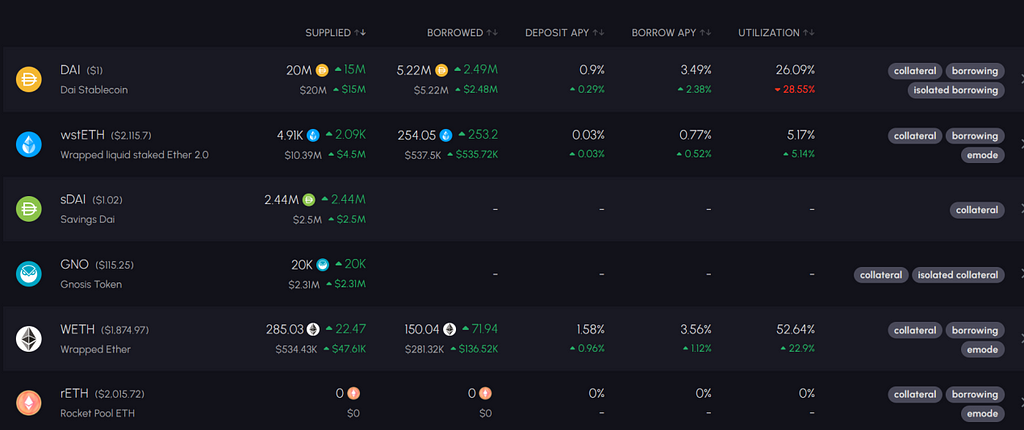
Total value locked (TVL) has reached $29.69 million, with DAI and wstETH being the most supplied assets. As shown in the asset supply curve below, after Maker announced the DSR rate increase, total supplied assets surged by more than 110%. However, only around $6 million worth of funds have been borrowed, resulting in a utilization rate of just 17%.
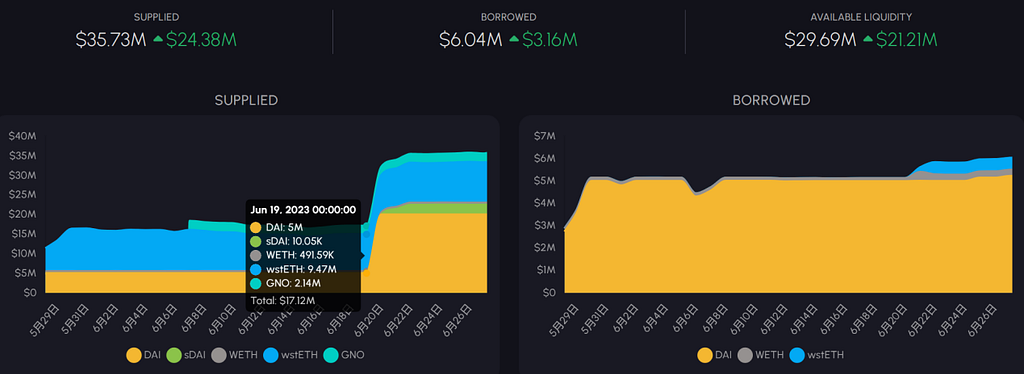
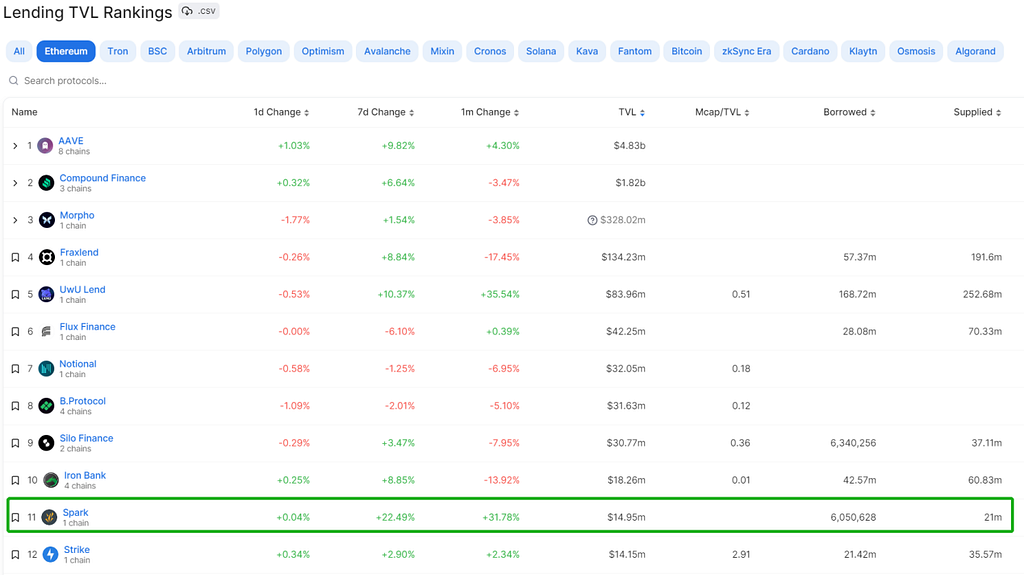
Despite MakerDAO’s backing, the new protocol initially struggled to attract significant assets; it was only after the DSR adjustment that TVL saw a sharp rise. According to data from defillama.com, Spark currently ranks 11th among Ethereum lending protocols. Its TVL has increased by 20% over the past seven days but remains only 0.2% of Aave’s TVL.
2. DSR Rate Adjustment
The DSR (Dai Savings Rate) refers to the deposit interest rate for DAI. MakerDAO offers a savings contract where users can earn passive yield by depositing their DAI. When users borrow DAI by collateralizing assets such as ETH or WBTC, they must pay a stability fee, which serves as the source of DSR returns. Therefore, changes in the DSR directly affect borrowing costs for DAI.
On June 16, the Maker community passed a proposal to raise the Dai Savings Rate from 1% to 3.49%. The change took effect on June 19, causing the amount of DAI in the DSR to jump from 110 million to 130 million within a single day. As seen in the DAI-in-DSR growth chart below, while the growth rate has slowed, it continues to trend upward. Over the past week, DAI supply increased by approximately 68 million, bringing the total supply to 186 million.
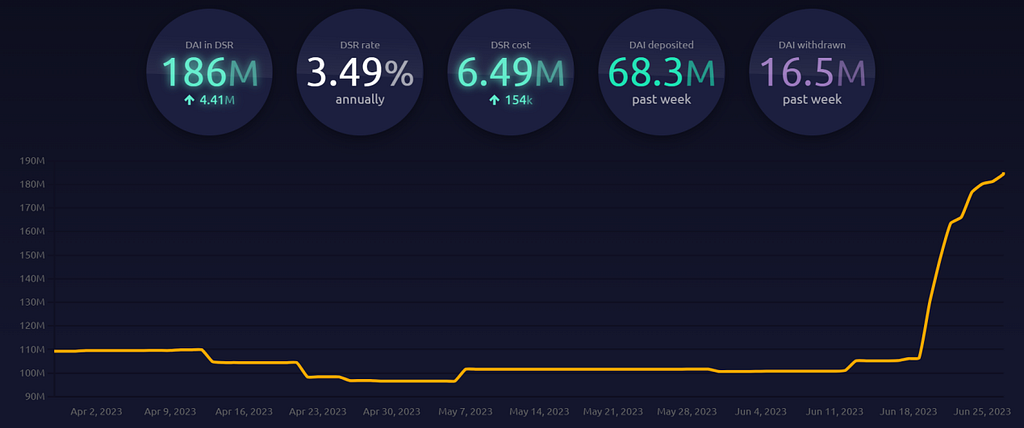
Within Maker’s monetary policy framework, the DSR serves as a key tool for balancing DAI supply and demand by incentivizing or discouraging users from locking up DAI. By adjusting the DSR, Maker can respond to short-term shifts in the Dai economy. As the Dai savings rate increases, participants in the Dai ecosystem may choose to withdraw funds from other lending platforms and deposit them into the DSR contract, or convert other stablecoins into DAI, thereby increasing demand for DAI. This shift also raises borrowing rates for DAI on external DeFi protocols, allowing Maker to offer more competitive yields and effectively recycle DAI back into its own ecosystem.
3. De-U.S.-Centric Collateral Strategy
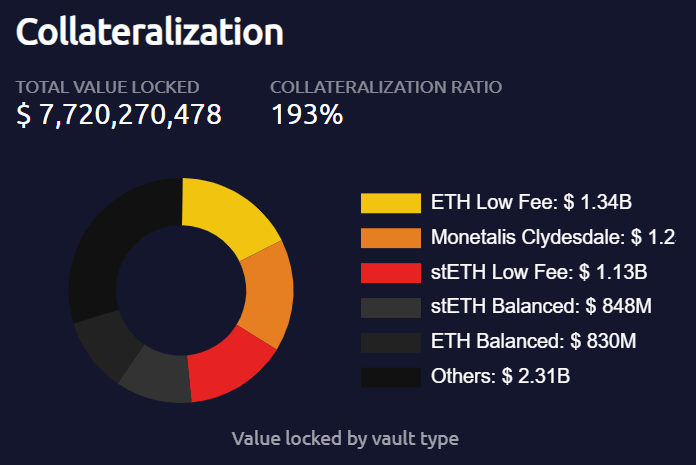
The total value locked (TVL) in MakerDAO currently stands at $7.7 billion, with the largest collateral vaults being ETH-A and stETH-A.
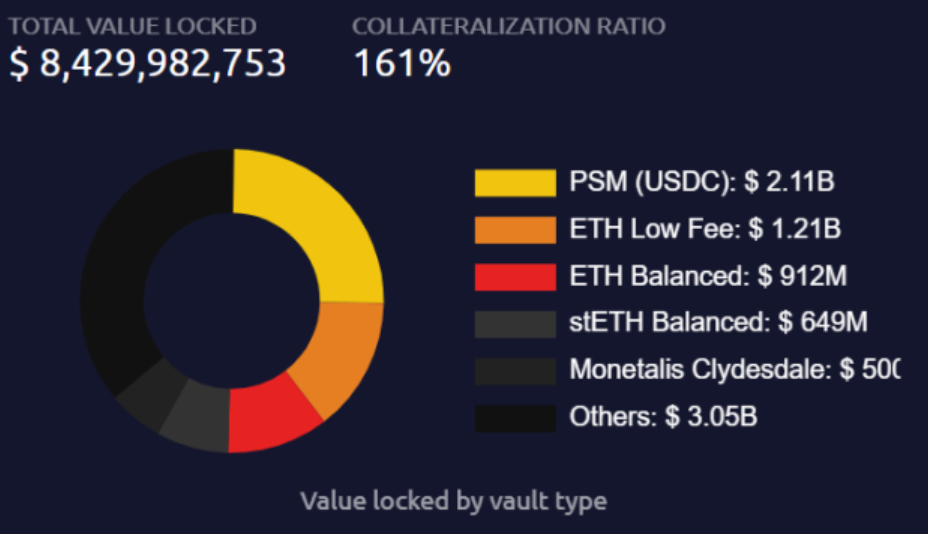
Looking back at data from March 2023, TVL was approximately $8.4 billion, with around $2.1 billion—about 25%—held in the PSM-USDC pool.
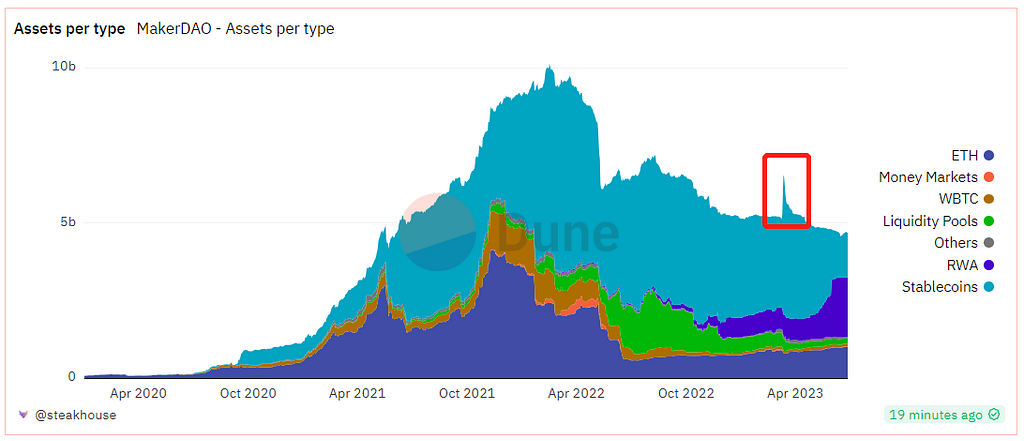
During the USDC depeg event on March 8, MakerDAO’s PSM quickly became a dumping ground for fleeing USDC, absorbing nearly $2 billion in USDC and pushing the total USDC in the PSM to $4 billion. Fortunately, the depeg stemmed from concerns about USDC’s reserve holdings and did not result in material losses for MakerDAO. After USDC regained its peg, the amount in the PSM gradually returned to around $2 billion.
Following this incident, the fact that USDC had become MakerDAO’s largest collateral asset reignited heated debate and concern within the community. As a result, MakerDAO has moved to diversify its balance sheet and reduce USDC’s share. That figure has now dropped to around $440 million—a decline of roughly 80%. Meanwhile, stETH’s share as DAI collateral has surged from $650 million to $1.1 billion, an increase of nearly 80%.
Additionally, the Maker community recently passed two proposals: reducing GUSD’s debt ceiling from $500 million to $110 million, and lowering USDP’s debt ceiling from $500 million to zero. These actions further underscore the community’s intent to minimize potential risks posed by centralized stablecoins and advance toward Maker’s “Endgame” vision.
4. The Endgame Roadmap Update
The goal of The Endgame is to simplify and parallelize the Maker ecosystem, introducing a new brand identity and launching six initial SubDAOs. On May 12, 2023, MakerDAO co-founder Rune Christensen posted a major update to The Endgame roadmap on the community forum, aiming to “enhance efficiency, resilience, and participation” by integrating AI tools into governance processes. This update provides further refinement and clarification of阶段性 tasks for the previously announced Endgame plan.
The roadmap consists of five phases:
1) Rebranding: Launch a unified new brand identity and governance website within the coming months. The new site will leverage AI-assisted workflows to build resilient and parallel governance structures. Users’ existing DAI and MKR holdings will be unaffected and can be upgraded directly to NewStable (new stablecoin) and NewGovToken (new governance token). Final names will be revealed alongside the new brand and platform.
2) SubDAO Launch: Roll out the first six Maker SubDAOs along with a new stablecoin for liquidity mining. SubDAOs will function as decentralized specialized units within MakerDAO, designed to eliminate operational costs and complexities by delegating “most of the complexity and risk” outside the core protocol.
3) AI Governance Tools Rollout: The Maker ecosystem will begin enhancing its AI-powered governance monitoring and improvement tools, including Alignment Artifacts, Governance AI Tools, Atlas, AVC, and Purpose Fund.
4) Governance Incentive Launch: Introduce the Sagittarius Lockstake Engine (SLE), enabling governance-as-mining.
5) Launch NewChain and Achieve Final Endgame State: This dedicated chain will use hard forks as a governance mechanism and feature optimizations for serving as the backend for AI-assisted DAO governance and AI tool usage—including smart contract generation, state leasing, and protocol-native MEV capture.
Dune Analytics aggregates PSM module data under the Stablecoin category without separately classifying USDC, GUSD, and USDP.
Source: Planet Daily
This section references our earlier publication: “LD Capital: MakerDAO’s Flourishing Ecosystem, The Spark Has Ignited”.
5. RWA Business Scale
The current value of real-world assets (RWA) locked in MakerDAO is approximately $1.6 billion, supporting around $1.4 billion in DAI issuance. RWA activities include asset-backed lending via Centrifuge, U.S. Treasury bonds, and custody services through Coinbase. The largest position comes from Monetalis Clydesdale’s U.S. Treasuries, totaling $1.2 billion—accounting for 76.9% of all RWA-backed DAI. MakerDAO initially purchased $500 million in Treasuries in October 2022 and added over $700 million more in June 2023.
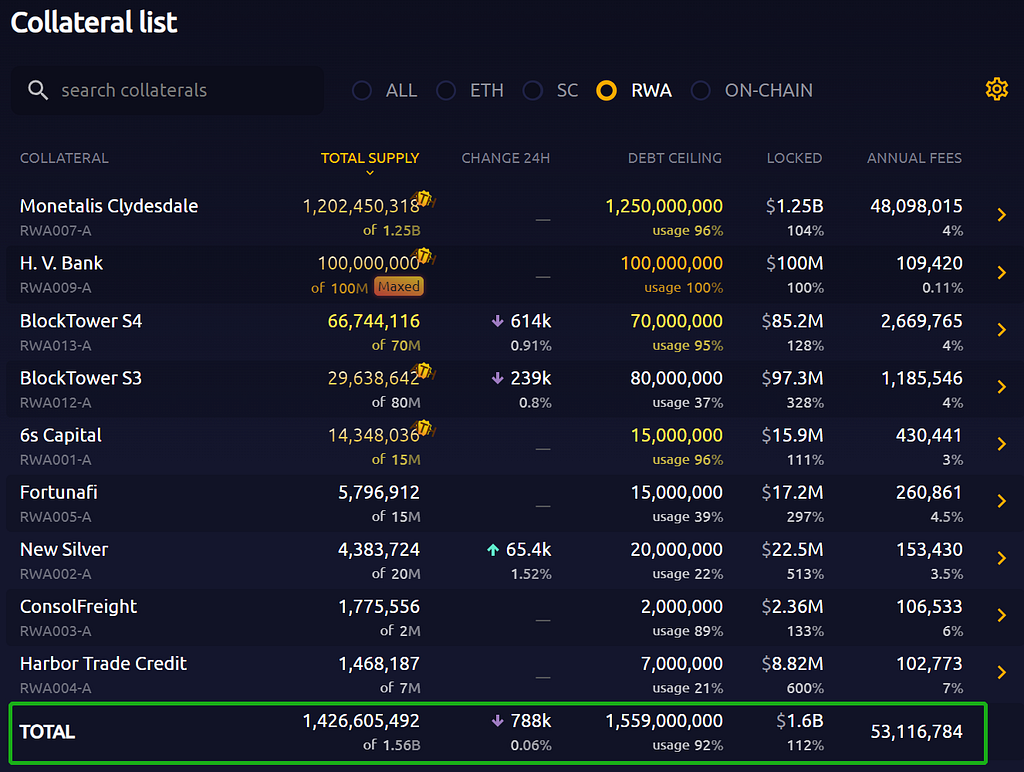
This figure does not include the $500 million in USDC that MakerDAO deposited with Coinbase Custody. Coinbase’s custody division pays an annual yield of 2.6% on these deposits, with USDC rewards calculated monthly. Coinbase charges no fees for participating in this reward program or for custodial services.
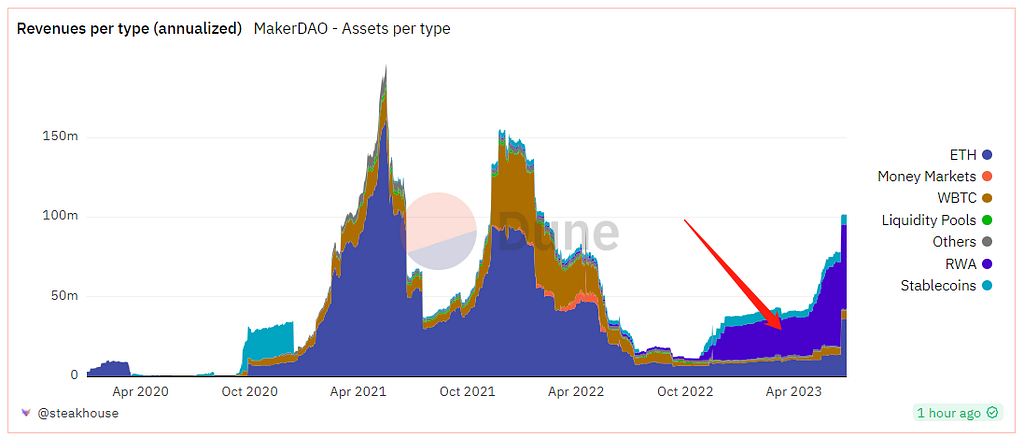
While RWA accounts for only 20.7% of MakerDAO’s total business volume, it generated $53 million in revenue—representing 45% of MakerDAO’s total revenue ($118 million). RWA is now MakerDAO’s most critical revenue stream, with U.S. Treasuries being the top contributor. This explains why the community has continued expanding its Treasury investments to maximize returns—an increase of 120% compared to the $23 million reported in our previous analysis.
Join TechFlow official community to stay tuned
Telegram:https://t.me/TechFlowDaily
X (Twitter):https://x.com/TechFlowPost
X (Twitter) EN:https://x.com/BlockFlow_News
 Cycle Capital Research






