Web3 Community Evolution: The Decline of PFP Communities and the New Dawn of NFTs
TechFlow Selected TechFlow Selected
Web3 Community Evolution: The Decline of PFP Communities and the New Dawn of NFTs
The new generation of NFT traders has shifted focus from viewing NFTs as representations of digital identity and community to treating them primarily as speculative assets.
 Navigating Web3 tides with focused insights
Written by: Ally Zach
Compiled by: TechFlow
Key Insights:
-
Initially, PFP NFT projects emphasized community, but over time, many shifted focus toward financialization, with NFT holders prioritizing financial returns over community engagement.
-
Applications focused on decentralized social media, digital identity, and blockchain-based domains have experienced unique increases in user adoption on the NFT market, surging nearly 10-fold from mid-2021 to early 2022.
-
By prioritizing organic network effects generated through user connections and offering opportunities for meaningful relationships and curated online identities, NFTs have laid a successful foundation for new consumer applications.
Historically, PFP NFT projects emphasized "community" as a core value. However, over the past year, many prominent NFT projects have increasingly focused on financialization, with NFT holders prioritizing financial returns over the emotional value of community membership.
From a user perspective, the shift from community-driven projects to financialization could occur via two paths: either existing users changed their values, or new users motivated by finance replaced the original community-oriented adopters. The latter is more likely, as the customer profile of early adopters of community-driven IP (NFT projects) differs significantly from individuals trading tokens purely for financial gain. Assuming community-driven users are more valuable to early-stage consumer projects, a critical question arises: where do these users go once financialization takes hold?
Largely, these users migrate to new types of consumer platforms that prioritize grassroots community participation in Web3. These platforms include decentralized social media, digital identity solutions, and blockchain-based domains. They not only fill the void left by the evolving NFT landscape but also usher in a new era of full-spectrum engagement. By analyzing user behavior across different NFT applications on EVM chains, we can extract valuable insights into user migration patterns and sub-communities forming within this rapidly evolving industry.
The Decline of PFP Communities
In the early days of NFTs, they were primarily associated with digital art and collectibles. Artists and creators quickly adopted the concept, tokenizing their work on blockchain-based platforms. Ethereum emerged as the pioneer enabling NFT transactions.
However, the launch of Bored Ape Yacht Club (BAYC) in early 2021 marked a turning point in NFT evolution. BAYC introduced a community-centric model, combining unique artwork with membership privileges and strong social components. Each Bored Ape NFT holder became part of an exclusive club with access to special events, virtual gatherings, and other benefits. This community-first approach proved highly influential, serving as a catalyst for numerous subsequent NFT projects to adopt similar strategies.
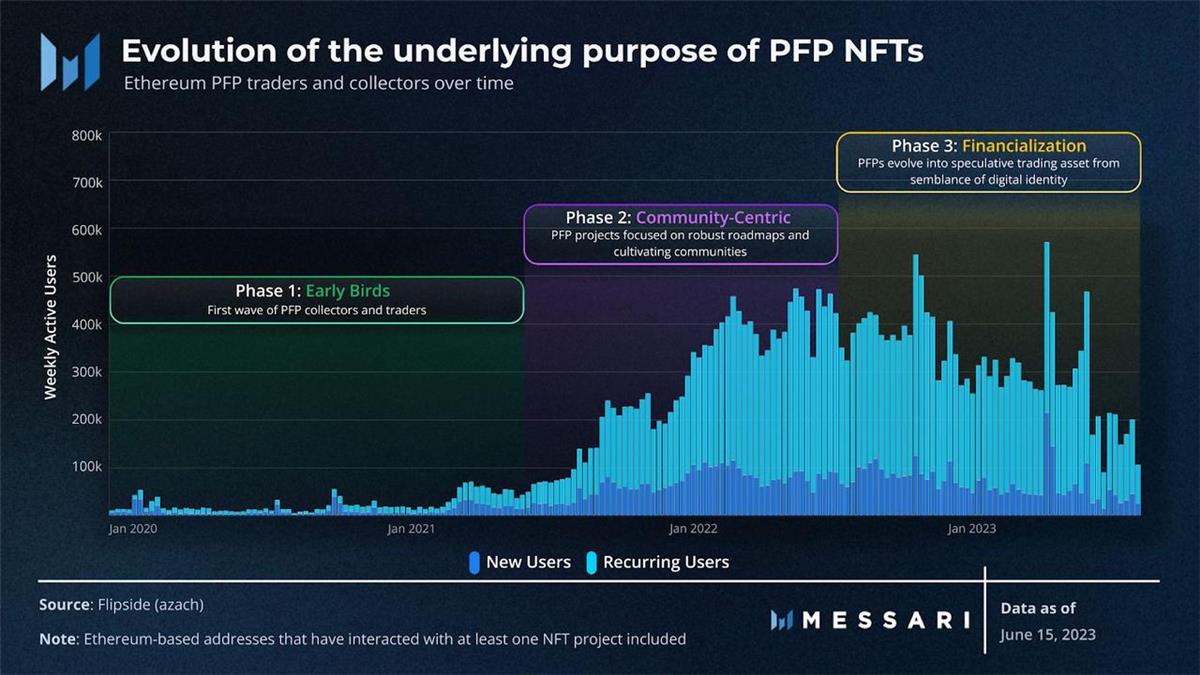
The success of BAYC and similar community-driven projects captured the attention of retail investors, leading to a near tenfold surge in NFT market adoption from mid-2021 to early 2022. Community engagement, committed roadmaps, and the potential for sustained value appreciation attracted many investors to purchase these collections.
By late 2022, the narrative shifted with the launch of the Blur trading platform. Blur, along with its ongoing, heavily promoted airdrop campaign, quickly gained popularity and attracted a massive user base. This success prompted other marketplaces, including industry giant OpenSea, to either adopt or launch their own specialized trading platforms. As a result, this transition also led to a significant decline in creator royalties, as the new generation of NFT traders shifted focus away from valuing community and roadmaps toward trading activity. The emphasis moved from NFTs representing digital identity and community to treating them primarily as speculative assets.
A New Dawn for NFTs
PFP projects, particularly those on Ethereum, were once the primary gateway for newcomers into the Web3 world. However, with the rapid rise of platforms like Blur, the landscape has undergone a significant transformation—shifting focus toward catering to traders rather than the core participants who originally drove growth: collectors, creators, and community members. Consequently, since January 2022, PFP projects across various EVM chains have seen a steady decline in attracting new users, with adoption rates dropping by nearly 50%.
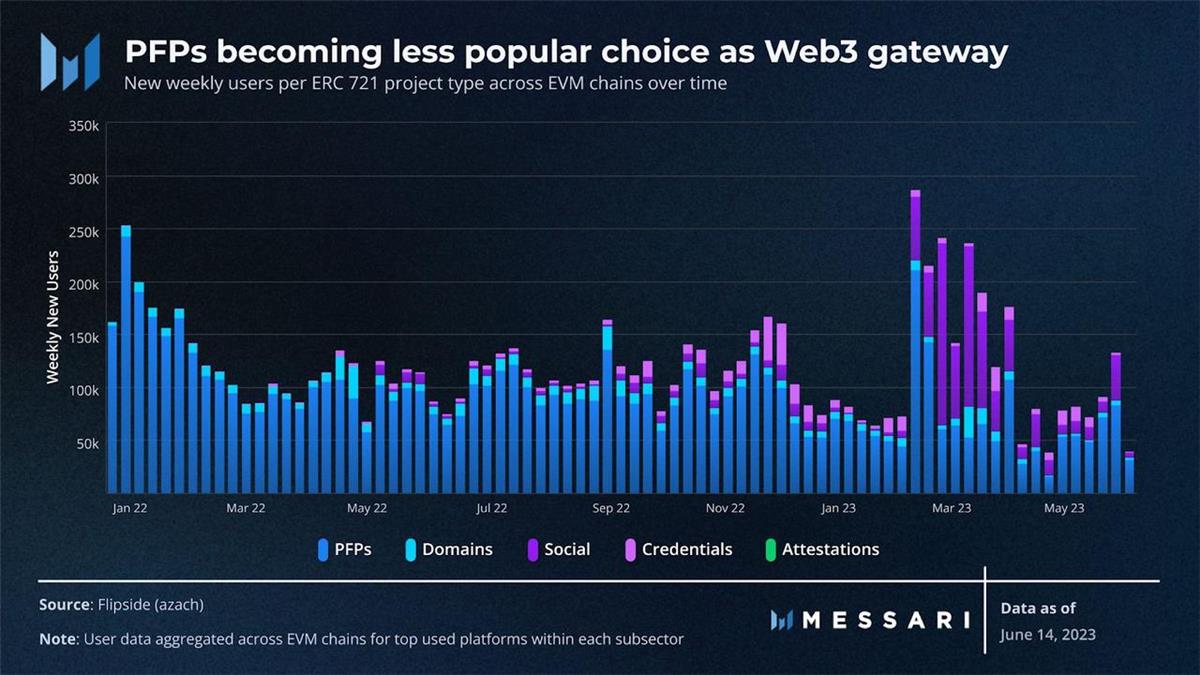
Over the past 18 months, development of consumer applications across various EVM chains has increased, focusing on decentralized social media, verifiable digital identity through credentials, and blockchain-based domains. These applications have reinvigorated Web3 by offering users meaningful connections, self-expression, and collaboration opportunities. They provide platforms where individuals can curate their online presence, interact with peers, and cultivate a sense of community in a more inclusive way.
To deliver seamless user experiences, consumer applications beyond traditional NFT marketplaces require high throughput and low GAS fees. In response to this need, many of these applications have turned to Layer-2 scaling solutions and sidechains. This shift has prompted Ethereum-based PFP traders to explore new chains, with approximately 80% of users exhibiting "nomadic" behavior across different networks.
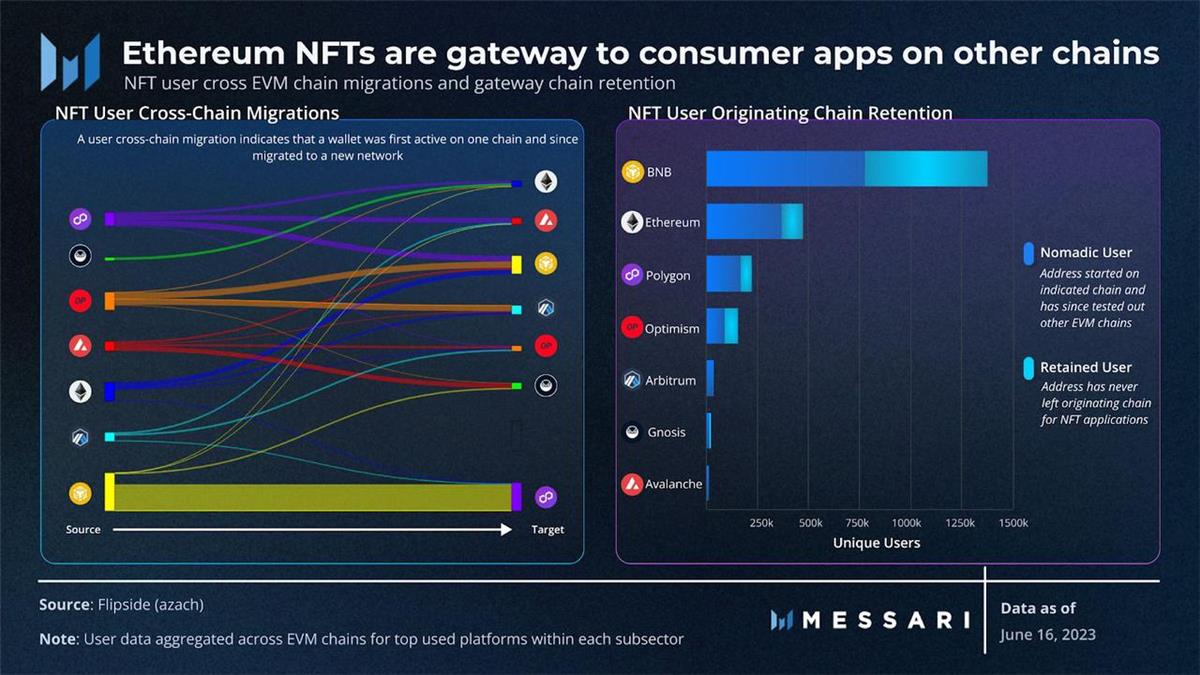
Nomadic users tend to engage with platforms serving similar purposes across different chains. For example, CyberConnect on BNB and Lens on Polygon share over 37,000 common users. Moreover, a new generation of Web3 users—those previously uninvolved in PFPs—has begun interacting with these new consumer applications.
These emerging consumer applications have not only successfully attracted prior cryptocurrency users but also drawn entirely new user groups. Notably, platforms such as ENS, Galxe, Lens, and CyberConnect enable users to experience their first NFT interaction directly on their respective chains—a departure from previous norms where traditional NFT marketplaces served as the primary entry point.
While the PFP narrative has evolved, users still seek to build online personas. Beyond social media or identity symbols, users have discovered new tools and applications to replicate this experience. Significantly, users who engaged with PFPs during the community-centric era constitute the largest segment of users for new consumer applications—compared to early NFT traders or participants from the financialization era.
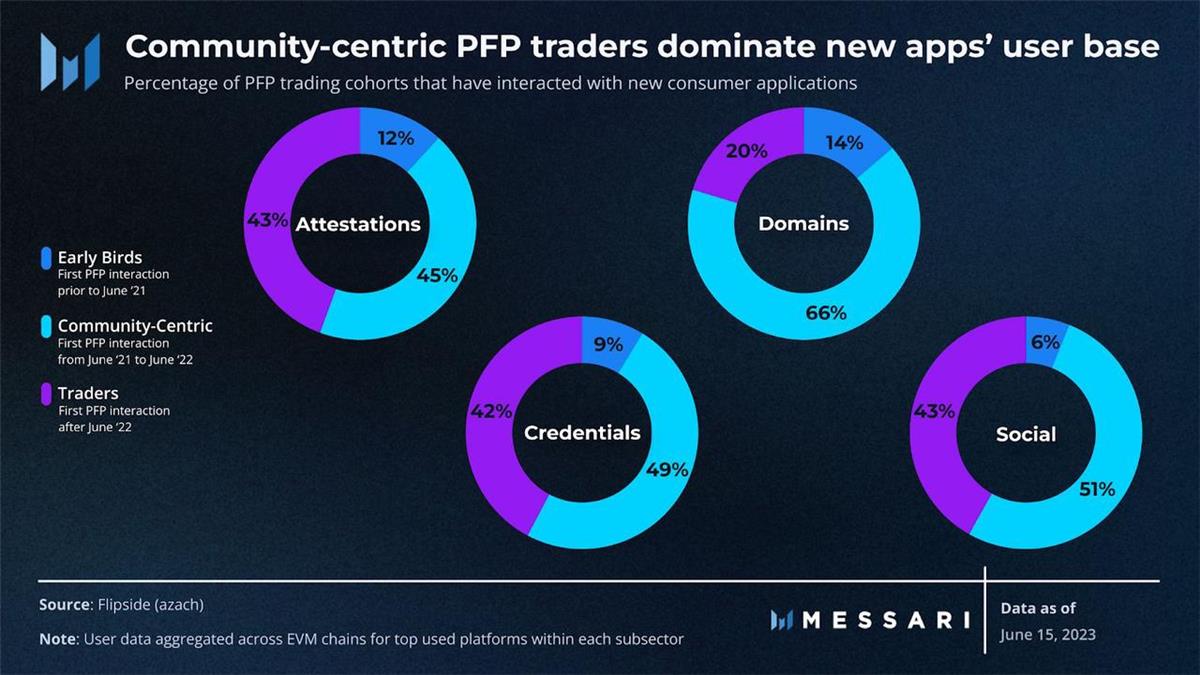
Although still in early stages, these emerging consumer applications have already succeeded in attracting a specific cohort of crypto users eager to witness their success. These applications offer comprehensive representations of digital identity—an essential aspect in an era where bots and artificial intelligence play increasingly significant roles.
The core values of these consumer applications are so compelling that they attract users across different networks. Users are willing to interact with these platforms across multiple chains, highlighting the importance of improving interoperability for credentials, domains, and profiles. Understanding user preferences and trends across communities is becoming increasingly crucial to achieving seamless interoperability and fostering cohesive user experiences across ecosystems.
Looking Ahead
Early NFT users were primarily explorers seeking online identity and community. Initially, PFP projects fulfilled this need but later shifted focus toward financial aspects. Currently, engaged users are primarily involved in decentralized social networks, identity, and credentialing projects. Looking forward, consumers are expected to continue seeking meaningful connections and unique identities. As consumers strive to fulfill these desires, consumer protocols that facilitate user connection and identity may thrive.
To succeed in a competitive environment, protocols should prioritize building organic network effects through user connections. An example is Lens, which integrates profile NFTs and follow NFTs directly into the protocol platform to establish user relationships. This approach embeds the network effect of user connections directly into the protocol itself. In contrast, traditional PFPs or standalone identity protocols rely on external platforms to facilitate user interactions, resulting in lower capture of network effect value within the protocol.
Profitability in this context is not limited to low-volume, high-frequency markets such as DeFi applications. These new consumer applications present promising opportunities by leveraging organic network effects and strategic market positioning. They deliver valuable experiences and services to community-focused users, encouraging engagement and potential long-term growth. As the dynamics of the PFP NFT trading market continue to evolve, these applications play a vital role in providing alternative pathways for users to connect, collaborate, and manage their online presence in more meaningful and inclusive ways.
Join TechFlow official community to stay tuned
Telegram:https://t.me/TechFlowDaily
X (Twitter):https://x.com/TechFlowPost
X (Twitter) EN:https://x.com/BlockFlow_News
 Messari