









Silicon Valley Wang Chuan: Why Can't People Hold Bitcoin for a 3x Return Over Four Years?
TechFlow Selected TechFlow Selected
Silicon Valley Wang Chuan: Why Can't People Hold Bitcoin for a 3x Return Over Four Years?
As long as you firmly grasp scarce resources, don't worry about how others are competing fiercely.
 Navigating Web3 tides with focused insights
Author: Wang Chuan
After BlackRock, the largest asset management group in the United States, officially filed an application with the U.S. Securities and Exchange Commission for a Bitcoin ETF on June 15, 2023, BTC's price approached $31,000. This scene recalls June 2019, when BTC reclaimed the $10,000 mark. A threefold return over four years isn't bad at all—it would easily outperform 99.9% of fund managers during the same period.
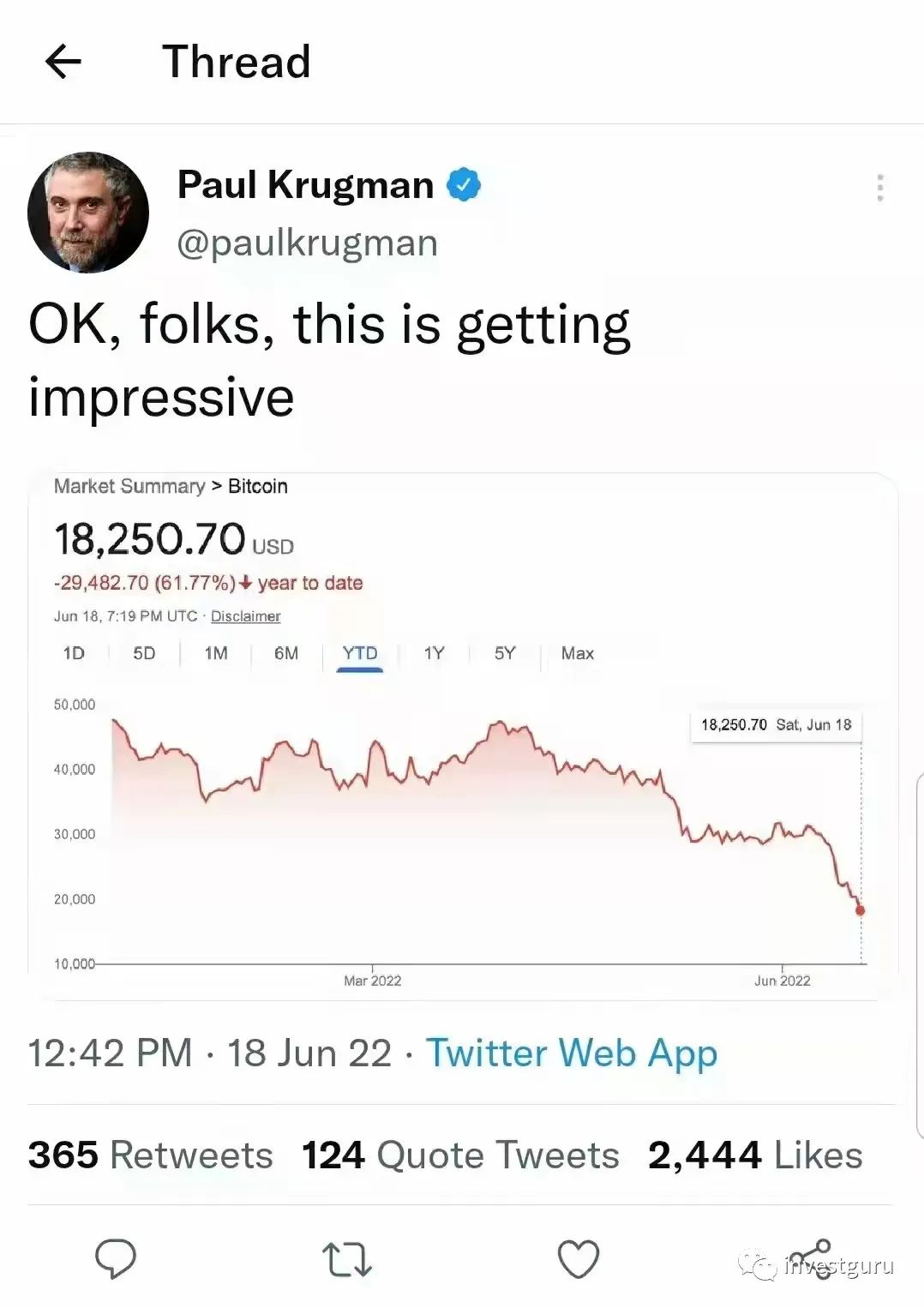
On June 18, 2022, BTC briefly dropped to $18,250. The renowned economist and Nobel laureate, Professor Paul Krugman, promptly resurfaced on Twitter, gleefully remarking, "Folks, this is so touching." (He had similarly emerged in late 2018 when Bitcoin fell to $3,000.) One year after Professor Krugman’s tweet, Bitcoin rose by 69%. Indeed, truly touching.
But many early participants no longer hold much BTC. The reason is simple: most people chase higher short-term returns, adopting various subjective and flashy strategies—essentially leveraged gambling—leaving themselves no margin for error. Inevitably, they are forced to liquidate during markets’ predictable yet unpredictable large swings.
An institutional fund nearly faced liquidation during the March 2020 market crash but doubled down on aggressive bets and ultimately profited more. Encouraged, they stuck with this high-risk strategy, only to be completely wiped out during the June 2022 downturn.
Players lacking redundancy, once hit by an unforeseen event, may rapidly experience cascading failures—failure in one subsystem triggering chain reactions that collapse higher-level systems, escalating quickly into catastrophic disasters or even total system destruction. Once eliminated, these players’ lessons are rarely passed on truthfully to future generations, guaranteeing a new wave of reckless newcomers will inevitably repeat their mistakes.
Many cannot bear BTC’s price volatility, but this volatility actually reflects more fundamentally the expansion and contraction of U.S. dollar credit. Even the Federal Reserve cannot accurately predict changes in inflation and employment, let alone precisely time its own policy shifts. In this world, you can’t have it all. You can’t demand both limited drawdowns during downturns and superior returns during upswings; you can’t expect the horse to run fast while refusing to let it eat grass. If clients make such demands, walk away—they’ll eventually fall into the arms of fraudsters like Madoff. If your boss makes such demands, he merely wants to claim credit when things go well and scapegoat you when they don’t.
People often mistake things with temporary premiums caused by short-term constraints as scarce assets. After the outbreak of the Russia-Ukraine war, crude oil spot prices were briefly driven up to $120 per barrel. But calmly reflecting, high oil prices suppress demand while encouraging more exploration and supply—oil prices will eventually come down. No matter how many new mining rigs you buy, BTC’s supply won’t increase; instead, it halves every four years. This is its most fundamental distinction from commodities and precious metals.
In March 2023, when Silicon Valley Bank teetered on collapse and hundreds of billions in depositor funds faced significant risk of being bailed in and written down, the Federal Reserve swiftly stepped in, magically conjuring hundreds of billions in emergency loans to rescue depositors. BTC, meanwhile, didn’t care at all—still producing a block every ten minutes, still adjusting its difficulty every two weeks like clockwork. At that moment, people suddenly realized what a truly scarce asset looks like, versus a game where a few insiders can arbitrarily inflate supply at will.
Just牢牢 grasp truly scarce resources. Don’t worry about how others hustle and compete. Let them waste real scarcity chasing and overpaying for what is, in fact, non-scarce.
Join TechFlow official community to stay tuned
Telegram:https://t.me/TechFlowDaily
X (Twitter):https://x.com/TechFlowPost
X (Twitter) EN:https://x.com/BlockFlow_News
 硅谷王川 Chuan









