Understanding zkSync Era: Principles, Advantages, and Ecosystem Projects
TechFlow Selected TechFlow Selected
Understanding zkSync Era: Principles, Advantages, and Ecosystem Projects
zkSync has many stories and possibilities for its own development.
 Navigating Web3 tides with focused insights
Summary:
According to Lookonchain monitoring, three whale addresses have collectively increased their holdings by approximately 1.95 million LDO tokens over the past week. The Lido Finance V2 upgrade proposal has passed, allowing users to withdraw staked ETH. Major players on-chain continue to position themselves in the LSD sector, reflecting strong confidence in the future growth potential of this space. This article outlines the latest developments in the zkSync Era ecosystem and draws the following conclusions:
- The emergence of zkSync Era has reduced transaction costs by up to 50x compared to before; the zkSync ecosystem is experiencing exponential growth;
- Numerous projects are deploying or migrating to the zkSync network across DeFi, cross-chain bridges, NFTs, and other domains;
- Due to Ethereum's scalability trilemma, the development of Layer 2 solutions is an inevitable trend;
-
Competition among zk-EVMs is intensifying; the zero-knowledge technology used by zkSync Era still requires further improvement and validation;
1. About zkSync Era
With Arbitrum and SuiNetwork launching their mainnets, zkSync Era has emerged as the hottest new blockchain network this year. On March 24, zkSync officially announced that zkSync Era was open to all users. As one of the most well-supported projects in the crypto space, zkSync has raised over $450 million from prominent investors including a16z, Dragonfly, and Lightspeed. Growing congestion and high fees on Ethereum have driven increasing interest in Layer 2 scaling solutions.
The $450 million raised by zkSync will significantly impact its development and path toward mass adoption. Many institutions are now actively developing zk-EVMs—such as Binance, Polygon, zkSync, StarkNet, Scroll, Aztec, and ConsenSys (the parent company of MetaMask)—are all entering this space.
Moka, COO of BitKeep, stated: "BitKeep Wallet was among the first to integrate zkSync Era, enabling users to manage their assets on zkSync Era via the BitKeep app and browser extension. With the recent 'composability' upgrade of zkSync 2.0, we will provide comprehensive support for the zkSync ecosystem across Swap, NFTs, and more, lowering the barrier to entry and growing the Rollup ecosystem together with zkSync."
Recently, BitKeep will co-host a Twitter Space titled "Diving into zkSync: An Ecosystem of Opportunities" with zkSync, featuring guests Bayo Akins (Infrastructure BD Lead at zkSync), Jimmy Yin (Co-Founder @iZUMi Finance), Mikayla (Operation Manager @Orbiter), Ervin (Co-Founder of Star Protocol and zkSync Name Service), and Gua (BD at SyncSwap). Click here to join the event.
1.1 What is zkSync Era
zkSync Era is a blockchain ecosystem built on zkSync technology, designed to enable high-performance, low-cost smart contracts and decentralized applications. Fully open-source, zkSync allows free access to view, modify, and fork its codebase. zkSync 2.0 is now known as zkSync Era, while zkSync 1.0 is referred to as zkSync Lite. Transaction costs have dropped by 50x, and it outperforms Ethereum with a throughput of 2,000 TPS. Its efficiency and affordability have attracted significant capital attention and fueled rapid development.
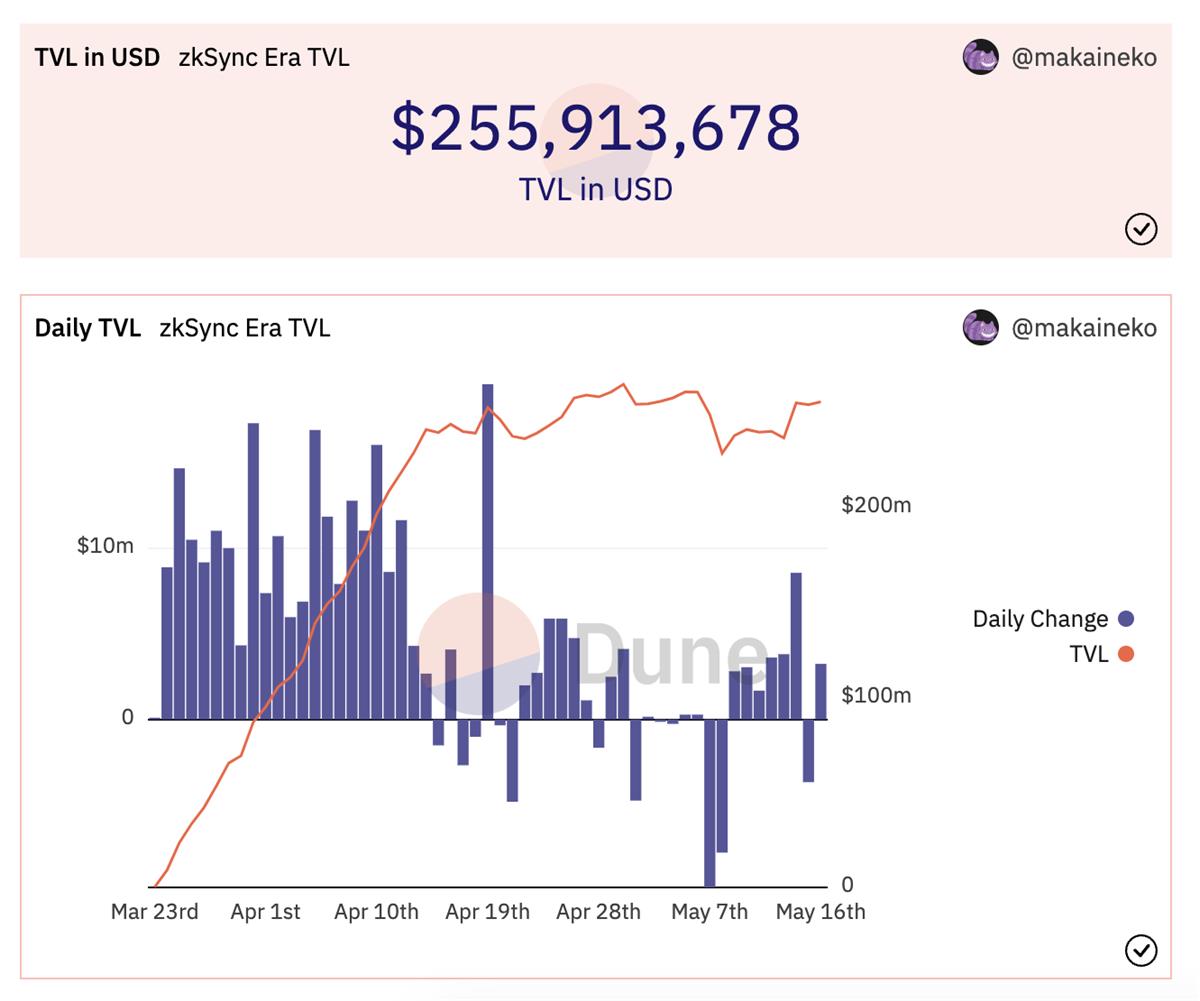
Figure1: Data from Dune @makaineko
In the weeks since the launch of zkSync Era and Polygon zkEVM, the zkSync ecosystem has grown rapidly. By the end of Q1, the total value locked (TVL) in the zkSync ecosystem had approached $200 million. BitKeep has already enabled mainnet support for zkSync Era with one-click swaps, allowing users to easily explore the zkSync Era ecosystem. Additionally, BitKeep will soon introduce gas fee borrowing functionality.
1.2 Principles and Advantages of zkSync Era
zkSync is a protocol using zk-Rollup technology to achieve high-performance scaling on Ethereum, resulting in lower transaction fees and faster confirmation times. Built upon the zkSync protocol, zkSync Era offers faster transactions, greater scalability, and enhanced economic efficiency, spanning sectors such as DeFi, cross-chain bridges, and NFTs.
zkSync’s architecture combines two protocols: zk-Rollups and Validium, also known as zk-EVM (for smart contracts) and zkPorter (for off-chain data availability). The diagram below illustrates how the latter operates.
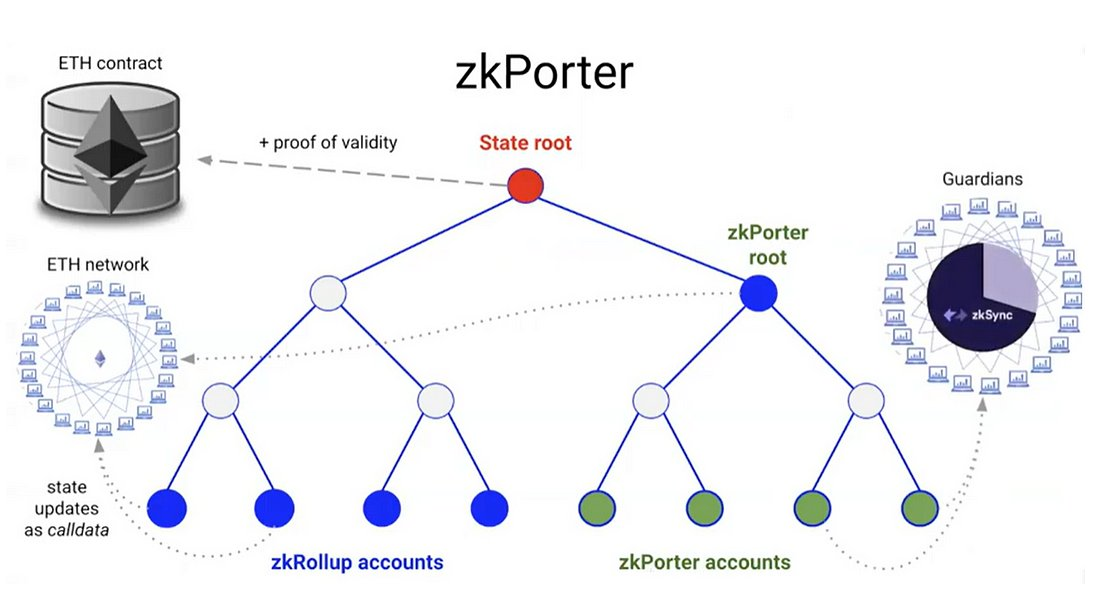
Figure2: From Twitter @milesdeutscher
Key Highlights of zkSync Era:
- Mainnet-level security without reliance on third parties
zkSync Era employs multi-layered security mechanisms along with independent monitoring and risk mitigation systems, ensuring mainnet-grade security. Unlike custodial layer solutions, zkSync Era is not only decentralized but completely independent of third parties—meaning users maintain full control over their digital assets without fear of attacks from centralized service providers. With on-chain verification and immutability, zkSync Era provides a high level of security assurance.
- Powerful LLVM Compiler
LLVM is one of the most mature compiler technologies globally. Leveraging the LLVM compiler brings significant performance improvements and better developer experience. Developers on Era can take advantage of LLVM to efficiently compile and execute smart contracts.
- EVM compatibility with added new features
zkSync Era supports permissionless EVM-compatible smart contracts, meaning anyone can deploy and interact with contracts without needing approval from centralized intermediaries. Developers can redeploy Ethereum L1 projects directly onto zkSync 2.0, provided they don't involve creating entirely new smart contracts, thus avoiding modifications to core underlying code.
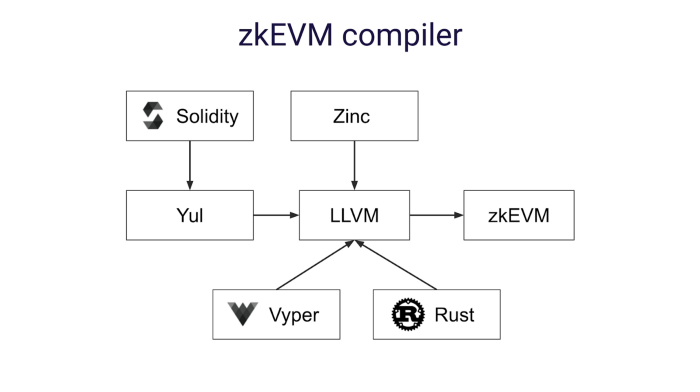
Figure2: Matter Labs
Additionally, zkSync Era introduces new features such as account abstraction. Account abstraction enables zkSync users to transact efficiently and scalably using various assets like ETH and ERC-20 tokens, improving user flexibility while reducing transaction costs and time.
According to Anthony Rose, account abstraction offers a less abstract way for more people to interact with blockchain applications. He stated that one of zkSync’s key goals for 2023 is to make on-chain interactions feel natural and effortless—just as Web2 users surf the internet without needing to understand HTML or HTTPS. Anthony believes zkSync can leverage account abstraction to deliver similarly seamless experiences. zkSync envisions transforming user accounts into smart contracts themselves, enabling greater flexibility and improved overall user experience.
1.3 Differences Between zkSync, zkSync Era, and ZK EVM
zkSync is a highly EVM-compatible zk-Rollup solution built for Ethereum. Its biggest advantage lies in allowing developers to use Solidity—the same language used for Ethereum smart contracts—to deploy applications in a low-cost, highly scalable Layer 2 environment, boosting TPS without compromising security or decentralization. It can process tens of thousands of transactions per second while reducing gas fees by about 99%.
zkSync 2.0 is zkSync Era, which makes it easier for more Ethereum-based dApps—including Aave and Uniswap—to migrate to the Era mainnet. The arrival of zkSync Era benefits the entire zkSync ecosystem, facilitating expansion and deployment of high-quality projects and broadening the overall project ecosystem.
zk-EVM stands for Zero-Knowledge Ethereum Virtual Machine—a term frequently heard in 2023. In simple terms, it uses a cryptographic method called "zero-knowledge proofs" to execute smart contracts, offering higher privacy, security, and speed. It represents a major technological innovation in the industry and has become a hot topic in the market. Moreover, zkSync was the first project to go live on zk-EVM.
2. zkSync Era Ecosystem
According to Matter Labs, over 150 projects have either deployed or expressed intent to deploy on zkSync. These projects represent a combined value exceeding $65 million, though many applications have yet to launch on the mainnet.
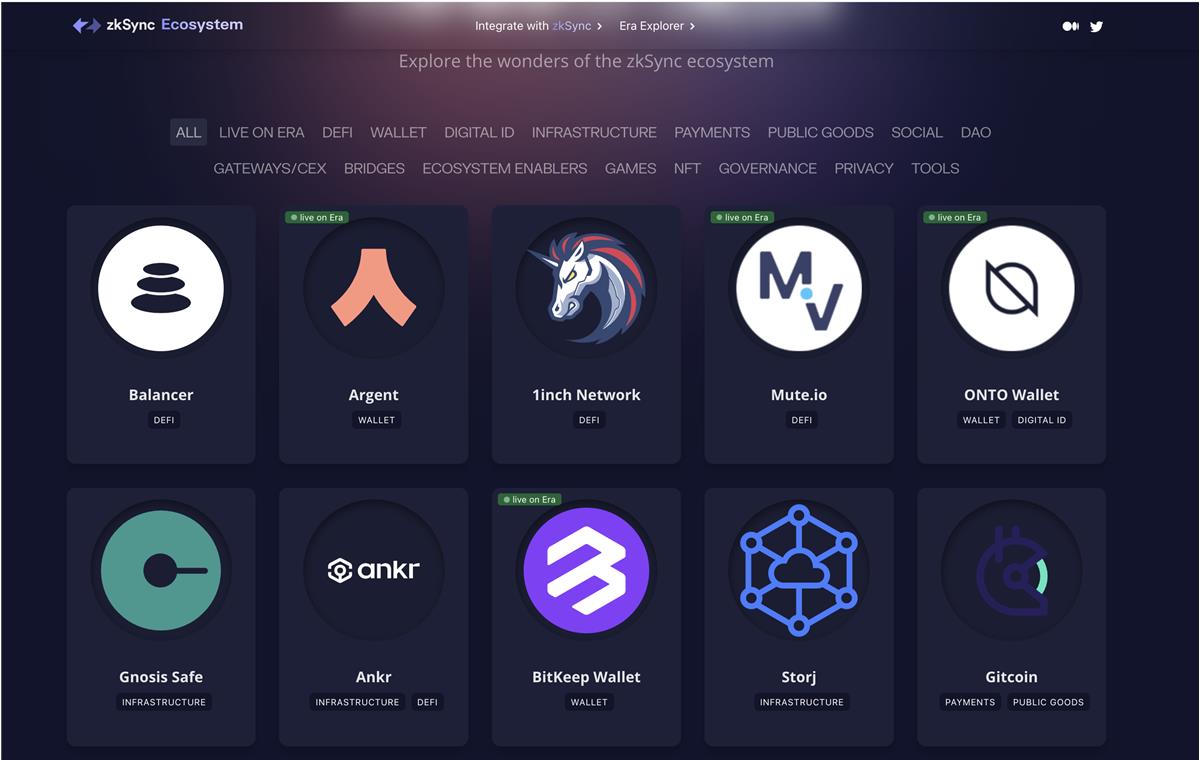
Figure 3: From zkSync.io
BitKeep supports the zkSync mainnet and its ecosystem applications. The list in this article covers only some of the DApps available on the zkSync 2.0 network. For more DApp experiences, follow this tutorial to activate your zkSync account using the BitKeep wallet and experience cutting-edge zero-knowledge proof technology.
2.1 zkSync Era Ecosystem Environment
How popular is zkSync Era? Within just 12 days of mainnet launch, it reached 260,000 unique users, now surpassing 530,000 independent addresses—an impressive figure even by Web2 standards. Total value locked surged to $100 million, ranking second only to dYdX.
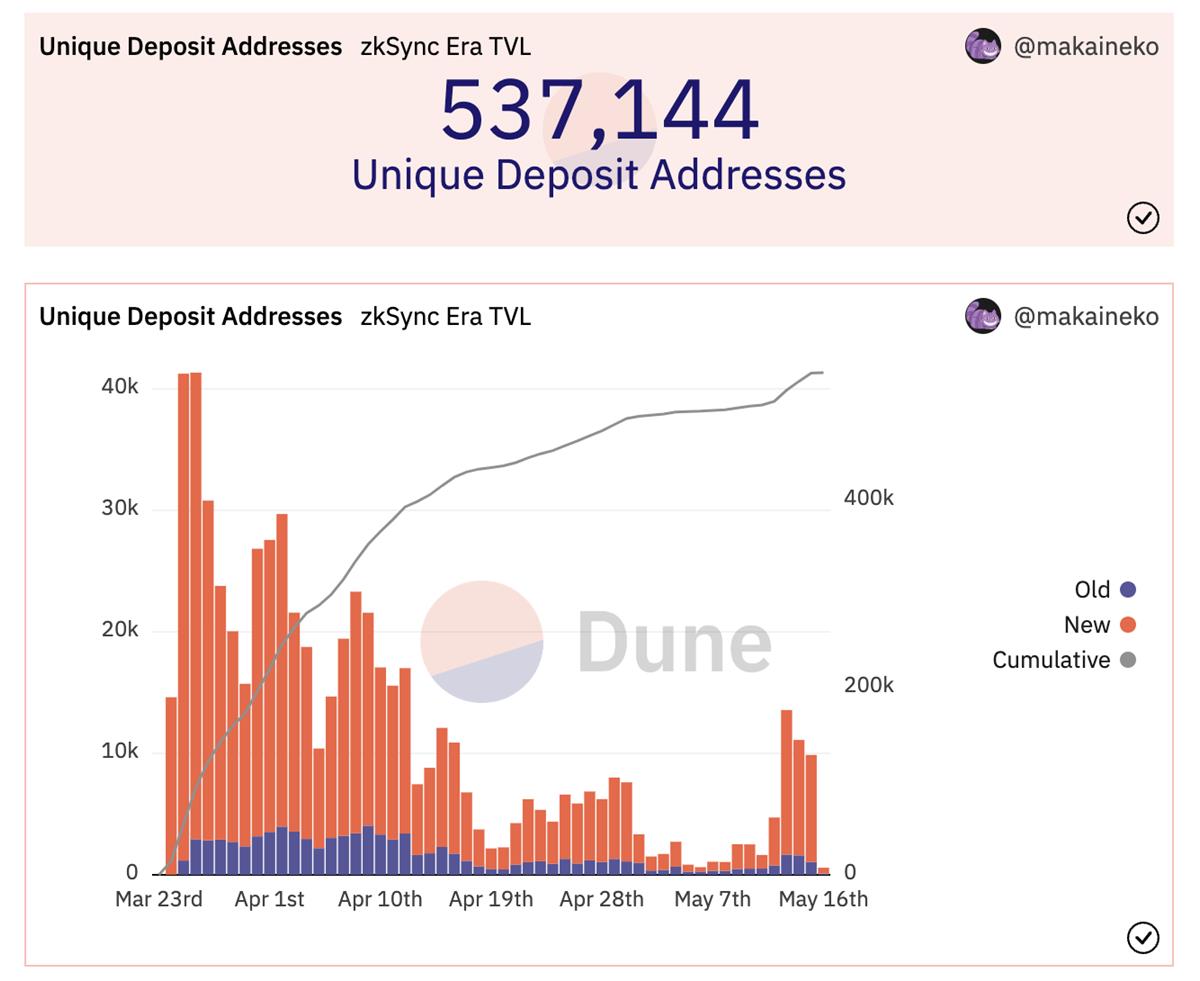
Figure 4: Data from Dune @makaineko
Gas fees via the official bridge to Ethereum rose to $5 per transaction, while spot swap fees on the mainnet reached $1.3 each. Keep in mind this is a Layer 2 network—compared to ~$0.3 gas fees on Optimism and Arbitrum—highlighting strong market enthusiasm for zkSync Era. Of course, high gas prices are partly driven by yield farmers.
2.2 zkSync Era Ecosystem Project Overview
Since launching in March 2023, the zkSync Era ecosystem has developed rapidly. Below we summarize several promising projects across DeFi, cross-chain bridges, NFTs, and other areas, reviewing their current progress and identifying potential leaders.
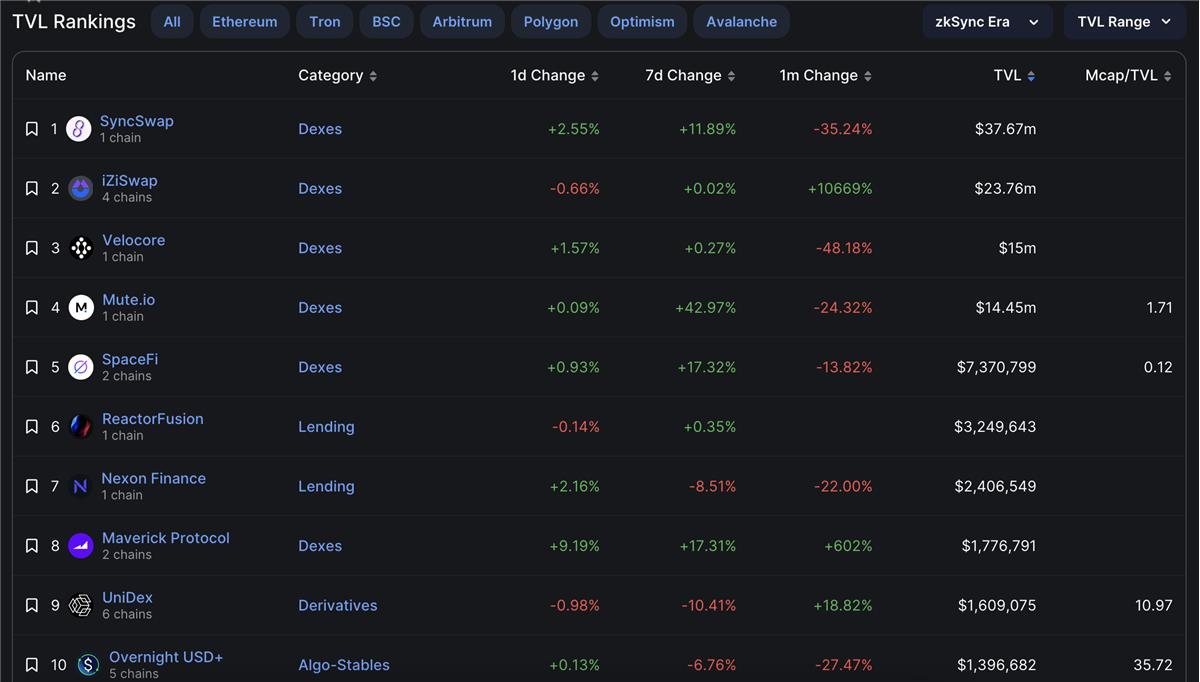
Figure 5: From DefiLlama
ORBITER FINANCE
Orbiter Finance is a decentralized Rollup cross-chain bridge enabling instant transfers of native Ethereum assets between L1 and L2. Cross-chain bridges allow different blockchains to interact, removing limitations on single-chain activity. For example, Orbiter Finance can bridge funds from Ethereum L1 to zkSync L2, where users can operate at much lower cost before bridging valuable assets back to L1. Bridges expand user access to diverse applications, services, and options, eliminating accessibility barriers.
Syncswap
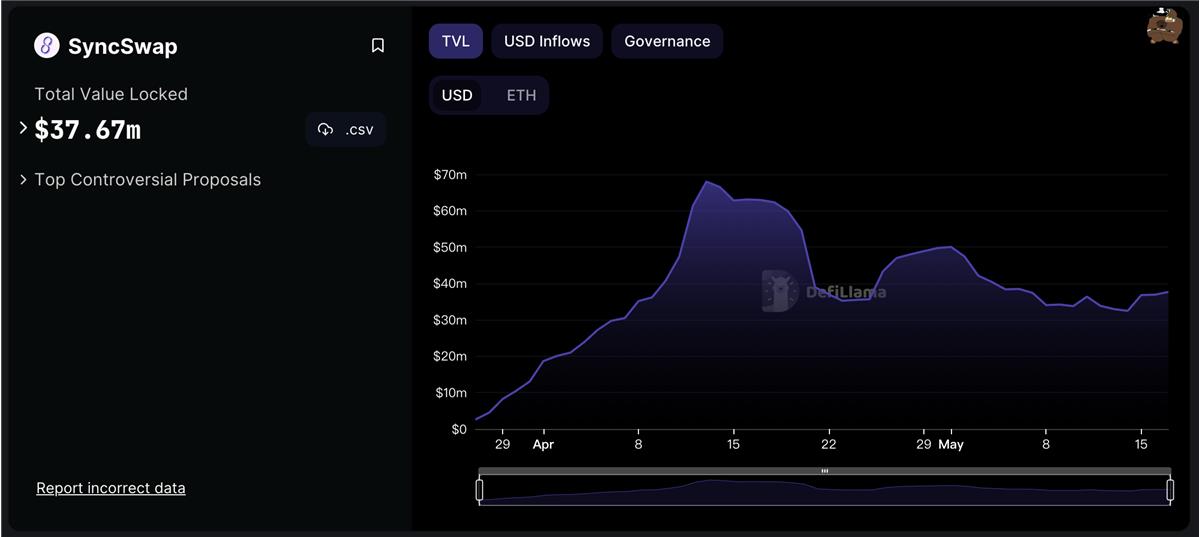
Figure 6: Data from DefiLlama
Syncswap is a spot decentralized exchange currently leading the network with $37.7 million in TVL—and notably, it hasn’t launched a token yet.
Its key features include support for multiple AMM algorithms, highly customizable fees, and Gas Refund functionality. Although still in early stages, Syncswap has already emerged as a leading project on zkSync Era and warrants close attention due to its first-mover advantage.
SpaceFi
SpaceFi is a Web3 platform based on EVM and zkSync cross-chain integration, addressing asset interoperability challenges. It also collaborates with Celestia to bring modular solutions to the EVM ecosystem. Product offerings include DeFi, NFTs, and a space-themed metaverse. Current TVL stands at $7.8 million.
As a Web3 cross-chain application platform, SpaceFi promptly supported zkSync Era and launched its DEX, Farm, PlantNFT, and other products on March 28.
Nexonfi
As a lending protocol, according to its website, it currently supports only ETH and USDC lending, offering up to 6.7% APY for USDC deposits.
Its whitepaper clearly states that token holders will receive protocol revenue shares, with 61% of the token supply allocated for community incentives. No token has been issued yet. Lending protocols often become flagship projects on a network, and as the first lending protocol on zkSync Era, Nexonfi deserves ongoing attention.
iZUMi Pro
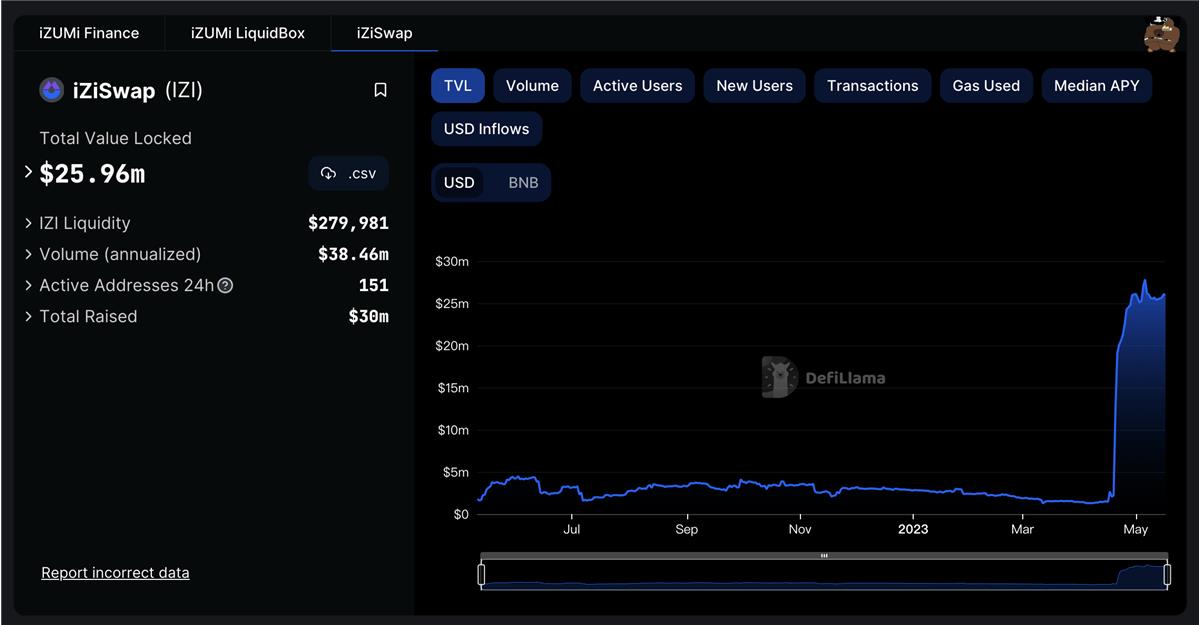
Figure 7: Data from DefiLlama
iZUMi Finance recently completed a $22 million funding round, aiming to use these funds to bootstrap early liquidity for iZiSwap Pro on zkSync Era. iZiSwap Pro is iZUMi Finance’s on-chain order book DEX, leveraging iZUMi’s innovative Discrete Liquidity AMM (DL-AMM) model, fully on-chain and 100% decentralized.
Tevaera
As a blockchain gaming platform similar to TreasureDAO on Arbitrum, its first game, TevaRun, is currently in testing on the Goerli testnet. Notably, the project plans to build its own dedicated gaming blockchain, TevaChain, based on zk technology. While Layer 2 scales Ethereum, TevaChain aims to scale zkSync itself. As a gaming platform, it holds stronger competitive advantages than standalone games. Its dedicated Layer 3 gaming chain is another point worth watching.
zkSync Name Service
zkSync Name Service (ZNS) is a decentralized identity (DID) solution within the zkSync Era ecosystem, providing domain name services. At its core, ZNS leverages zkRollup technology to batch-process large volumes of transactions and submit them to Ethereum for settlement, enhancing efficiency and reducing costs. This approach enables efficient, decentralized digital identity and asset management while safeguarding user privacy and security.
zkSync Era is a permissionless network—any project can deploy. Therefore, users should invest rationally, secure their wallets carefully, and avoid unauthorized signatures to prevent theft. BitKeep Wallet now supports one-click addition of the zkSync mainnet and integration with the aforementioned DApps, enabling easy participation in the zkSync ecosystem.
3. Competitive Analysis
ZK Rollups
ZK Rollups perform rollup operations verified via zero-knowledge proofs, capable of handling up to 2,000 TPS under peak load! More importantly, ZK Rollups are the only Layer 2 scaling solution that can scale across orders of magnitude through a unified system: zkPorter can reach up to 20,000 TPS.
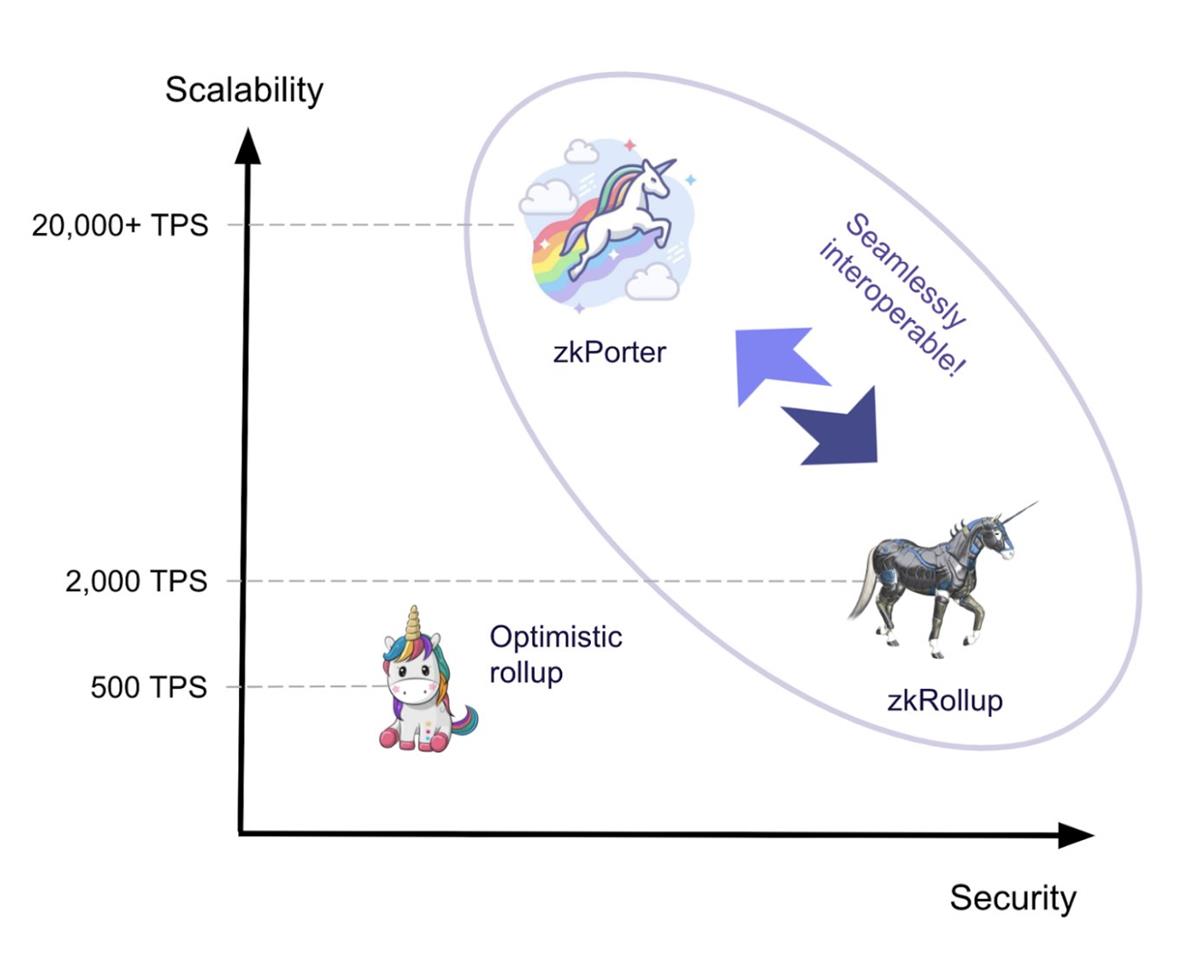
Figure3: From zkEVM website
zkSync 2.0’s architecture integrates zk-Rollup and Validium, a combination known as “volition,” giving users the freedom to choose between the two.
Compared to Optimistic Rollups, ZK Rollups offer higher security as they require no additional trust assumptions, relying instead on Ethereum and zero-knowledge proof algorithms for security. This security is achieved through mathematical verification of transaction correctness, preventing malicious behavior and ensuring system reliability. However, while ZK Rollups excel in security, they may face challenges in implementation complexity and performance.
Optimistic Rollups
Optimistic Rollups are a technique for scaling Ethereum networks by publishing public data to verify on-chain transactions. When suspicious activity is detected, a "challenge window" opens, allowing other validators and users to challenge potentially fraudulent transactions. This challenge period typically lasts seven days. Thus, withdrawing tokens from an Optimistic Rollup L2 environment back to Ethereum L1 may require waiting up to seven days.
The fundamental difference between Op Rollups and ZK Rollups is that ZK Rollups allow anyone to participate in verification via PoW-like mechanisms, whereas OP Rollups rely on a select group of trusted verifiers to oversee transaction bundling.
Arbitrum
Arbitrum is a Layer 2 protocol utilizing Optimistic Rollup technology and currently leads Layer 2 in total value locked (TVL). Benefiting from first-mover advantage, it leads in applications, transaction volume, and market share. Arbitrum uses multi-round fraud proofs during validation. Transactions are not executed on Layer 1, and it runs on its own virtual machine, maintaining strong compatibility with the Ethereum network.
Polygon zkEVM
Polygon zkEVM also leverages zero-knowledge Rollup technology, offering lower transaction fees than Ethereum. It maintains compatibility with most Ethereum applications. If an app doesn’t require precompiles, no code changes are needed to adapt to zkEVM. Additionally, while withdrawals on Optimism may take 7 days and Arbitrum up to 2 weeks, withdrawals via Polygon’s PoS bridge can be completed within 3 hours.
zk-Rollups like zkSync rely on cryptography and mathematical proofs to verify transaction authenticity, enabling far faster processing speeds than other rollup types—processing transactions almost as quickly as mathematical proofs can be validated. Even Vitalik Buterin has acknowledged the long-term superiority of zk-Rollups.
4. Opportunities and Development
zkSync Era is one of many projects currently developing zk-EVMs, alongside StarkNet, Polygon Hermez, and Scroll. All zk-EVMs differ significantly, involving a clear trade-off between composability (how closely they resemble the original EVM) and performance (speed of zk-Rollup execution). zkSync prioritizes performance at the expense of composability.
Currently, there are four distinct types of zk-EVM, illustrated below:
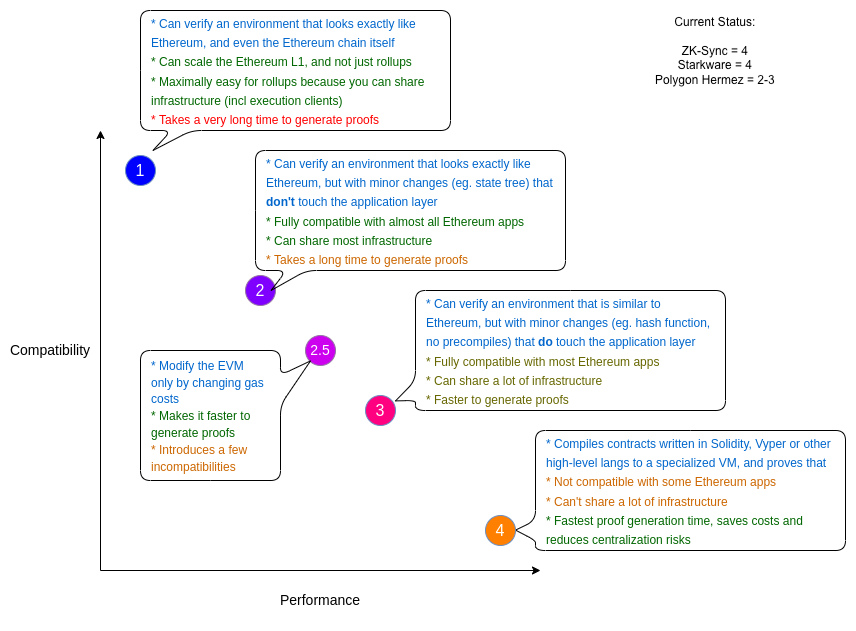
zkSync Era is optimized for high performance, specifically maintaining source-level compatibility (Solidity and Vyper). This design offers additional security benefits: when redeploying to L2, EVM projects require no code changes, preserving battle-tested best practices from L1 and reducing vulnerability and attack risks. It also ensures fewer bugs and higher security for L2 deployments using the same codebase as L1, while minimizing time and cost for redeployment.
Facing Ethereum’s scalability trilemma—difficulty achieving scalability, security, and decentralization simultaneously—many projects attempt to solve scalability, each with unique trade-offs and use cases. zkSync has demonstrated superior efficiency, seamless transactions, and lower costs for DApps.
The zero-knowledge technology used by zkSync Era is still relatively new in blockchain and hasn't undergone extensive retrospective testing like traditional validation methods. It relies on complex mathematical assumptions and cryptographic techniques, making it vulnerable if any assumption is broken or implementation errors occur. Additionally, the complexity of understanding ZK-Rollups may hinder mainstream adoption by average users.
As shown in this article, many projects on the zkSync network are still in early stages, with limited disclosures, low project quality, and lack of ultra-high APY incentives—making it difficult to retain user funds. Beyond advancing the zkSync mainnet, expanding the application ecosystem and encouraging more developers and teams to join will be crucial for further growth. According to the roadmap, future efforts will focus on accelerating prover technology and hardware, integrating modern programming languages via LLVM compiler support, and innovations in zkSync 3.0.
5. Conclusion:
zkSync holds numerous possibilities and narratives for growth. As Ethereum technology evolves, competition in the zk-EVM space grows increasingly fierce. Despite zero-knowledge proof technology being nascent, multiple teams are actively building zk-EVMs and continuously introducing new features and improvements. zkSync Era has already demonstrated exceptional performance and efficiency in a short time. As the ecosystem expands, we look forward to what surprises zkSync 3.0 may bring in the future.
Finally, regarding token issuance, zkSync President Alex Gluchowski explicitly stated: zkSync is still in early stages and not sufficiently decentralized—token launch may come in about a year. However, the signal that zkSync will issue a token is quite clear. Given the intense competitive landscape, an earlier-than-expected token launch is certainly possible.
Disclaimer
BitKeep has no affiliations with third parties mentioned in this report that could affect the objectivity, independence, or impartiality of the content. All data and information cited in this report come from compliant sources. BitKeep makes no guarantees regarding their accuracy, truthfulness, or completeness.
Opinions and conclusions expressed in this article do not constitute investment advice for any digital assets. BitKeep assumes no responsibility for losses arising from the use of this report. Digital asset contract trading involves innovative products with high risk and technical complexity. Please assess your investment capabilities rationally and make prudent decisions. The views and opinions expressed herein reflect the author’s judgment at the time of writing and may change in the future due to industry dynamics and updated data.
Join TechFlow official community to stay tuned
Telegram:https://t.me/TechFlowDaily
X (Twitter):https://x.com/TechFlowPost
X (Twitter) EN:https://x.com/BlockFlow_News
 BitKeep Wallet