The Next Big Trend in the NFT Market: Understanding Dynamic NFT Mechanisms and Use Cases
TechFlow Selected TechFlow Selected
The Next Big Trend in the NFT Market: Understanding Dynamic NFT Mechanisms and Use Cases
A Comprehensive Comparison of Static and Dynamic NFTs: Understanding the Advantages and Future of dNFTs
 Navigating Web3 tides with focused insights
In 2022, NFTs became increasingly ubiquitous, capturing the attention of capital and emerging as new stars in the on-chain world. A pair of socks from Uniswap sold for $160,000; five words from Twitter’s founder fetched $2.5 million; digital artist Beeple's work "First 5000 Days" was auctioned for $69 million... The NFT market is demonstrating tremendous growth potential.
A key segment data report on the NFT market in Q2 of the same year revealed significant growth in metaverse and application-based NFTs across total sales volume, number of sales, total profit, active wallets, and circulating assets. The NFT market is projected to grow at a compound annual growth rate (CAGR) of 10.7% between 2021 and 2030, with an estimated market value of $125.07 billion by 2030. Growth in these segments highlights rising demand for NFT technology applications beyond digital art, a trend that will also drive the development and adoption of dynamic NFTs.
Forbes once defined NFTs as digital assets representing real-world objects such as art, music, and games, which are bought and sold using cryptographic digital assets. These NFTs are typically encoded using the same underlying software as other crypto assets. Over the past two decades, NFTs have undergone widespread evolution, continuously iterating their formats to become mainstream in Web3 transactions.
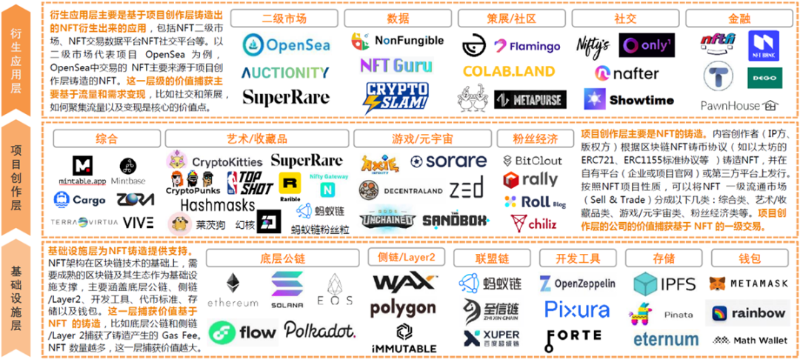
Among the various products circulating in the NFT market, highly popular items like Bored Ape Yacht Club, FIFA+ Genesis Drop launched during the World Cup, and TME Digital Collectibles introduced by internet giant Tencent—these treasures cherished by NFT enthusiasts—are all examples of "static" digital creations.
However, after a wave of PFP projects in 2022, the industry has been anticipating fresh innovation to dispel the gloom of the crypto winter and create newer, more “lively and engaging” products. Thus, dynamic NFTs emerged as a promising new trend. Today, we explore the origin and development of dynamic NFTs, gaining deeper insights into this Web3 “darling” by comparing static and dynamic NFTs.
From Static NFTs to Dynamic NFTs
When first hearing about static NFTs, one might feel confused—what exactly are static NFTs?
In fact, most NFTs we encounter are "static NFTs." A static NFT is a non-fungible token that cannot be altered or modified once minted. Once created, it remains unchanged on-chain because its metadata (core attributes) is fixed and permanently immutable when coded—a feature particularly suitable for digital artworks such as videos, images, GIFs, and 3D models.
Currently, static NFTs are primarily used in art projects, blockchain gaming, music and photography, sports competitions, and similar fields. Their advantages include supporting original artistic design, providing users with accurate and stable ownership rights, enhancing creators' future income potential, ensuring works remain unaltered and easier to verify, requiring lower storage and bandwidth usage, and adapting well to complex operating environments.
Nevertheless, static NFTs also have shortcomings:
- Fixed metadata limits potential use cases, including applications involving real-world assets.
- They struggle to deliver value beyond authenticity and uniqueness verification, resulting in limited value propositions.
- According to OpenSea data statistics, over 80% of current NFTs on the market are suspected of being fake or plagiarized.
These issues exposed in static NFT products and markets are precisely what dynamic NFTs aim to address.
Comparative Analysis: Advantages of Dynamic NFTs
Building upon the legacy of static NFTs, dynamic NFTs improve upon inherent flaws such as immutability, lack of flexibility, and vulnerability to plagiarism. They excel in areas like updatable content, flexible configuration, and interactive responsiveness. Through the comparative analysis below, we can better understand the differences and relative strengths between the two—and gain deeper insight into what defines a dynamic NFT.
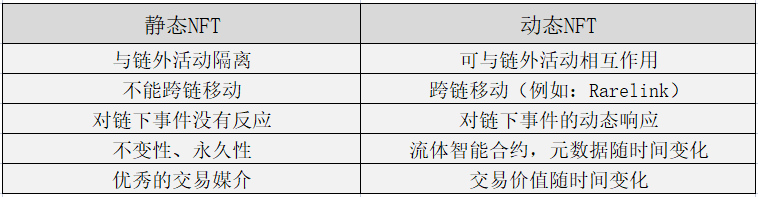
Data source: Zeeve.io
Mechanisms and Use Cases of Dynamic NFTs
Dynamic NFT (dNFT) can be expressed through a formula: dNFT = NFT + Oracle.
In general, the execution process of a dynamic NFT works as follows:
-
Data is continuously updated via oracles, creating a mechanism for dynamic NFT products that evolve over time.
-
Metadata can change (programmed and built via smart contracts) to adapt to external data and events.
-
Changes to dNFT metadata triggered under certain conditions bridge the on-chain and off-chain worlds.
-
Off-chain data is brought onto the blockchain and analyzed by smart contracts.
-
Oracles provide off-chain data and computational services that power dNFT updates.
-
Ultimately, automation, decentralization, and user participation in the dNFT process are enabled.
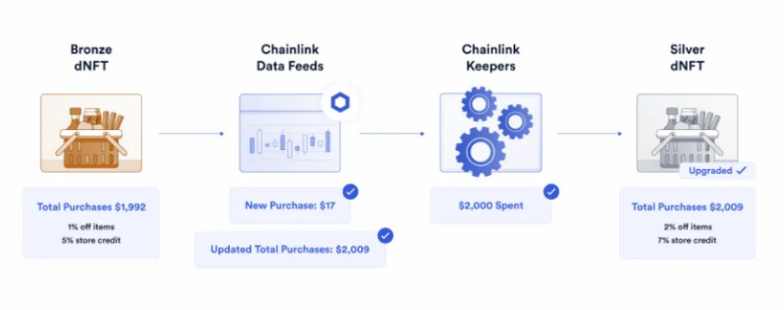
A typical dynamic NFT product execution flow includes:
-
An individual or program requests the URI of an NFT digital asset from a smart contract.
-
The on-chain smart contract receives and processes the request.
-
The smart contract retrieves and processes on-chain data.
-
The smart contract fetches off-chain data via oracles and processes the result.
The emergence of dNFTs has overturned the technical principles of static NFTs, opening up vast possibilities for NFT products. As game items that evolve as players level up, or as sports event passes enabling participation in competitive activities—the practical applications of dynamic NFTs are within reach.
Enabling Collaborative Art Creation
dNFTs can obtain external data from real-world sources. In artistic creations related to minting, astronomy, time, and similar themes, creative materials can be co-created and aggregated through network transmission before artists make final selections and compositions.
These collaboratively created dynamic artworks may originate from individual creators or intermediaries/platforms—for example, Artist Mari Inks Arts & Organic Growth: Crystal Reef Project. This generative art project consists of 10,301 crystals. Gradually, this crystal initiative evolved into a shared artwork, culminating in a physical sculpture.
Transforming Gaming Experiences
dNFTs allow modifications based on progress and enable uniquely designed gameplay, giving blockchain games comparable appeal to traditional mobile games and esports. Metadata can be flexibly configured according to external data such as weather, time, and location, including adapting to live results from sports and esports competitions. Features like activating in-game skills, fan celebrations of athletic achievements, and tracking unlocked rewards—elements traditionally experienced offline—are now “replicated” within dNFTs, revitalizing online esports and sports initiatives.
Dynamic Brand Marketing
Previously, brand NFT projects required building entirely new NFT series from scratch, often done independently by brands—an effort-intensive and time-consuming process. Now, platforms like Metaverse Zepeto can receive full support from major brands like GUCCI, expanding commercial pathways and increasing product value throughout the lifecycle.
This is closely tied to the oracle functionality of dNFTs, integrating on-chain and off-chain data resources to design dynamic marketing strategies that maximize brand benefits.
Precise Audience Targeting
Applying dNFT concepts to web browsers allows measuring user engagement through view counts or timers, generating verifiable traffic proof for websites. Integration with tools like Google Analytics enables open-source tracking of content popularity and engagement metrics, allowing monetization through query subscriptions. These methods act as "monitors" for browser applications, helping enterprises, platforms, and project teams precisely target user pools, achieve accurate customer acquisition, and enable targeted dissemination—potentially becoming a “killer app” for dynamic NFTs.
Beyond these primary use cases, dynamic NFTs are also active in event ticketing, education and training, exhibitions, and announcements. Projects like Sol Soldiers, VenVuu, Liquid Earth, and Unstoppable Domains integrate advertising with real estate, identity, art, and other forms, truly bringing NFTs to life!
The Future of Dynamic NFTs
While dynamic NFTs offer irreplaceable advantages, developers and project teams must carefully consider potential risks and actively pursue innovation.
Challenges include high-performance cross-chain compatibility requirements bridging on-chain and off-chain systems, security risks arising from NFTs being subject to capital gains taxes but not yet integrated into tax frameworks, centralized oracle operations leading to greater corruption and hacking vulnerabilities, and incomplete auxiliary functions on platforms like Chainlink or Bond. These ongoing challenges have become stumbling blocks for dynamic NFT development and hinder broader innovation in the NFT market, necessitating more robust solutions.
Looking ahead, dynamic NFTs should offer more customizable pathways. Providing guidance for different types of NFTs toward dynamic or static configurations, improving periodic modification and update features, maximizing user autonomy, and delivering innovative applications that enhance everyday life and generate tangible benefits will be crucial.
Join TechFlow official community to stay tuned
Telegram:https://t.me/TechFlowDaily
X (Twitter):https://x.com/TechFlowPost
X (Twitter) EN:https://x.com/BlockFlow_News
 @OurTinTinLand