A Deep Dive into the Decentralized Perpetual Contracts Sector and the Future of the Protocol Vela Exchange
TechFlow Selected TechFlow Selected
A Deep Dive into the Decentralized Perpetual Contracts Sector and the Future of the Protocol Vela Exchange
Vela is a Perp DEX (perpetual futures decentralized exchange) launched on Arbitrum.
 Navigating Web3 tides with focused insights
Written by: Crypto Pragmatist
Translated by: TechFlow

Vela is a Perp DEX (decentralized perpetual futures exchange) launched on Arbitrum. The story of decentralized perpetual contracts is long and complex—we’ll try to summarize today the key points about Vela Exchange, what they’re doing, why it matters, and what it could mean for you.
Origin Story: Why Are DEXs Important?

In a year of wild collapses across crypto, FTX absolutely stole the spotlight in November 2022. Once seen as an unshakeable institution and the most trusted place to trade crypto, it was completely destroyed by a bank run triggered by fraud and lies.
You probably already know about FTX, but perhaps you haven’t yet realized that alternatives exist.
Decentralized exchanges like Vela raise a counterintuitive but important question: why should trading decentralized assets rely on centralized entities? When we can hold our assets ourselves while trading, why must we trust institutions to custody them? From a product standpoint, in what ways are decentralized exchanges superior to centralized ones?
Vela and the concept of decentralized perpetual exchanges represent the ability to remove intermediaries from leveraged trading. No need to register with an exchange or go through sometimes tedious and annoying KYC processes—just sign a message with your private key and deposit funds to log in, then you're ready to trade.
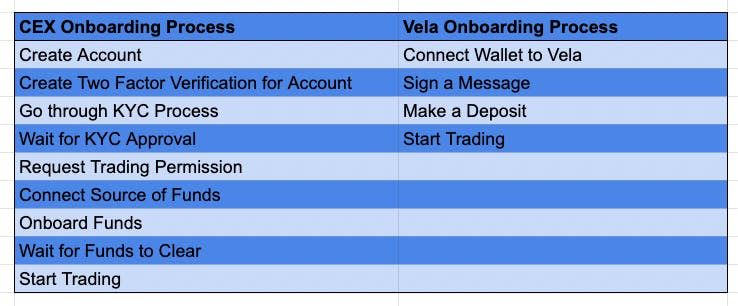
Therefore, from a user onboarding perspective, Vela is much easier than CEXs. But there's an even more important advantage: Vela is non-custodial, so you can withdraw your funds at any time. Vela’s smart contracts have been audited, meaning you’re interacting with a transparent and verified public platform. If you can get funds into a crypto wallet, you can make better use of Vela.
Understanding Perps
Crypto trading can be divided into two distinct parts.
Spot asset trading is the most familiar way to trade crypto—"spot" assets refer to actual underlying assets—I want 1 BTC, so I buy it.
The other class of assets traded among crypto traders are derivatives: options, futures, and crypto’s most popular product: perpetual futures.
Perpetual futures, also known as "perps," are the primary method traders and investors use to gain leveraged exposure to assets. They are tools that make it very easy to obtain leveraged long and short positions. Perps offer several advantages:
-
They provide a similar method to create leveraged crypto exposure.
-
They do not require custody of crypto assets.
-
Like other futures contracts, there’s no need to worry about expiration dates.
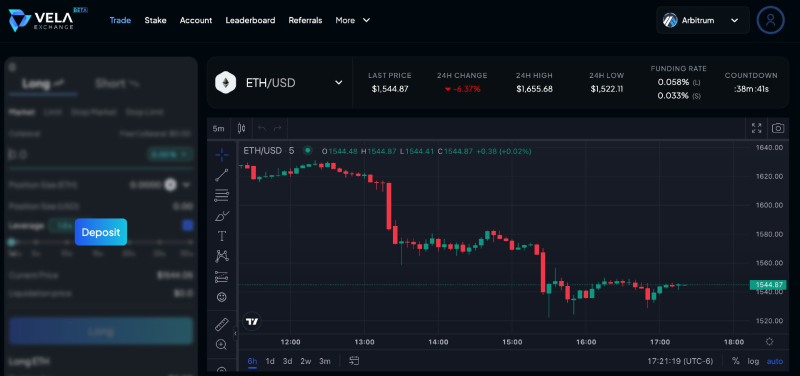
Vela has an interface similar to most exchanges, both centralized and decentralized. If you’ve traded perps before, it will feel familiar. The interface looks like this:
What Makes Vela Unique?
If Vela wants to be a strong contender in the Perp DEX arena, it needs to stand out.
Vela offers several unique value propositions:
-
An upcoming airdrop reward program to reward early users and attract users from other platforms.
-
Extended reward periods to incentivize liquidity provision.
-
Up to 100x leverage, higher than many competitors.
-
Forex-style trading pairs.
-
A token buyback model designed to stabilize price.
-
Novel trading pairs based on asset market caps (e.g., total crypto market cap).
-
Trader-friendly integrations (bot integration, notifications, etc.).
-
Built-in integration for peer-to-peer OTC swaps.
Of course, all these features give Vela a distinctive selling point. And its liquidity model, called VLP, will take it even further. In essence, VLP allows users themselves to become the house.
Understanding VLP
VLP is a large pool of capital (denominated in USDC) provided by people like you and me, which VELA leveraged traders use for trading. Here’s how it works:
Let’s say Bob is a trader who wants to open a 10x long position on ETH. He deposits $100 into VELA to buy 1 ETH perp worth $1,000 (100 x 10 = 1,000, 10x leverage). We are VLP holders who mint VLP by depositing USDC into the exchange’s liquidity pool.
If ETH drops to $900, Bob gets liquidated, and we as VLP holders receive his $100—we acted as the counterparty to his trade. We also collect his funding fee (the cost Bob pays to “borrow” the $900 in capital he used) and trading fees. That’s a pretty good deal for us.
If ETH rises to $1,100, we have to pay Bob. Traders win sometimes and lose sometimes, but overall, over time, they lose. We still earn his funding fee and trading fees, plus some eVELA (see below for details) as a bonus. Since traders sometimes win, the VLP price may fluctuate. But because traders tend to lose over time, the VLP price may trend upward.
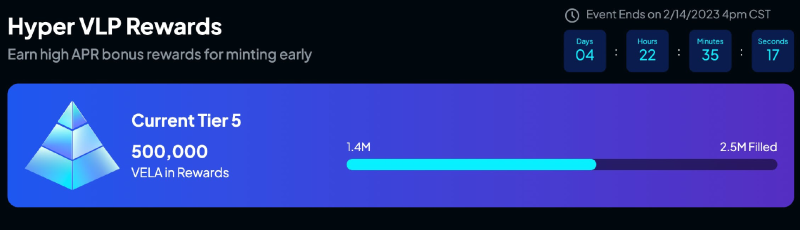
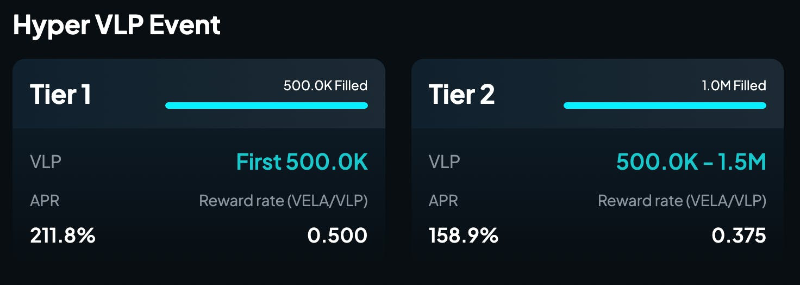
It’s important to note Vela’s current promotional campaign. To attract liquidity to the platform, Vela is offering additional rewards to those providing liquidity. The more VLP you provide, the more rewards you earn, with a total of $1,250,000 in rewards distributed based on the current VELA token price. This makes LPing more attractive to users. During this period, minting VLP incurs no fees—an extra incentive, since fees are typically around 0.3%.
Its early APR figures are astonishing:
eVELA, Staking, and Vesting
A balanced token economy is part of what drives Vela forward in the crypto space. Balancing revenue and expense design is critical to creating long-term value for token holders.
Through its tokenomics model, Vela achieves balance in value distribution across the following areas:
-
VLP holders, who earn fees for providing liquidity.
-
VELA token holders, who must also earn a portion of platform fees.
This is achieved through a third token: eVELA. eVELA, or escrowed VELA, is a mechanism to reward different stakers without increasing selling pressure on the VELA token itself.
It’s somewhat like issuing stock options—a promise to deliver VELA in the future. Vela allows you to earn eVELA in two ways:
-
As part of the VLP rewards structure.
-
By holding the VELA token directly.
Staking eVELA allows you to:
-
Receive VELA from fee buybacks—essentially regular dividends paid to holders.
-
Earn a share of the USDC generated by the exchange.
-
Collect trading fees.
-
Accumulate additional eVELA.
-
Access other platform fees.
Competitor: GMX
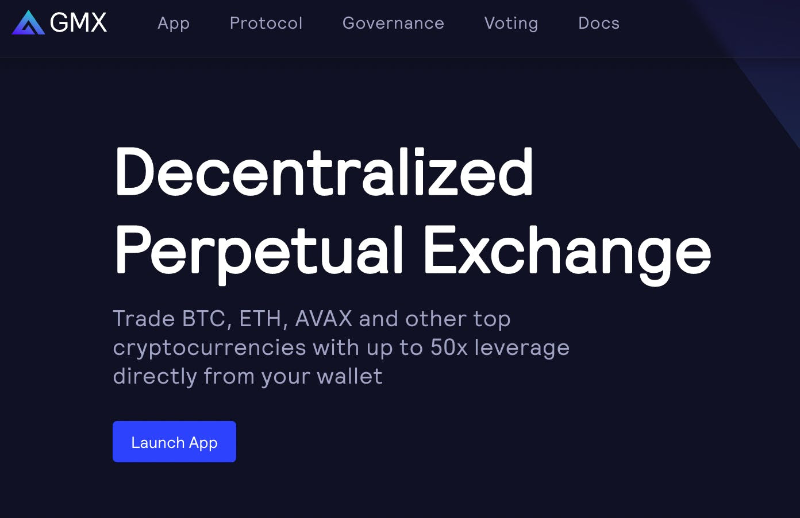
Before GMX emerged, there were already some decentralized perpetual exchanges, but the GMX team was the first to solve the dilemma of decentralized crypto trading.
The main challenge was how to create liquid markets for perps while building a strong value accrual model for the token. Other decentralized exchanges struggled to attract institutional market makers.
Their biggest breakthrough was their liquidity model, which enables passive liquidity. This is very similar to VLP, except that GMX uses a basket of volatile assets instead of simply using USDC like Vela does. GMX is a major player in this space and has spawned a wave of competitors. Vela competes with GMX and other exchanges primarily in the following areas:
- Trading pairs
- User interface
- Tokenomics
- Approach and strategy
- Marketing
Is there room for more than one major player? Given the lack of new choices in the perpetuals space, this corner of crypto is being filled in, with each project bringing new variations and angles. The industry tends toward consolidation, especially during bear markets, and due to winner-take-all dynamics in the Perp DEX space, we’re likely to see some consolidation. With several unique selling points, a novel USDC-based (rather than volatility-based) tokenomic model, and an experienced team, Vela is well-positioned to pose a serious threat to GMX’s success.
Why Haven’t Perp DEXs Taken Off Yet?
With censorship-resistant products, seamless login, solid liquidity, and strong user experience, DEXs seem more appealing than custodial exchanges that might spend your deposits on Bahamian real estate.
Yet only the largest decentralized exchanges have surpassed $100 billion in total volume, with Uniswap being the only DEX to exceed $1 trillion in trading volume. Meanwhile, Binance completes roughly $50 billion in trading volume every week—equivalent to twice GMX’s lifetime volume every two days. Optimists would say there’s huge growth potential in this space, while pessimists wonder why DEX trading volumes remain so small compared to centralized exchanges.
I lean toward optimism here, but also realism: in doing so, I aim to fairly outline the barriers facing DEXs and their widespread adoption. On a ten-year horizon, ideologically, DEXs clearly have the upper hand—and technically and in terms of adoption pathways as well. Before 2020, there wasn't a single usable Perp DEX in the industry; now we have many. However, the biggest issues that still need to be addressed are:
1. Awareness

Decentralized exchanges don’t buy Super Bowl ads, sponsor F1 teams, or appear before congressional panels. This stems from the decentralized nature of DEXs and the fact that, compared to established crypto exchanges, DEX projects are often smaller, scrappier startups. But this isn’t always the case—Vela shows that Perp DEXs can compete using native crypto-native tactics:
- Offering airdrops
- Using NFTs to bootstrap community
- Providing higher yield incentives
2. Robustness
The first competitive advantage of centralized exchanges parallels tightly around robustness, with a model summed up as “just trust us.” Some of the most obvious advantages of DEXs stem from their non-custodial nature—anyone can withdraw assets at any time, whereas CEXs send emails and freeze funds arbitrarily.
Both CEXs and DEXs are vulnerable to hacks, but the risks differ—Vela faces smart contract risk, where funds could be exploited, while CEXs face custody risk, where hackers gain access and drain user funds.
In theory, an “honest” exchange should always be able to compensate its customers (though in FTX’s case, they couldn’t). Vela’s liquidity model implies there’s a maximum scale for profitable trades. Gains Network experienced this when the LUNA short drained their liquidity pool. Later, a GMX developer attempted a similar manipulation of Avalanche’s price to profit from zero-slippage swaps.
Robustness between CEXs and DEXs is debatable, but it’s clear that decentralized exchanges are improving faster than traditional centralized ones.
3. Liquidity
Liquidity is a game that tends toward a single winner, as we’ve seen with Binance over the past few years. Exchanges collapse and merge until one dominant player emerges—one with the best liquidity, making it hard for new competitors to enter.
Order-book-based exchanges like dYdX tried solving this by incentivizing market makers with rebates, but that strategy only led to long-term downward pressure on their token prices. Liquidity models like Vela’s VLP solve this—fees, borrowing interest, and trader PnL are all paid from the VLP pool. As long as traders lose money on average, liquidity begets liquidity. Since the protocol also takes a cut of fees, the VELA token holds intrinsic value.
4. Interface
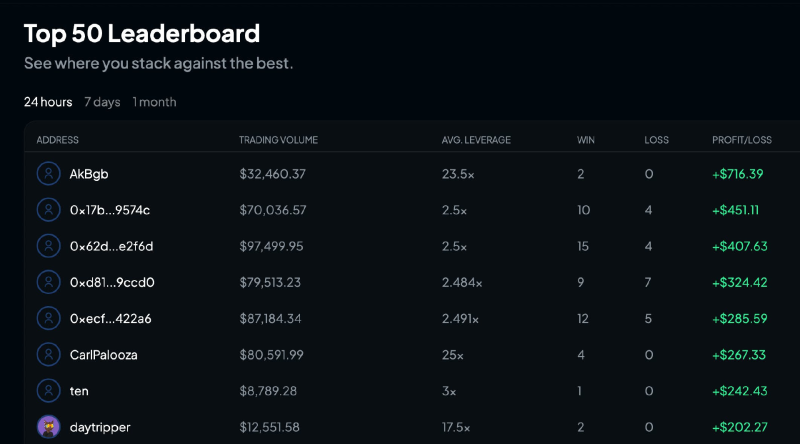
User interface and experience are extremely important. Generally, centralized exchanges have an edge here, offering better UX, instant usability of deposits for trading, and faster addition of new tradable assets by a central entity.
Vela’s interface closely resembles that of CEXs, and DEXs like this might even have an advantage—enabling others to build new front-ends on top. Imagine a lending platform that lets you borrow against your Vela positions, or a front-end specifically designed for institutional traders.
5. Collateral
Exploring different collateral models and types is another competitive advantage of centralized exchanges—but it depends on what kind of user you are and how you prefer to trade. FTX was known for allowing coin-denominated margin perpetuals, enabling users to trade ETH-BTC perpetuals, for example.
The mechanism works like this: hold BTC, use leverage to go long on ETH. If ETH rises, your profit is paid in BTC. Now multiple exchanges offer this service—it allows users to gain exposure to two assets in a single trade (if BTC goes up and ETH goes up even more, traders can earn massive profits). In bull markets, it can generate huge returns for traders.
Conclusion
If you've been paying attention, most signs point to one thing: we’re on the brink of an explosion in on-chain crypto trading activity. dYdX was first, then GMX, and now a wave of new projects are iterating and improving upon their predecessors.
If you’re a trader, the benefits of using a DEX are clear—especially after FTX—and Vela delivers a CEX-like experience. If you’re an investor looking to generate yield on your holdings, tools like VLP allow you to profit from the casino effect.
In the coming months, the competition ignited by Vela among perpetual DEXs can only move us in one direction: forward.
Join TechFlow official community to stay tuned
Telegram:https://t.me/TechFlowDaily
X (Twitter):https://x.com/TechFlowPost
X (Twitter) EN:https://x.com/BlockFlow_News
 @cryptoprag