
A Look at the Cryptocurrency Venture Capital Landscape: Which Are Today's Top Early-Stage VC Funds?
TechFlow Selected TechFlow Selected
A Look at the Cryptocurrency Venture Capital Landscape: Which Are Today's Top Early-Stage VC Funds?
When founders consider which investors to partner with, it's important to focus on funds with a track record of successfully investing in early-stage companies.
 Navigating Web3 tides with focused insights
Written by: ELI NUSS
Translated by: TechFlow
The purpose of this article is to use data-driven analysis to highlight the top early-stage cryptocurrency venture capital funds. It aims to serve as a resource for founders raising capital and for capital allocators looking to invest in this space.
Venture Fund Landscape
Since 2018, over 3,300 venture funds have entered the crypto space. Among them, only 339 have made 10 or more investments since early 2021—indicating that most are transient investors rather than dedicated, active crypto funds.
We can break down these 339 active crypto funds into two relevant subcategories:
-
190 funds are actively investing at the early stage, defined as having made at least 10 pre-seed or seed investments since early 2021.
-
Among these early-stage active funds, 40 were launched in 2020 or later—emerging managers.
Early-Stage Deal Trends
Since early 2021, there have been over 1,500 early-stage (pre-seed and seed) crypto fundraising rounds, raising nearly $7.5 billion with a median round size of $3 million. Given the large volume of investments, we used a data-driven approach to assess the quality of these 1,500 rounds—measured by how many companies went on to raise a follow-on round. Path dependency is an important factor in early-stage investing; companies that proceed to subsequent funding rounds are more likely to achieve long-term success. This has been well supported by extensive research.
The chart below shows the number of early-stage funding rounds from January 2021 to March 2022, broken down monthly, along with the number of companies within each cohort that have already raised follow-on funding. We chose this time frame because it best represents the current seed landscape in crypto venture—it includes both emerging and established managers. We excluded company cohorts founded after March 2022, as they are not yet mature enough to reliably secure follow-on rounds.
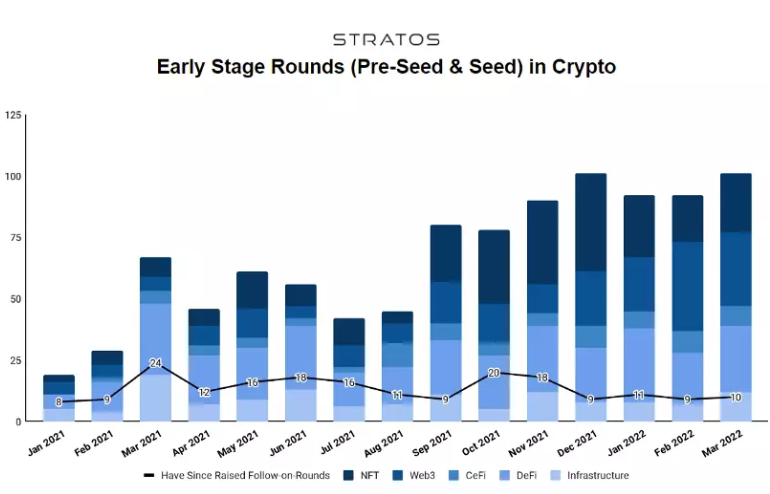
From January 2021 through March 2022, nearly 1,000 early-stage funding rounds occurred. DeFi was the most popular category, accounting for 31%, followed by NFTs, Web3, infrastructure, and then CeFi. Over time, the number of monthly rounds increased significantly—19 in January 2021 compared to 92 in January 2022. Interestingly, the number of DeFi and infrastructure deals remained relatively stable throughout the period. Most of the growth came from NFT and Web3 categories, which dominated deal flow starting from September 2021.
As expected, only a small fraction of companies that raised early-stage funding during this period went on to secure follow-on financing—approximately 20%. Over time, we expect this percentage to increase, as strong-performing companies typically raise their next round 12–18 months after their initial seed round.
To understand the types of companies included in this dataset, the table below lists the top 20 companies that first raised funding between January 2021 and March 2022, ranked by the amount raised in their follow-on round:
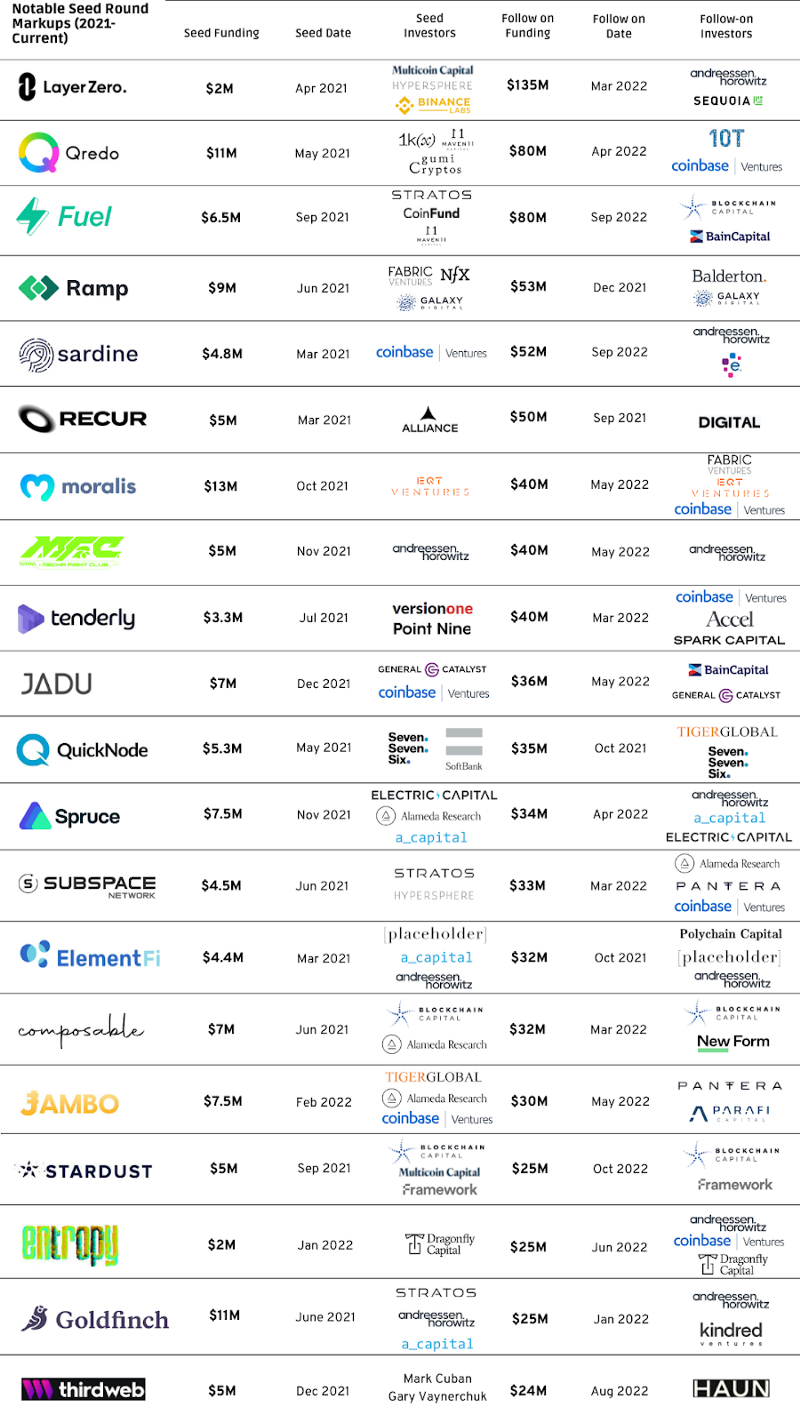
Sector details are telling: 4 out of the top 5 and 12 out of the top 20 companies are infrastructure-related.
Given that only 16% of early-stage funding went into infrastructure, this sub-sector appears to be outperforming others. This includes scaling solutions like Fuel and Subspace, as well as centralized infrastructure providers like Moralis and QuickNode.
Recur is the most well-funded NFT company, raising a $5M seed round followed by a $50M follow-on.
Element Finance and Goldfinch Finance lead in DeFi, raising $32M and $25M respectively.
Several funds appear multiple times across the data.
Hypersphere, Maven 11, Stratos, A_capital, and Andreessen Horowitz each appeared in at least three of the top 20 early-stage rounds.
The list below shows funds that invested in at least five early-stage companies between 2021 and 2022 that have since raised follow-on funding:
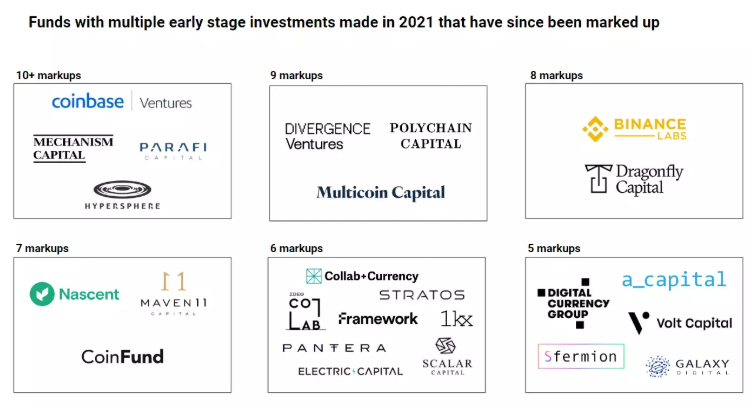
The chart above highlights investors with the highest frequency of backing top early-stage companies. The list includes most of the well-known names in the space.
Coinbase Ventures leads with 22 marked seed investments.
To gain a more accurate understanding of a fund’s investment judgment or “hit rate,” it’s important to consider their total number of investments during the same period. Some investors simply deploy more capital and thus naturally back more winners.
The next chart accounts for this by showing the follow-on or markup rate:
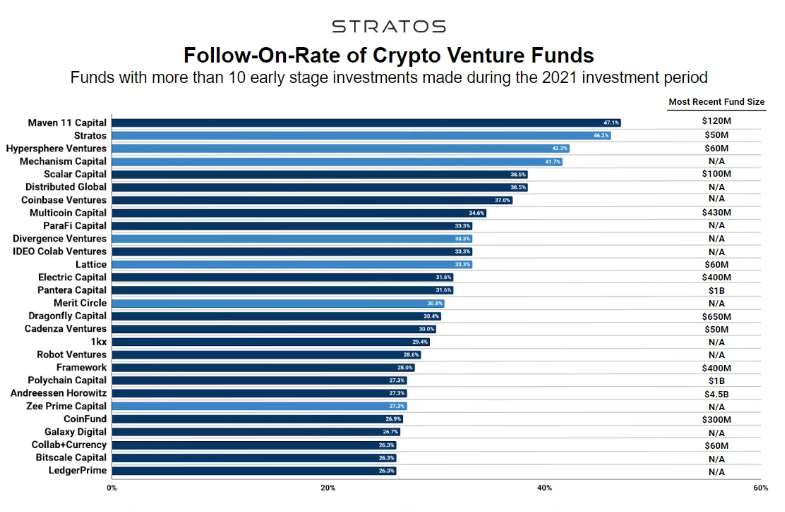
In this dataset, Maven 11 leads with 8 out of 17 early-stage investments leading to follow-on rounds. Notably, 3 out of the top 4 performing crypto VC firms are emerging managers. Given that only 21% of active early-stage crypto funds are newly launched, this suggests newer funds may have higher hit rates than established ones.
Another interesting observation is that the funds with the highest follow-on rates recently raised funds in the $50M–$150M range—the smaller end of the 2021–2022 vintage year for crypto venture funds.
If we assume that follow-on rates are predictive of future portfolio success, and that this group of companies represents a significant portion of these funds’ capital deployment, then smaller funds are likely to outperform larger funds over time.
Conclusion
There are currently 339 funds actively investing in crypto. However, data shows that only a select few emerging and established funds consistently back high-quality companies at scale.
When founders consider which investors to partner with, it’s critical to focus on funds with a proven track record of investing in successful early-stage companies. The data above aims to help founders identify the best-performing funds in early-stage crypto, particularly those whose early involvement increases the likelihood of successful follow-on fundraising.
Statistics show that companies failing to raise a follow-on round after their seed financing are extremely unlikely to succeed long-term. Top early-stage funds can help increase the odds of follow-on funding through targeted support and relationships with later-stage investors.
Founders should also weigh the pros and cons of partnering with early-stage specialists (e.g., Nascent, Maven 11, Stratos) versus full-lifecycle funds (e.g., Pantera, Polychain, a16z). Smaller, early-stage-focused funds often offer deeper involvement and more hands-on support, while larger, full-lifecycle funds provide greater resources and stronger capacity to deploy capital over time.
Another consideration is sector specialization. Some investors focus on infrastructure, while others specialize in DeFi, gaming, etc.
Join TechFlow official community to stay tuned
Telegram:https://t.me/TechFlowDaily
X (Twitter):https://x.com/TechFlowPost
X (Twitter) EN:https://x.com/BlockFlow_News
 @nuss_eli