








How can NFT project treasuries achieve transparent governance?
TechFlow Selected TechFlow Selected
How can NFT project treasuries achieve transparent governance?
NFT projects are not hedge funds; treasury funds are meant to grow the business.
 Navigating Web3 tides with focused insights
Written by: Teng, Researcher at Delphi Digital
Compiled by: TechFlow
2022 will forever be etched in our memories. Let's count the collapse events:
-
Terra/Luna’s death spiral: Retail + funds harmed. Massive forced liquidations.
-
3AC + Celsius collapse: Retail + funds + lenders harmed.
-
FTX / Alameda bankruptcy: Retail + funds + lenders + project treasuries harmed.
-
Will DCG / Genesis be next?
Those still here today are either true believers in crypto or gamblers who can’t quit.
For many, FTX’s shocking bankruptcy was the final straw. The extent of lies, fraud, and blatant misuse of customer funds by SBF and his inner circle is nauseating. $10 billion in customer funds vanished into thin air—only uncovered during a bank run.
If there’s one common thread across these explosions, it’s a severe lack of transparency. How ironic for an industry that prides itself on ideals of transparency and decentralization via blockchains.
Did the FTX fallout impact NFT teams?
After the explosion, I spent time looking into NFT teams to assess how heavily they were affected by the FTX situation.
Among the 36 teams I reviewed:
🔸 5% had significant exposure to FTX;
🔸 8% had minor risks but no major operational impact;
🔸 87% were unaffected.
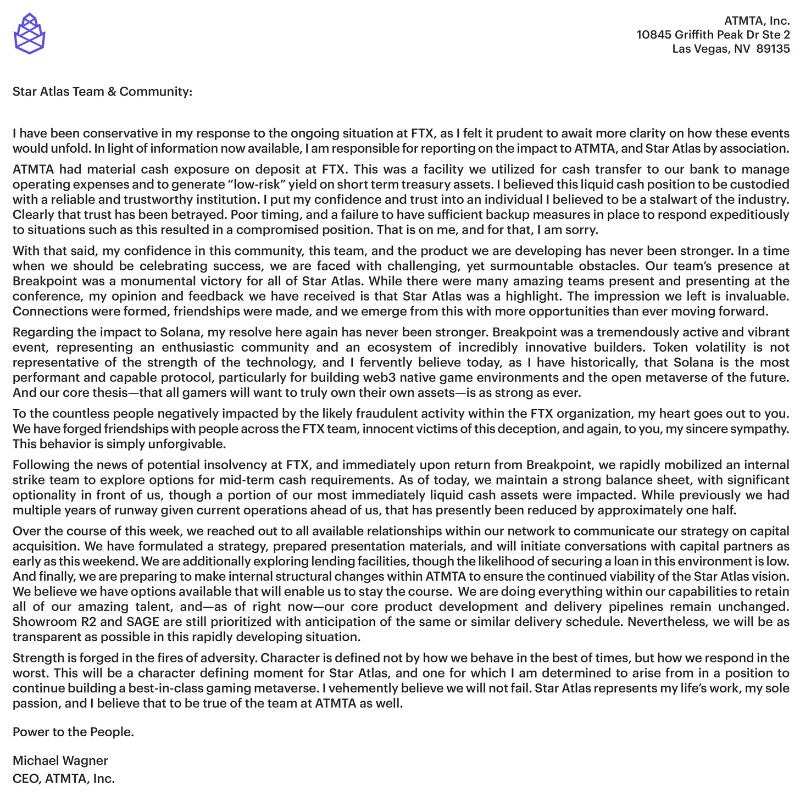
Two teams were severely impacted: Star Atlas (an AAA game under development on Solana) and bywassies (loomdart’s memetic PFP brand).
-
For Star Atlas, this is a survival crisis. They had around 50% of their treasury funds on FTX seeking “low-risk” yields. The team previously raised $10 million from VCs and is far from launching the game. Given the resource demands of an AAA game, we’re uncertain if they can fully deliver. To make matters worse, Star Atlas is built on Solana, which currently faces its own existential crisis.
-
bywassies had 60% of their liquid cash on FTX (now lost). However, the team stated they will continue building the brand along their roadmap. For a PFP, direct impacts are less severe. IRL activations and brand-building efforts may slow down, but the community remains central. Thankfully, most NFT teams were not directly affected.
Transparency over semi-transparency
What I found interesting is the clear divergence among teams regarding transparency and risk management.
On one end, some teams quickly and publicly shared their risks and how much cash they held.
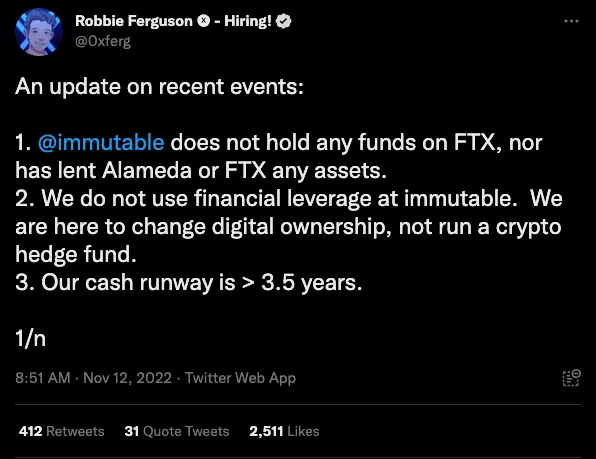
On the other end, some semi-transparent teams couldn’t be bothered to issue public statements, simply replying “we’re fine” when asked by community members.

Some teams still hadn’t spoken about their exposures even a week later. Silence speaks volumes here.
Community ownership = greater transparency
NFT teams are a peculiar type of organization. Many start with just a creative idea and bootstrap their way into existence. Often, teams raise initial funds by selling NFTs without involving professional investors. Founders are kings here, with no rules.
Crucially, NFT teams have communities who believe in their vision and are often willing to financially support them. Community members are typically eager to back them economically and participate in co-creation. Their success depends heavily on their community. It’s this symbiotic relationship that makes Web3 so fascinating.
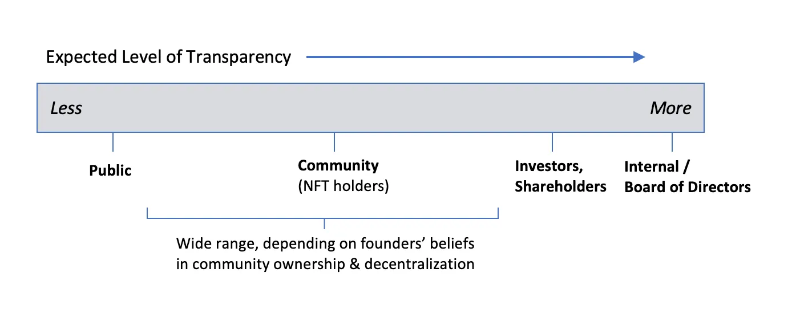
In my view, NFT holders (i.e., the community) represent an ownership class between token holders and the general public. The expected level of reporting and transparency toward the community should lie between—and lean closer to—expectations for shareholders.
While no legal framework enforces this, the degree of transparency founders choose to pursue reflects how deeply they believe in decentralization and community ownership. If they truly see community members as “shareholders,” they’ll strive for higher trust and transparency within the community.
A transparency framework for NFT teams
I’ve taken the liberty to draft a 3-tier transparency framework for NFT teams.
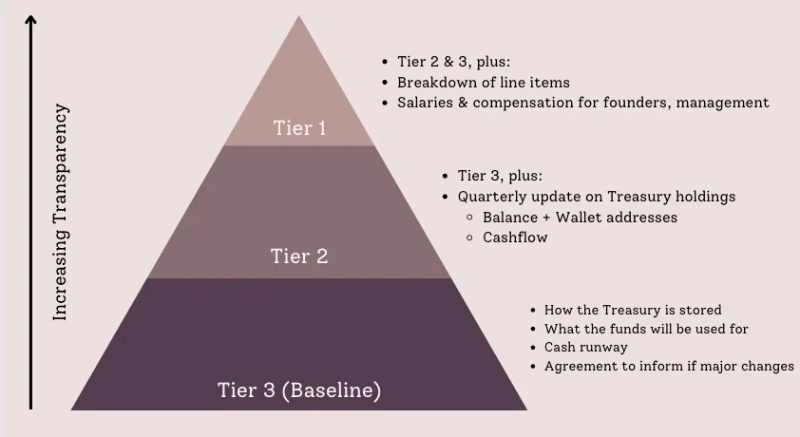
Tier 3 (Baseline)
-
How and where treasury funds are stored, including who has access (e.g., multisig signers).
-
What are the funds used for?
-
Willingness to update the community on any major changes.
-
Regular updates on projected cash flow: How long can the project operate before funds run out?
These four points are the basic expectations we should have for any NFT team. Concise, requiring minimal effort, yet powerful in building trust. Over time, as teams gain confidence and see the benefits of transparency, they can elevate themselves through the tiers. Teams failing to meet this baseline should raise red flags.
Tier 2
-
Meets all Tier 3 conditions;
-
Quarterly treasury updates:
a. Treasury balance and wallet address;
b. Cash flow: Total income vs. total expenses.
In tech, VC-backed startups often must provide monthly cash flow reports to key investors. Similarly, if Web3 teams treat their communities as partial investors, they should share financial balances and cash flows.
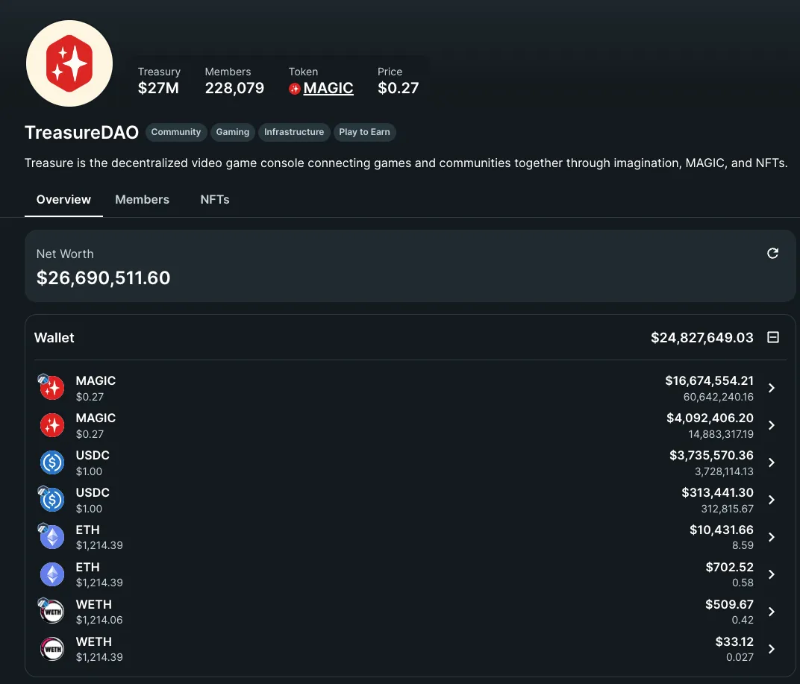
A prime example is TreasureDAO, a decentralized “Nintendo.” They publicly share their treasury wallet addresses and allow members to easily track treasury value and usage in real-time via Zapper.
Tier 1
-
Includes all Tier 2 and Tier 3 items;
-
Detailed breakdowns of various expenditures, including founder/management salaries and compensation.
This is the highest level of transparency. It requires maintaining proper accounting records and founders adopting an open mindset. Some Web2 companies like Buffer have set precedents. They publicly disclose all employee salaries, treating it as a way to build a culture of trust.
Let’s avoid Ragnarok-style scenarios—the project raised $17.5 million from NFT sales during this year’s bull market, with the founder paying himself $1.2 million annually while also losing $1 million of treasury funds through trading.
Actions speak louder than words. NFT teams that loudly champion community ideals but deliberately avoid discussing finances are hypocritical. Beware—they likely see members merely as customers.
Startups, not hedge funds
Last note: NFT projects are not hedge funds. Treasury funds are meant to grow the business.
Using treasury funds for trading or yield staking without informing the community (or investors) is a serious breach of trust. For the vast majority of teams, keeping funds safely as cash in banks or non-custodial multisig wallets should be the gold standard.
Looking ahead, I foresee potential businesses from mature financial institutions helping well-funded startups manage finances while minimizing risk.
The failure of FTX-Alameda-SBF has taught us a harsh lesson about transparency.
Founders need to hold themselves and their teams to higher standards.Community members must do their part to ensure their teams remain accountable.
Otherwise, we’ll never be treated as a legitimate industry. Star Atlas is an unfortunate victim—but it could have been avoided.
Join TechFlow official community to stay tuned
Telegram:https://t.me/TechFlowDaily
X (Twitter):https://x.com/TechFlowPost
X (Twitter) EN:https://x.com/BlockFlow_News
 Delphi Digital






