CIG Labs Lao Duo Seminar | Arbitrum Upgrade: Is the End of the Odyssey 100X?
TechFlow Selected TechFlow Selected
CIG Labs Lao Duo Seminar | Arbitrum Upgrade: Is the End of the Odyssey 100X?
Will the main narrative of the next bull market be the "Three Heroes of L2 versus Luyu"?
 Navigating Web3 tides with focused insights
Author: LaoDuoDaniel, CIG MOD (Twitter @LaoDuoEth)
Editor: Arain, Core Member of CIG (Twitter @arainqinqin)
Produced by CIG Labs
All discussions in this article are for academic purposes only and should not be taken as investment advice.
On Wednesday, September 7 at 8 PM, LaoDuoDaniel hosted a "web3 alpha" Twitter Space via CIG DAO, centered around Arbitrum's upgrade and the upcoming restart of Odyssey. He was joined by Amber Group blockchain analyst Laobai, 33DAO airdrop interaction expert Fengmi, and JasonWan, Arbitrum’s APAC Integration Engineer. They discussed the impact of Arbitrum’s upgrade, notable projects to watch, and shared insights on potential airdrops and capital outlooks related to Arbitrum.
Arbitrum is an Optimistic Rollup Layer 2 scaling solution for Ethereum, developed by Offchain Labs. It offers trustless security, seamless compatibility with Ethereum, high throughput, and low transaction costs.
On August 31, Arbitrum successfully completed its Nitro upgrade. While the Odyssey campaign has not yet restarted, data shows that Arbitrum and Arbitrum Nova gained over 60,000 new users during the first week of September. Notably, Arbitrum has not officially announced any token issuance plans—but this topic was discussed during the Space.
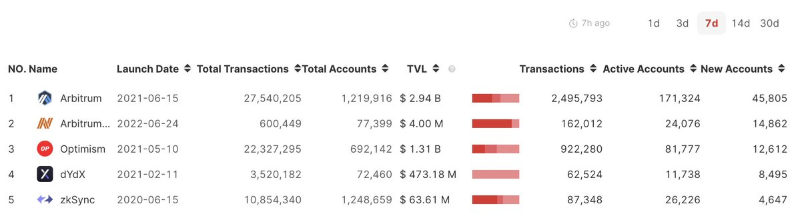
Data source: https://www.orbiter.finance/data
Below is LaoDuo’s “web3 alpha” interview notes:
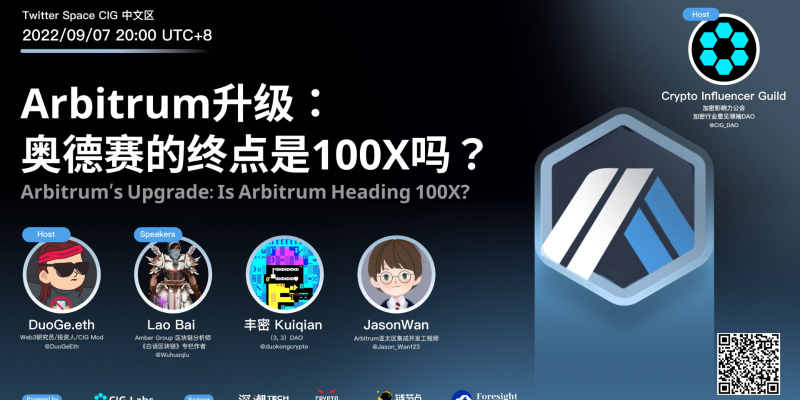
Nitro Upgrade: Faster Transactions, Lower Fees
In the L2 race, Optimism took the lead by launching its token, while Zksync and StarkNet loom large on the horizon—especially StarkNet, which enjoys significant popularity. Will the next bull market narrative revolve around an epic battle among three L2 titans?
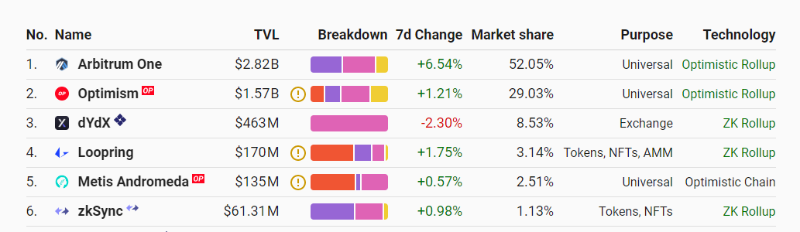
Data source: https://l2beat.com/scaling/tvl/
Currently, Arbitrum leads both in total value locked (TVL) and number of projects. After the Nitro upgrade, daily transaction volume surged rapidly. On-chain transaction speeds improved significantly, with average gas fees dropping by 80%.
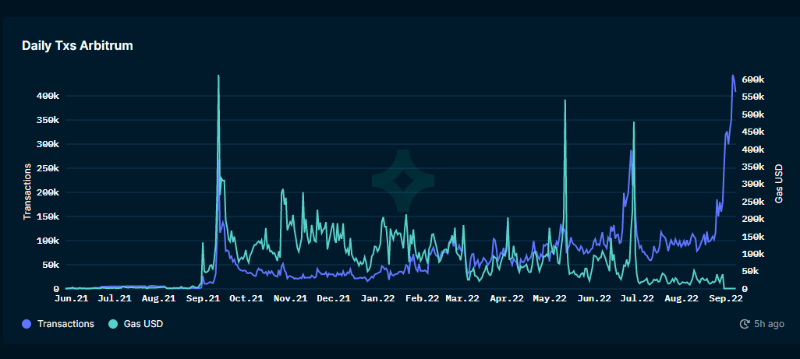
Data source: https://pro.nansen.ai/multichain/arbitrum
Jason explained that Nitro was a technology announced last October, effectively replacing Arbitrum’s entire codebase. The GitHub repository was migrated to a new Nitro-based one—a massive engineering effort.
For users, this change translates into lower gas fees. Most gas costs come from data archiving on L1 (Ethereum mainnet). Arbitrum introduced a compression algorithm that reduces archived data size, significantly lowering these costs. Additionally, a lighter, more streamlined system architecture was implemented, improving efficiency and making transactions feel faster.
For developers, improvements were made to RPC interface compatibility, making it easier to integrate with Arbitrum.
Laobai pointed out that after the upgrade, swap gas fees on Arbitrum can drop as low as $0.05, and TPS increased 10–20 times overall. He believes the重启 of the Odyssey campaign will be able to accommodate far more users than before.
Ethereum’s Future Gas Fees Could Drop to $0.01
"Simply put, Nova is like a more secure Polygon. In contrast, Nitro is a standard, secure Layer 2, while Nova trades a small amount of security for higher speed and lower fees. Therefore, Nova is better suited for high-frequency, low-value applications like GameFi, whereas Nitro is ideal for DeFi and NFTs."
— Laobai
Laobai noted that six months after the ETH merge, when EIP-4488 is implemented, calldata costs will decrease fivefold, potentially bringing gas fees down to $0.01. At that point, Ethereum could compete directly with so-called high-performance chains like Solana or Fantom. Then, in about 1–2 years, when EIP-4844 rolls out, calldata will be replaced entirely by Blob data structures capable of storing vast amounts of L2 data. Crucially, this data won’t compete with other L1 economic activities for gas—it will have its own dedicated fee market, resulting in lower and more stable costs. Thus, L2 fees could eventually become even cheaper than Solana’s current rates.
Laobai believes that over the next 3–5 years, Ethereum L2s will gain substantial performance and cost advantages in the multi-chain landscape. We may also see the full realization of Danksharding—the true form of sharding—where different rollups attach to different shards, possibly enabling hundreds of application-specific chains to operate as rollups on Ethereum. This would create an immensely expansive ecosystem.
Odyssey Will Restart, But Challenges Remain
“Odyssey” comes from Homer’s ancient Greek epic, symbolizing a long and arduous journey home. Arbitrum named this user engagement campaign “Odyssey,” likely reflecting their vision for participants’ experiences.
The Odyssey campaign launched in June, originally planned for eight weeks. However, due to rapid user growth causing congestion on Arbitrum One, the event was paused after just two weeks.
Now that Nitro has been upgraded, will Odyssey resume?
Fengmi shared his hands-on experience: although transaction speeds are faster and fees cheaper, “RPCs are still hard to use.”
He had raised this issue before the Odyssey campaign began, and it persists today. He believes that if Arbitrum restarts Odyssey now, similar problems may reoccur—during traffic spikes, users might face errors and failed transactions.
Jason responded that this stems from L2 mechanics: when transaction volume exceeds capacity, the sequencer rejects some transactions instead of including them all in a block. To address this, the Arbitrum team continues to improve scalability, increasing the number of transactions that can be processed simultaneously.
“The Odyssey campaign will definitely restart, but everyone needs to wait patiently for the official announcement. As for the content, it will largely follow the original plan unless individual protocols have updated arrangements after coordination,” said Jason.
User Guide: How to Capture Opportunities on Arbitrum?
Fengmi believes participating in Odyssey remains worthwhile. Users who complete 13 out of 16 tasks can earn the final Odyssey NFT, proving themselves as valuable, heavy users of Arbitrum. The cost to obtain NFTs through protocol interactions is relatively low, and given future airdrop expectations, the risk of loss is minimal.
Laobai agrees that Odyssey is worth joining, but stresses that from an airdrop perspective, deep interaction is key—as demonstrated by Optimism’s airdrop criteria.
Which sectors and projects on Arbitrum do the guests find most promising?
Laobai:
Umami, TracerDao, and GMX. Umami uses a neutral trading strategy from TracerDao to offer 3x leverage on Bitcoin and Ethereum, hedging price volatility—an interesting composable derivatives strategy. Users simply deposit stablecoins (U) and earn ~20% APY.
However, recently, due to high volatility in BTC and ETH prices, TracerDao failed to rebalance leverage in time, causing users to lose money instead of earning 20% APY. Fortunately, the team fully reimbursed losses and plans to relaunch V2 soon, aiming to restore the 20% stablecoin APY. While many called Terra’s 20% APY a Ponzi scheme fueled by endless minting, this combined strategy using Umami/TracerDao/GMX theoretically could achieve sustainable, non-Ponzi 20% APY on stablecoins.
(Note: TracerDao has since rebranded to Mycelium. Umami, Mycelium, and GMX have all launched tokens—do not FOMO.)
Notably, DopeX recently launched Atlantic options. The use case isn't fully clear yet, but Atlantic options allow users to temporarily access collateral before expiry, potentially enabling novel strategies. Magic and RageTrade are also fun native projects on Arbitrum. From these alone, I’m quite bullish on Arbitrum’s ecosystem.
Broadening the view beyond Arbitrum, Aptos, Sui, NFTFi, and SudoSwap are also worth watching.
Fengmi:
I mainly focus on the L2 ecosystem, particularly the four major L2 players: OP, Arb, zkSync, and StarkNet. On Arbitrum, I pay close attention to DeFi derivatives projects such as GMX, DopeX, and the DEX Slingshot (token not launched). For NFTs, I follow MAGIC, which has already issued a token.
Arbitrum Airdrop and Tokenomics Outlook
Arbitrum has not officially announced a token launch plan or detailed tokenomics. However, LaoDuo noticed a telling tweet from Arbitrum CEO Steven Goldfeder on April 21: “The appetizer is always served before the main course.”
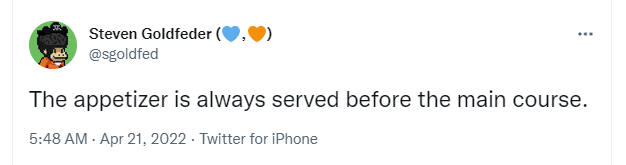
This suggests something bigger is coming. Just days after this tweet, Optimism officially announced its airdrop—fueling speculation that Arbitrum may follow suit.
Fengmi believes there is strong airdrop anticipation for Arbitrum. Since all L2s aim to scale Ethereum and reduce fees, it’s logical that L2 gas fees will eventually be paid in native L2 tokens. Hence, he is confident all major L2s will issue tokens. That’s why he went all-in on L2s last year and remains firm in his conviction.
Laobai also sees strong airdrop expectations for Arbitrum. Given that StarkWare (StarkNet) and Matter Labs (zkSync) have clearly stated their intent to tokenize, and Optimism has already launched, Arbitrum’s eventual token launch is expected—and likely to draw inspiration from Optimism’s distribution model.
Therefore, users may benefit from studying Optimism’s airdrop criteria to increase their chances of receiving an Arbitrum airdrop.
“If you love Arbitrum, you need to use it. So, comprehensive participation across Arb-native projects is essential. Start with the official bridge, then try other cross-chain bridges connecting to Arbitrum. Timing-wise, stay active for the upcoming Odyssey campaign to build up transaction history in your wallet. From a competition standpoint, aim to build a ‘premium account’—that is, achieve deeper engagement than others. Can your wallet address rank in the top 20% of transaction volume within the Arb ecosystem? Can you increase the amount bridged into Arbitrum and boost your number of transaction hashes? Prioritize native Arbitrum protocols that haven’t launched tokens yet,” said Fengmi.
LaoDuo summarized the frequently mentioned Optimism (OP) airdrop criteria, illustrated below:
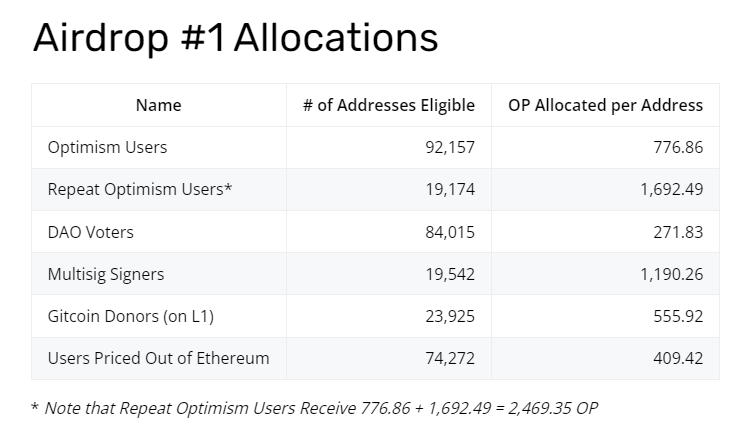
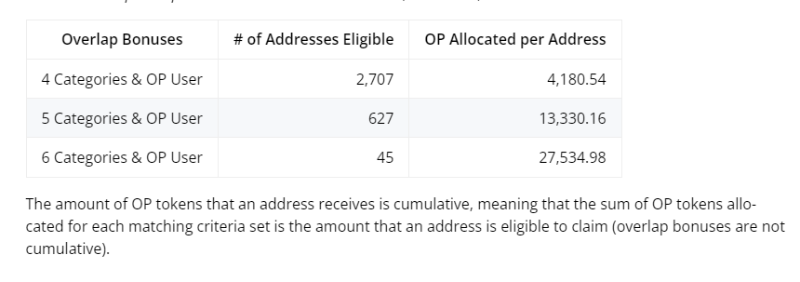
In short, OP’s airdrop targeted six types of users: early adopters, repeat active users, DAO voters, multisig wallet holders, Gitcoin donors, and loyal Ethereum mainnet users. The more categories you qualify for, the more tokens you receive. Meeting four or more criteria granted bonus tokens. Simple math shows a well-crafted premium wallet could earn dozens of times more tokens than a basic eligibility address.
LaoDuo summarized the core airdrop engagement strategies into three aspects:
First, breadth of interaction—consider whether you meet the six dimensions highlighted in OP’s airdrop. Of course, Arbitrum might add additional criteria later.
Second, depth of ecosystem engagement—can you surpass most users in metrics like transaction volume, number of transactions, and diversity of protocols used on Arbitrum?
Third, efficiency of interaction—this involves strategic planning and execution, especially around capital flow, capital utilization rate, and nested interactions across multiple protocols (achieving multiple goals with one action). These require personal experimentation and critical thinking.
If you’re focused on the next bull market peak, could Arbitrum’s token reach a 100X premium in secondary markets? If you're interested in this question and want to learn more about Arbitrum’s ecosystem details and roadmap, check out the recording of this Twitter Space. Follow @CIG_DAO on Twitter for replays, or click the link: https://twitter.com/i/spaces/1yoKMZRaRnXGQ?s=20
Can Arbitrum emerge victorious in the long-term L2 battle and claim the top spot? Currently, zkSync and StarkNet ecosystems haven’t fully entered mainnet phase, so their lagging data is temporary. The winner remains to be seen. If you’d like to explore this further, feel free to reach out to LaoDuo on Twitter—we could organize a future Twitter Space debate on the Layer 2 wars.
All discussion content in this article is for academic purposes only and does not constitute investment advice.
Join TechFlow official community to stay tuned
Telegram:https://t.me/TechFlowDaily
X (Twitter):https://x.com/TechFlowPost
X (Twitter) EN:https://x.com/BlockFlow_News