








Who Controls iBox?
TechFlow Selected TechFlow Selected
Who Controls iBox?
A more pressing question for investors is, who exactly controls iBox?
 Navigating Web3 tides with focused insights
Author: Ma Bangde, TechFlow
NFT, short for Non-Fungible Token, has a Chinese-specific term—digital collectibles. This might be one of today's hottest buzzwords. At the end of 2020, the global NFT market cap was only $317 million. But in 2021, the NFT market exploded, and today the global NFT market cap has surpassed $20 billion.
Digital collectibles cover a wide range—from digital images and music to videos—and once encrypted via digital technology, each gains a unique "digital certificate," giving it collectible value.
However, driven by FOMO sentiment and deliberate "pyramid-style" models, digital collectibles can also devolve into financial schemes.
On April 13, the National Internet Finance Association of China, the Bank of China, and the Securities Association of China jointly issued an initiative titled "Proposal on Preventing Financial Risks Related to NFTs."
The three associations noted that China's NFT market continues to heat up. As an innovative blockchain application, NFTs show potential value in enriching digital economy models and promoting cultural and creative industries. However, risks such as speculation, money laundering, and illegal financial activities also exist.
Recently, iBox has frequently surfaced in online communities. As one of China’s largest digital collectibles issuance and trading platforms, iBox is highly controversial, with many users accusing it of exploiting investors. A key concern for investors is: who actually controls iBox?
Multiple Ownership Changes, iBox Now Independent
Founded in 2021, iBox's official website indicates it belongs to Hainan Lianhe Technology Co., Ltd. (hereinafter referred to as “Lianhe Tech”). According to Tianyancha, on January 14, 2022, Lianhe Tech experienced its first investor equity change since inception.
Former shareholders—Hainan Xinruan Software Co., Ltd., Shenzhen Jiedakang Network Technology Co., Ltd., Shanghai Huoyuan Technology Co., Ltd., Hainan Yingdong Network Technology Co., Ltd., and Hainan Daruitong Network Technology Co., Ltd.—all exited completely.
It was widely rumored that iBox was incubated by Huobi. In reality, as Huobi fully withdrew from mainland China operations, the actual controller of the iBox NFT trading platform also changed hands.
After the equity restructuring on January 14, 2022, Super Starlink Digital Technology Co., Ltd. became the sole shareholder of Lianhe Tech with 100% ownership, making it the ultimate controlling entity. At that time, both Super Starlink and Hainan Lianhe Technology had Li Wei as their legal representative.
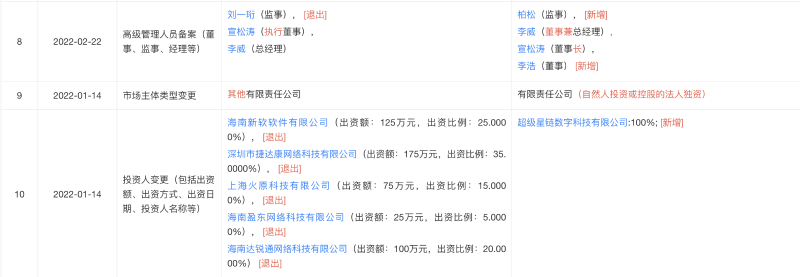
According to the latest information from Tianyancha, Lianhe Tech underwent two additional equity changes on February 22 and March 21 this year. After these adjustments, the current equity structure is as follows:
Super Starlink Digital Technology Co., Ltd., majority shareholder with 50%;
Hainan Lianzhong Internet Service Partnership (Limited Partnership), holding 20%;
Hainan Liancang Internet Service Partnership (Limited Partnership), holding 14.5%;
Shanghai Fumu Technology Co., Ltd., holding 5.5%;
Zheng Haipeng, holding 5%;
Hainan Ducheng Cangqiong Consulting Management Partnership (Limited Partnership), holding 5%.
Among them, Xuan Songtao serves as the managing partner of both Hainan Lianzhong Internet Service Partnership and Hainan Liancang Internet Service Partnership, holding 80% and 60% stakes respectively. Meanwhile, Xuan Songtao owns 10% of Super Starlink Digital Technology Co., Ltd.
Thus, Xuan Songtao emerged as the largest shareholder of iBox’s parent company, Lianhe Tech, with a 29.7% stake, and is also the ultimate beneficiary. Li Wei, serving as director and general manager, holds 22.5%, making him the actual controller of the company.
This means iBox has completely detached from Huobi and become an independently operated digital collectibles platform.
The Inkchain Team Runs iBox
Another noteworthy point: according to Tianyancha, the major shareholders of Super Starlink include Li Wei, Xuan Songtao, Chen Chang, Tang Ling, among others, holding 45%, 10%, 10%, and 5% respectively.
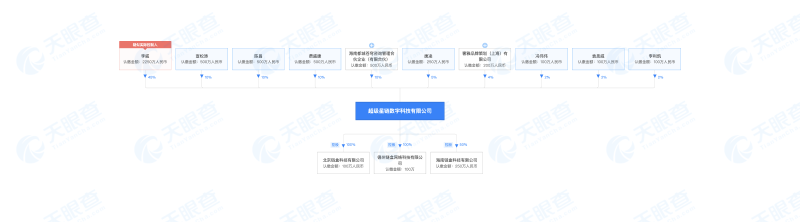
Equity data from Tianyancha shows that Xuan Songtao is a co-founder of Zhigu Tech. According to Baidu Encyclopedia, he initiated the Blockchain Finance Research Center at Tsinghua University, serves as council member of Shaanxi Key Laboratory of Blockchain and Secure Computing, and vice president of Xi’an Blockchain Technology Application Association. He brings extensive practical experience in industrial blockchain, Web3.0, and digital collectibles.
Zhigu Tech was founded in 2016. Officially described as a technology-driven enterprise focused on empowering real economies through blockchain, its service scenarios include supply chain finance, asset digitization, data governance, product traceability, judicial evidence storage, and military applications. The company has completed three rounds of financing so far and built a team exceeding 100 people.
Qimingbei data shows the company has raised nine rounds of funding, backed by investors including Manzi Fund, SAIF Partners, Hongqiao Capital, and Li Zhenguo.
Tianyancha data indicates Tang Ling is chairman and CEO of Zhigu Tech, holding 28.2% shares and serving as the actual beneficiary.
Baidu Encyclopedia states Tang Ling graduated from Xi’an Jiaotong University, is founder and CEO of Zhigu Tech, executive council member of the All-China Federation of Industry and Commerce Science & Equipment Committee, initiator of the Blockchain Technology and Legal Innovation Research Lab at Xi’an Jiaotong University, vice-chairman of the Blockchain Finance Research Center at Tsinghua University School of Economics and Management, and advisory committee member of APEC Future Academy.
Chen Chang is executive president and CTO of Zhigu Tech. A Tsinghua University graduate, he previously worked as a senior researcher at IBM.
Public records show that Inkchain (INK), a blockchain project launched in 2017, was led by Tang Ling, Xuan Songtao, and Chen Chang under Zhigu Tech.
Initiated jointly by Tang Ling and developed primarily by Chen Chang, the project registered trademarks and issued 1 billion INK tokens. At its peak, the number of token holder addresses reached 100,000.

However, after the ICO bubble burst, INK gradually faded into obscurity and entered history.
Following INK, acquiring iBox and entering the digital collectibles market marks Tang Ling, Xuan Songtao, and Chen Chang’s “third entrepreneurial venture.”
Riding the Wave of Digital Collectibles
In recent months, over 60 digital collectibles trading platforms have emerged in China. Internet giants like Alibaba, Tencent, and JD.com have all joined the race.
In June last year, Alipay launched its “AntChain Fanshi Granule” mini-program (now renamed “Jingtan”), releasing two limited-edition payment code skins in collaboration with Dunhuang Art Institute—only 16,000 sets at 9.9 yuan each—sold out instantly upon release.
Two months later, Tencent launched its own digital collectibles platform “Huanhe,” selling 300 limited “audio Black Vinyl NFTs of Thirteen Invitations” at 18 yuan—also sold out within seconds.
The explosion of digital collectibles platforms signaled an opportunity for Zhigu Tech.
On February 28 this year, Zhigu Tech launched its digital collectibles platform “Lijing Collection,” whose first two offerings sold out within 10 seconds.
In an interview, Chen Chang said: “Digital collectibles boomed overseas last year. We began planning in the second half of 2021. From our perspective as industrial blockchain practitioners, past business scenarios were mostly oriented toward government and enterprise clients. Digital collectibles represent a rare native blockchain use case targeting consumers directly, where users are willing to pay. Facing such a promising scenario for blockchain adoption, we decided to dive in ourselves.”
This may explain why Tang Ling, Xuan Songtao, and Chen Chang took over iBox—after all, iBox is already one of the better-known digital collectibles platforms in China.
But controversy quickly followed.
For example, in September 2021, iBox issued 10,000 charity digital collectibles honoring Leslie Cheung, claiming proceeds would be donated to a charitable foundation long associated with him, aimed at helping blind children who lost vision due to childhood accidents. However, afterward, iBox failed to disclose where the funds went or publish any follow-up announcements, eventually deleting the original post.
Later, it was discovered that the issuer of the Leslie Cheung charity collectibles, Xiamen Renxing Investment Co., Ltd., has legal representative Xue Chao, who is also the legal representative of Zhigui Yunke (Beijing) Technology Co., Ltd.—suggesting Zhigu Tech may be acting both as referee and player.
Moreover, the surging popularity of digital collectibles has drawn in many young college students, sparking widespread controversy.
“The digital collectibles industry remains in a regulatory gray zone. Consumers’ payments lack effective protection, and there is no proper complaint or safeguard mechanism, posing risks of fraud or even illegal fundraising,” said Su Xia, senior analyst at Analysys.
Therefore, the biggest uncertainty lies in regulation. Currently, China has neither clearly defined the nature of digital collectibles nor established rules or oversight for related trading platforms—the relevant legal framework remains blank.
Experts suggest that as digital collectibles continue heating up, regulatory authorities should clarify the attributes of digital collectibles and gradually bring them under supervision to promote standardized development of this emerging industry and avoid potential financial or legal risks.
Join TechFlow official community to stay tuned
Telegram:https://t.me/TechFlowDaily
X (Twitter):https://x.com/TechFlowPost
X (Twitter) EN:https://x.com/BlockFlow_News






