TechFlow, April 2 — According to Jinshi Data, on Wednesday, April 2 (U.S. Eastern Time), U.S. President Trump signed two executive orders on "reciprocal tariffs" at the White House, announcing that the United States would impose a 10% "minimum baseline tariff" on all trading partners and higher tariffs on several others.
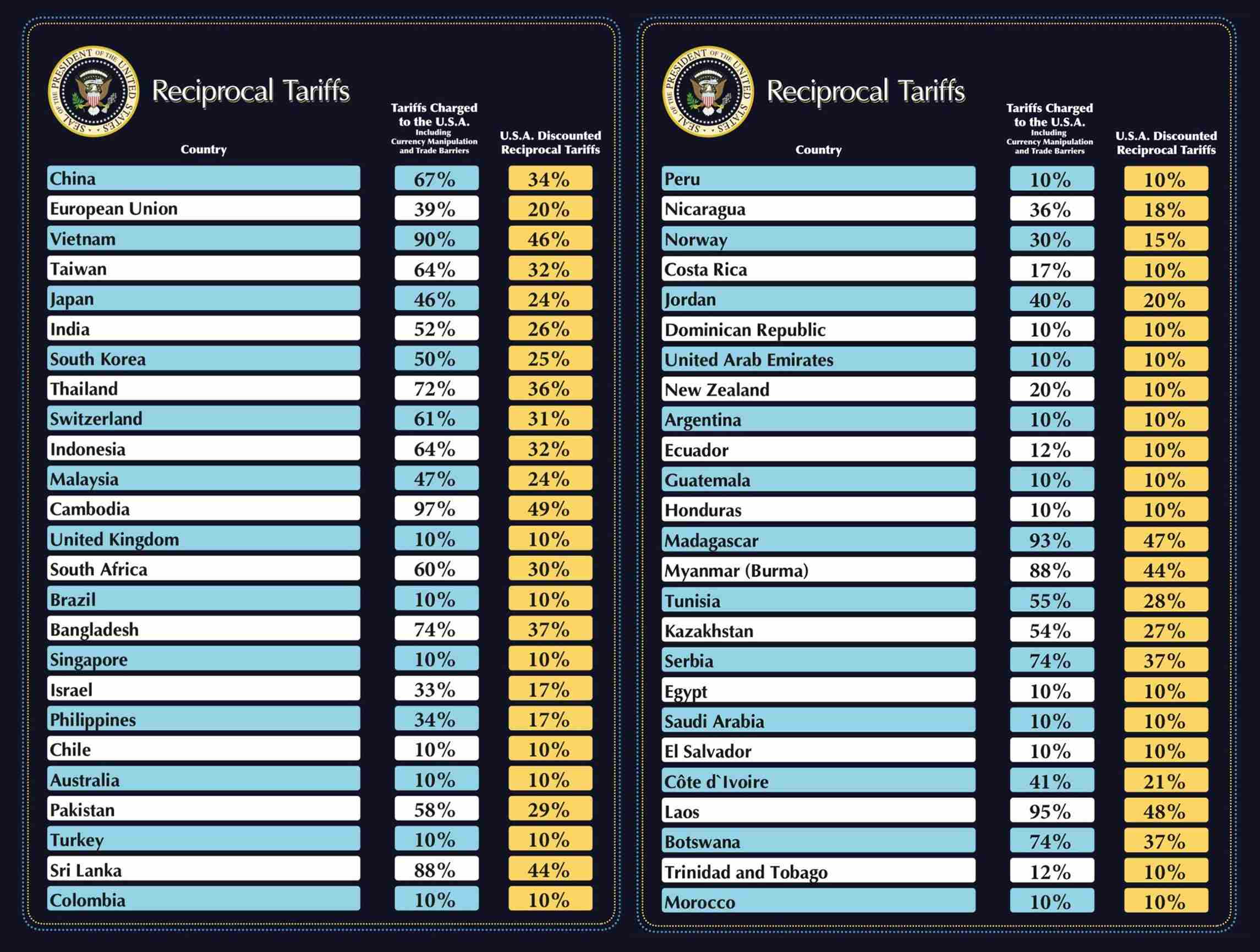
Trump stated that the U.S. would impose reciprocal tariffs on dozens of trading partners, though the tariffs would not be fully reciprocal; instead, the U.S. would collect rates approximately half of the combined total. Trump displayed a poster listing the proposed reciprocal tariffs. The chart showed the U.S. imposing a 34% reciprocal tariff on China, 20% on the European Union, 10% on Brazil and the United Kingdom, 31% on Switzerland, 26% on India, 25% on South Korea, 24% on Japan, 32% on Indonesia, 36% on Thailand, 46% on Vietnam, and 49% on Cambodia.
A senior White House official said the baseline tariff rate (10%) will take effect in the early hours of April 5, while the reciprocal tariffs will come into force in the early hours of April 9. Tariff exemptions for goods under the USMCA will continue, but goods not compliant with USMCA will still face a 25% tariff. Previously, multiple trading partners have indicated they will respond with countermeasures. European Commission President von der Leyen said that in the face of new tariffs expected from the Trump administration, the EU "has many cards to play" and has developed a strong retaliatory plan to be implemented if necessary. Canadian Prime Minister Carney said that if Trump follows through on his "reciprocal tariff" promise, Canada plans to impose retaliatory tariffs on U.S. goods this week. Carney warned that the relationship between Canada and the U.S. has fundamentally changed, and Canada has "multiple measures available to respond."