Event Details
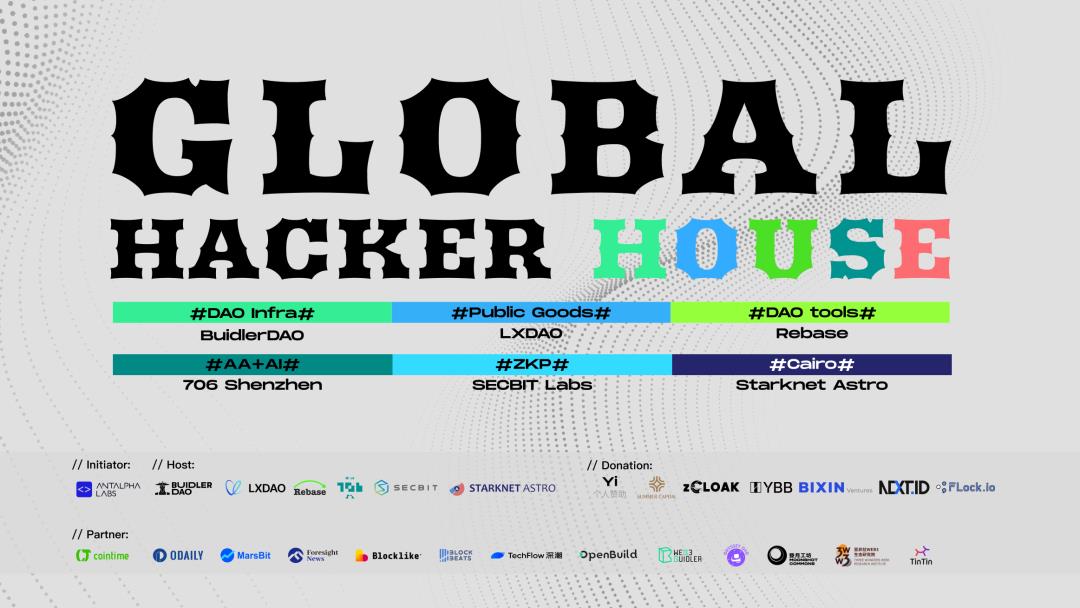
This Global HackerHouse (GHH) is initiated by Antalpha Labs and co-organized by Rebase, LXDAO, 706 Shenzhen, Starknet Astro, BuidlerDAO, and SECBIT Labs. The mission is to build HackerHouses worldwide and host integrated online-to-offline developer co-creation events. It aims to engage thousands of developers and deep researchers across China, ultimately selecting 60–80 creative and technically skilled participants to collaborate. We hope this event can spark a flame, light the way forward, and inject new narratives and vitality into China’s developer ecosystem!
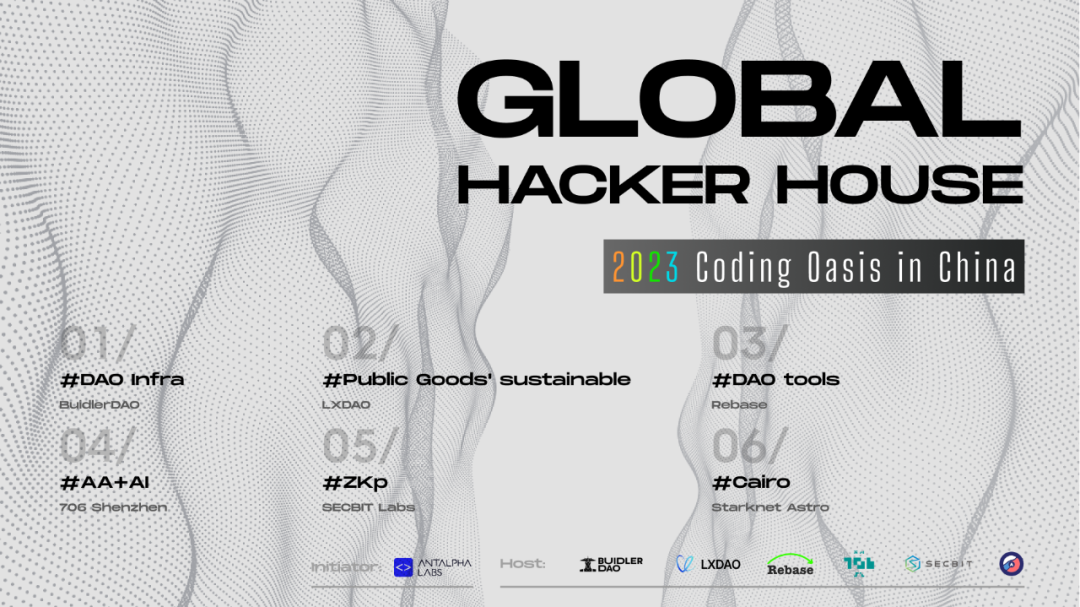
The first edition of <2023 Coding Oasis in China> will officially launch in August. We warmly invite developers and professionals from around the globe to join us. This edition features six cutting-edge themes — DAO Infra, DAO Tools, AA+AI, ZK, Public Goods, and Cairo — with HackerHouses established across six cities (Shanghai, Wuhan, Shenzhen, Dali, Suzhou, and Chengdu). We’ll organize sharing sessions and work together to build projects from scratch, refine ideas through brainstorming and expert mentorship, and showcase the latest results at DemoDay.
01 DAO Infra HackerHouse
Organizer: BuidlerDAO
Location: Shanghai
Date: 8.15 – 8.27
Number of Participants: 10–20
Main Focus: The Ideal and Reality of New Autonomous Organizational Relationships
-
AI + DAO: Integrate AI technologies with rich on-chain/off-chain DAO scenarios such as onboarding, ice-breaking, decision-making governance, and internal data management to reduce manual intervention costs and collaboration friction. Examples include building a smart assistant for DAO onboarding—product forms are open-ended.
-
Social + DAO: Explore unique social scenarios within and between DAOs (DAO2DAO), lower trust barriers, improve social efficiency, and foster more interactions among interesting individuals inside and outside DAOs.
-
DAO + Service: Explore technologies and tools that integrate decentralized organizational models with other industries, leveraging DAO characteristics to empower other organizations, such as creator economy DAO toolkits.
-
Collaboration Tools: We also welcome exploration of various DAO infrastructure tools, such as private voting, governance incentives, transparent financial reporting, and automation.
02 Web3 Public Goods (Open Source, Non-excludable, Non-rivalrous)
Organizer: LXDAO
Location: Dali
Date: 9.2 – 9.9 (Note: Hackers must arrive by the evening of 9.2 for registration and depart after the evening of 9.9)
Number of Participants: 10–20
Theme Explanation: Web3 Public Goods (Open Source, Non-excludable, Non-rivalrous)
-
“Web3 Public Goods” refers to resources or services in the Web3 environment that are open to everyone and freely usable, where usage does not prevent others from accessing or benefiting from them.
-
Web3 represents a new phase of internet development designed to be decentralized, emphasizing privacy, openness, and inclusivity, enabled by blockchain technology. In Web3, public goods may include open-source software, decentralized protocols, public datasets, open APIs accessible to all, educational and knowledge resources, and public digital spaces.
-
The core characteristics of public goods are non-excludability (anyone can use them without depriving others) and non-rivalry (one person's use does not diminish availability for others).
Recommended Subtopics for Web3 Public Goods:
1. Web3 Education Products
2. Web3 Social Reputation/Credit Systems Based on ERC-6551
3. Fair Distribution Mechanisms
4. Anonymous Voting
5. Decentralized Collaboration and Incentive Mechanisms
Notes:
1. Public goods are not equivalent to charity.
2. Benefit mechanisms for public goods projects may include token economics, transaction gas fees, donations, and sponsorships.
03 Starknet Stack and Cairo 2.0
Organizer: Starknet Astro
Location: Chengdu
Date: 8.21 – 8.27
Number of Participants: 12
Main Focus: Starknet Development Technologies
-
Starknet: We will introduce the fundamentals of Starknet, covering network architecture, STARK proof systems, ecosystem progress, network data, and developer communities.
-
Cairo 2.0: On Starknet, developers write contracts using the Cairo language. From Cairo 0 to Cairo 2, the language has undergone major updates in syntax, compiler, and intermediate representation, and continues to explore Cairo to MLIR. We will examine the evolution, future outlook, and contract syntax of Cairo.
-
Starknet layer2/layer3: Starknet's engineering builds upon StarkEx. Recent developments like Kakarot and the Starknet Stack reveal promising technical prospects. This session will analyze how Starknet layer2/layer3 works and demonstrate engineering practices.
-
Starknet Account Abstraction and Contract Wallets: Starknet is one of the few blockchains with native account abstraction. We will explore its underlying principles and cutting-edge practices in account abstraction and contract wallets.
Requirements:
-
Basic understanding of blockchain and Starknet
-
Some experience learning Rust and Cairo
04 AA+AI Theme HackerHouse
Organizer: 706 Shenzhen
Location: Cactus Digital Nomad Space, Dapeng, Shenzhen
Date: 8.21 – 8.27
Number of Participants: 10
Main Focus: Co-exploring Innovative Web3 Products Through AA + Onboarding, AA+RWA, and Web3 + AIGC
-
“Onboarding next billion users”: Focusing on “AA”, explore potential projects in the RWA sector to onboard more new users. Under the theme of “AI”, encourage Hackers to leverage automation and AI capabilities to enhance efficiency across the entire Web3 stack.
-
Co-create innovative projects based on Web3 & AI, aiming to foster interaction, collaboration, and innovation between Web3 and artificial intelligence.
-
The mutual advancement of Web3 and AI opens up many new narratives and leaves vast room for imagination. Now, we want to place the narrative of AA and AI innovation directly in the hands of developers.
If you want to seize the opportunity at the forefront of Web3 and AI technological innovation, don’t miss this event.
05 ZK Research HackerHouse
Organizer: SECBIT Labs
Location: Suzhou
Date: 8.21 – 8.27
Number of Participants: 6–10
Main Focus: Frontier Research in ZKP
Introduction: Zero-Knowledge Proofs (ZKP) are currently one of the most dynamic areas in the crypto community. Over the past three years, ZKP theories and technologies have rapidly advanced due to industry growth. This HackerHouse will invite around 6–10 participants for an intensive week of research and whiteboard discussions. Topics may include:
-
Nova folding theory and recursive zero-knowledge proofs
-
Common schemes and trends in Lookup proofs
-
Sumcheck and multivariate polynomial commitments
-
Various zkSNARK/PIOP protocols such as PLONK/Marlin/Spartan
Requirements:
-
Demonstrated depth in at least one ZKP subfield
-
Complete understanding of at least one relevant academic paper
06 Rebase HackerHouse DAO Tool
Organizer: Rebase
Location: Wuhan
Date: 8.03 – 8.09
Number of Participants: 10
Main Focus: Research and Innovation in DAO Tools
-
What are your thoughts on existing DAO tools? Which ones frustrate you? Which tools do you desperately need but aren’t available on the market?
-
Faced with the growing number of DAOs, DAOstar proposed ERC-4824 — DAO Interface — providing a unified API for accessing DAOs and enabling cross-DAO interoperability. Are you interested in such meta-DAO concepts?
-
This HackerHouse offers a short-term, face-to-face opportunity to exchange ideas and build your own DAO tools.
Requirements:
-
Basic understanding of blockchain and smart contract languages
-
Basic experience using DAO governance tools