Coinbase: LooksRare's vampire attack on OpenSea
TechFlow Selected TechFlow Selected
Coinbase: LooksRare's vampire attack on OpenSea
Only in the crypto space could a platform built within weeks by an anonymous founder compete with industry-leading platforms.
 Navigating Web3 tides with focused insights
Authors: Connor Dempsey & Justin Mart & Mike Cohen
Translation: Kxp, BlockBeats
Coinbase Ventures’ Around the Block series explores major trends in crypto.
The authors of this article are Connor Dempsey, Justin Mart, and Mike Cohen.
Only in crypto could a platform built anonymously within weeks compete with an industry-leading incumbent.
The newly launched NFT marketplace LooksRare exemplifies this phenomenon, recording over $9 billion in trading volume in January—nearly three times OpenSea’s volume during the same period. Moreover, within 30 days of launch, LooksRare generated $307 million in protocol revenue compared to OpenSea’s $110 million.
However, these raw figures don’t tell the whole story.
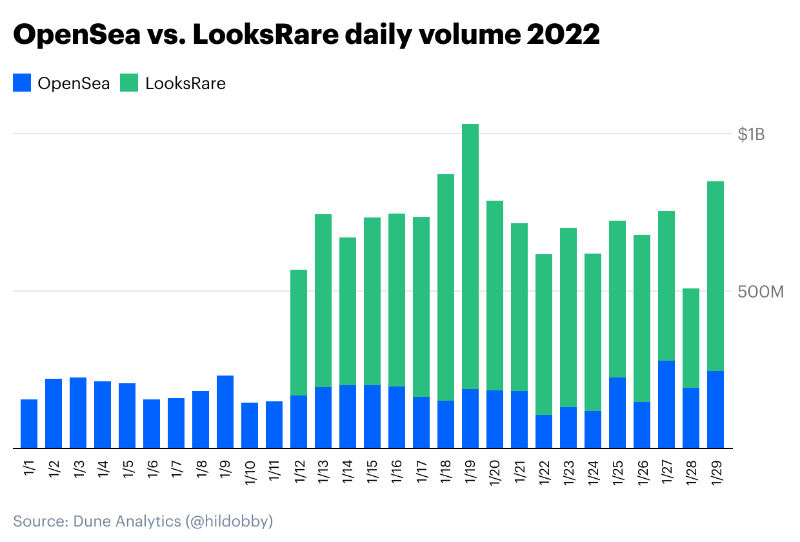
In this post, we explore how LooksRare executed a vampire attack on OpenSea, the dominant NFT marketplace.
Vampire Attacks: Origins
A vampire attack is a phenomenon unique to crypto or Web3. Broadly speaking, it refers to a strategy where a new platform lures users from an existing one by offering incentives, typically in the form of tokens.
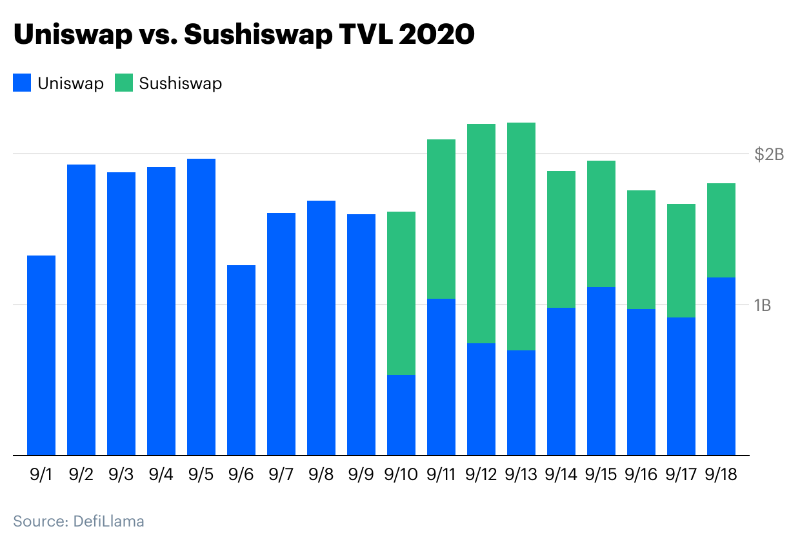
The most infamous vampire attack occurred in 2020 when SushiSwap launched a decentralized exchange nearly identical to Uniswap, the market leader. It rewarded users who migrated their liquidity from Uniswap to SushiSwap with SUSHI tokens. In addition to lower trading fees on SushiSwap, SUSHI holders gained governance rights over the platform.
Ultimately, $1.2 billion in liquidity moved from Uniswap to SushiSwap, causing a temporary dip in Uniswap’s liquidity. SushiSwap delivered on its promise by distributing tokens to users. Uniswap later recovered its liquidity levels and eventually launched its own token. Nevertheless, SushiSwap successfully bootstrapped liquidity in the short term.
LooksRare's Vampire Attack
LooksRare followed the classic vampire attack playbook:
1. Identify the leading incumbent platform
2. Build a competitive and strategically advantageous platform
3. Offer generous rewards to users who migrate
The key difference between SushiSwap and LooksRare lies in implementation: while SushiSwap forked almost all of Uniswap’s code and layered token incentives on top, LooksRare appears to have built its own smart contracts, according to its documentation. However, both followed the same general approach:
1. Identify the leading platform: Check. They targeted OpenSea directly.
2. Build a competitive platform: They launched looksrare.org.
3. Reward migrating users: Distribute LOOKS tokens.
Initial Incentives
Thanks to blockchain’s open-source nature, the LooksRare team was able to identify OpenSea users who had traded at least 3 ETH worth of NFTs in the previous six months and airdropped LOOKS tokens to them. However, to claim these tokens, users first had to list an NFT on the LooksRare marketplace.
This airdrop to active members of the NFT trading community proved highly effective, quickly drawing NFT activity to the new platform. Within 10 days of launch, LOOKS reached a price of around $7, achieving a $1 billion market cap.
But the airdrop wasn’t the only incentive.
Additional Incentives
Beyond the initial airdrop, users on LooksRare can earn more tokens by staking their LOOKS tokens and the NFTs they trade on the platform. LooksRare charges a 2% fee on each transaction (compared to OpenSea’s 2.5%). Once LOOKS tokens are staked—locked in a smart contract—users become entitled to a share of all trading fee revenues. Additionally, stakers have a chance to earn extra LOOKS tokens.
At the time of writing, the annual percentage yield (APY) for staking LOOKS exceeds 500%, an extraordinary rate.
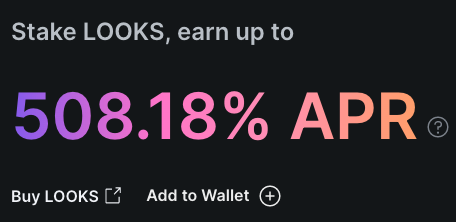
The trading incentives on LooksRare are particularly interesting and straightforward: users earn LOOKS simply by buying and selling NFTs on the platform. Rewards are distributed based on daily trading volume, with LooksRare currently issuing approximately 2.8 million LOOKS per day—worth about $10 million at current prices.
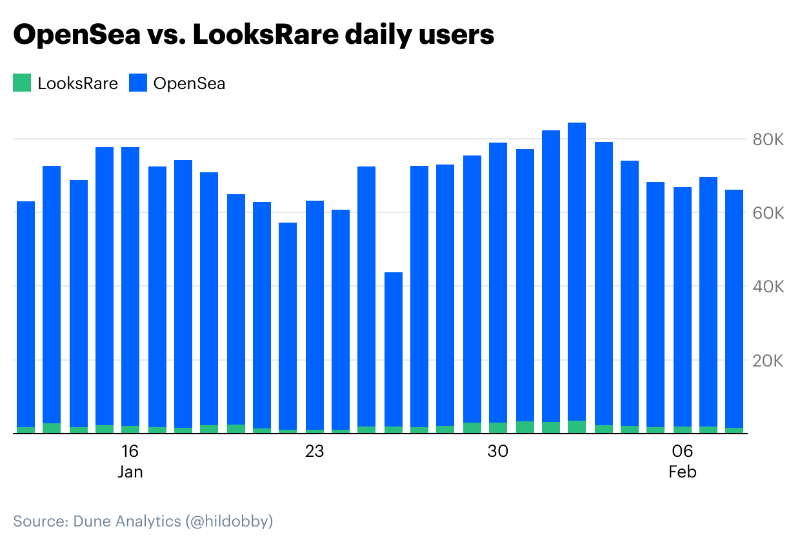
Undoubtedly, the free airdrop was enough to attract users, but the $10 million daily reward pool propelled LooksRare’s daily trading volume far beyond OpenSea’s. However, a closer look at daily user counts reveals that LooksRare’s impressive volume isn’t as organic as it might seem.
Wash Trading
Although LooksRare often reports double OpenSea’s daily trading volume, OpenSea has 20 to 40 times more active users. This suggests that LooksRare’s volume is largely driven by a small number of traders gaming the system to earn LOOKS rewards.
Since daily rewards on LooksRare are proportional to trading volume, users are incentivized—even with trading fees—to repeatedly buy and sell the same high-value NFT across their own wallets. For example, a trader contributing 10% of the day’s volume could earn $1 million worth of LOOKS.
The catch is that every transaction incurs a 2% fee paid in ETH. Calculations show that the ETH spent on fees roughly equals the value of the LOOKS earned. Effectively, traders are exchanging ETH for LOOKS—and profit if LOOKS appreciates against ETH.
At its core, this is a speculative bet: early participants stand to gain if LooksRare becomes successful.
Actual Trading Volume on LooksRare
Indeed, LooksRare’s staggering volume is primarily fueled by its incentive structure. But that doesn’t mean the platform is purely artificial.
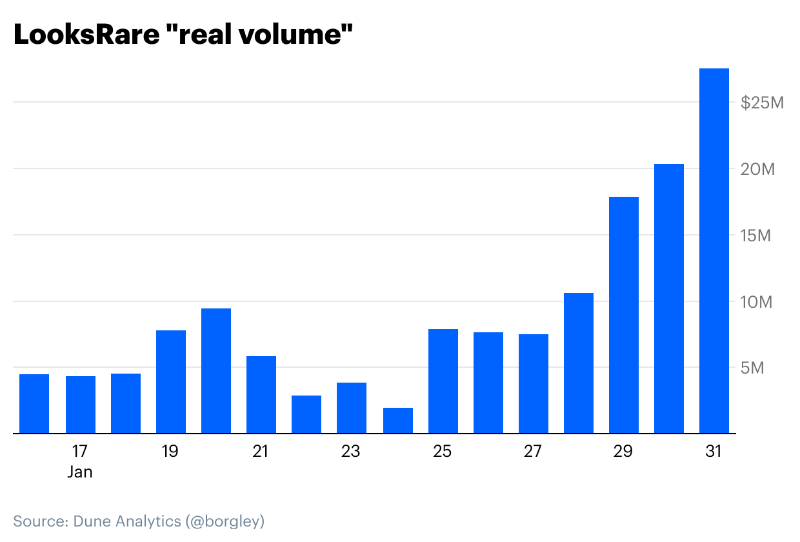
At the end of January, CryptoSlam estimated that about $8 billion of LooksRare’s $9 billion in January trading volume was likely wash trading. However, even the remaining $1 billion in genuine NFT volume exceeded the combined 2021 annual volume of other major NFT marketplaces like Rarible, SuperRare, Foundation, MakersPlace, and Async.
Even after accounting for inflated volume, LooksRare remains a significant player. Furthermore, it offers novel features such as fee-free private sales and bulk offers for entire NFT collections. As a result, LooksRare’s “real” trading volume continues to grow.
Can Trading Rewards Be Sustained?
LooksRare’s trading rewards will gradually decrease over the next two years, after which the platform will need to rely on product quality and community strength to remain competitive. Whether LooksRare can maintain or grow its market share without generous incentives will depend heavily on its anonymous founding team.
We can draw parallels from SushiSwap’s trajectory. In many ways, SushiSwap continued growing after its initial incentive phase ended. Through continuous innovation and multi-chain expansion, SushiSwap now boasts nearly $5 billion in total value locked (TVL).
Yet, SushiSwap’s growth hasn’t displaced Uniswap. Uniswap eventually launched its own token (OpenSea may do the same one day) and remains the dominant DEX in crypto, with over $7.5 billion in TVL. Historically, no hard fork (e.g., Bitcoin Cash, Ethereum Classic) or vampire attack (e.g., SushiSwap, Swerve) has permanently overtaken an established platform.
While SushiSwap has achieved success, it has also faced setbacks. Internal conflicts between the core team and SUSHI token holders led to the departure of several key members, including the project’s CTO. When LooksRare transitions governance to LOOKS token holders, it may encounter similar challenges, revealing that DAO governance is still immature and fraught with difficulties.
Finally, for users, there remains the risk that the anonymous LooksRare team could exit scam at any moment. Additionally, LooksRare launched its smart contracts未经审计 (without audit) and without a public GitHub repository, so traders should proceed with caution.
Join TechFlow official community to stay tuned
Telegram:https://t.me/TechFlowDaily
X (Twitter):https://x.com/TechFlowPost
X (Twitter) EN:https://x.com/BlockFlow_News