
Analysis of Goldman Sachs Research Report: AWS AI Service Revenue to Account for 40% by 2028, Amazon Price Target Set at $370
Amazon (AMZN) management expects revenue growth for its cloud business to exceed 40% year-over-year in 2027 and 2028, with long-term potential to reach a trillion-dollar scale. Goldman Sachs analyst Eric Sheridan’s team reiterated a “Buy” rating and added the stock to its Americas Conviction List in a Nov. 20 report, setting a 12-month price target of $370. The firm believes the market has underestimated the upside potential for cloud profitability and the benefits of retail automation.
AI Shopping Assistant to Drive $16 Billion in Additional Sales in 2026
To prevent external general-purpose large language models from intercepting e-commerce traffic, Amazon has integrated AI capabilities directly into its proprietary shopping funnel.
Previously known as Rufus, the shopping assistant has been upgraded to Alexa for Shopping, capable of automatic price comparison, monitoring, and completing repurchase orders once a target price is triggered. In 2025, the tool reached over 300 million users, generating approximately $12 billion in incremental revenue.
Consumers using the tool have more than a 60% higher likelihood of placing an order compared to standard browsing. Based on industry-standard conversion rates, Goldman Sachs calculates that Alexa for Shopping achieves an actual conversion rate of 16%. With the user base expected to grow to 400 million in 2026, incremental revenue is projected to reach $16 billion, representing a 33% year-over-year increase.
Amazon has also expanded its reach to off-site product inventories and SMS-based conversations. Through the “Shop Direct” and “Buy for Me” features, the shopping assistant can directly pull products from brand websites and complete checkout on behalf of users, without requiring Amazon to stock inventory or handle fulfillment. Meanwhile, Amazon has partnered with Uber Eats; Prime members across 10,000 U.S. cities can enjoy free delivery when ordering at least $25 worth of food through the Amazon app. Uber Eats has also been integrated into the Alexa+ ecosystem.
Fresh & Grocery Sales Drag Down Averages as Millions of Robots Underpin Profits
The retail segment is enduring the pain of declining average selling prices.
In Q3 2026, Amazon’s North American sales growth for everyday household goods and fresh grocery items was roughly three times that of other categories, increasing their share of total sales from about one-third in Q1 2025 to 50%. The combination of these high-frequency, low-ticket items and investments in same-day delivery drove a 12% year-over-year decline in first-party unit revenue in Q3, compressing the retail segment’s contribution margin by approximately 220 basis points year-over-year.
High-frequency essential purchases are reinforcing site-wide consumer stickiness. According to the report, consumers buying fresh groceries via same-day delivery purchase everyday household goods at roughly seven times the volume of ordinary users; active grocery buyers purchase non-grocery items across categories at about four times the volume of ordinary users, with spending amounts exceeding them by more than double.
Logistics fulfillment has already achieved economies of scale. Global paid item sales grew 12% year-over-year in Q3, while first-party sales growth reached 15%, both outpacing the growth in fulfillment costs. Due to regionalized warehousing shortening delivery distances, the volume of same-day and next-day delivery packages for Prime members in H1 2026 grew over 40% year-over-year.
Amazon’s fulfillment network currently deploys over 1 million robots. Goldman Sachs estimates that by 2030, Amazon’s per-unit fulfillment service cost could drop by approximately 13%, driving the operating margin for North American and International retail businesses (excluding device and services losses) from 9% in 2026 to 21% in 2030, surpassing the baseline forecast of 17% by 4 percentage points.
Surge in AWS Backlog Orders, Management Guidance Points to >40% Growth
On the eve of AWS’s annual Re:Invent conference, Goldman Sachs views cloud computing as the largest engine determining Amazon’s valuation.
AWS revenue grew 39% year-over-year in Q3. Although compute capacity deployment fell slightly short of Goldman Sachs’ earlier expectations, management explicitly guided for revenue growth exceeding 40% in 2027 and 2028, indicating that AWS has the potential to become a trillion-dollar business within the next five to ten years.
Goldman Sachs’ forecasting model shows AWS total revenue rising from $128.7 billion in 2025 to $177 billion in 2026, reaching $247.9 billion in 2027 and $336.4 billion in 2028. Among these, the run rate for AI service revenue surpassed $15 billion in Q1 2026, quickly crossing the $25 billion threshold in Q2. The bank projects AWS’s AI service revenue will surge from $28.1 billion in 2026 to $136.9 billion in 2028, increasing its share of total AWS revenue from 15.9% to 40.7%.
Goldman Sachs also modeled an optimistic scenario under accelerated compute capacity release. If capital expenditure efficiently converts into backlog orders over a six-year cycle (with AWS backlog projected to surge 136.9% year-over-year to $578 billion by year-end 2026), AWS’s actual revenue growth in 2027 and 2028 could potentially reach 55.3% and 53.8%, respectively.
In-House Chips and Model Hosting Stabilize Cloud Business’s High Profit Margins
While AI workloads initially diluted some margins, proprietary hardware is reshaping the cost structure.
Goldman Sachs estimates that AWS’s current AI service operating margin stands at around 22%, below the 41% seen in traditional core cloud services. As inference demand scales up, customers expand from isolated frontier labs to broader enterprises, and proprietary Trainium chips replace costly third-party GPUs, the operating margin for AI services is expected to rise to 30% by 2028, supporting AWS’s overall operating margin to remain firmly in the high 37% to 38% range.
On product strategy, management disclosed on the Q3 earnings call that direct external sales of Trainium chips are expected to begin by the end of 2027. Although direct external sales yield lower cumulative lifecycle cash flow per chip compared to retaining them for internal cloud computing, they allow for earlier hardware revenue recognition, faster manufacturing capacity turnover, and reduced capex for downstream data centers.
At the model middleware layer, Amazon Bedrock provides access to multiple models, offering enterprises multi-model orchestration, proprietary data integration, and security governance control surfaces, establishing itself as the core entry point for deploying enterprise AI agents.
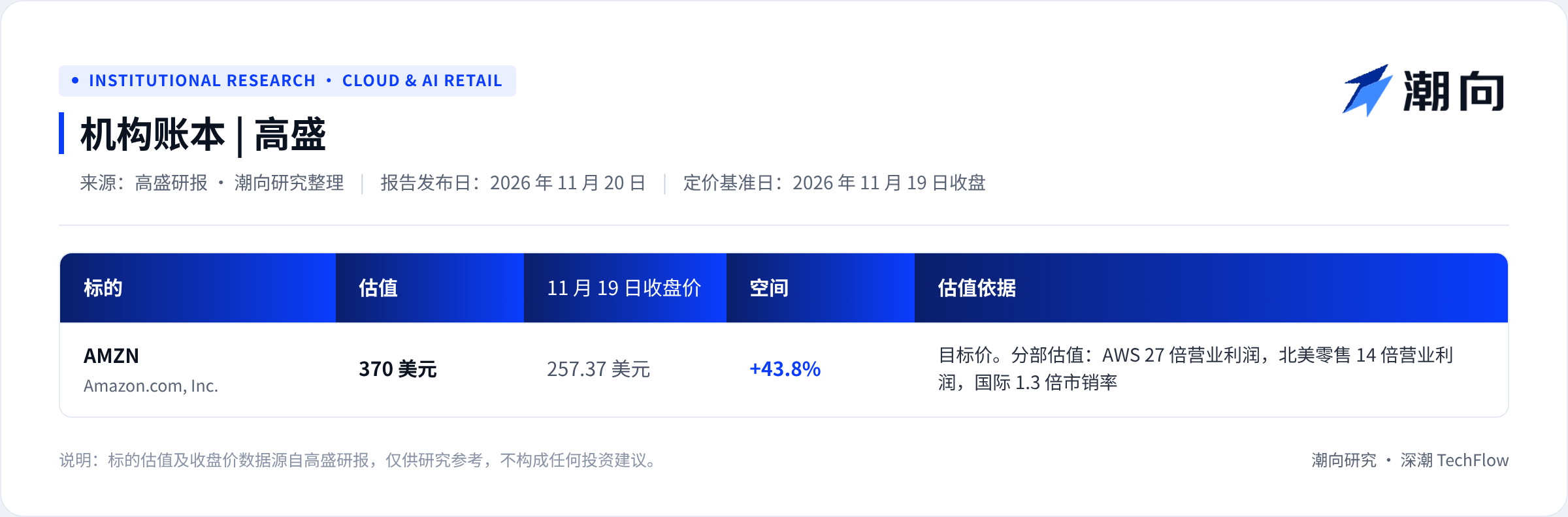
Using a sum-of-the-parts valuation methodology based on forward results beyond the next 12 months, Goldman Sachs assigns a 27x operating profit multiple to AWS (implying a valuation of $3.135 trillion), a 14x operating profit multiple to North America retail (implying $776.2 billion), and a 1.3x price-to-sales multiple to International business (implying $277.6 billion). After summing these valuations and deducting net debt, the firm derives a $370 price target.
Institutional Ledger
Fixed Disclosure Regarding Research Report Content (Brokerage Views, Not TechFlow Research Views)
This article is a compilation and interpretation by TechFlow Research of third-party brokerage research reports. The ratings, price targets, earnings forecasts, and related judgments cited herein reflect solely the views of the respective brokerages' analysts, represent only the positions of their affiliated institutions, do not represent the views of TechFlow Research, and do not constitute any investment advice.
Markets involve risks, and decisions require independent judgment. This article should not serve as the basis for trading any securities.
Join TechFlow official community to stay tuned
Telegram:https://t.me/TechFlowDaily
X (Twitter):https://x.com/TechFlowPost
X (Twitter) EN:https://x.com/BlockFlow_News
 @chaoxiangooo