US Institutions Still Underweight the Magnificent Seven by 124 Basis Points, but Heavily Concentrated in Memory and Semiconductor Equipment | Morgan Stanley Latest Research Report Analysis
As of the end of the third quarter of 2026, the average underweight position held by U.S. active institutions in the Magnificent 7 tech giants stood at 124 basis points, narrowing by only 5 basis points compared to 129 basis points at the end of the second quarter.
In a report dated November 17, the team of Morgan Stanley analyst Erik Woodring tracked 13F holding data from the top 100 active management institutions across 28 U.S. mega-cap tech stocks. The firm found that institutional capital continued to heavily concentrate on AI compute bottleneck segments such as memory and semiconductor equipment during the third quarter, while significantly underweighting traditional software stocks.
Citing historical quantitative backtests, the report notes that after adjusting for market capitalization and earnings surprise factors, stocks with deeper underweights by active institutions tend to exhibit significant upward pressure for mean reversion.
The Magnificent 7 Remain Overall Underweighted, With Tesla as the Sole Overweighed Name
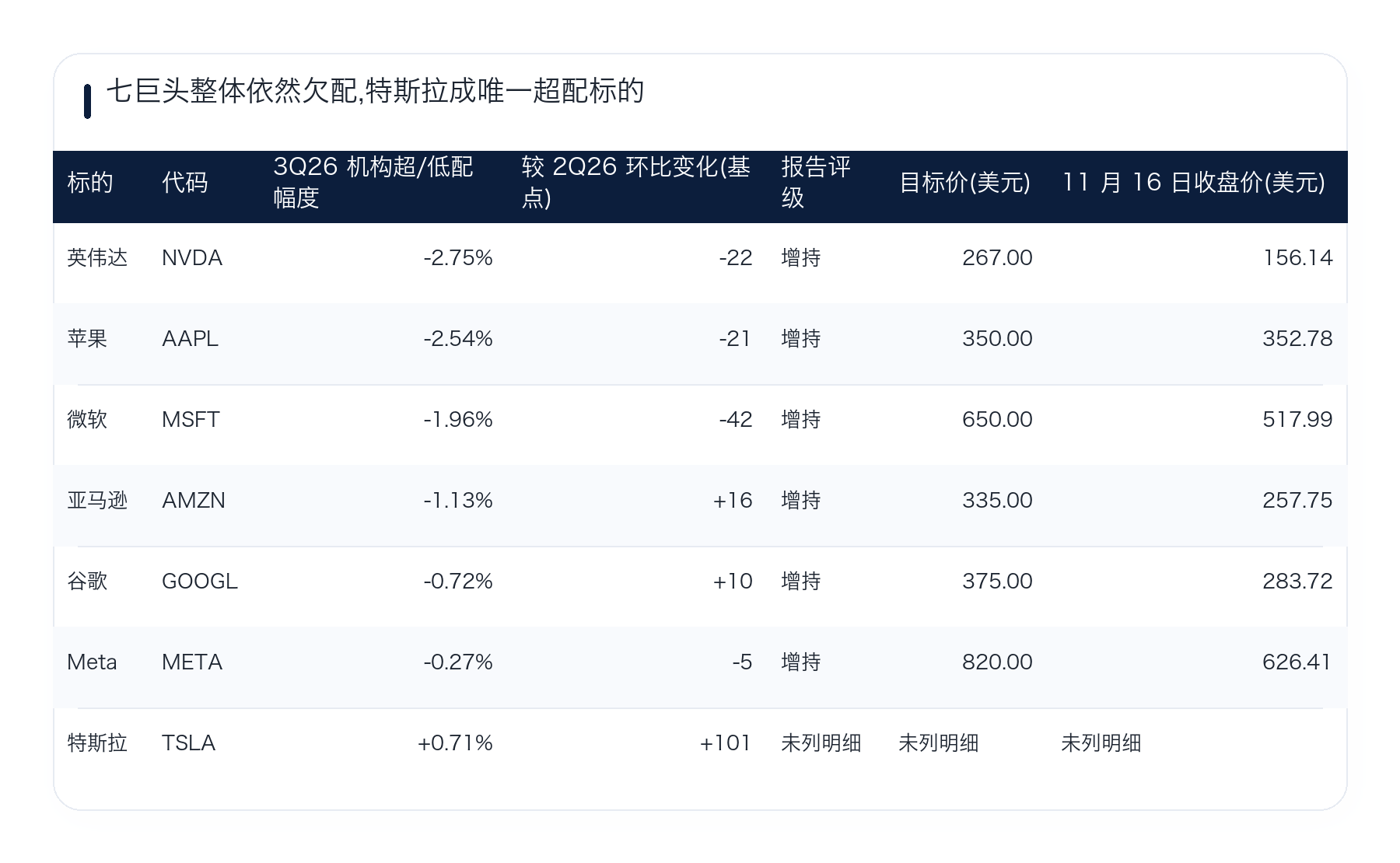
Although active institutions increased their allocations to the Magnificent 7 tech giants at a slightly faster pace than the S&P 500 index weight changes during the third quarter, the group as a whole remains noticeably underweighted.
NVIDIA’s (NVDA) underweight widened by 22 basis points to -2.75% at the end of Q3, setting a record low. Apple (AAPL) and Microsoft (MSFT) followed closely, with underweights of -2.54% and -1.96%, respectively.
The sole exception among the seven giants is Tesla (TSLA). Institutional relative allocations to Tesla surged by 101 basis points in Q3, flipping it from an underweight to an overweight position of 0.71%.
Morgan Stanley noted that since the end of the third quarter, NVIDIA’s stock price has fallen 32% over 45 days, while Apple’s stock rose 6% over the same period. At this juncture, Apple has likely replaced NVIDIA as the tech giant most deeply underweighted by active institutions.
Capital Clusters in Storage and Semiconductor Equipment, Abandons Traditional Software Stocks
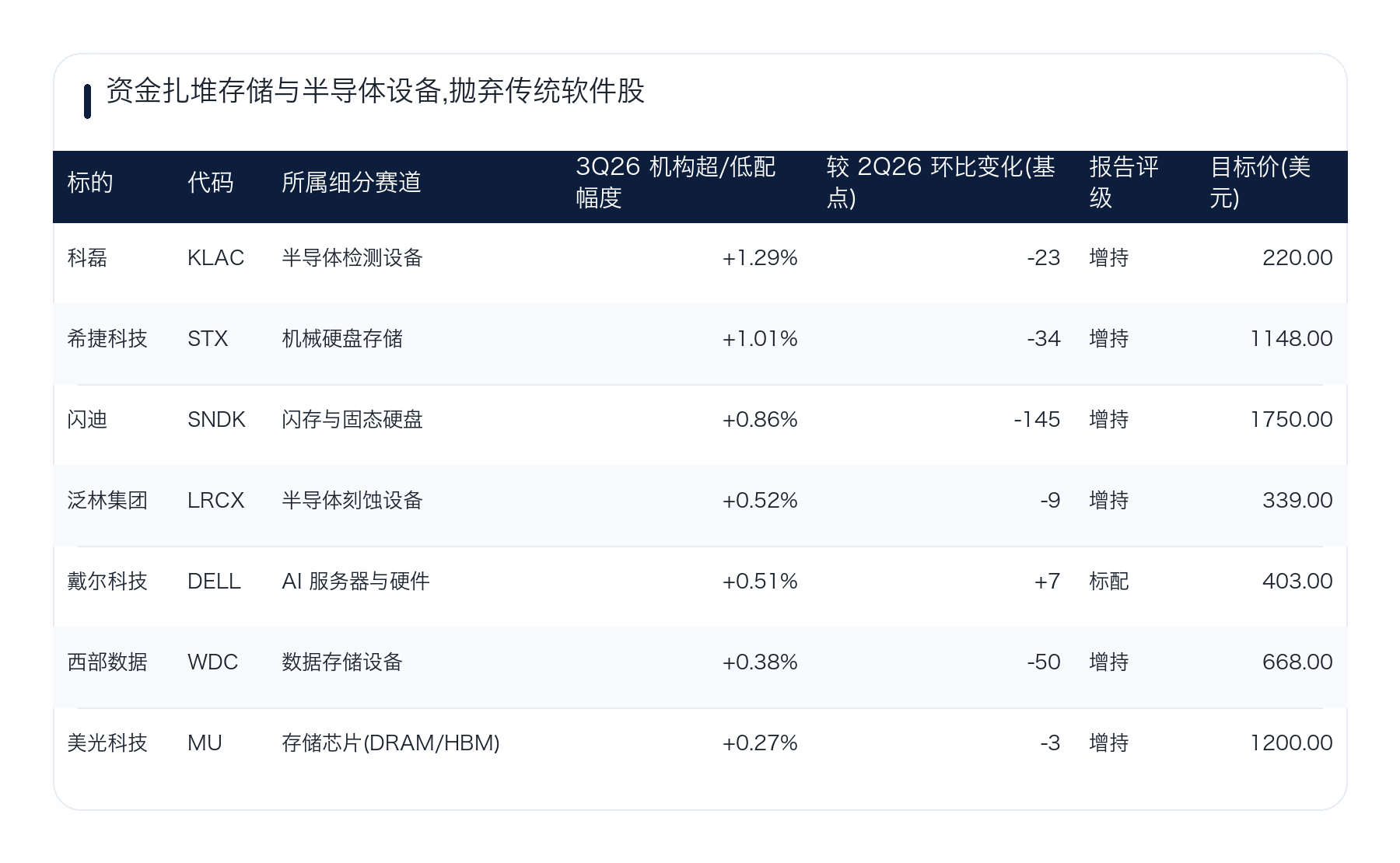
Among the 21 large-cap tech stocks outside the Magnificent 7, active institutions’ average overweight position stood at 28 basis points at the end of Q3, down slightly by 11 basis points from 39 basis points at the end of Q2.
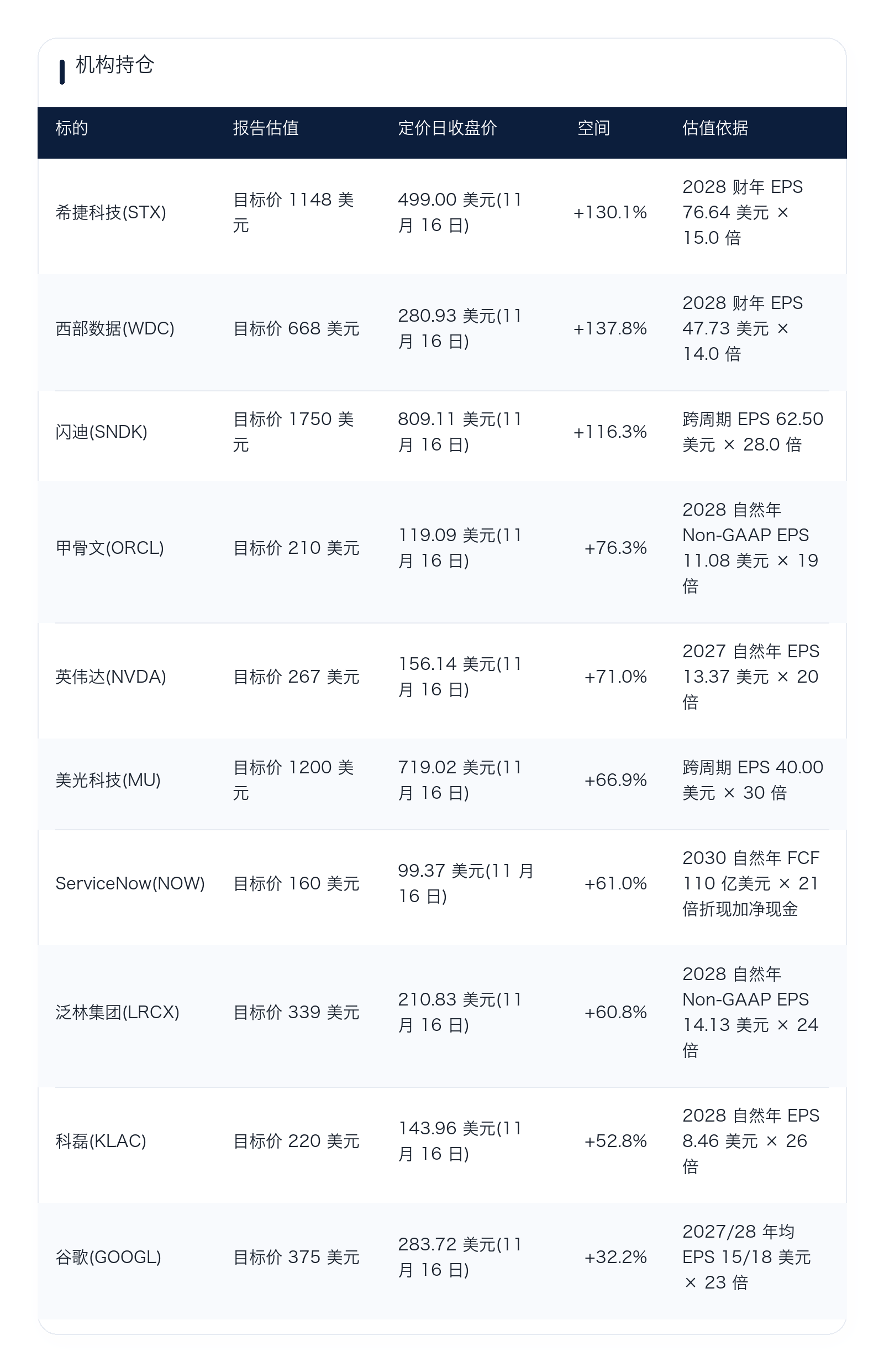
Capital distribution reveals a clear divergence of “prioritizing hardware bottlenecks over software applications.” The three tech stocks with the highest overweight proportions at the end of Q3 were all concentrated in wafer inspection equipment and data storage: KLA (KLAC), Seagate Technology (STX), and SanDisk (SNDK).
However, crowding in some storage names began to ease at the end of Q3. The storage and hard drive sector’s overall overweight dropped 41 basis points quarter-over-quarter to 0.63%, with SanDisk’s overweight narrowing by 145 basis points in a single quarter and Western Digital (WDC) narrowing by 50 basis points.
In stark contrast to storage devices, the traditional software sector lagged. Excluding Microsoft, the remaining six tracked software stocks averaged only a 0.26% overweight at the end of Q3.
Palo Alto Networks (PANW), Adobe (ADBE), Oracle (ORCL), and ServiceNow (NOW) all had overweight positions below 0.20%, while IBM was even underweighted by 0.06%. Morgan Stanley pointed out that this extremely crowded positioning structure at the end of Q3 was a key catalyst for the underperformance of semiconductor and infrastructure stocks relative to software stocks entering the fourth quarter.
Institutional Holdings
This article is compiled and interpreted by TechFlow Research based on third-party broker research reports. The ratings, price targets, profit forecasts, and related assessments cited herein represent the views of the respective broker analysts, reflecting only the stance of their affiliated institutions, not those of TechFlow Research, and do not constitute any investment advice.
Markets carry risks; decisions must be made independently. This article should not serve as the basis for buying or selling any securities.
Join TechFlow official community to stay tuned
Telegram:https://t.me/TechFlowDaily
X (Twitter):https://x.com/TechFlowPost
X (Twitter) EN:https://x.com/BlockFlow_News
 @chaoxiangooo