
Arm Data Center Royalties Nearly Double, But In-House Chip 2031 Revenue Target Cut by One-Third | Latest Morgan Stanley Research Report Analysis
Arm's data center royalty income is projected to nearly double in FY2027, while its FY2031 revenue forecast for self-developed CPUs has been downgraded to less than $10 billion, falling short of management's target of $15 billion.
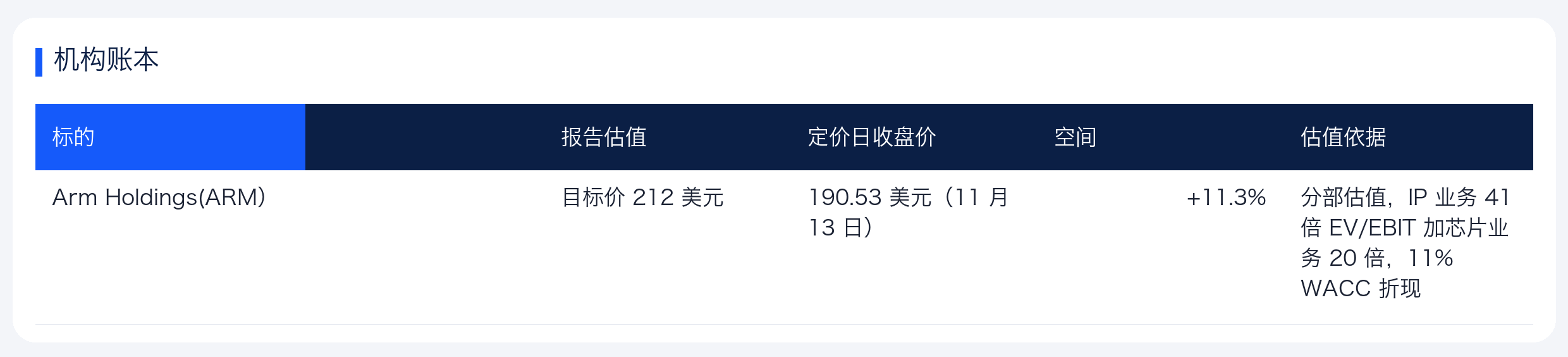
In a November 16 report, Morgan Stanley analyst Lee Simpson's team upgraded cloud computing royalty forecasts while lowering mobile royalty and long-term self-developed chip expectations, maintaining an "Equal-weight" rating and $212 price target for Arm Holdings (ARM).
The firm noted that only if operating leverage and FY2030 deployment targets are validated can the stock see further upside during this transition period where in-house chips weigh on gross margins.
Mobile Business Slows as Data Center Takes Up the Growth Baton
Mobile remains the bedrock of Arm's royalty business, but growth is decelerating. Weakened global smartphone shipments led Morgan Stanley to project that Arm's FY2027 mobile royalty income will grow by only about 3%, significantly below the roughly 28% growth seen in FY2026.
By FY2028, stabilizing Apple shipments and increased penetration of the v9 and Compute Subsystem (CSS) architectures are expected to drive mobile royalty growth back up to around 14%. At that point, smartphones will account for approximately 37% of total royalties.
The true growth engine has now shifted to cloud data centers.
As hyperscale cloud providers heavily deploy Arm-based CPUs alongside AI accelerators, coupled with rising cores per chip boosting royalty fees per unit, Morgan Stanley raised its FY2027 data center royalty forecast by 9% to $686 million and its FY2028 forecast by 17% to $1.15 billion.
The report projects overall cloud AI royalties to grow 86% year-over-year in FY2027, with the data center segment's share of total royalties jumping from 14% in FY2026 to 31% in FY2028. This upgrade was primarily driven by volume ramp-ups of Amazon Graviton, Google Axion, and Nvidia Vera chips in both integrated and standalone inference systems.
Power Shortages Cripple Data Center Deployments, Cutting Long-Term Self-Developed CPU Targets by 30%
While royalty revenues remain strong, Morgan Stanley has cooled expectations for Arm's long-term in-house chip ambitions.
The firm maintained its FY2028 revenue forecast for Arm's self-developed chips largely unchanged at approximately $1.5 billion, but slashed its FY2031 forecast for self-developed CPUs by 38.2% to just under $10 billion, notably below management's internal target of roughly $15 billion.
Power deficits represent the first physical hurdle delaying long-term deployments.
Morgan Stanley's U.S. technology strategy team calculated that U.S. data centers face a net power shortfall of 44 gigawatts between 2026 and 2028, accounting for 38% of total power demand during that period. Delayed facility commissioning directly constrains the rollout pace of inference orchestration CPUs.
Model projections indicate the accessible market size for global inference orchestration CPUs will grow from roughly 4 gigawatts in FY2027 to about 19 gigawatts in FY2031, with Arm capturing share expanding from approximately 7% to 42%. However, even with successful market share gains, competitive pricing pressures will still erode some revenue potential.
Given intensifying competition in the custom silicon market, Morgan Stanley assumes Arm's average selling price per core for each successive generation of self-developed CPUs will decline by about 5%, diverging sharply from management's expectation to maintain pricing resilience through integrated networking and I/O interfaces.
Chip Fabrication Weighs on Margins, Testing Operating Leverage
As Arm transitions from purely licensing intellectual property (IP) to also selling physical chips, its income statement structure is undergoing drastic changes.
In FY2026, Arm's overall gross margin reached a high of 97.5%. With first-generation self-developed CPUs beginning shipments, constrained by wafer foundry capacity, testing bottlenecks, and tight memory supply, Morgan Stanley assumes this segment will carry a gross margin of only about 35%.
Scaling low-margin hardware volumes will directly pull down the company's overall profitability.
Per the report, Arm's blended gross margin is projected to step down annually from 97.5% in FY2026 to 95.4% in FY2027, 86.9% in FY2028, and further to 85.0% in FY2029. Meanwhile, R&D expenses continue to swell rapidly, forecast to rise from $2.776 billion in FY2026 to $4.128 billion in FY2029.
Earnings pacing consequently shows clear divergence. Morgan Stanley slightly cut its FY2027 adjusted earnings per share (EPS) forecast for Arm by 1% to $2.23, but expects future revenue scaling to dilute R&D costs, raising its FY2028 and FY2029 adjusted EPS forecasts by 14% and 9% respectively to $3.95 and $5.66.
Bifurcated Valuation Approach, $212 Target Price Implies 11% Upside
Faced with two distinct business models, Morgan Stanley adopted a sum-of-the-parts (SOTP) valuation method to reprice Arm.
Influenced by a downward shift in the valuation midpoint across the broader semiconductor IP sector, the firm lowered Arm's traditional IP business FY2029 EV/EBIT multiple from 49x to 41x, which still sits at the upper end of its historical range. For the nascent self-developed chip business, the firm assigned a 20x multiple, below the global semiconductor peer average.
Discounting the combined segments at a 11% weighted average cost of capital (WACC) yields a $212 price target, representing an 11.3% upside from the $190.53 closing price on November 13.
The report also provided bull and bear case scenarios. In the bull case, if AI and cloud compute scale beyond expectations and the market prices in FY2031 results early (50x for IP, 20x for chips), the stock could reach $370, though the implied probability approaches zero. In the bear case, if self-developed chips turn unprofitable, end-user royalty rates weaken, or significant litigation losses occur, the stock could fall to $65, with options markets implying a downside probability of approximately 13.1%.
Investors should closely monitor two key validation points next: whether software licensing and early partnerships for the next-generation v10 architecture can sustain their ~50% YoY high growth rate, and whether the blended operating margin will rebound above 30% in FY2028 as planned following self-developed chip volume ramp-up.
Institutional Summary
This article presents the collation and interpretation of third-party broker research reports by TechFlow Research. All ratings, price targets, earnings forecasts, and related judgments cited herein reflect the views of that broker's analysts, represent solely the stance of their respective institutions, do not constitute the views of TechFlow Research, and are not intended as investment advice.
Markets carry risks, and decisions must be made independently. This article should not be used as a basis for buying or selling any securities.
Join TechFlow official community to stay tuned
Telegram:https://t.me/TechFlowDaily
X (Twitter):https://x.com/TechFlowPost
X (Twitter) EN:https://x.com/BlockFlow_News
 @chaoxiangooo