Qwen4-Max Per-Task Cost Drops 58%, Citi Sets $193 Price Target for Alibaba | Analysis of Citi's Latest Research Report
Alibaba's flagship model, Qwen4-Max, has compressed the average cost per task from 26.58 RMB to 11.16 RMB, a decrease of 58%.
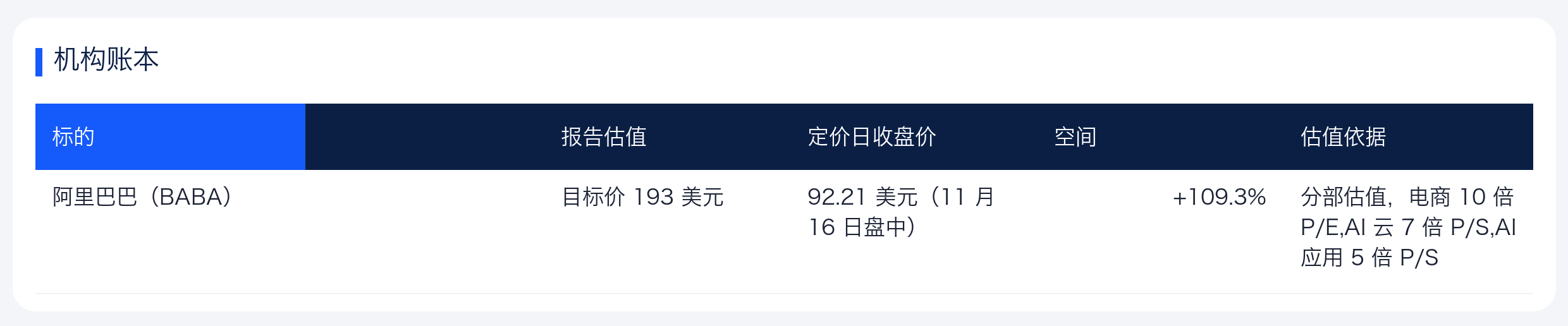
In a report dated November 16, the Citi analyst team led by Alicia Yap maintained a Buy rating on Alibaba (BABA), setting a price target of $193, implying 109.3% upside potential from the stock's intraday price of $92.21 on that day.
The bank noted that Qwen4-Max signals a shift in the large model competition from mere parameter stacking to corporate unit economics and the deployment of all-day intelligent agent (Agent) workflows.
Only 71 Billion Activated Parameters, Token Consumption Cut by Nearly Half at Peak
On November 16, Alibaba officially launched Qwen4-Max, a flagship mixture-of-experts (MoE) foundation model based on the new Qwen4 architecture. With a total of 2.4 trillion parameters, the model activates only 71 billion parameters per token generation while supporting a 1-million-token context window and native visual processing.
Architectural modifications directly translated into improved inference efficiency. According to Citi's report, Qwen4-Max introduced Sparse Attention (QSA), Gated Residual (GR), and 328 billion N-gram word embedding technology, significantly reducing the computational overhead for long-task inference.
In practical tests, Qwen4-Max showed a marked decrease in token consumption compared to its predecessor, Qwen3.8-Max. Token usage decreased by 24% to 35% under the high-inference load of Work360, and dropped by 48% to 49% in the Terminal-Bench 4.0 coding evaluation.
The saved tokens translate directly into tangible financial savings for enterprise clients. Data from Citi shows that the average cost per task for Qwen4-Max dropped to 11.16 RMB, down approximately 58% from 26.58 RMB for Qwen3.8-Max.
API pricing also maintains high cost-effectiveness. Qwen4-Max is now accessible via the Tongyi Qianwen platform, with domestic input and output prices set at 10 RMB and 30 RMB per million tokens, respectively, while overseas prices are 1.5 USD and 4.5 USD per million tokens.
From Coding to Financial Due Diligence, the Model Begins Handling Complex Long-Term Tasks
Following the cost reduction, Alibaba is deploying Qwen4-Max into enterprise production environments that require multi-step collaboration.
In the web development benchmark CodeArena, Qwen4-Max scored 1750, ranking sixth globally. In the long-horizon, high-value task evaluation Agents' Last Exam v1.1, its score leapt from 27.9 for the previous generation to 46.7.
Citi outlined four key deployment scenarios demonstrated by Alibaba, all centered on using agents to replace manual repetition in lengthy processes:
First is industrial and vertical sector coverage. Alibaba's Work360 scenario framework already spans 26 primary vertical industries, 182 secondary industries, and 721 tertiary segments. In automotive manufacturing, the model has begun participating in production scheduling, component design, and process validation.
Second is 3D content and game development. By integrating with Blender, Qwen4-Max supports architectural design, material assignment, and lighting rendering, and can build scenes and script gameplay logic in Unity, Unreal Engine, and Godot through natural language commands.
In financial and legal scenarios, Qwen4 can call upon 90 Model Context Protocol (MCP) tools covering financial reports, interest rates, and derivatives data for A-shares, Hong Kong stocks, and US stocks. The model can conduct multi-factor backtesting and equity-bond comparisons, directly generating Excel or PowerPoint reports, and assist in corporate IPO legal due diligence and multi-source clinical medical decision-making.
To support long-duration unattended operation, Qwen4-Max introduces a "Live Delivery" capability, allowing agents to dynamically adjust output results based on user feedback during execution.
Cloud Inference Demand Becomes Core Growth Driver, Segment Valuation Raised to $193
Citi believes that the accelerated adoption of enterprise-grade agents and Model-as-a-Service (MaaS) will become the core driver of Alibaba Cloud's future revenue growth. With task execution costs down by 58%, more enterprises are willing to connect software development, manufacturing scheduling, and financial investment research workflows to Alibaba Cloud APIs, driving sustained expansion in inference computing demand.
Regarding valuation methodology, Citi applied a Sum-of-the-Parts (SOTP) approach to re-price Alibaba. The bank assigns a 10x Price-to-Earnings (P/E) multiple to Net Profit for FY2027 Tmall Taobao Commerce Group, a 7.0x Price-to-Sales (P/S) multiple to FY2027 AI Cloud & Computing Services Revenue, a 5.0x P/S multiple for AI Lab & Application Revenue, and calculates remaining businesses at 0.2x P/S, applying a 30% discount to net cash position.
Summing these business segments yields a fair value of $193 per share for Alibaba. Combined with an expected dividend yield of 2.2%, the projected total return rate reaches 111.5%.
The report also highlighted six major downside risks, including retail strategy execution falling short of expectations, increased strategic investments dragging on profit margins, slowing growth in user traffic and Gross Merchandise Value (GMV), integration risks of newly acquired businesses, US-China trade tensions and macroeconomic volatility, and regulatory risks stemming from merchant quality control.
Institutional Ledger
This article is compiled and analyzed by Chaoxiang Research based on third-party brokerage research reports. The ratings, price targets, earnings forecasts, and related judgments cited herein are solely the views of the respective brokerage analysts, representing only their institutional positions, and do not reflect the views of Chaoxiang Research nor constitute any investment advice.
Markets carry risk, and decisions must be independent. This article should not serve as the basis for buying or selling any securities.
Join TechFlow official community to stay tuned
Telegram:https://t.me/TechFlowDaily
X (Twitter):https://x.com/TechFlowPost
X (Twitter) EN:https://x.com/BlockFlow_News
 @chaoxiangooo