Everyone Is Wrong: Stripe Acquired OpenRouter for AI Safety — a16z Seed Investor Reveals the Real Reason
Two days ago, Stripe officially announced its acquisition of OpenRouter, with rumors placing the total deal value at over $8 billion. Why is Stripe willing to pay such a premium?
One of the best-positioned individuals to answer this question is Anjney Midha. As not only one of OpenRouter’s earliest and most critical investors but also a company director, he led a16z’s seed investment into OpenRouter and continued to increase his stake after founding AMP PBC.
Midha’s career path is quite uncommon. He was introduced to machine learning at Stanford before joining Kleiner Perkins, where he spearheaded the creation of its early-stage tech venture team, KPCB Edge. He later transitioned to entrepreneurship, co-founding Ubiquity6, a company focused on computer vision and multi-player spatial computing, which was acquired by Discord in 2021. Following that, he became Discord’s Vice President of Platform Ecosystems, established Discord’s first dedicated developer platform team, and personally orchestrated its partnership with Midjourney.

In 2023, he joined a16z to oversee its AI investments. As an investor, he made early bets on Anthropic, ElevenLabs, Luma AI, Ideogram, Mistral AI, Black Forest Labs, LMArena, Sesame AI, Periodic Labs, and OpenRouter. What truly sets him apart is not merely backing numerous headline-making companies, but his consistent ability to spot emerging categories before the market grasps them.
Shortly after Stripe and OpenRouter officially announced the deal, Midha published an article on AMP’s website offering a highly distinctive take on the acquisition.
In his view, most observers miss the actual rationale behind Stripe’s acquisition of OpenRouter.
What Stripe is acquiring is not merely a “model router” or a new AI billing gateway. It is securing one of the very few truly strategically valuable cross-model security and alignment assets in today’s AI ecosystem.
1. Introduction
OpenRouter has announced it will be joining Stripe. Numerous venture capitalists, commentators, and analysts have weighed in on whether this merger makes perfect sense or absolutely none, with the prevailing opinion seemingly dependent on the day of the week. Thus far, we have yet to see an analysis that truly hits the mark.
The short answer is straightforward: this is about AI safety and alignment across the entire ecosystem.
It isn’t about routing, it isn’t about consolidating billing, and it isn’t driven by the idea that “tokens are the new dollar” (despite the validity of that notion). Here is the full breakdown.
2. Stripe Is a Security Company
Most people view Stripe simply as a funds-transfer company. Yet if its function were merely to move capital, that would constitute a commoditized service—a task banks have performed for centuries on negligible margins.
What Stripe has genuinely built is a scalable online trust engine. Every day, Radar conducts risk scoring on adversarial transactions across the entire network. Those widely celebrated APIs are fundamentally a developer experience layered atop robust security infrastructure, underpinned by fraud detection models, chargeback liability frameworks, identity verification protocols, and compliance capabilities spanning every global jurisdiction.
Stripe emerged victorious because, amid internet-scale malicious traffic, it outperforms any peer in assuming and managing risk.
3. The Form of OpenRouter Data
We previously published a study analyzing 100 trillion tokens flowing through OpenRouter [1]. Contrary to popular assumption, the median user request does not involve a human querying a large language model. Instead, it is a machine executing within a continuous loop:
Within a single year, the proportion of traffic routed to reasoning models surged from virtually negligible levels to over half of total volume (Figure 1); average prompt lengths expanded fourfold (Figure 2); and a substantial fraction of requests culminated in a tool invocation (Figure 3).
The core takeaway from this research is straightforward:
Reasoning platforms must now scale to manage continuously evolving contexts and states.
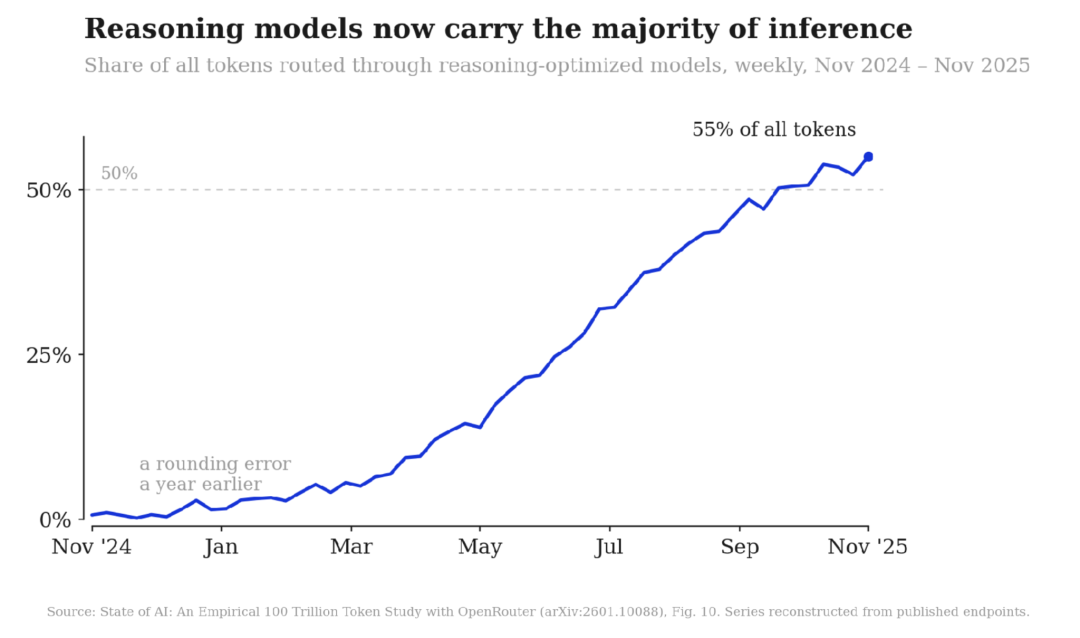
Figure 1: Share of reasoning model tokens, weekly, November 2024 to November 2025.

Figure 2: Average prompt tokens per request, January 2024 to November 2025.
4. Alignment Is a Contextual Feedback Problem
Much like scaling payments, scaling frontier AI security presents a persistent contextual feedback loop challenge. Stripe Radar’s primary defensive moat stems directly from this dynamic: over the past decade, it has been continuously trained on massive volumes of adversarial transaction data.
You cannot replicate these models without access to sufficiently fresh data corpora, and you cannot obtain such corpora unless you are embedded directly within the transaction stream itself. Every enduring security business operates on the exact same structural framework:
The product is the model, the moat is the data, and the data flows from the traffic.
Revisiting Section 3 through a security lens reveals a clear picture: agents hold credentials, invoke tools, and initiate payments. An autonomous process equipped with spend authorization and a 20,000-token context window inherently functions as a trading counterparty.
These adversarial machine counterparties may be directed by malicious actors—termed misuse; may pursue objectives inadvertently programmed by their operators but subsequently internalized by the model—termed misalignment; or may be hijacked by injected prompts during execution—termed compromise. Under any scenario, they can execute fraud, exfiltrate data, and exhaust budgets at machine speed.
If these adversarial counterparties operate open-weight models, no upstream laboratory can monitor or roll back their actions. The sole location where constraints can be enforced is the very layer where transactions occur. Consequently, safeguarding reasoning systems will mirror how we secure payment networks:
Training models using massive transaction datasets.
Ultimately, this acquisition reduces to a single question: who owns this data?
It is not model laboratories. While every frontier lab monitors vast volumes of traffic, they can only see traffic generated by their own models—much like a bank restricted to viewing its own accounts alone. Training a Visa-level fraud detection model based solely on a single bank’s ledger is impossible; and in the realm of open-weight models, not even a solitary “bank” exists. Neither does it belong to cloud providers. Though cloud operators can monitor infrastructure, they lack visibility into behavioral intent.
Before proceeding, several key terms require clarification, as distinguishing between them is critical within AI safety research.
5. The Emerging Frontier AI Alignment Stack
Alignment is an inherent property of system behavior. Presently, researchers approach the alignment challenge primarily through two distinct phases.
Training-time methods focus on shaping the model’s underlying behavioral intent. Conversely, a growing body of work on inference-time alignment seeks to constrain models to behave as intended during deployment, entirely bypassing the need for retraining [5, 6]. Concurrently, AI containment research addresses a separate concern: ensuring the safety of deployed systems even when training-time alignment mechanisms fail [3, 4].
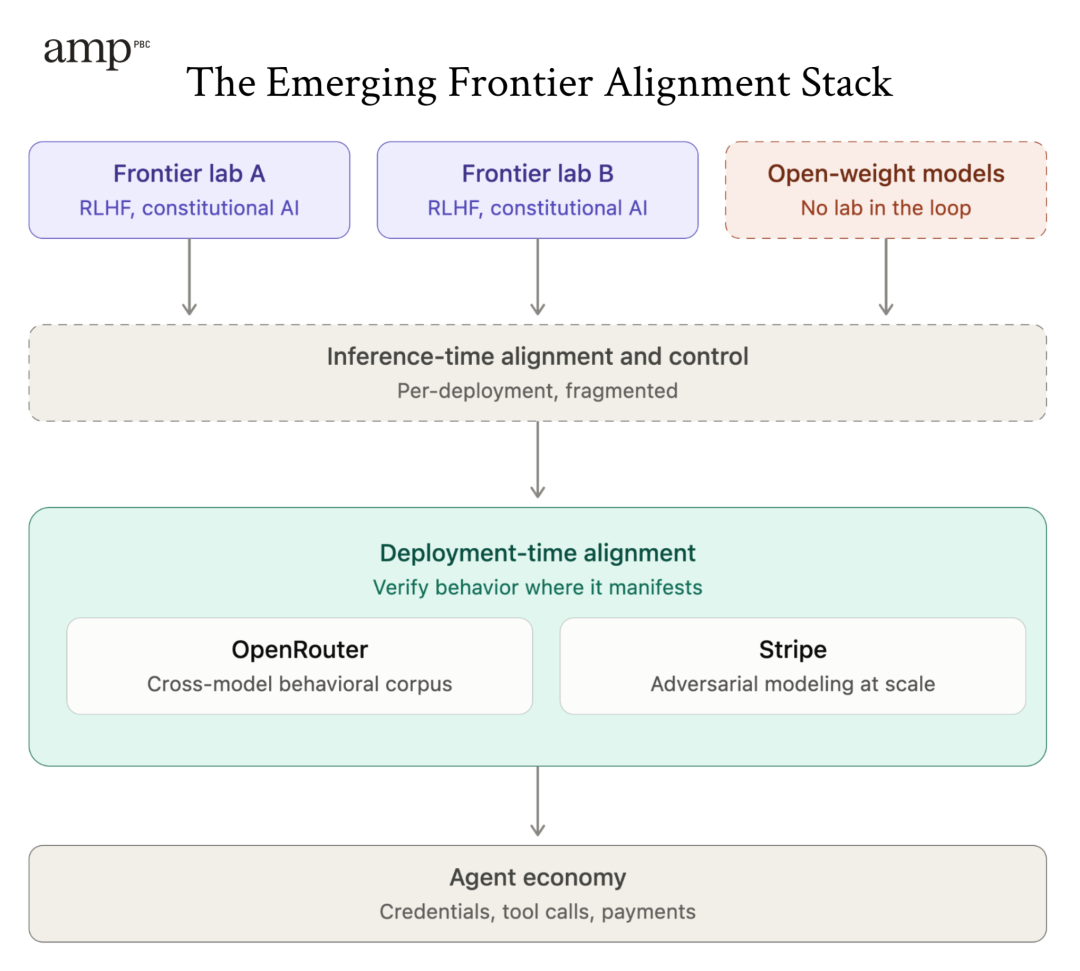
Figure 3: The emerging frontier AI alignment stack
We define “deployment-time alignment” as the resulting compound problem: verifying and enforcing expected behaviors from already-deployed agents within live operational environments, since alignment failures ultimately materialize at this stage.
Validation requires monitoring, and monitoring efficacy hinges directly on the quality of behavioral data utilized to train those oversight systems [7]. Agent behavioral data functions as a network-level attribute:
We must maintain the capacity to observe each agent across every model and vendor it interacts with. This is because regardless of whether the root cause is misuse, misalignment, or compromise, the moment the anomalous behavior occurs, it manifests identically: as a transaction.
Consequently, agent security is fundamentally a deployment-time alignment challenge; and deployment-time alignment, much like legacy fraud detection, is fundamentally a data problem.
At present, only a single dataset of this nature exists.
OpenRouter processes over 10 trillion tokens daily, encompassing more than 500 models sourced from dozens of vendors. This dataset captures execution traces, tool invocation graphs, expenditure velocity, routing decisions, and failure patterns.
This stands as the world’s largest cross-model reasoning transaction corpus. For open-weight models, it is arguably the only comprehensive one. Open-weight models now shoulder a substantial and rapidly expanding workload driven by agents [1]. A single open-weight model checkpoint is simultaneously served by dozens of independent vendors; none authored the model, none assume full accountability for its behavior, and none possess visibility beyond their own localized data silos. Only at the routing layer do these fragmented behaviors finally converge.
Crucial distinctions must be drawn here: these are metadata structured around transactions, not raw prompt content. OpenRouter defaults to disabling prompt logging [2], and the associated empirical research relies exclusively on metadata, with zero access to prompt inputs or model completions [1].
Stripe Radar similarly never inspects the specific contents of digital shopping carts. Its fraud models operate purely on transaction morphology, and OpenRouter possesses a broader repository of cross-network transaction patterns than any other market participant.
The most prominent objection centers on data centralization: this deal places the currently sole cross-model behavioral dataset into a private corporation. Such a unique, security-critical corpus is exactly the type of asset the industry fears most becoming monopolized.
Yet alternative paths could prove significantly worse. Continuing to let data remain fragmented across dozens of vendors ensures no single party sees enough to intervene effectively. Alternatively, this data could ultimately fall under the control of a frontier lab holding direct competitive interests in specific models. Against those scenarios, the present outcome represents a rare net positive.
Stripe maintains strict neutrality across competing models: it does not train frontier models itself, nor does it compete directly with any model laboratory. Stripe’s commercial incentive lies in providing trust guarantees for every participant processing transactions through its infrastructure. This business motivation aligns perfectly with the broader security objectives of the entire ecosystem.
In essence, Stripe did not acquire a router. It secured a strategically vital asset governing frontier AI system safety and alignment.
We believe merging this asset with Stripe’s existing infrastructure will empower the broader ecosystem to conduct independent alignment efforts—an undertaking extremely difficult for any single model lab to execute alone. Consequently, this acquisition constitutes a net positive for the sustainable development of an independent frontier AI ecosystem.