Willing to Lose $41.9 Million to Terminate Contract? Block's Major Mining Client Chooses to Exit
TechFlow Selected TechFlow Selected
Willing to Lose $41.9 Million to Terminate Contract? Block's Major Mining Client Chooses to Exit
Renting data centers to AMD is far more profitable than using Dorsey's mining rigs to mine Bitcoin.
 Navigating Web3 tides with focused insights
Written by: Protos
Compiled by: Chopper, Foresight News
Since 2024, Core Scientific has paid at least $67.9 million to Jack Dorsey's Block company for the procurement of Bitcoin mining chips. Subsequently, the company incurred a loss of $41.9 million due to terminating the remaining mining machine procurement contract.
The data center operator paid Block $10 million in July 2024, $21.3 million in January 2025, and completed the final payment of $36.6 million in January 2026.
However, the company's latest quarterly report released today shows: Core Scientific "has signed a termination settlement agreement with Block and its subsidiary Proto Global LLC, terminating the existing contract and all subsequent mining machine delivery obligations, resulting in a loss of $41.9 million."
Despite having to bear this huge loss, Core Scientific still decided to terminate its procurement obligations with Proto, Block's mining hardware division, to advance its own "strategic transformation."
Block announced a procurement framework agreement as early as July 2024, planning to deliver self-developed 3-nanometer mining chips with a computing power of approximately 15EH/s. Core Scientific is the first customer for Proto chips and the only large-scale purchaser on Block's public list.
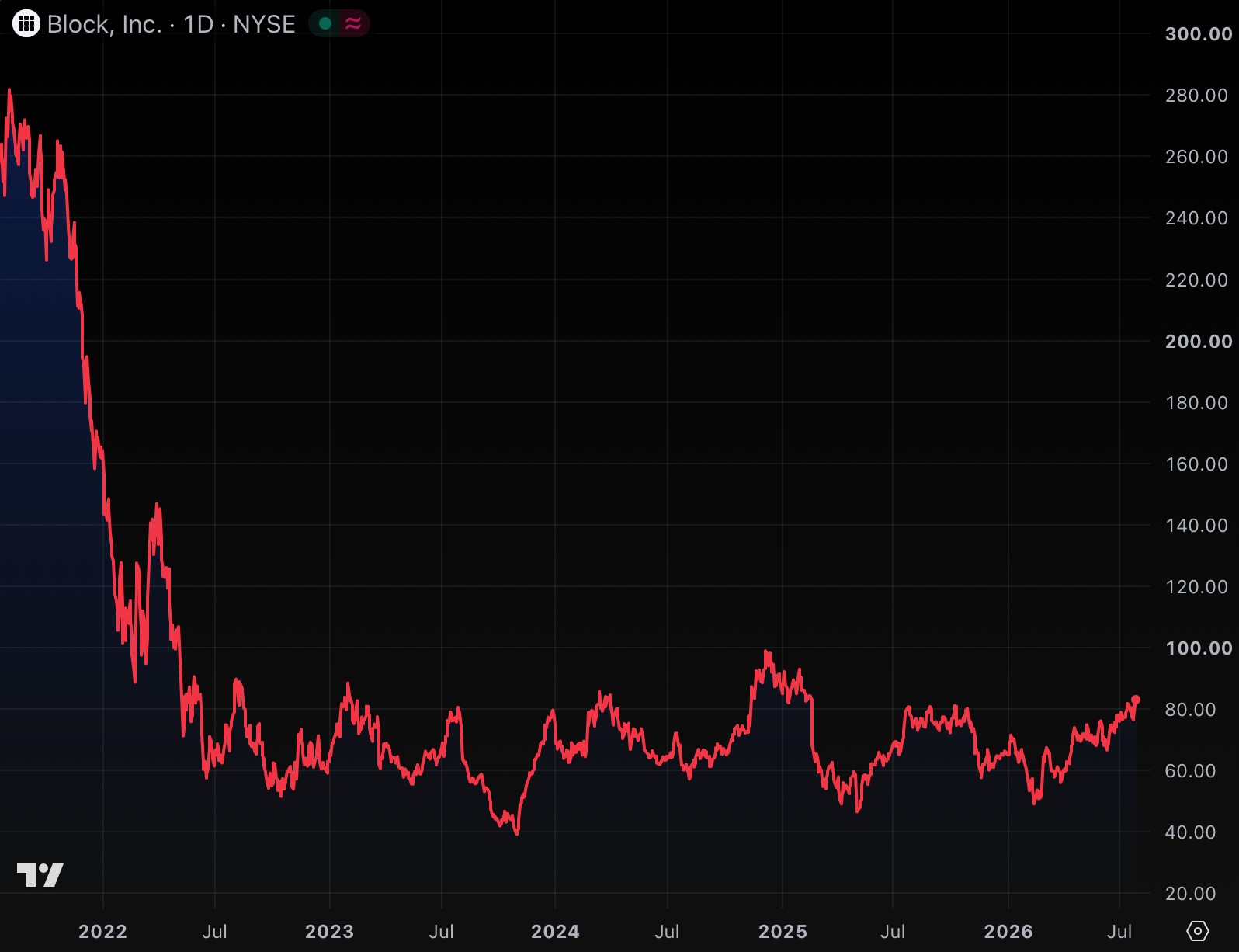
Block Stock Price Trend
Jack Dorsey's Bitcoin Mining Business
As of January 2025, Core Scientific had paid $31.3 million in deposits and prepayments, at which time it was estimated that $64.8 million in payments would still be required subsequently. In January 2026, after partial delivery of mining machines, the company paid another $36.6 million. Immediately after, Core Scientific accrued a loss of $41.9 million and canceled all remaining orders.
Core Scientific's announcement did not detail the specific composition of this cost, but the result is very clear: the company is willing to bear a huge loss to stop purchasing Bitcoin mining machines launched by Dorsey.
One day before the announcement, Core Scientific signed a 15-year data center leasing agreement with a total capacity of 529 megawatts, with the vast majority of data centers leased directly to AMD. The company stated that this leasing contract, unrelated to Block, is expected to bring over $14 billion in contract revenue.
Nowadays, leasing data centers to AMD is far more profitable than using Dorsey's mining machines to mine Bitcoin.
Protos previously reported that Block had shut down its internal incubated Bitcoin mining project and the TBD department for Web5 identity projects in November 2024.
The shareholder letter for that quarter wrote: "We will reduce our investment in the music streaming platform Tidal and shut down the TBD department. This allows us to have more funds to invest in the Bitcoin mining business. This business has good product-market fit, sufficient order demand, and simultaneously continues to develop the Bitcoin self-custody wallet Bitkey."
The so-called "sufficient order demand" ultimately resulted in a major customer willing to lose $41.9 million to escape the procurement contract.
When discussing the mining business during the Q2 2025 earnings conference call, Dorsey stated: "We will gain a large number of satisfied customers, expand the market size, and seize a large market share."
One week after this conference call ended, Block officially released the Proto mining machine at Core Scientific's campus in Dalton, Georgia. Less than a year later, this core major customer directly terminated the contract at a loss and canceled all remaining orders.
Jack Dorsey Encounters Consecutive Business Setbacks
The cooling of Block's mining machine business is just one link in a series of failed projects by Jack Dorsey. Over the past five years, Block's stock price has cumulatively fallen by 68%.
In 2021, Block spent $237.3 million (adjusted) to acquire Jay-Z's music platform Tidal. Reuters reported that this acquisition was generally regarded by the market at the time as a "major mistake." Subsequently, Block accrued a goodwill impairment of $132.3 million on this investment in Tidal, equivalent to directly admitting a huge loss on this acquisition.
In July 2025, Dorsey launched the open-source communication software Bitchat. Within just a few days of launch, he added a risk warning in the code repository: this software has not yet undergone external security auditing, may have vulnerabilities, and may not achieve the advertised security goals.
In January 2025, the Consumer Financial Protection Bureau (CFPB) ruled that Block pay a $55 million fine and additionally compensate up to $120 million to resolve issues regarding improper handling of Cash App fraud complaints. Just one day before the penalty was issued, state financial regulators had just issued an $80 million fine to Block.
In February 2026, Block disclosed to shareholders a plan for significant layoffs, reducing the employee scale from over 10,000 to within 6,000, with over 4,000 employees facing departure or negotiated layoffs.
Block will release its Q2 2026 earnings report after the U.S. stock market closes on August 5 and has not yet made any response regarding the Core Scientific contract termination.
Join TechFlow official community to stay tuned
Telegram:https://t.me/TechFlowDaily
X (Twitter):https://x.com/TechFlowPost
X (Twitter) EN:https://x.com/BlockFlow_News
 @Protos