When ETH Goes Deep into the Balance Sheet: The Historical Positioning of Staking's Next Phase, Where Do We Go from Here?
TechFlow Selected TechFlow Selected
When ETH Goes Deep into the Balance Sheet: The Historical Positioning of Staking's Next Phase, Where Do We Go from Here?
The staking ratio has hit an all-time high, with queued ETH remaining elevated, redefining the boundaries of ETH's yield, liquidity, and risk.
 Navigating Web3 tides with focused insights
Written by: imToken
Now, if you want to become an Ethereum validator directly, you have to queue for more than a month.
As of July 22, there are still about 2.5 million ETH in the Ethereum staking entry queue, with an estimated wait time of over 43 days. In contrast, the exit queue wait time is about a few minutes, almost negligible.
Judging from the numbers alone, undoubtedly, more and more ETH staking is siphoning off market circulation.
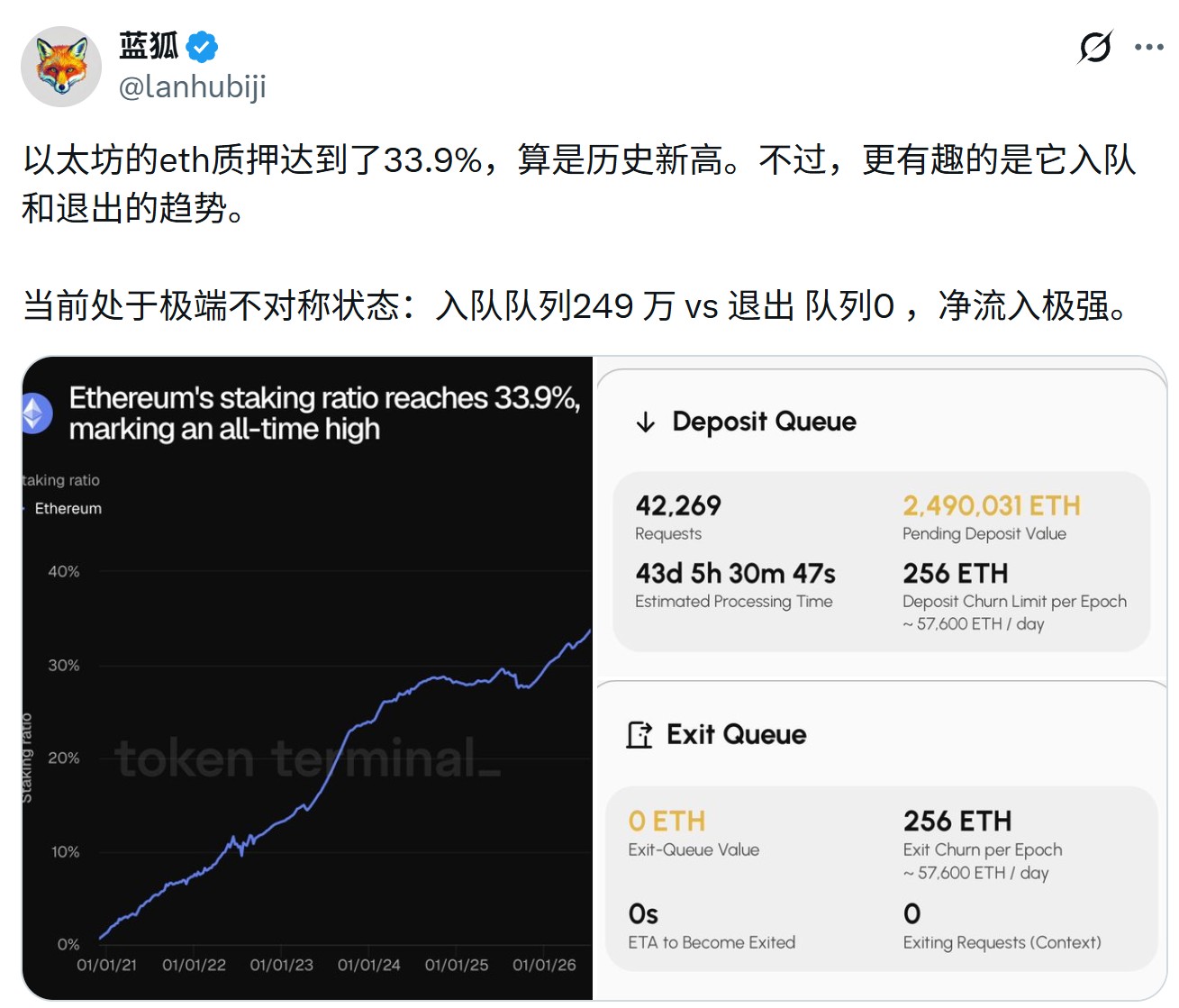
But more noteworthy than the growth in staking scale is that queuing is starting to become a capital efficiency issue.
After all, for ETH treasury companies and institutions choosing the native staking path, a queue wait of over 40 days means a considerable amount of assets cannot temporarily generate staking rewards, and asset allocation, liquidity arrangements, and opportunity costs all need to be recalculated.
Ultimately, when ETH is more deeply incorporated into balance sheets, the problem facing Staking is no longer just "how to get more people involved," but begins to become a set of more traditional and also more complex asset management issues.
I. Staking Rate Hits New High, How to Understand the Queue?
The current high staking rate of Ethereum was not formed suddenly at a certain point in time.
In 2023, the Shapella (Shanghai + Capella) upgrade opened staking withdrawal functionality, enabling validators to retrieve staked principal and rewards at the protocol level, allowing ETH Staking to form a relatively complete entry, operation, and exit loop. Since then, the LSD-based derivatives market has expanded rapidly, driving the ETH staking rate continuously higher.
As of the time of writing, the ETH staking amount has exceeded 40 million, calculated at current prices to be about $140 billion, accounting for over 33% of the total supply. Compared to the staking rate of about 10% a few years ago, this is a significant increase, hitting a historic high.
In other words, currently, for every 3 ETH, more than 1 is participating in staking.

Under the premise of a record-high staking rate, the persistently high entry queue also exposes a new problem.
As everyone knows, Ethereum's entry and exit queues are essentially a rate-limiting mechanism to protect consensus stability.
New ETH cannot enter the validator set simultaneously without limit, nor can exits occur concentratedly in a short period. The protocol sets the amount of ETH that can be processed per Epoch based on the current validator scale. When funds applying to enter or exit exceed processing capacity, a queue forms.
From this perspective, 2.5 million ETH queuing to enter first indicates that market demand for staking capacity is far higher than the speed the protocol can currently release—this may include new long-term capital entering, treasury companies deploying existing holdings, staking service providers adjusting validator structures, and institutions transferring ETH from custody accounts into the staking system.
Therefore, this actually releases a clear signal: at least at the current stage, funds willing to let ETH enter the staking system are far greater than funds actively withdrawing from the validator set.
This is already significantly different from the staking logic in the early days of the Beacon Chain launch.
Early ETH Staking was closer to a network participation mechanism for technical users, independent validators, and long-term Ethereum supporters, where participants ran nodes, maintained the network, and bore technical risks in exchange for protocol rewards.
After the rise of liquid staking, it gradually became a product for ordinary token holders to obtain on-chain yields. For example, exchange staking, staking-as-a-service, and staking pools gradually lowered technical thresholds. Liquid staking protocols such as Lido and Rocket Pool further released the availability of staked funds, allowing users to obtain liquid staking tokens such as stETH and rETH after staking ETH, which can not only be transferred and traded but also enter lending, liquidity pools, and other DeFi protocols.
Now, as large amounts of ETH enter corporate treasuries, fund products, and professional custody systems, Staking is undoubtedly moving towards a third stage, shifting further from "who can participate in staking" to "how large-scale ETH should be managed."
Of course, the institutionalization mentioned here does not mean that early staking was completely dominated by retail investors, nor does it mean that institutions will replace ordinary users. More accurately, the focus of market discussion is changing:
In the past, the focus was on how ordinary users could obtain staking yields. Now, the focus is on how staking becomes a standardized treasury management capability after hundreds of thousands or even millions of ETH enter corporate balance sheets.
II. Structural Changes Behind Institutions Like BitMine
The emergence of ETH treasury companies is making this change more intuitive.
Because the core logic of Bitcoin treasury companies is to continuously accumulate BTC through financing and capital market operations to increase the amount of Bitcoin corresponding to each share; but for ETH treasury companies, holding assets is not the end of the strategy.
After all, BTC itself does not have protocol-native staking yields. If holders want to obtain extra returns, they usually need to introduce lending, custody, derivatives, or other counterparty risks, whereas ETH can directly participate in Ethereum consensus and obtain protocol rewards without selling assets.
This gives ETH treasuries naturally an extra layer of operational space, meaning that besides deciding how much ETH to buy, it is also necessary to decide how these ETH are deployed.
BitMine's actions are a concentrated embodiment of this institutional language.
According to its latest disclosed data, as of July 19, BitMine holds a total of 5,777,468 ETH, accounting for about 4.8% of the total ETH supply, of which a total of 4.917 million ETH are staked, accounting for 85% of its total ETH holdings, valued at about $9.2 billion.
Calculated based on the ETH price at the time and BitMine's own 7-day annualized staking yield of 2.67%, the company expects to obtain about $247 million in staking income annually; if its ETH is eventually all staked, the expected annualized reward scale may reach about $290 million.
What is more noteworthy is the speed of this numerical change.
In early February this year, BitMine had about 2.8975 million ETH participating in staking, accounting for about 67% of holdings at the time; by mid-July, its staking scale had increased to about 4.9172 million.
That is to say, in less than half a year, BitMine newly deployed over 2 million ETH, and the staking coverage rate also increased from about two-thirds to 85%.
This indicates that Tom Lee and BitMine are participating their held ETH in staking at a visible speed, making the ETH in hand no longer just a crypto asset waiting for price increases, but an on-chain base asset with native yield capability.
For ordinary investors, the staking rate may just be a yield option, but for BitMine, it is becoming a treasury operation indicator alongside ETH holdings, net asset value per share, and financing costs.
At the same time, BitMine also launched its own institutional-grade staking platform MAVAN to serve the company's own ETH treasury, and plans to provide staking infrastructure to institutional investors, custodians, and ecosystem partners in the future (Further Reading "Hong Kong Ethereum Observation: When the "World Computer" Meets "Yield-Bearing Assets", How Do Two ETHs Resonate?").
This means that Staking assumes at least three layers of roles for BitMine: First, it adds a layer of ETH-denominated yield for long-term holdings; second, staking rewards can be continuously reinvested to increase the amount of ETH owned by the treasury; finally, when self-built validator capabilities are opened to the outside, the staking infrastructure itself may become a service business.
SharpLink further pushes this logic from native staking to active yield management.
For it, basic staking yield is just the starting point; part of the staked ETH can continue to enter on-chain yield funds, allocated to liquidity, lending, and other DeFi strategies.
Changes in Lido V3 occur at the infrastructure layer.
In the past, users and institutions mainly entered unified liquid staking pools. Now, institutions can choose node operators, fee structures, and risk parameters independently through more independent staking vaults, while retaining the option to obtain stETH liquidity. This means liquid staking is moving further from standardized products to isolatable and customizable institutional-grade infrastructure.
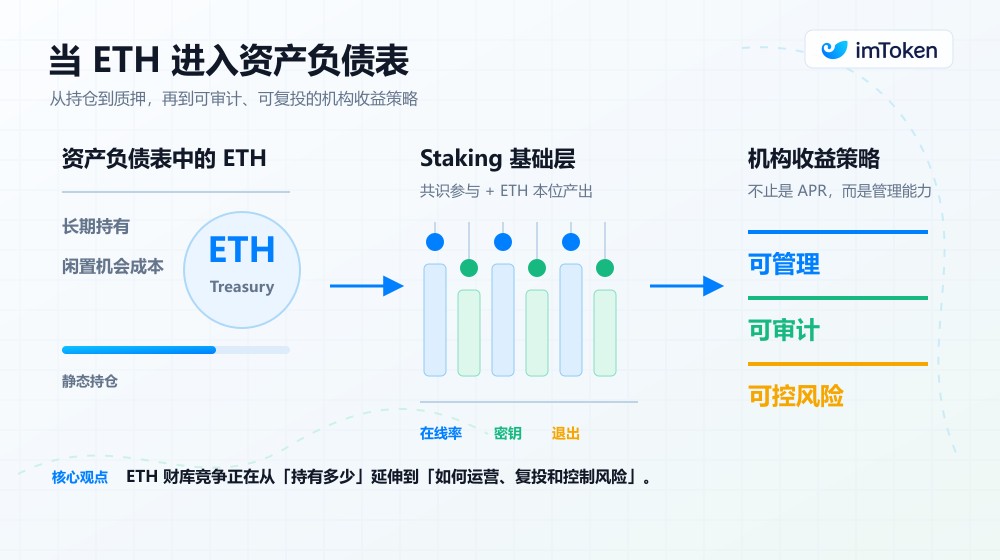
Therefore, the competition among ETH treasury companies in the future may not just be about who holds more, but also includes who can manage these ETH with lower costs, higher online rates, and more complete risk control.
From this perspective, ETH is also changing from a crypto asset waiting for price increases into an asset that requires continuous operation.
III. Yields Are Not High, Why Is Staking Instead More Important?
As of the time of writing, the Ethereum network-wide staking APR is about 2.64%. To be fair, compared with some DeFi products, this level is not particularly outstanding, and as the ETH participating in staking continues to increase, this base yield may be further diluted.
But the demand of institutions for Staking cannot be understood solely by the level of yield—Staking reduces their opportunity cost of holding ETH long-term.
For short-term investors, an annualized yield of 2% to 3% is difficult to offset the price volatility of ETH itself, but for treasury companies, funds, or large addresses that have already decided to hold ETH long-term, the question is since ETH is already on the balance sheet, they must continuously obtain more ETH through participating in network security without giving up ETH price exposure (Further Reading "When Wall Street's ETH Starts to "Bear Interest": From BlackRock's ETHB, Look at the Shift in Ethereum's Asset Attributes").
This is easy to understand. For ordinary users holding 100 ETH, a 2.6% yield may not be significant; but for treasury companies holding millions of ETH, the same yield rate will form considerable absolute income and gradually affect the amount of ETH corresponding to each share through long-term reinvestment.
This is also one of the important differences between ETH and BTC in the treasury narrative.
Therefore, when ETH enters institutional balance sheets, the treasury department is not facing a static position, but an on-chain asset that can be continuously deployed, accounted for, and adjusted.
And as institutional participation increases, native staking yields may also assume another function, which is to become the yield benchmark for the entire ETH asset system.
This is easy to understand. For example, in the future when a DeFi strategy promises 5%, 8%, or even higher yields, what institutions need to compare is not "with yield" and "without yield," but how much more it earns relative to the about 2.6% native staking yield, and what additional risks are borne.
Lending, liquidity market making, structured products, and restaking strategies all need to prove whether their risk-return is reasonable on top of this base yield. From this perspective, the importance of Staking in the next stage lies not only in how much ETH it brings to holders, but also in that it begins to become the underlying coordinate for measuring other on-chain strategies.
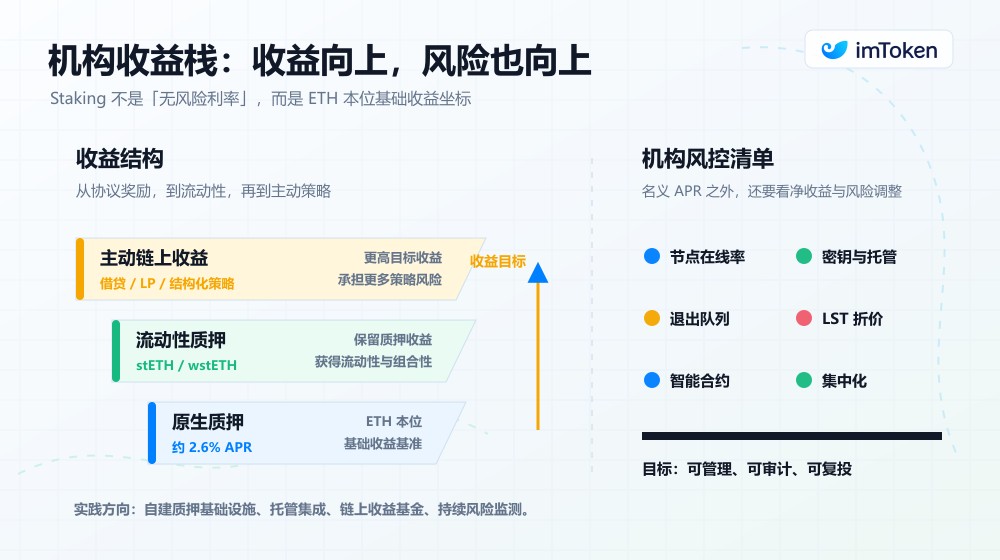
However, it still cannot be simply regarded as Ethereum's "risk-free rate." Stakers need to bear risks such as ETH price volatility, validator offline, node failures, and potential slashing; participating through service providers will also increase operator and custodian risks; if continuing into DeFi, risks will also accumulate with the increase of protocol and strategy layers.
In addition, higher staking rates do not only have positive impacts. Once new funds are mainly concentrated in the hands of a few treasury companies, custody institutions, liquid staking protocols, and node operators, it is very likely to exacerbate validator, cloud service provider, and jurisdiction centralization.
So when staking gradually evolves from a network participation mechanism to an institutional asset allocation tool, what Ethereum needs to solve is not just how to accommodate more funds, but also how to maintain balance between capital efficiency, institutional demand, and decentralization.
In Conclusion
Overall, from the 32 ETH validator node requirement in the early days of the Beacon Chain launch, to liquid staking protocols lowering participation thresholds, to today's treasury companies, self-built validator networks, and institutional on-chain yield funds, the change in Staking is essentially also a change in how the market understands ETH.
It was initially a mechanism for participating in network consensus, subsequently became a tool for ordinary users to obtain on-chain yields, and now begins to enter corporate balance sheets, custody systems, and professional yield management frameworks.
For these long-term holders, a yield of 2% to 3% may not be stunning.
But as long as ETH no longer only lies in addresses or custody accounts waiting for price increases, and can participate in network security, obtain protocol rewards, continuously reinvest, and on the basis of maintaining certain liquidity, it will help accelerate its becoming the underlying asset for other financial strategies.
This is also where ETH's new era proposition lies.
Join TechFlow official community to stay tuned
Telegram:https://t.me/TechFlowDaily
X (Twitter):https://x.com/TechFlowPost
X (Twitter) EN:https://x.com/BlockFlow_News
 @imTokenOfficial