Robinhood Chain's Trading Volume Rivals Base Three Weeks After Launch, But Revenue Share to Ethereum Is Less Than 1%
TechFlow Selected TechFlow Selected
Robinhood Chain's Trading Volume Rivals Base Three Weeks After Launch, But Revenue Share to Ethereum Is Less Than 1%
Once again exposed the old problem of insufficient base layer value capture in the L2 economic model.
 Navigating Web3 tides with focused insights
Author: Tanay Ved
Compiled by: TechFlow
TechFlow Editor's Note: Robinhood Chain attracted $200 million in cross-chain ETH within just three weeks of launch, with daily transaction volume matching Coinbase's Base chain. However, on-chain data shows Robinhood retained 89% of fee revenue, allocating less than 1% to Ethereum — this once again exposes the old problem of insufficient base layer value capture in the L2 economic model.
Key Points
Within just three weeks of launch, Robinhood Chain has attracted over $200 million in cross-chain ETH, processed over 130 million transactions, and its daily transaction volume has matched Coinbase's Base chain.
Robinhood Chain has generated approximately $1.9 million in fee revenue, of which about 10% is allocated to Arbitrum as Rollup infrastructure fees, and less than 1% is paid to Ethereum for data availability and settlement.
The growing supply of stablecoins and tokenized stocks provides infrastructure for lending vaults and 24/7 stock trading — this is precisely the on-chain financial system Robinhood is building.
Introduction
With the launch of Robinhood Chain, one of the world's largest retail brokerages has officially joined the race to build a financial "super app," attempting to integrate traditional markets, cryptocurrency, and tokenized RWAs. At the core of this strategy is an on-chain settlement layer leveraging Robinhood's global influence. At Robinhood's "The World Is Flat" event, the company released a series of products, including its own Layer-2 blockchain — a model becoming increasingly common among exchanges like Coinbase (Base) and Kraken (Ink).
Early user activity and on-chain data show Robinhood Chain has achieved rapid growth, with over $200 million in cross-chain ETH, total transaction volume of approximately 130 million, and fee revenue of about $1.9 million (as of July 20). Since Robinhood retains most of the network's revenue, this launch has once again sparked questions about the Ethereum Layer-2 economic model and how much value the base layer can ultimately capture.
In this issue of State of the Network, we will outline Robinhood Chain, compare its early on-chain usage with other Layer-2 networks, and analyze the economic relationship between Robinhood Chain and Ethereum.
Robinhood Chain Overview
Robinhood Chain is an Ethereum Layer-2 based on the Arbitrum Orbit tech stack, operated by Robinhood. It focuses on tokenized real-world assets (such as stock tokens and ETFs) and on-chain financial services, including 24/7 trading, lending, with block times as low as 100 milliseconds. The chain is compatible with EVM tools and applications, uses Ethereum for data availability and security, and uses ETH as the native Gas token.
Since its mainnet launch on July 1, Robinhood Chain has quickly attracted liquidity and early adoption. Over $200 million worth of ETH has been bridged to Robinhood Chain (custodied on Ethereum and minted on Robinhood Chain) for spending, trading, or as collateral. This demonstrates its early appeal, with users committing capital and generating demand for ETH as Gas and collateral.
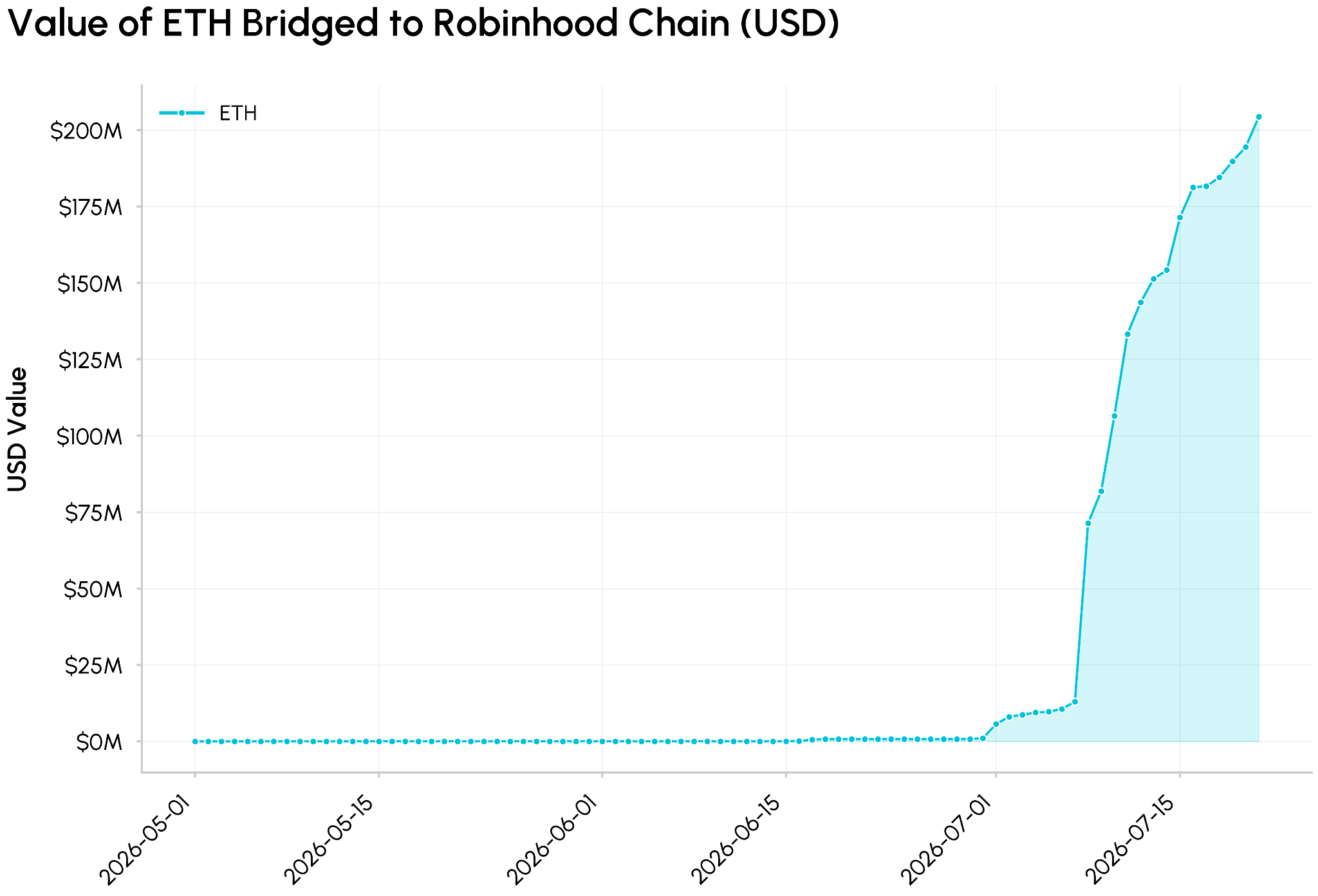
Figure: USD value of ETH bridged to Robinhood Chain (exceeded $200 million as of July 20). Source: CoinMetrics
Meme Coins, Stablecoins, and Tokenized Stocks
Robinhood Chain has accumulated approximately $700 million in liquidity, of which ETH accounts for 28% ($205 million). However, early growth was driven by speculative activity around Cash Cat, a natively minted Meme coin that quickly reached a market cap of about $200 million, helping kickstart initial liquidity and user engagement.
The chain also has a $430 million stablecoin supply, including the natively issued Global Dollar (USDG) on-chain and bridged Ethena USDe. These stablecoins support Robinhood's Earn product, which is built on Morpho vaults managed by Steakhouse Financial, with total deposits reaching $163 million.
USDG is a consortium stablecoin issued by Paxos, distributing reserve interest to partners within the Global Dollar Network, creating an incentive structure similar to OpenUSD (OUSD). This not only supports on-chain liquidity but also ties distribution partners like Robinhood to USDG supply growth, providing an additional revenue stream related to stablecoin base expansion.
This liquidity translates into strong on-chain activity: Robinhood Chain's daily transaction volume has matched Coinbase's Layer-2 network Base, with approximately 270,000 daily active addresses and a total of about 3.4 million addresses.
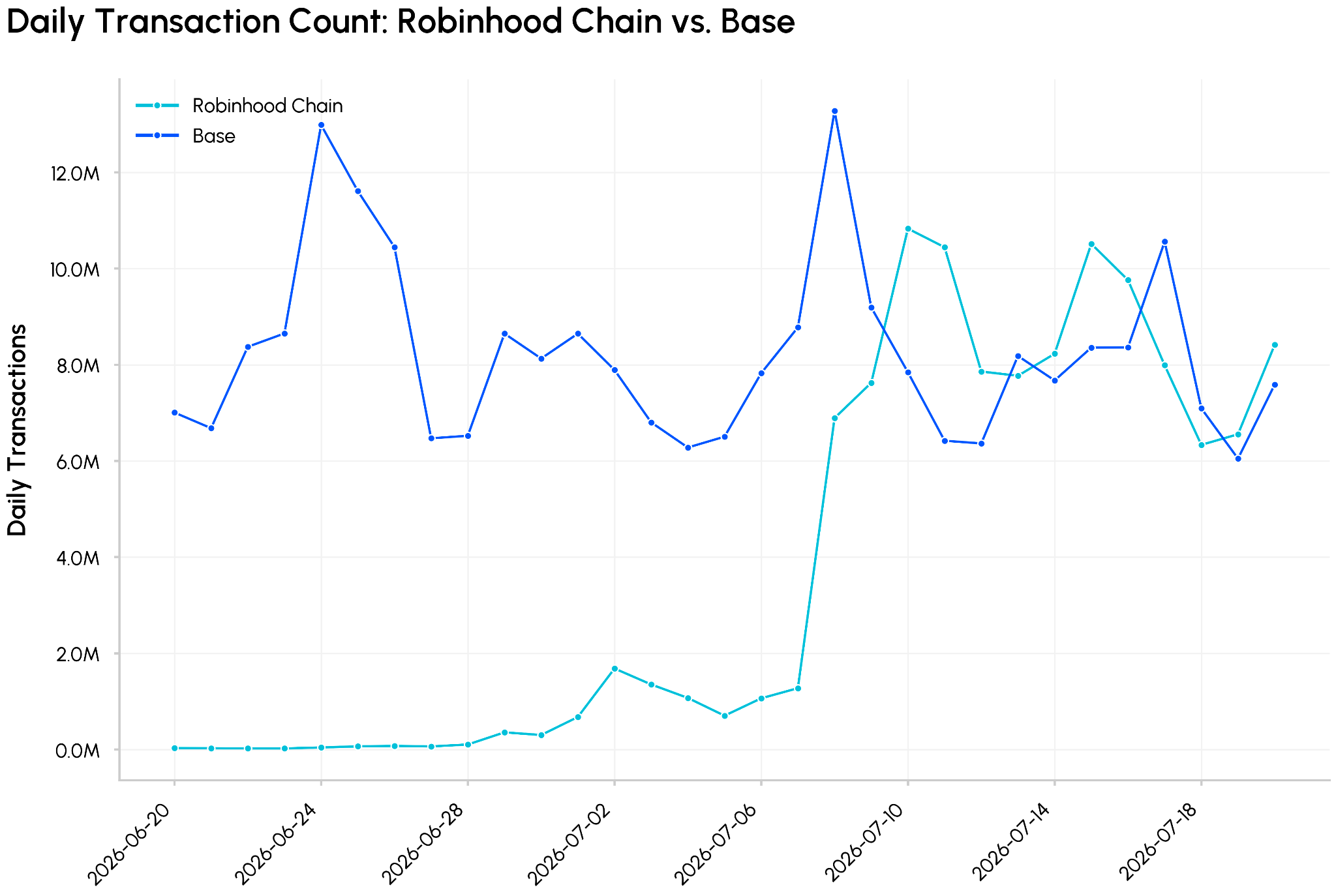
Figure: Comparison of daily transaction volume between Robinhood Chain and Base. Source: CoinMetrics
Activity is currently driven by multiple factors: speculative Meme coin trading via Uniswap, Lighter, and other spot/perpetual DEXs, Morpho vault infrastructure, and early growth of tokenized stocks via Robinhood stock tokens. Robinhood's tokenized stocks are ERC-20 tokens, adopting a model similar to Backed xStocks, structurally tokenized debt securities providing economic exposure to underlying assets held by custodians.
Whether this initial burst can mature into sustainable usage across the chain, particularly around RWAs and on-chain financial products, remains an important trend to watch.
Robinhood Chain Economics: Fee Revenue and Operating Costs
The value generated by these activities ultimately accrues to different parts of the tech stack. Since launch, Robinhood Chain has earned approximately $1.94 million in total transaction fee revenue, which is the total fees paid by users on the L2. Of this, about 10% (approximately $193,000) is allocated to Arbitrum for providing Rollup infrastructure and execution environment, less than 1% (approximately $12,000) is paid to Ethereum for data availability and security. The remaining approximately 89% (approximately $1.73 million) is retained by Robinhood, reflecting how L2 operators capture most of the value from application usage.
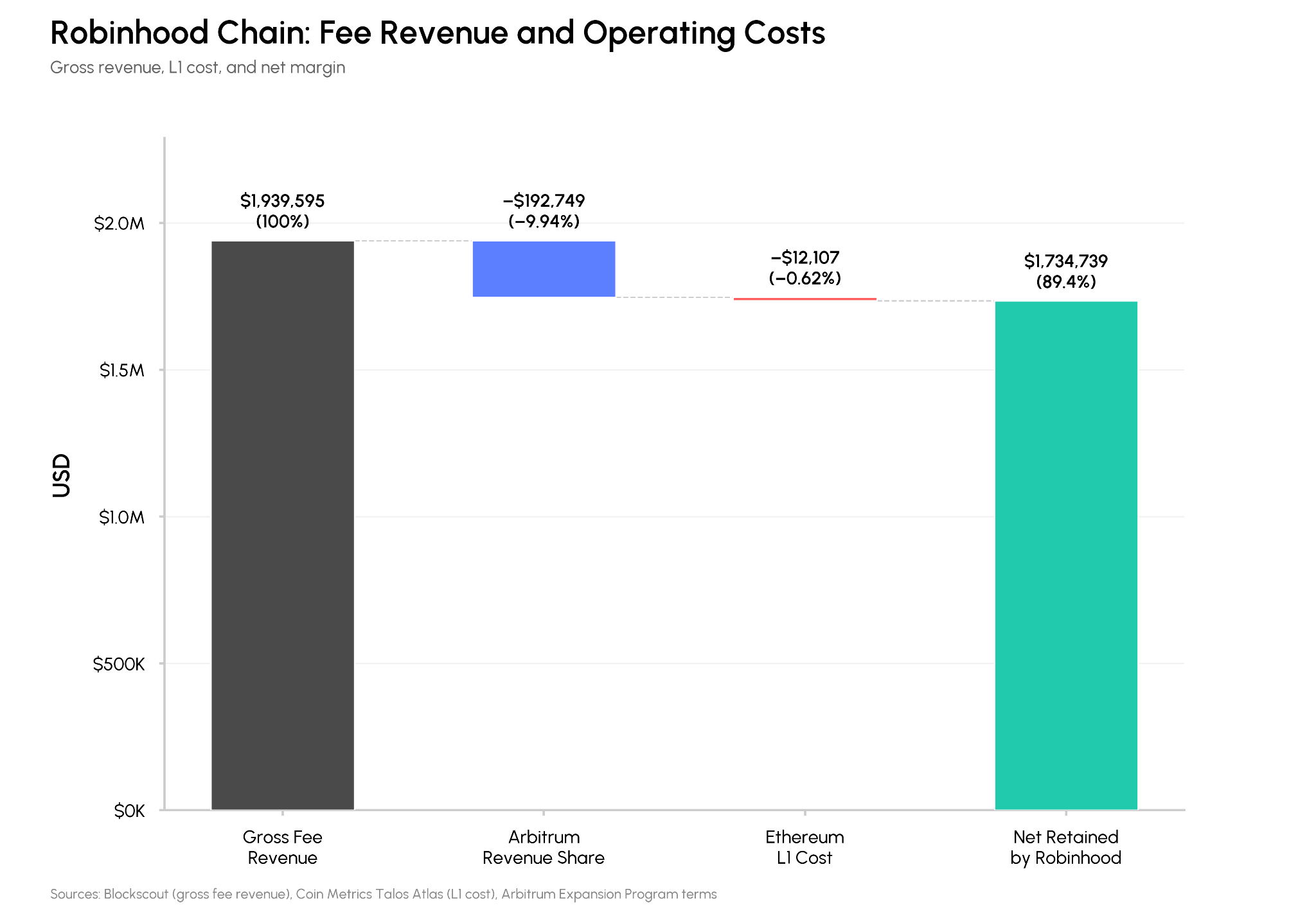
Figure: Robinhood Chain's gross revenue, Arbitrum share, Ethereum L1 costs, and Robinhood net retention (as of July 20). Source: CoinMetrics
Robinhood Chain currently uses First-Come-First-Served (FCFS) ordering. Transaction order is determined by arrival time rather than auction, meaning the chain does not derive additional revenue from transaction ordering or MEV like some sequencers.
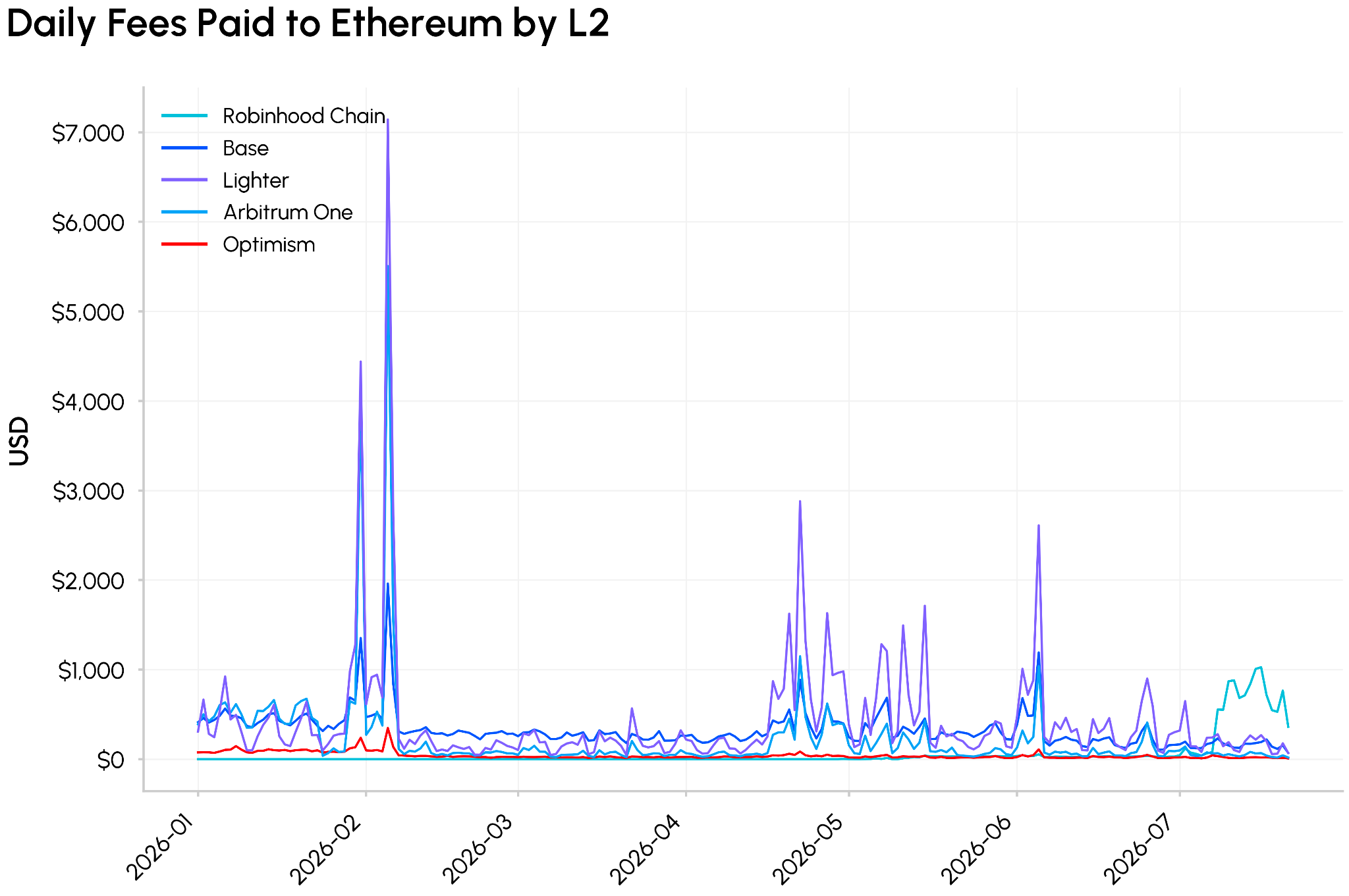
Figure: Comparison of fees paid daily to Ethereum by various L2s. Source: CoinMetrics
This model is not unique to Robinhood; among major Layer-2s, L1 costs (for data availability and settlement) account for only a small fraction of total fee revenue. Despite occasional high demand spikes, the fee revenue generated by these networks consistently exceeds the data availability and settlement fees they pay to Ethereum.
As shown in the table below, Base has generated $30.08 million in total fee revenue year-to-date in 2026, while paying $65,500 to Ethereum, sharing approximately $4.5 million with the Optimism Collective, and retaining approximately $25.5 million in net profit, with a profit margin of about 85%. Robinhood Chain, less than a month after mainnet launch, retained approximately $1.73 million (about 89%) out of $1.94 million in fees, paying only $12,000 to Ethereum, and sharing 10% (approximately $193,000) with Arbitrum according to the fee sharing program.
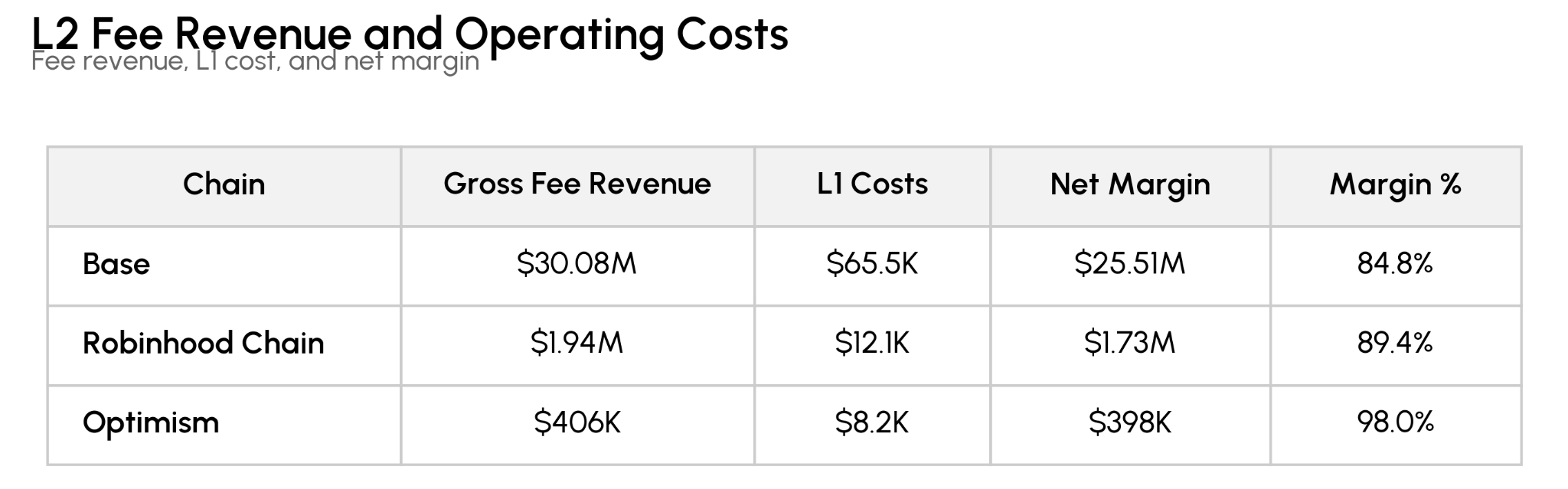
Figure: Comparison of fee revenue and operating costs for Base, Robinhood Chain, and Optimism. Source: CoinMetrics
For Ethereum, this re-exposes a familiar contradiction. Layer-2s and their tech stacks capture most of the direct fee revenue, but their growth creates network effects, expands the ecosystem, increases demand for ETH as Gas, and demand for Ethereum as a neutral settlement layer securing these high-margin application chains.
Robinhood Chain has quickly become a high-activity, high-margin Layer-2, kickstarted by Meme coins, stablecoin liquidity, and a growing tokenized stock base. Its economic model highlights how Robinhood captures most of the fees generated by user activity while relying on Ethereum for security and settlement.
Whether this initial burst can mature into sustainable usage across the chain, particularly around RWAs and on-chain financial infrastructure built on 24/7 markets and Robinhood's global distribution capabilities, remains an important trend to watch as these markets accelerate convergence.
Join TechFlow official community to stay tuned
Telegram:https://t.me/TechFlowDaily
X (Twitter):https://x.com/TechFlowPost
X (Twitter) EN:https://x.com/BlockFlow_News
 @coinmetrics