Staking ETH Earned a Steady $46 Million, Why Is BitMine Still Facing Huge Losses?
TechFlow Selected TechFlow Selected
Staking ETH Earned a Steady $46 Million, Why Is BitMine Still Facing Huge Losses?
BitMine wiped out all its profits trading options.
 Navigating Web3 tides with focused insights
Written by: Oluwapelumi Adejumo
Compiled by: Chopper, Foresight News
BitMine is aggressively building its Ethereum holdings, attempting to convert them into a source of stable cash flow, with staking operations generating nearly $46 million in revenue last quarter.
However, a $92.1 million loss on derivatives options completely offset staking earnings. Coupled with rising asset management costs and the company's aggressive stock issuance, the profit margin for existing shareholders has been significantly compressed.
Financial results for the third quarter of fiscal year 2026 ended May 31 show that company revenue surged from $2.1 million in the same period last year to $46.5 million; 98% ($45.7 million) of this came from staking and node validation business. BitMine is accelerating the divestiture of its Bitcoin mining business and fully transitioning to an Ethereum treasury model.
Behind the significant revenue growth, the company reported a net loss of $83.6 million this quarter, compared to a slight loss of only $623,000 in the same period last year, marking a sharp expansion in the scale of losses.
Huge Options Loss Wipes Out All Ethereum Staking Earnings
The core factor dragging down this quarter's performance was the company's Ethereum derivatives options trading strategy. BitMine incurred a total loss of $92.1 million on Ethereum-related derivatives this quarter, approximately twice the total revenue from staking operations during the same period. Of this, $78.6 million came from net losses on expired option contracts, and $14 million came from losses on exercised positions. Gains of $534,000 from open contracts could only slightly offset part of the losses.
The company did not engage in any derivatives trading in the same period last year, marking a qualitative leap in asset management business risk exposure. In the first nine months of this fiscal year, cumulative derivatives losses totaled $133.3 million, including $79.3 million in losses from exercised positions and $54.5 million in losses from expired contracts, with only $515,000 in profits from open contracts. During the same period, staking and validation business generated only $56.9 million in total revenue, with derivatives losses exceeding staking income by more than double.
BitMine stated that its options strategy primarily involves selling put options, as part of an overall position management plan. While selling put options can earn premiums and allow for accumulating assets at lower prices, once the market moves adversely and contracts are exercised under unfavorable conditions, it will generate huge losses. This large loss demonstrates that the attempt to enhance earnings through options has currently completely offset the stable income created by node staking business.
Meanwhile, the company's general and administrative expenses surged from $744,000 in the same period last year to $37.3 million. Management explained that the increase was mainly due to digital asset custody and asset management service fees, salary increases, and increased compensation for directors in the form of cash and stock.
Before excluding changes in crypto asset valuations, staking revenue was sufficient to cover cost of sales and administrative expenses for this quarter. Even after deducting multiple non-cash items, the company's adjusted non-GAAP net loss still reached $70.8 million. This financial report indicates that while the node validation business has formed considerable stable cash flow, the overall position trading strategy continues to consume staking profits.
Continuous Issuance of BMNR Stock to Accumulate Ethereum Significantly Dilutes Shareholder Equity
The funds for BitMine's large-scale accumulation of Ethereum almost entirely come from issuing additional common stock in the public market, with the cost borne entirely by existing shareholders. Within the nine months ended May 31, the company cumulatively sold 340.7 million shares of BMNR common stock through at-the-market issuance plans, raising $11.87 billion after deducting issuance expenses; during the same period, it spent $11.69 billion to purchase Ethereum.
Shareholder equity has been significantly diluted. The number of outstanding common shares increased by 149% over nine months, rising from 232.4 million shares on August 31, 2025, to 579.7 million shares at the end of May 2026; issuance continued after the quarter ended, with total share capital reaching 603.2 million shares as of July 9.
Relying on equity financing, as of May 31, BitMine cumulatively held 5.42 million Ethereum, with a comprehensive holding cost of $19.05 billion; at the time of writing, the holding amount has increased to 5.7 million.
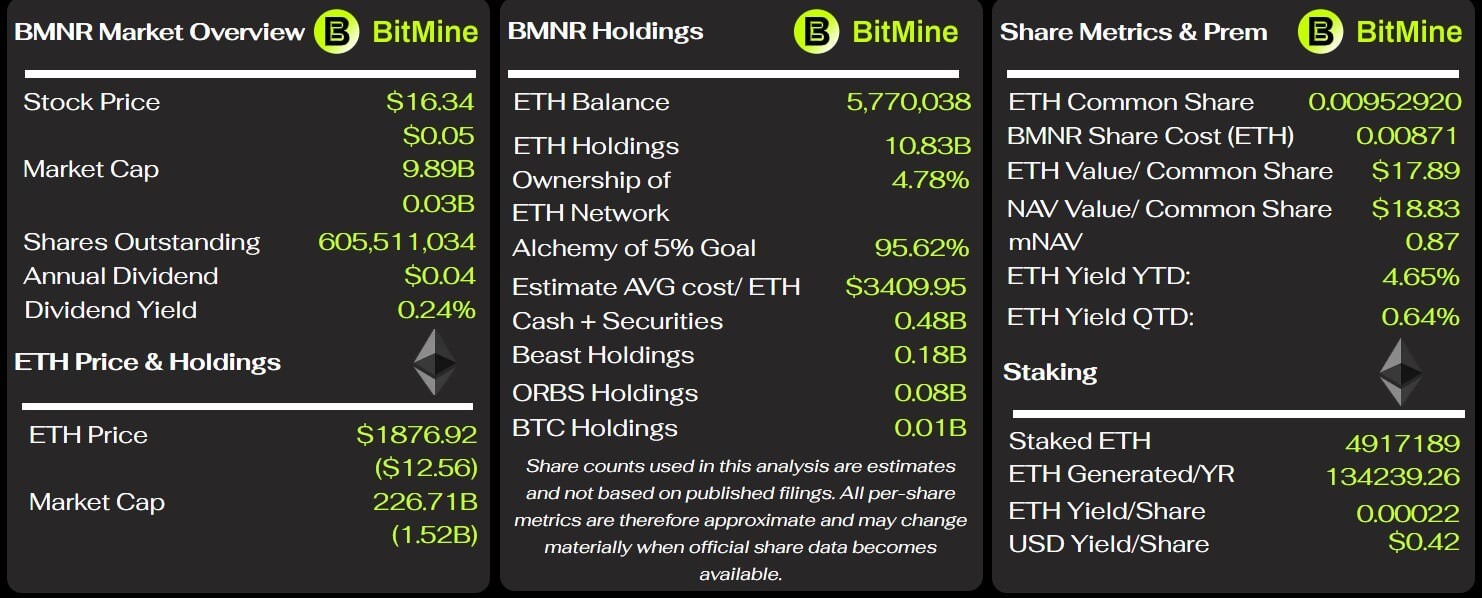
Key Metrics of BitMine, Source: BitMine Tracker
At the end of May, the market value of this batch of Ethereum holdings was only $10.86 billion, with an unrealized loss of approximately $8.2 billion, representing a loss magnitude of 43%.
The impairment of this holding is the main source of the $9.04 billion unrealized loss on digital assets for the first nine months of the company's fiscal year, during which the company cumulatively recorded a net loss of $9.1 billion. The huge unrealized loss clearly demonstrates that BitMine issued stock to buy Ethereum at high prices, with all risks borne by shareholders.
In January this year, the shareholders' meeting approved increasing the company's authorized common stock limit from 500 million shares to 50 billion shares. This authorization does not mean the company must issue the full amount, but it gives management ample space to continue issuing stock for purchasing digital assets and other investments.
BitMine cautioned that the ability to expand Ethereum holdings highly depends on continuously smooth financing channels. A decline in Ethereum price, weakening company stock price, or cooling investor subscription willingness will all raise subsequent financing costs, even limiting the company's ability to issue securities on favorable terms.
The supporting conditions for this business model include not only staking annual yields and subsequent Ethereum price increases, but also require shareholders to accept significant equity dilution, holdings consistently carrying billions in unrealized losses, and continuously providing funds for the company to accumulate coins.
Long-term Service Contracts Raise Staking Operating Costs, Compressing Profit Margins
BitMine relies on staking business to hedge against holding price fluctuations, but supporting long-term cooperative agreements generate fixed fees and revenue sharing, continuously compressing overall profits. The company signed a ten-year consulting agreement with third-party service provider Ethereum Tower, spending $12.8 million on this this quarter, accounting for approximately 28% of total staking revenue for the period. Cumulative expenses for this item in the first nine months were $37.5 million; the company estimates annual expenses between $40 million and $50 million, with billing standards charged on a tiered basis according to the total value of custodied digital assets.
The agreement can only be terminated under a few specific conditions. If BitMine terminates the cooperation without cause, it needs to pay Ethereum Tower 85% of all estimated service fees for the remaining contract period.
In addition, after BitMine acquired node operator Pier Two, it separately signed a ten-year management service agreement. The agreement stipulates that Ethereum Tower receives 2% equity in the MAVAN platform and collects a share monthly based on the platform's native staking reward ratio. As of May 31, the company has not accrued expenses related to this agreement, and sharing costs are not yet reflected in the staking business income statement.
BitMine stated that the vast majority of Ethereum is staked through MAVAN, and in the long run, staking rewards are sufficient to cover asset custody costs. Looking at the operational level of this quarter alone, staking revenue indeed covers sales and administrative expenses excluding changes in crypto asset valuations. However, with the superposition of ten-year fixed consulting fees, future revenue sharing, and various asset management comprehensive expenses, relying solely on staking revenue cannot fully measure the true profitability level of the business.
Although BitMine Has No Debt, Its Dependence on Capital Markets Is Deepening
At the end of May, BitMine's balance sheet structure had extremely low leverage, holding $340.3 million in cash, working capital of $433.1 million, and no traditional debt. The company's total assets were $11.63 billion, with total liabilities of only $30.1 million, and the vast majority of assets were digital assets such as Ethereum. From the financial statements, the company does not face an immediate solvency crisis, but operating activities cash outflow was $287.6 million in the first nine months. The company stated that cash consumption was mainly due to legal, consulting, investment banking fundraising, and other related expenses brought by Ethereum holding expansion.
After the quarter ended, BitMine issued another 3.5 million shares of 9.5% annualized perpetual preferred stock BMNP, raising $273.8 million. This issuance supplements liquidity in the short term, but adds $33.25 million in rigid preferred stock dividend expenses annually. This security belongs to equity rather than debt, but its liquidation priority is senior to common stock, and high dividends continuously occupy company cash flow.
Management judges that existing cash, expected operating cash flow, and at-the-market issuance tools are sufficient to support company operations for at least the next 12 months. The premise for this judgment to hold is that capital markets continue to open financing windows: if Ethereum market conditions remain sluggish long-term, company stock price weakens, or investor subscription willingness declines, company financing costs will rise, and operational flexibility will be limited.
Combining the latest financial report, BitMine currently faces a set of contradictory realities: On one hand, the company has built a mature staking business, generating tens of millions of dollars in revenue in a single quarter, which can cover core operating expenses; on the other hand, large options losses completely swallow staking profits, long-term cooperative contracts continue to raise management costs, Ethereum accumulation expansion relies entirely on stock issuance, and total share capital has more than doubled.
Therefore, BitMine's long-term economic benefits depend on whether staking revenue can steadily cover various asset management costs and options losses, whether the company can continuously and stably obtain equity financing, and whether Ethereum prices can significantly recover.
Join TechFlow official community to stay tuned
Telegram:https://t.me/TechFlowDaily
X (Twitter):https://x.com/TechFlowPost
X (Twitter) EN:https://x.com/BlockFlow_News
 @CryptoSlate