
Past Glories Hard to Regain, What Is Crypto VC Going Through?
TechFlow Selected TechFlow Selected
Past Glories Hard to Regain, What Is Crypto VC Going Through?
The investment firm that single-handedly built the industry is no longer solely focused on the crypto sector.
 Navigating Web3 tides with focused insights
Byline: Vaidik Mandloi
Compiled by: Luffy, Foresight News

Paradigm, one of the world's leading pure crypto specialized funds, recently completed fundraising for a new $1.2 billion fund, with capital directed towards startups in artificial intelligence, robotics, aerospace, and other sectors. The firm has even completely deleted all "cryptocurrency" related terms from its official website. Its core investment logic is: crypto was merely the first frontier sector they布局 (layout), and now other frontier technology waves are equally unmissable.
Framework Ventures also completed a $400 million fund raise in June, initiating cross-sector investment layout, and it is far from the only institution making such adjustments. Over the past year, almost all top crypto specialized VCs have been broadening investment boundaries and adjusting investment themes. In Q1 2026, only 8 pure crypto VC funds were newly established across the market, hitting the lowest value since 2020.
In this article, I will delve into whether venture capital funds focused on cryptocurrency are truly dying. If the answer is yes, how will this industry reshuffle affect the lifecycle of various funds? For crypto startups, what does it mean that in the future they will compete for resources with other sectors within the investment portfolios of diversified funds?
Development Cycle of Crypto Specialized Funds
The core reason for the birth of crypto specialized funds lies in their willingness to invest significant time building industry information barriers; they were also the only investors willing to bear the high risks of the sector back then. In 2017, partners at diversified growth funds like Tiger Global fundamentally could not understand the underlying logic of Solidity smart contracts, let alone establish deep cooperative relationships with anonymous developers in Discord communities.
To judge whether the crypto VC sector is coming to an end, one can refer to the rise and fall patterns of other specialized investment categories in history; similar industry iterations have been played out repeatedly.
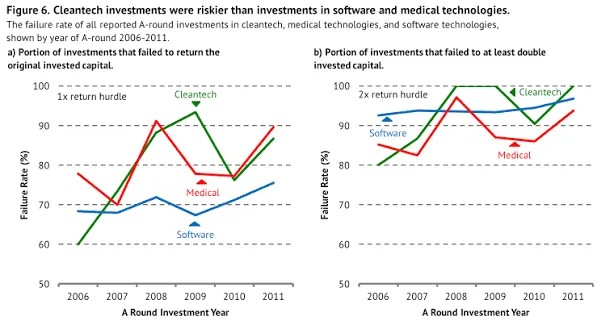
From 2006 to 2011, the clean energy sector became an investment hotspot, with a large number of institutions establishing specialized new energy funds. The logic behind this was exactly the same as crypto VC back then: investors believed they had seized a cross-era technological change first and hoped to build an exclusive investment landscape around this sector.
Capital cumulatively invested over $25 billion into clean energy startups, and ultimately more than half of the investments lost money. Intriguingly, the relevant technology itself was feasible for implementation; today the clean energy market is huge, and during the same period solar power generation costs dropped by 85%. But VC firms made a fundamental judgment error: they applied the software enterprise investment model, writing $5 million seed round checks to startups, but such projects actually required $200 million in project finance and needed to undergo 15 years to achieve profitability.
The MIT Energy Initiative reviewed afterwards and concluded that the traditional VC model was fundamentally incompatible with the clean energy industry from the underlying logic. Early specialized funds bore technical R&D risks, funded industry basic research, accumulated credibility for the sector, and attracted large-scale industrial capital entry; but once technology matured, infrastructure loans and project finance funds entered, and the unique information barriers of specialized funds disappeared completely.
Source: MIT
Special Purpose Acquisition Companies (SPACs) also walked the same rise and fall curve. SPACs are blank check companies that raise capital through an IPO listing themselves without实体 (entity) business, and subsequently acquire private companies to complete a fast listing, a process simpler than traditional IPOs. In 2020–2021, many investors viewed them as replicable capital tools, even establishing investment institutions operating completely around SPACs.
Chamath Palihapitiya once raised a $1.6 billion specialized SPAC fund. But by 2022, two-thirds of SPACs listed in 2021 failed to complete mergers, and Chamath ultimately had to return funds to investors. The market reversed completely in just two years, enough to show that once the information advantage of a specialized sector disappears, the industry landscape will reconstruct quickly.
The same plot plays out repeatedly in different industries,背后 (behind) which lies a unified underlying law. Carlota Perez sorted through 250 years of technological change history and proposed the Techno-Economic Paradigm theory: every major technological revolution will experience an early niche phase where only insiders understand the technology, investors deep in the sector hold exclusive information and become the most valuable capital providers; as technology matures, it gradually integrates into the traditional existing industrial system.
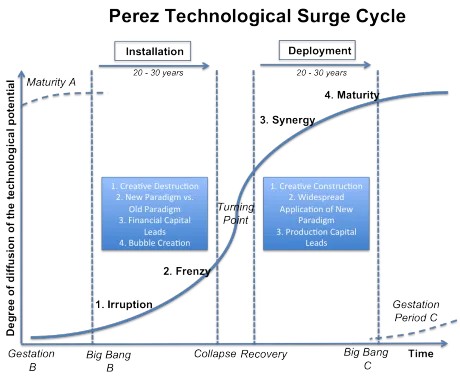
When developing to this stage, the information barriers supporting the survival of specialized funds no longer exist — general large institutions can also understand the asset sector. Fred Wilson predicted this inflection point for crypto early on; he wrote in 2015 proposing: the crypto industry will usher in a key financial watershed, completing the leap from "Installation Period" to "Deployment Period" in Perez's theory.
Now this watershed has arrived, and features of the crypto deployment and popularization phase are everywhere: payment giant Stripe acquired Bridge and launched its own stablecoin public chain; asset management institutions like BlackRock and Fidelity issued tokenized money market funds; traditional payment leaders like Visa and Mastercard are also building settlement networks on top of the stablecoin underlayer.
These traditional giants do not need crypto specialized funds to explain MEV extraction or validator economic mechanisms; such exclusive industry knowledge is meaningless for their business expansion. What they truly need are regulatory licenses, traffic channels, and bank cooperation resources, completely consistent with the resources needed for scaling ordinary fintech companies. Nowadays, investors at diversified funds like Sequoia and Founders Fund evaluate crypto projects with the same logic as evaluating fintech projects like Stripe and Plaid.
Polarization and Fund Sector Expansion
Since the information barriers of specialized crypto funds have collapsed, where will funds established relying on this advantage go? Their ultimate destiny is completely determined by the capital logic of fund management scale.
Over the years, the venture capital industry has formed a "barbell distribution" pattern: one end consists of giant diversified investment platforms like a16z, Sequoia, and Founders Fund, which can incorporate complete sectors as vertical segments under them into their investment landscape; the other end is small boutique funds, relying on investors' deep industry knowledge to bet on niche frontier projects, where a single hit project can cover the entire fund's total return; while the survival space for medium-sized funds sandwiched in the middle is completely squeezed, and currently the vast majority of crypto specialized funds are in this "death zone".
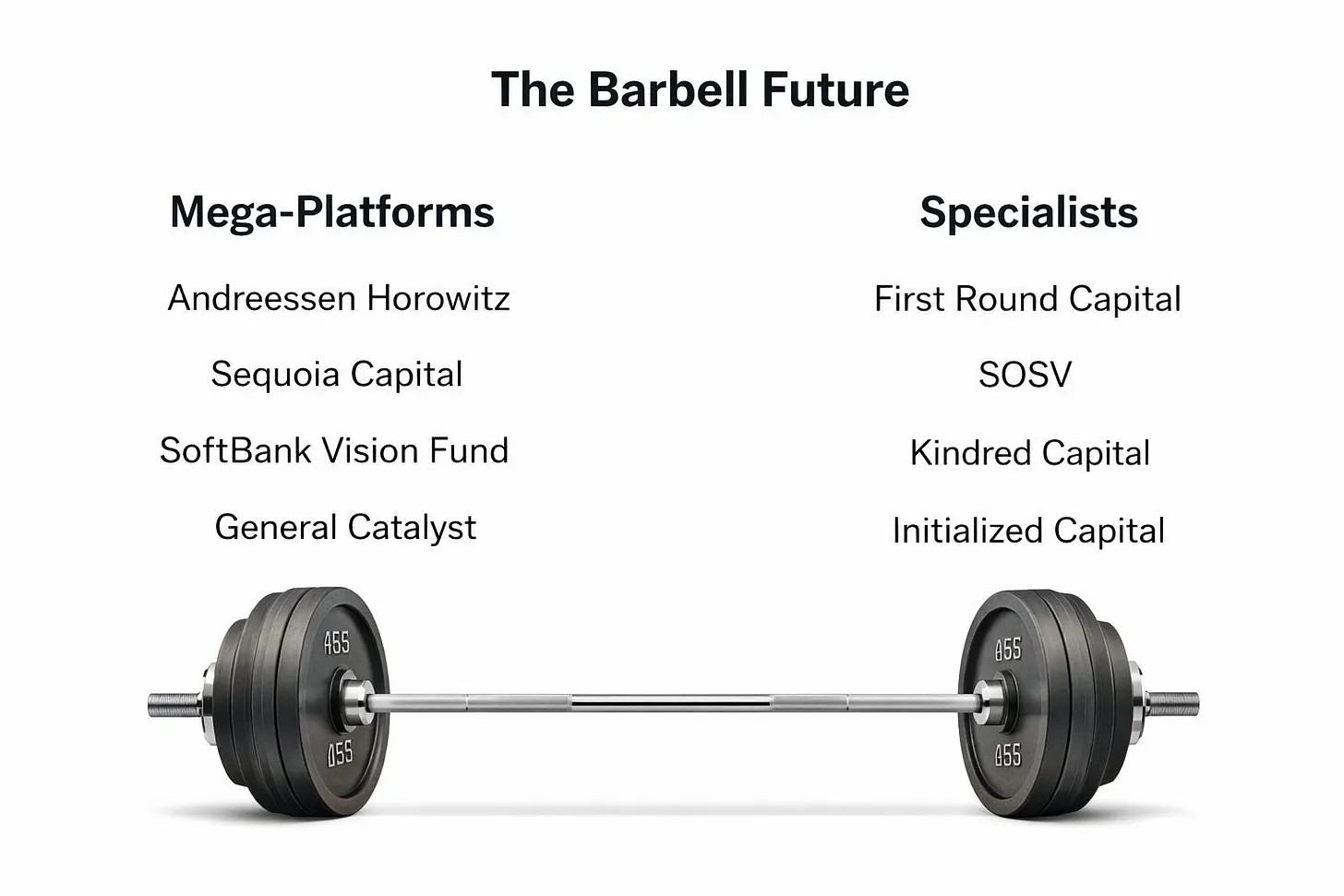
A fund with a scale of $500 million needs a total project exit amount of $1.5 billion to achieve a 3x net return for investors. Relying solely on small seed round investments cannot achieve this goal; a single seed portfolio is hard to run head projects of sufficient scale; at the same time, they lack the power to compete with giant funds of $50 billion scale for growth round targets — the latter can casually write large investments of over $100 million. For example, in H1 2025, Founders Fund's total fundraising amount alone was equal to 1.7 times the sum of all emerging small funds' fundraising in the same period. Capital continues to concentrate on both ends of the industry.
Even though both broadened investment sectors, the underlying strategies of Framework Ventures and Paradigm are completely different, the root cause being the size difference. Framework manages a scale of $400 million, the volume is too small to rely on a few seed projects to break even, yet not enough to compete with giant funds for growth round projects. Exit returns generated solely from the crypto sector cannot cover fund return requirements, so it must broaden investment boundaries. Whereas Paradigm manages a scale of $1.2 billion, the volume is sufficient to transform into a cross-industry diversified investment platform; there is an essential difference in their strategic choices. In short, fund size determines which end of the barbell pattern it falls on, and also determines its optional development path.
Even those VCs claiming to stick to the crypto sector have completely redefined the connotation of "crypto investment". Dragonfly completed a $650 million raise in February this year, with fundraising scale oversubscribed three times. But the institution clearly stated that crypto application sectors divorced from financial scenarios have comprehensively failed, and the fund is only betting on two directions: stablecoins and prediction markets. a16z completed a $2.2 billion crypto specialized fund raise in May 2026, only half of the 2022 fund scale of $4.5 billion. Not only that, partner Chris Dixon also adjusted the core narrative shift: no longer defining crypto as a new computing paradigm, instead proposing that finance is the underlying foundation of the entire industry.

Nowadays, the "pure crypto investment" spoken of by these institutions is essentially layout of financial infrastructure built on the blockchain underlayer, and this sector is also a key layout direction for diversified funds holding large capital.
Another core force driving the industry shift comes from behavioral changes of fund Limited Partners (LPs). The current VC industry generally faces a DPI (Distributed to Paid-In Capital) crisis; funds established in 2021 have an average DPI of only 0.08x. The 2022 crypto bear market caused massive losses for many LPs, and now the AI sector has become a new outlet, absorbing 70% of primary market funds globally. LPs hold idle funds unable to be cashed out for four years; seeing AI projects deliver the high returns once promised by the crypto sector, fund managers can only actively layout the AI sector to satisfy LP demands.
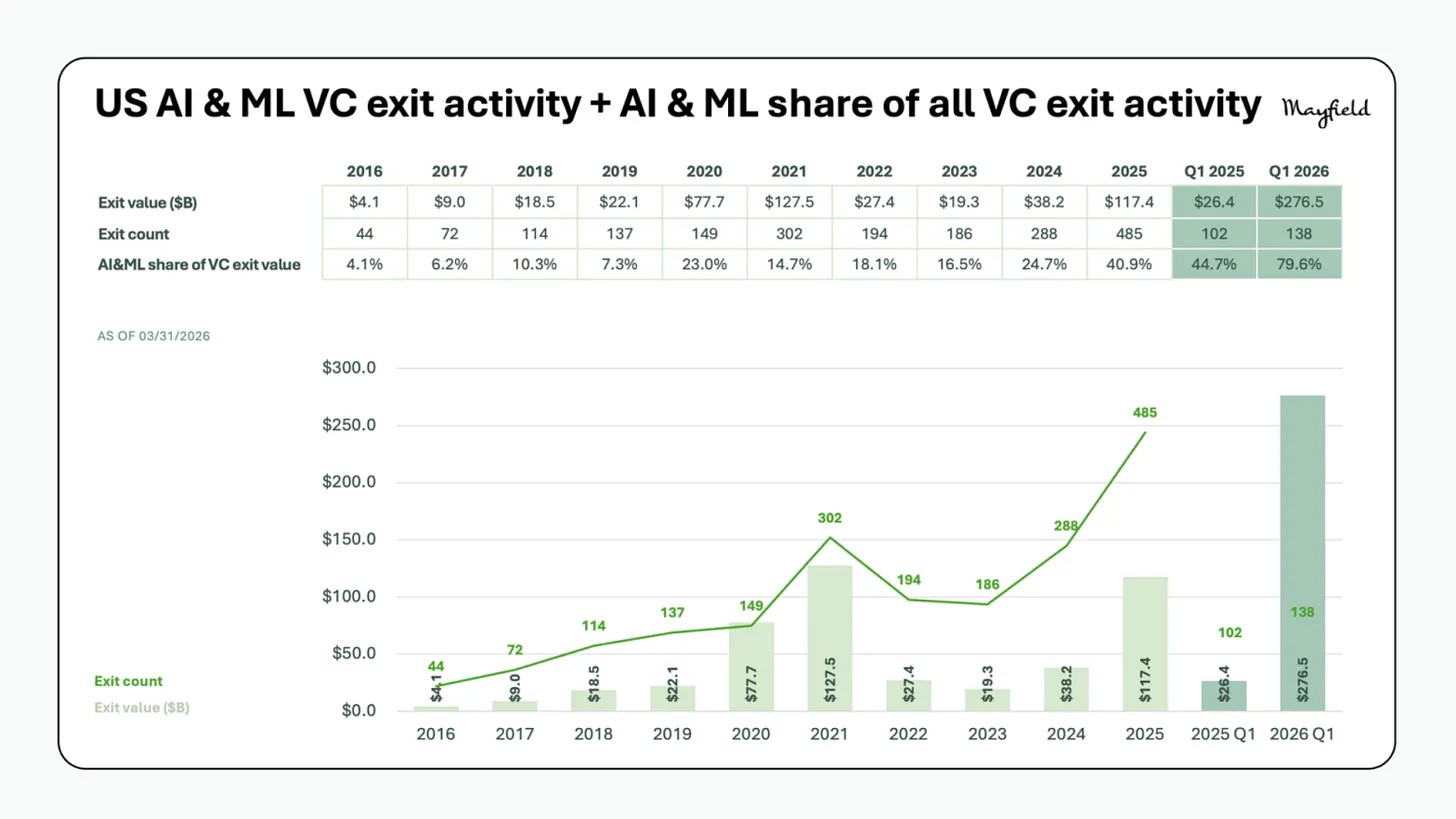
This trend is not good for entrepreneurs still deep in crypto: the number of investment institutions that truly understand crypto and are willing to continue adding positions continues to shrink. Many will say entrepreneurs can directly raise funds from diversified funds; theoretically this seems feasible — Sequoia and Founders Fund can write larger checks and also provide commercial channel resources that native crypto funds cannot match.
But reality has two hard injuries. First, currently the AI sector absorbs the vast majority of quality project resources; crypto projects inside diversified funds need to compete with massive AI projects for the investment team's attention; only extremely quality targets have a chance to enter the investment decision agenda, which is a completely different competition logic than roadshowing to specialized funds deep in crypto. Second, the development of the crypto ecosystem cannot do without long-term investment in underlying infrastructure by specialized funds. Paradigm funds MEV related academic research, Dragonfly supports cross-chain development tools; such investments are hard to produce commercial returns looking at single projects individually, but they build underlying public facilities shared by the entire industry. Diversified funds will never layout such projects; they judge targets looking only at independent commercial returns.
I believe that in a few years, the title "crypto investor" will become outdated like "internet investor" today. Crypto has become underlying infrastructure, a set of underlying channels supporting the operation of various financial products; no one will build a complete investment logic around underlying pipes alone; investment value is born on the application layer above the pipes. If Perez's technological cycle theory holds, the industry is currently at this transition node: crypto is no longer an independent investment sector, but underlying infrastructure for various investment targets.
But this does not mean crypto specialized funds will disappear completely. As new sub-categories like tokenization and on-chain securities continue to emerge, many niche frontier sectors that diversified funds are unwilling to touch will be born; every cycle will see small specialized funds established around sub-fields. What is truly declining is the current batch of medium-to-large pure crypto funds — relying solely on crypto niche projects cannot support fund break-even needs. The entire sector will continue to reconstruct according to the barbell pattern: large growth round investments will be taken over by diversified funds, and frontier niche experimental projects will be laid out by small specialized funds.
Early specialized funds established in 2017–2018 incubated core infrastructure like Uniswap, the Ethereum ecosystem, stablecoin supporting tools, etc. But times have changed; head crypto projects emerging in recent years like Hyperliquid and MegaETH went through the entire process solely through community fundraising, completely without reliance on VCs. Back then specialized funds gave the crypto sector a clear investment logic, attracting diversified capital entry; nowadays more and more entrepreneurs realize that projects can complete cold starts detached from VCs.
Join TechFlow official community to stay tuned
Telegram:https://t.me/TechFlowDaily
X (Twitter):https://x.com/TechFlowPost
X (Twitter) EN:https://x.com/BlockFlow_News