
Morgan Stanley Research Report Analysis: Google Cloud 2028 Revenue to Hit $308 Billion, Profit Contribution Rate Surges from 2% to 46%
TechFlow Selected TechFlow Selected
Morgan Stanley Research Report Analysis: Google Cloud 2028 Revenue to Hit $308 Billion, Profit Contribution Rate Surges from 2% to 46%
Transforming from an advertising company into an AI computing power operator.
 Navigating Web3 tides with focused insights
By: Rita
TechFlow Guide
Morgan Stanley raised Alphabet's target price from 375 to 415 USD. The real driver is TPU, not Search and YouTube. Reverse-engineering through chip shipment data, Google Cloud revenue in 2028 will increase seven-fold to 308 billion USD, while EBIT's proportion of the whole company will surge from 2% to 46%. This signifies a fundamental shift in business model: from an advertising company to an AI computing power operator.
Google Cloud's One-Year Growth Equals Three AWS
On June 29, Morgan Stanley raised Alphabet's target price from 375 to 415, maintaining an "Overweight" rating. The real drive comes from TPU, not from Search, YouTube, or Gemini. The report uses a bottom-up computing power deduction framework. Reverse-engineering Google's computing power expansion pace from Broadcom and MediaTek's chip shipment data, it calculated figures that Google itself has not disclosed. Morgan Stanley's semiconductor team started from Broadcom's public guidance of 10 GW in 2027, combined with ASIC revenue estimates of $12/W, to establish an estimation framework of 14 GW total shipments in 2028, from which Google's TPU share of about 60% was carved out.
Specifically: Google will add about 9 GW of local computing capacity in 2028. Among them, 7 GW comes from self-developed TPU (Broadcom supplies about 5 GW for internal use, 4 GW for external sales; MediaTek contributes about 1.5 GW), and another 2 GW comes from NVIDIA GPU.
This stems from reverse-engineering based on actual shipment and price data from chip manufacturers, not conceptual hype.
Structural Changes in Revenue Breakdown
The most critical change lies in the monetization logic. Morgan Stanley breaks Google Cloud down into two revenue lines.
The first is core cloud services, monetized at $18 per watt of revenue. By 2028, it is expected to contribute 229 billion USD. This is the traditional cloud computing revenue model.
The second is first-party TPU external sales. Google plans to sell 4 GW of TPU computing capacity externally. Calculated at 20 billion USD per GW, this is 79 billion USD in incremental revenue. Morgan Stanley estimates the gross margin for 1P TPU systems is only 20%, far lower than core cloud services. Google's strategic intent is to stuff more AI data centers with TPU architecture to build an ecosystem moat, rather than earning gross profit from this business.
Adding the two lines together, Google Cloud revenue in 2028 will reach 308 billion USD. This is seven times the 43 billion in 2024.
Restructuring of Profit Structure
Morgan Stanley predicts that Google Cloud's EBIT in 2028 will reach 132 billion USD, accounting for 46% of the company's total EBIT.
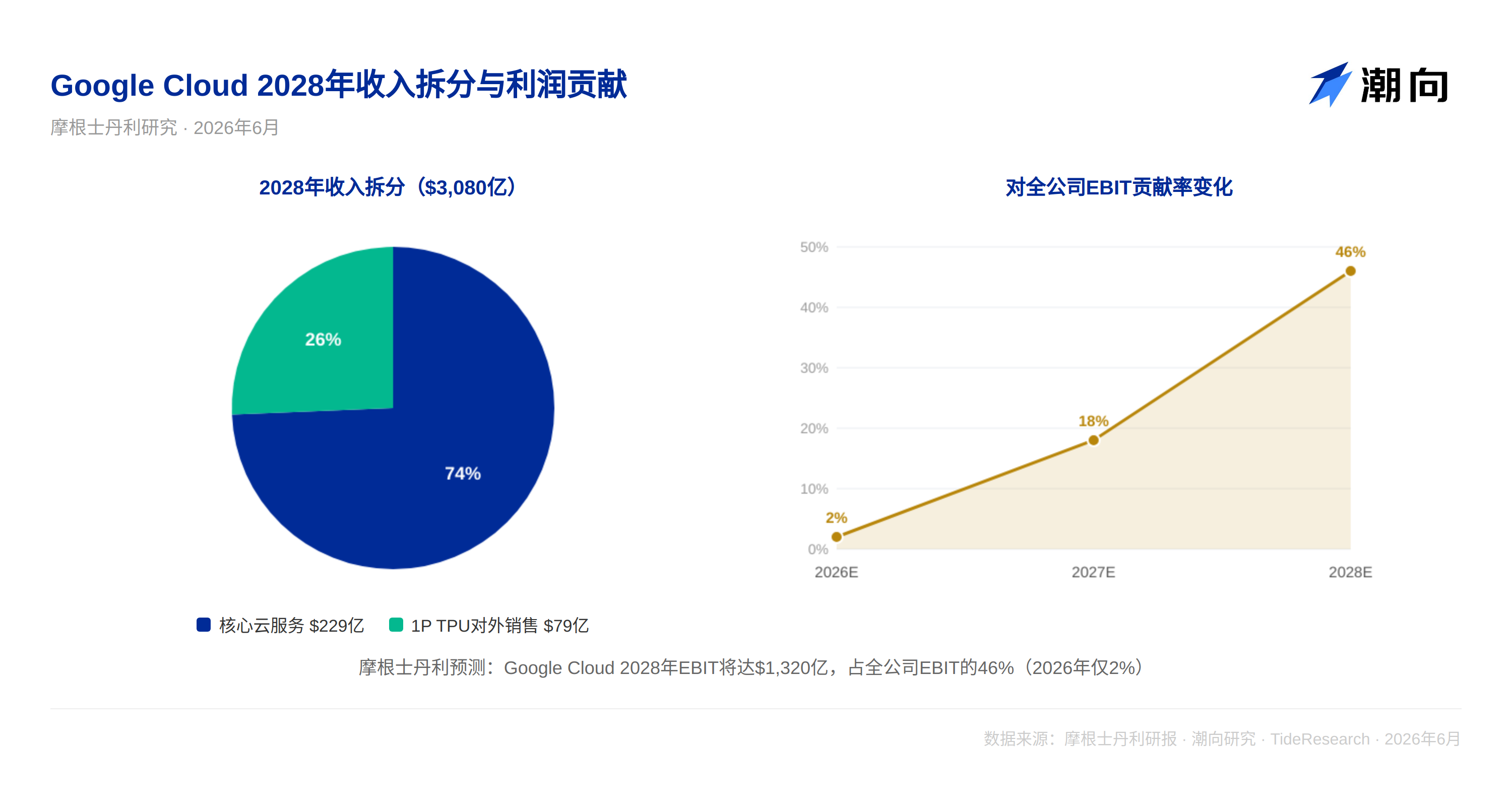
Two years ago, this ratio was only 2%. Google's profit engine is switching from advertising business to cloud computing plus AI infrastructure. The valuation framework must also change accordingly; the current 18 times 2028 EPS multiple appears conservative.
Capital Expenditure and Cost Optimization
However, the cost is significant; capital expenditure is raised from 300 billion USD in 2027 to 350 billion USD, and further increased to 375 billion USD in 2028.
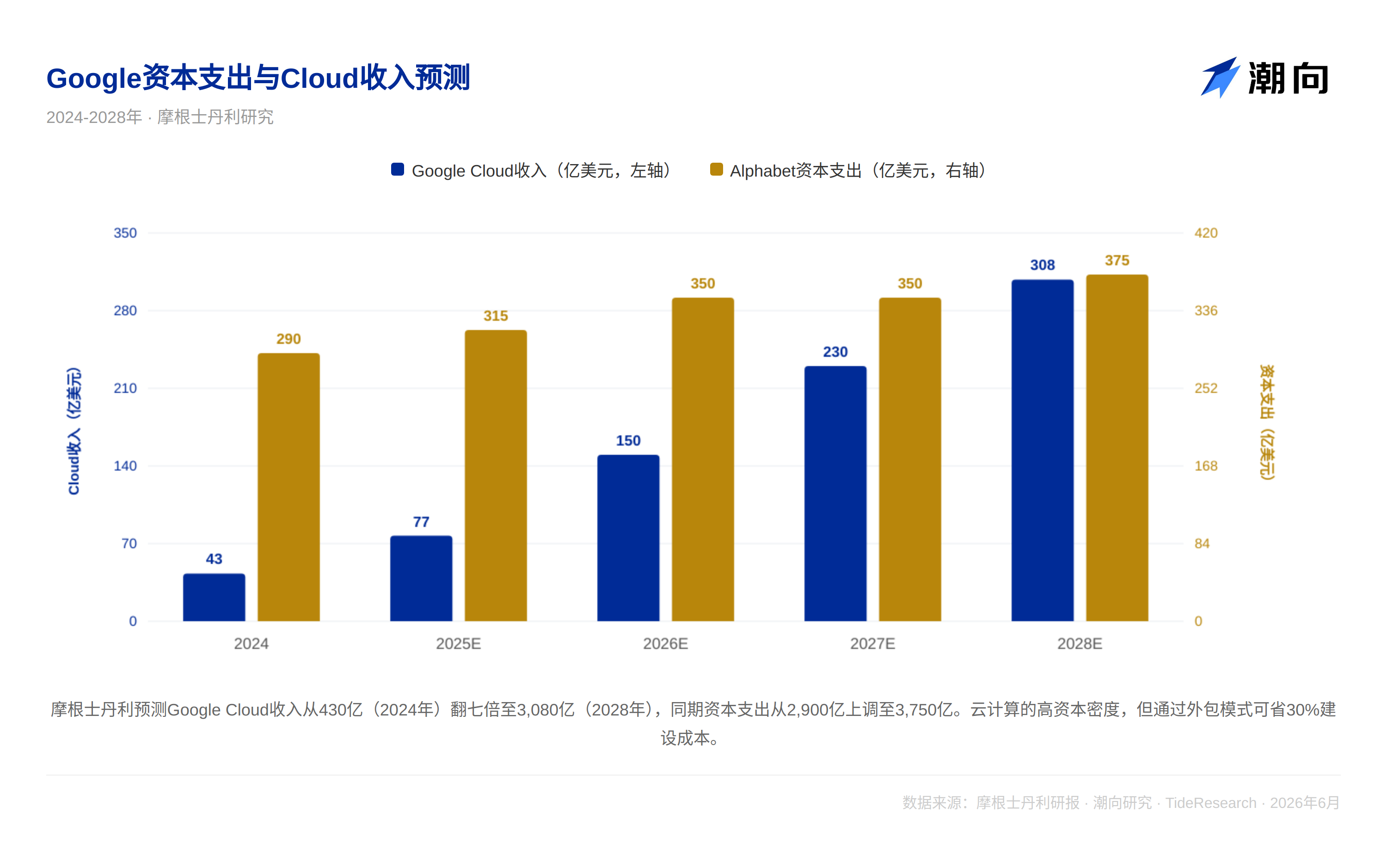
However, Google is absorbing this burden in new ways. First, by outsourcing data center power facilities and infrastructure through partners like Blackstone, saving about 30% of GW-level data center construction costs. Second, MediaTek's TPU manufacturing costs are significantly lower than Broadcom's. As MediaTek's share in Google TPU orders increases, unit computing power costs continue to decline.
TechFlow Perspective
The biggest assumption in this report is the realization of revenue from external TPU sales. The report assumes Google sells TPU full racks externally at a 20% gross margin, bringing 20 billion USD in revenue per GW. However, there are two issues to point out:
First, the report admits it "cannot fully determine Google's gross margin pricing for 1P TPU systems". If Google aggressively cuts prices to expand the ecosystem, the 79 billion USD 2028 1P TPU revenue forecast faces significant downside revision risk. Once this revenue fails to meet expectations, Google Cloud's overall revenue target will be pulled down.
Second, Morgan Stanley has extensive investment banking relationships with Alphabet. It provided investment banking services and collected fees within the past 12 months, and holds more than 1% of Alphabet's common stock. The analysts also personally hold Alphabet stock. This does not affect the framework value and data depth of the report, but readers should independently judge whether the assumptions about TPU ecosystem expansion in this report are too optimistic.
Currently, Alphabet's stock price is 353 USD, corresponding to 18 times Morgan Stanley's 2028 EPS forecast, lower than the past long-term average of 21 times. However, this valuation discount depends on two assumptions holding true: Google Cloud revenue climbs to 308 billion as scheduled, and the gross margin for external sales of the TPU ecosystem can be maintained above 20%. If there is any deviation in either link, the price must be re-priced.

Disclaimer
Fixed Statement Regarding Research Report Content (Brokerage Viewpoint, Not TechFlow Research Viewpoint)
This article is TechFlow Research's organization and interpretation of third-party brokerage research reports. The ratings, target prices, earnings forecasts, and related judgments cited in the text are all the views of the brokerage analysts, representing only their affiliated institution's stance, not representing TechFlow Research's views, nor constituting any investment advice.
The market has risks, decisions must be independent. This article should not be used as a basis for buying or selling any securities.
Join TechFlow official community to stay tuned
Telegram:https://t.me/TechFlowDaily
X (Twitter):https://x.com/TechFlowPost
X (Twitter) EN:https://x.com/BlockFlow_News
 @chaoxiangooo