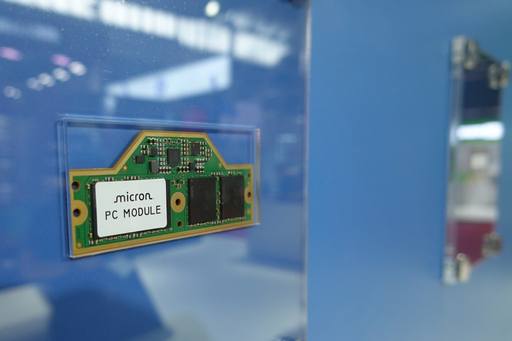
Bank of America Research Report Analysis: The Memory Chip Super Cycle Has Just Begun, LTA Is Locking in Long-Term High Profitability
TechFlow Selected TechFlow Selected
Bank of America Research Report Analysis: The Memory Chip Super Cycle Has Just Begun, LTA Is Locking in Long-Term High Profitability
Bank of America's view provides a high-confidence short-to-medium-term framework, but the certainty of forecasts after 2027 is rapidly declining.
 Navigating Web3 tides with focused insights
Author: Rita
TechFlow Guide
Micron Technology's latest earnings report gave Wall Street a surprise: revenue for the May quarter was $41 billion, a staggering 346% year-over-year increase. But even more astonishing than the numbers themselves is Micron's guidance for the August quarter, reaching $50 billion, continuing a 21% quarter-over-quarter growth. The company's gross margin reached 85% and operating margin 81%, both setting historical records.
In the memory industry, where the five-year average operating margin was less than 20%, top companies can now achieve over 80%. The team of BofA Securities analyst Simon Woo proposed a bold judgment in the Global Memory Technology Weekly Report on June 26: this is structural profit growth, and the industry super-cycle may last until 2027, or even extend to 2030.
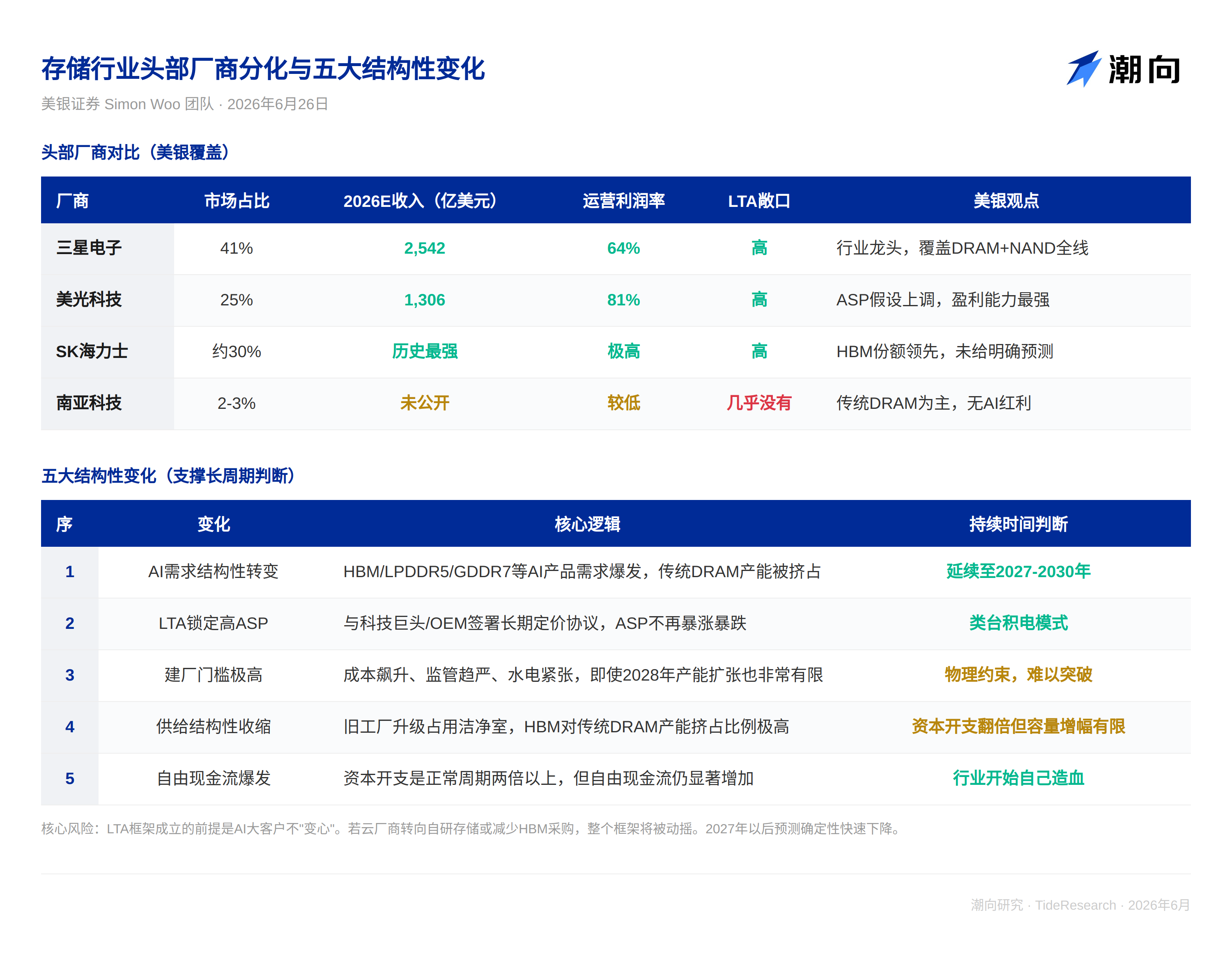
Five Structural Changes Support Long-Cycle Judgment
First is that the chip shortage may continue until 2027 or even 2030. Computing power demand driven by AI has fundamentally changed the demand curve for memory chips. The explosion in demand for AI-related products such as HBM (High Bandwidth Memory), SOCAMM, LPDDR5, and GDDR7 has severely squeezed traditional DRAM capacity. This reflects a permanent shift in demand structure.
Second, Long-Term Agreements (LTA) are changing the industry rules. Major manufacturers like Micron are increasingly signing long-term pricing agreements with tech giants and OEMs. This means ASP (Average Selling Price) will no longer skyrocket and plummet like in the past, but is locked at higher levels. BofA believes memory chips are becoming like TSMC's logical foundry business: high profitability + low volatility. This shift is significant for investors because cyclical violent fluctuations are being smoothed out.
Third, the threshold for building new fabs is extremely high. Construction costs are soaring, local government regulations are tightening, water and electricity supplies are tight, and even by 2028, capacity expansion will be very limited. Micron is building factories in multiple locations globally (Boise/New York/Virginia in the US, Tongluo in Taiwan, Singapore, Japan), but new capacity landing still takes several years. This is a issue of physical constraints.
Fourth is structural capacity contraction. Upgrading existing old factories requires significant cleanroom space, manufacturing cycles are extended, front-end and back-end equipment sizes are larger, and HBM occupies an extremely high proportion of traditional DRAM capacity. The result is: even if capital expenditure doubles, available capacity growth remains limited. This is a hard constraint on the supply side.
Fifth, free cash flow is growing explosively. Although capital expenditure is more than twice that of a normal cycle, free cash flow for Micron and peers is still increasing significantly. This industry was previously known for "burning money," but is now starting to generate its own blood. This shift provides long-term support for stock prices.
Data Validates Cycle Extension
South Korea's semiconductor exports (mainly memory chips) reached $25.5 billion in the first 20 days of June, a 16% quarter-over-quarter increase and a 188% year-over-year increase, maintaining triple-digit growth for five consecutive months. DRAM spot prices have risen for five consecutive weeks, with a cumulative increase of 20%.
BofA raised its global DRAM/NAND sales forecast for 2026–2028 by 2-4%, but emphasized the adjustment magnitude is limited. The most intense price increase phase (first half of 2026) is basically reflected in the data; ASP growth in the second half will slow down due to increased LTAs, but the overall volume-price structure is healthier. Forecasts show global DRAM+NAND revenue of $87.68 billion in 2026, soaring to $121.22 billion in 2027, and $128.51 billion in 2028. This is a derivation based on existing agreements and capacity constraints.
Target Differentiation: Not All Manufacturers Are Equal
The industry coverage arrangement given by BofA shows obvious differentiation at the top. Samsung Electronics (market share 41%) DRAM+NAND revenue for 2026E is estimated at $254.2 billion, with an operating margin of 64%. SK Hynix has the strongest historical data, but BofA did not provide clear 2026–2028 forecasts. Micron (share 25%) 2026E revenue is $130.6 billion, operating margin 81%, and BofA also raised Micron ASP assumptions. Nanya Technology (share 2-3%) mainly does traditional/older DRAM, has almost no LTA exposure, and BofA did not give positive expectations.
A warning signal is that NAND spot prices recently fell by 5%. Although DRAM spots are rising, NAND is weakening, indicating that AI dividends are not evenly distributed in the memory field. NAND's ASP growth expectation rapidly slowed from +234% in 2026 to +8% in 2027, turning negative in 2028 (-13.3%). If the structural shift in AI demand favors HBM/DRAM over NAND, NAND manufacturers may face an earlier cycle inflection point.
TechFlow Perspective
The most noteworthy assumption in this BofA report is "the chip shortage may continue until 2030". This is rare in history. The previous strongest super-cycle in 2017-2018 lasted only about 18 months. BofA's logic chain is: the incremental storage demand brought by AI continues to expand, while the supply side is subject to hard constraints of physical bottlenecks (factory approval, electricity, cleanrooms, equipment delivery times).
But there is an obvious weakness here: BofA assumes LTAs will "lock" ASPs preventing them from plummeting, the premise of which is that major AI clients do not "change their minds". If large cloud vendors switch to self-developed memory chips or reduce HBM procurement proportions in 2027-2028, the entire LTA framework will be shaken. Most "structural change" narratives in the memory industry end with a return to cycles. Whether this time is truly different remains to be verified by time. For investors focusing on US stock + HK stock memory-related targets, BofA's view provides a high-confidence medium-to-short-term framework, but prediction certainty after 2027 is rapidly declining.

Disclaimer
This article is a compilation and interpretation of third-party brokerage research reports by TechFlow Research. The ratings, target prices, earnings forecasts, and related judgments cited in the text are the views of the brokerage analysts, represent only the position of their affiliated institutions, do not represent the views of TechFlow Research, and do not constitute any investment advice.
The market has risks, decisions must be independent. This article should not be used as a basis for buying or selling any securities.
Join TechFlow official community to stay tuned
Telegram:https://t.me/TechFlowDaily
X (Twitter):https://x.com/TechFlowPost
X (Twitter) EN:https://x.com/BlockFlow_News
 @chaoxiangooo