Has the crypto market hit bottom? Here’s how institutions see it
TechFlow Selected TechFlow Selected
Has the crypto market hit bottom? Here’s how institutions see it
For long-term investors, debating this issue is not particularly meaningful.
 Navigating Web3 tides with focused insights
By Matt Hougan, Chief Investment Officer, Bitwise
Translated by Chopper, Foresight News
Over the past two weeks, three cryptocurrency research firms I’ve long followed—other than Bitwise—have each released in-depth reports addressing the same question: Has the crypto market already hit bottom?
- Galaxy Digital: Bitcoin has not yet bottomed; data points to a potential bottom range.
- NYDIG: What factors are suppressing Bitcoin’s price action.
- Standard Chartered: The market bottom has already occurred.
All three reports are comprehensive, packed with extensive data and rigorous logical reasoning—well worth reading in full. But if you’re hoping for one simple, unified answer, you’ll likely be disappointed: these authoritative institutions have reached sharply divergent conclusions.
Has the market hit bottom?
- Galaxy Digital: No.
- NYDIG: Possibly—but unlikely.
- Standard Chartered: Yes.
Below, we unpack the core logic behind each institution’s view.
Three Institutions, Three Views
Galaxy Digital
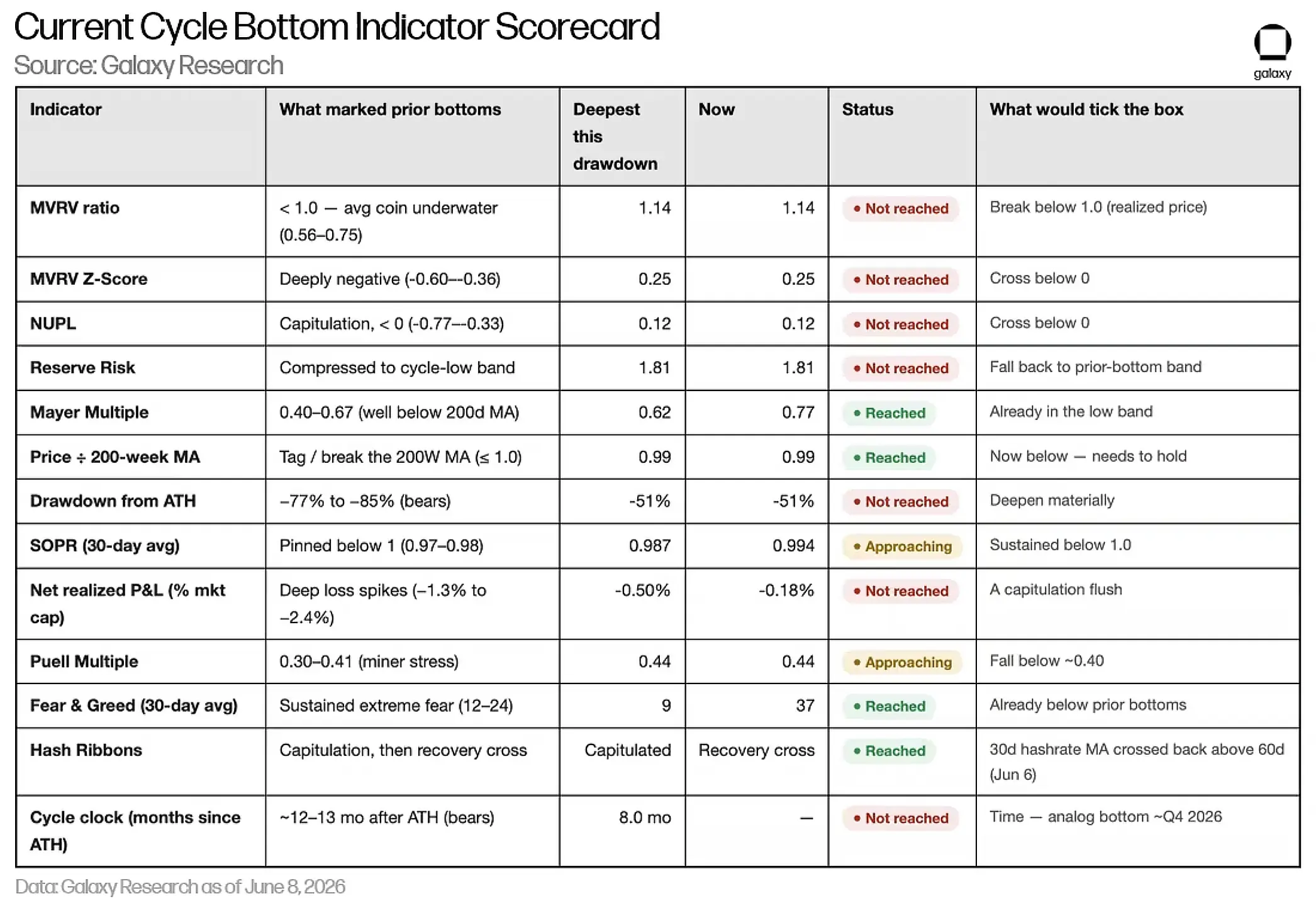
Galaxy Digital reviewed Bitcoin’s entire 17-year price history and identified 13 indicators that consistently coincide with genuine market bottoms. These span six dimensions: valuation, profit-taking sell-offs, miner stress, trend dynamics, bull/bear cycles, and market sentiment. Longtime Bitcoin investors will recognize many of these metrics—including the 200-week moving average, Fear & Greed Index, and Mayer Multiple.
Galaxy found that only four of these 13 indicators are currently fully satisfied, two are partially met, and the remaining seven have yet to trigger any bottom signal. The report concludes that Bitcoin’s current bottom range lies between $30,000 and $54,000, with a neutral base-case bottom between $40,000 and $46,000.
NYDIG
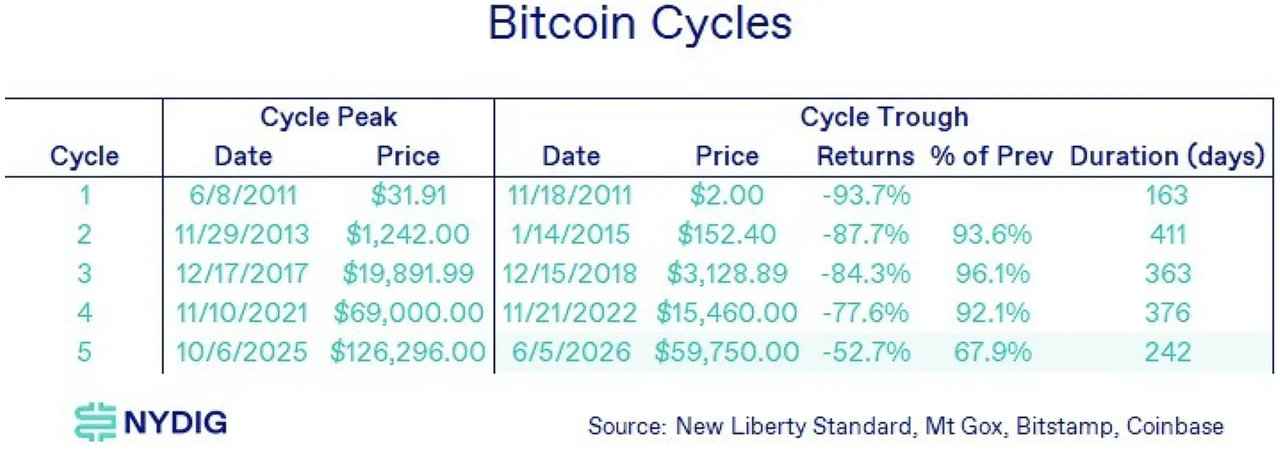
NYDIG also employs a multi-metric analytical framework, comparing current conditions against historical cycles—assessing factors such as drawdown duration and holder profitability (what Bitcoin users call “MVRV,” or Market Value to Realized Value ratio).
NYDIG observes that most metrics are now near their extreme values observed at previous major cycle lows—but the kind of broad-based panic selling characteristic of past bear markets has yet to materialize. The report introduces one key variable: institutional capital inflows have fundamentally altered Bitcoin’s cyclical dynamics. This cycle’s correction may therefore be shallower than prior bear markets—and from this perspective, a bottom may already have formed.
Standard Chartered
Standard Chartered isn’t blindly bullish on Bitcoin. Back in February, when Bitcoin traded at $67,000, the bank lowered its annual price forecast and warned that prices could fall to $50,000—citing weakening macroeconomic conditions and persistent selling pressure from Bitcoin ETFs.
But last Friday, Standard Chartered updated its outlook, declaring $59,000 as this cycle’s bottom. Its rationale rests on two key developments: the possibility of a U.S.-Iran diplomatic agreement, and the highly anticipated IPO of SpaceX. Standard Chartered argues that much of the recent ETF-driven Bitcoin selling was motivated by investors raising cash to participate in the SpaceX listing—and that this selling pressure will gradually subside. The bank’s latest forecast sees Bitcoin reaching $100,000 by year-end.
Consensus Far Outweighs Disagreement
You might wonder: What actionable insights can possibly be drawn from three reports whose surface-level conclusions appear diametrically opposed? In reality, the underlying consensus among them far exceeds their apparent disagreements. For long-term investors, the points of agreement—not the differences—are what truly matter:
- All three agree the market bottom will occur within this year.
- All three believe current prices are closer to the bottom than to the previous high.
- All three remain bullish on Bitcoin’s next bull run.
At the time of writing, Bitcoin trades around $67,000. One report declares the bottom at $59,000 already in place; another forecasts a drop to $50,000; a third cites a neutral base-case bottom at $43,000. Yet their core conclusion is remarkably aligned: the bottom will arrive this year.
That’s the single most important takeaway for long-term investors. Whether the bottom lands at $40,000, $50,000, or $60,000 makes relatively little difference. What truly matters is whether Bitcoin can rally to $100,000, $200,000—or even $1 million. At today’s price, any of those outcomes would deliver substantial long-term returns.
There’s an ironic paradox unfolding in today’s market: everyone is obsessing over whether the bottom has arrived—while overlooking the far more consequential question: Has the top already been reached? In my view, so long as the top hasn’t yet materialized, Bitcoin retains strong long-term allocation value.
The fundamental drivers underpinning Bitcoin’s long-term value haven’t just endured—they’ve strengthened: sovereign debt continues mounting globally, with no viable resolution in sight; inflation persistently erodes real purchasing power; public trust in centralized institutions—including governments and banks—continues declining; global digital transformation accelerates; Bitcoin’s trading and investment infrastructure matures steadily; and early crypto-native participants grow older, accumulating greater wealth and influence over both the industry and broader financial systems.
Of course, risks remain—including quantum computing threats and tightening global regulation. But overall, the current environment is more favorable than during any prior crypto winter.
Join TechFlow official community to stay tuned
Telegram:https://t.me/TechFlowDaily
X (Twitter):https://x.com/TechFlowPost
X (Twitter) EN:https://x.com/BlockFlow_News
 @BitwiseInvest