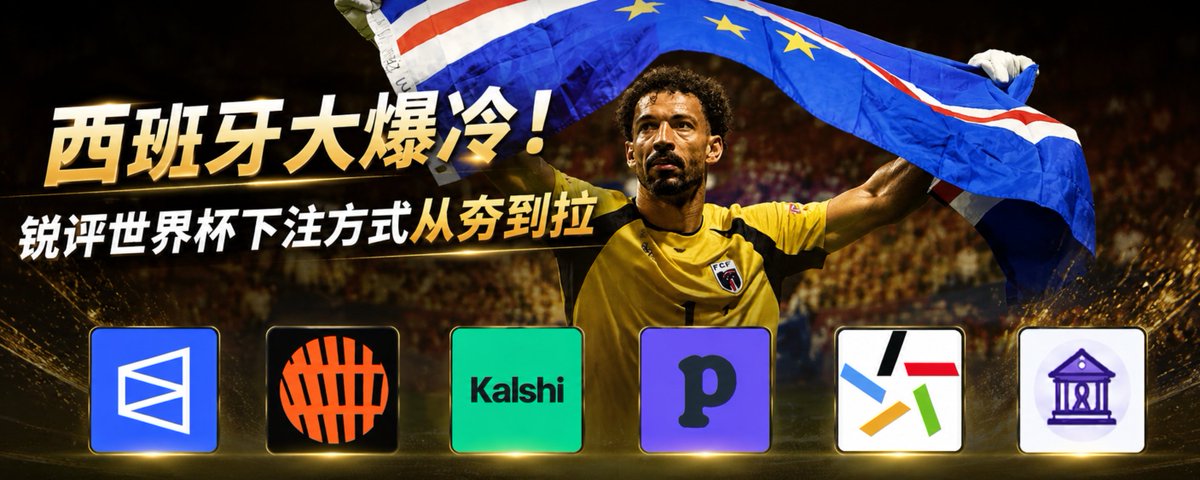
Spain’s Major Upset: A Sharp Review of World Cup Betting Methods—from “Boring” to “Thrilling”
TechFlow Selected TechFlow Selected
Spain’s Major Upset: A Sharp Review of World Cup Betting Methods—from “Boring” to “Thrilling”
World Cup betting markets are evolving from “odds” into “information markets”—humanity’s desire to price the future will always persist.
 Navigating Web3 tides with focused insights
By Alan, Biteye Content Team
Today marks Day 5 of the 2026 FIFA World Cup co-hosted by the U.S., Canada, and Mexico—the tournament’s first major upset. Spain, the overwhelming favorite to win with a squad valued at €500 million, was held to a 0–0 draw by Cape Verde’s 40-year-old goalkeeper, whose market value stands at just €50,000. Netizens joked: “How can a human foot possibly beat ‘Buddha’s foot’?”
To fans who bet on Spain as champions: How are your hearts—and wallets—holding up?
Strong teams faltering, dark horses emerging, last-minute drama—this 48-team World Cup has barely kicked off, yet it’s already slapped the “paper-strength theory” hard across the face. Put another way, upsets and underdog victories may well be the true essence of sports competition.
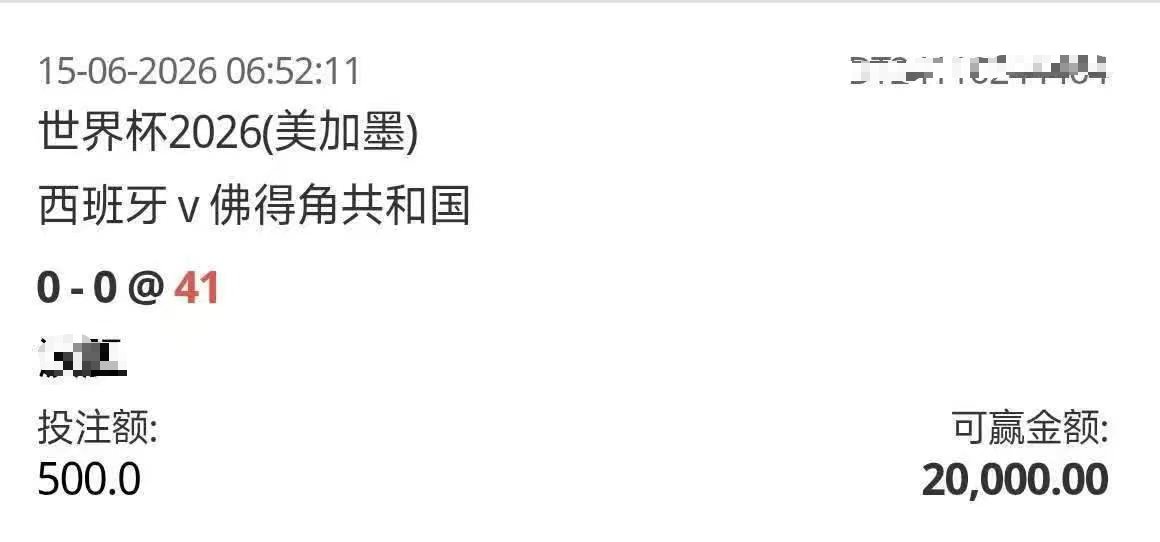
So here’s the question: Have you backed your home team or predicted scores in group chats with friends? Have you placed bets—either offline or on compliant platforms?
In fact, the opening of the World Cup isn’t just about 48 teams battling on the pitch—it’s also a head-to-head showdown among multiple prediction products.
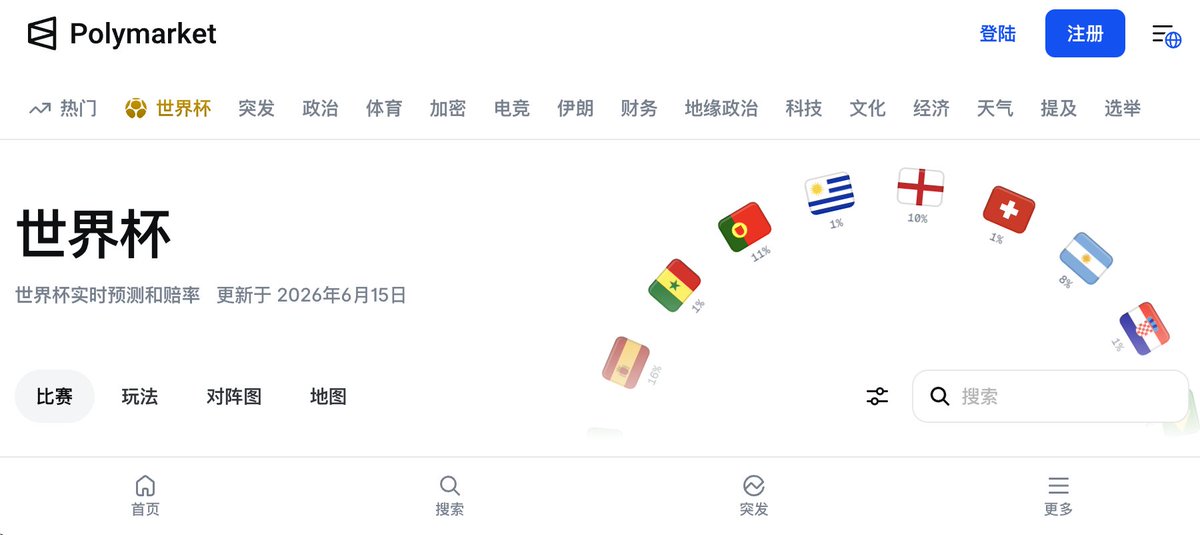
If you open Polymarket, you’ll immediately spot a golden football icon prominently featured in its top navigation bar—the official World Cup gateway. Clicking through reveals the full tournament schedule, betting options, match pairings, and interactive maps—all laid out clearly.
Currently, World Cup prediction falls into three broad categories: (1) traditional state-sanctioned lotteries; (2) conventional online gambling platforms; and (3) emerging crypto-based prediction markets—including mature players like Polymarket (@Polymarket .fun) and Kalshi (@Kalshi), alongside newer entrants such as Opinion (@opinionlabsxyz) and Predict.fun (@predictdotfun).
On the surface, they all answer the same question: “Who will win?” Yet their underlying product logic, transparency, regulatory pathways, and user experience differ significantly.
Next, Biteye delivers a no-holds-barred review of the overall betting experience across four distinct channels and multiple platforms for the 2026 World Cup.
First, the “From Solid to Shaky” Ranking Table
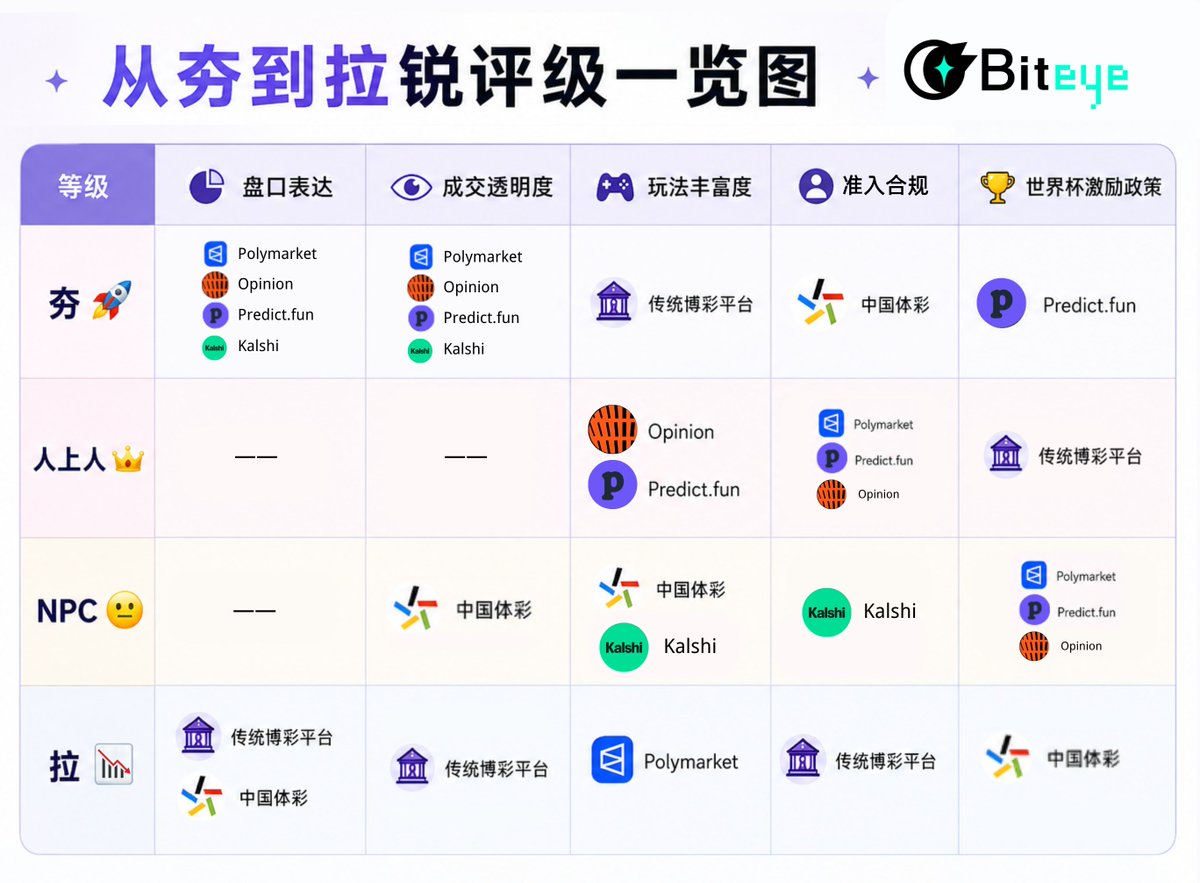
To spare readers from getting lost amid odds, contracts, and payout indices, we’ve ranked them directly across five dimensions—from most solid (“Solid”) to least reliable (“Shaky”):
One-sentence sharp take:
Polymarket tops the World Cup betting popularity charts; Opinion follows closely. Predict.fun is the most aggressive token-dropping World Cup campaign operator on BNB Chain. Kalshi is the suit-and-tie stock exchange for watching matches. Traditional gambling platforms offer rich gameplay and enduring reliability—the “gambling supermarket.” State lotteries serve as officially endorsed, wholesome companions to match-watching.
Market Presentation: Can I Understand What It’s Selling?
If you’re new to World Cup betting, odds on traditional gambling platforms might leave you puzzled.
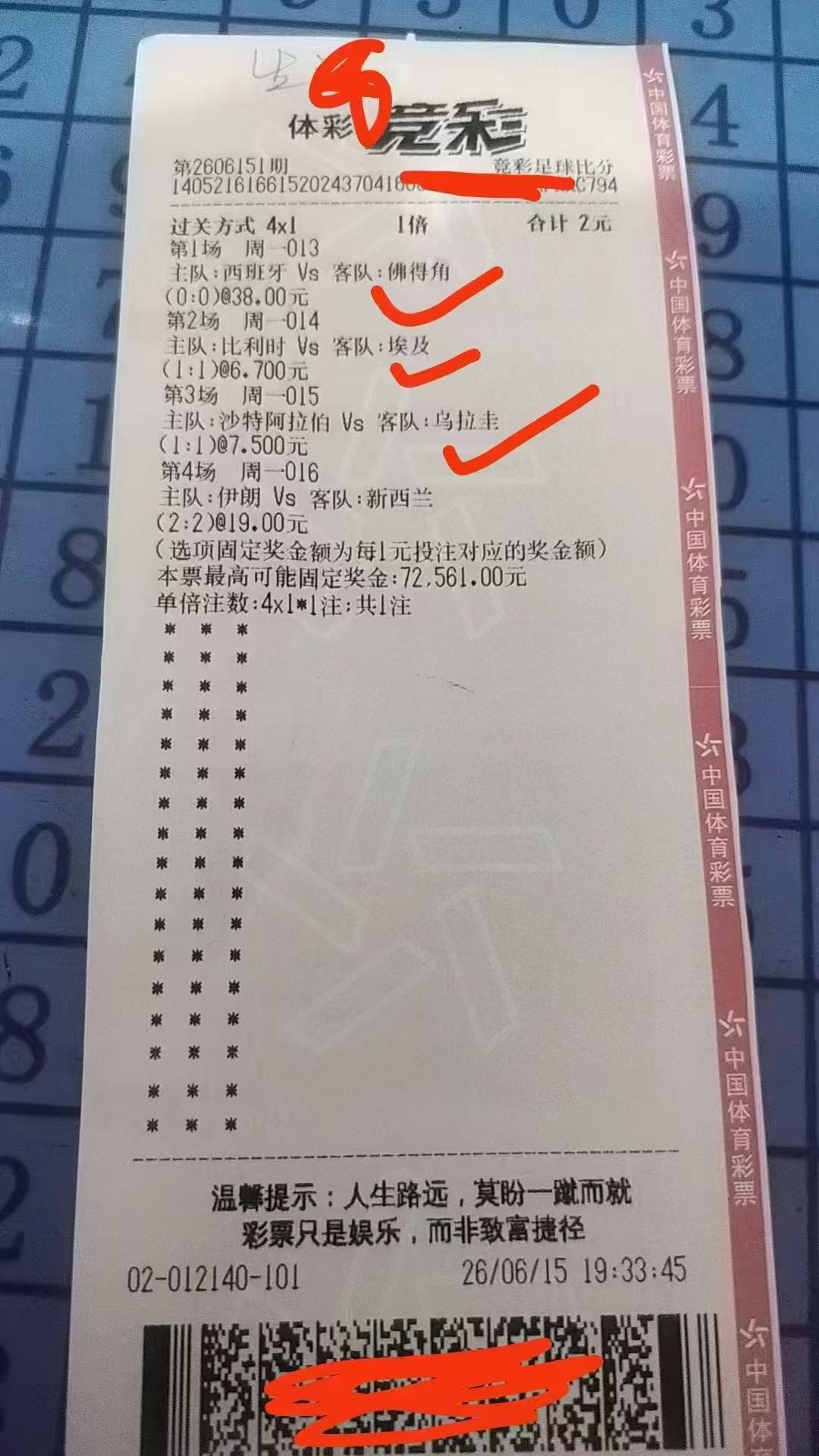
These platforms use classic odds notation—for example, +450, +850, +1000. Seasoned players grasp them instantly, but newcomers may pause for three seconds, dazzled by the numbers yet daunted by the complex math behind them. Similarly, China’s state lottery payouts are fundamentally odds-based too—requiring conversion rather than offering intuitive, real-time market pricing.
By contrast, whether it’s veteran prediction platform Polymarket, event-contract exchange Kalshi, or rising stars Opinion and Predict.fun, prediction markets’ core advantage lies in eliminating odds conversion and jargon-heavy terminology. Instead, they turn the World Cup into a visible, real-time probability curve.
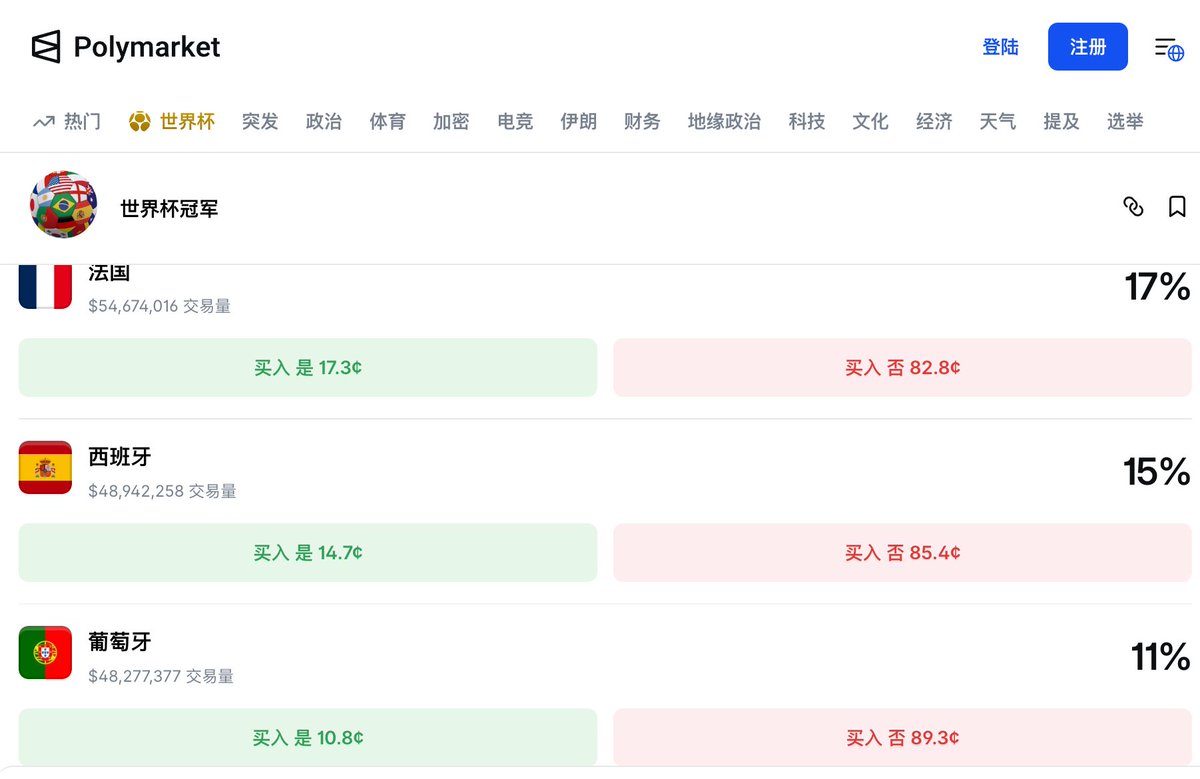
For instance, “Spain 16¢, France 16¢, Portugal 11¢” translates directly to market-implied championship probabilities of ~16%, ~16%, and ~11%. If you back Spain now and they ultimately win, your return would be roughly a 6.17x gain—from 16% to 100%.
This pricing language is exceptionally beginner-friendly for new World Cup predictors—not necessarily because placing bets is easier, but because gauging market sentiment becomes far more intuitive.
Moreover, this type of prediction-market data is inherently media-ready: it transforms the subjective judgment of “which team is stronger?” into real-time, money-backed pricing.
This round is complex and highly dependent on user habits, so for now we rank solely by dissemination attributes:
- Solid: Polymarket / Kalshi / Opinion / Predict.fun—probability equals price, optimized for sharing.
- Top Tier: /
- NPC: /
- Shaky: Traditional gambling platforms / State lotteries—odds menus aren’t newbie-friendly.
Trade Transparency: Can I See How Others Are Betting?
Understanding price is only step one. The crucial question is: How is that price formed?
This is where emerging prediction markets deliver their most lethal blow against the traditional bookmaker model. While prediction-market data doesn’t guarantee “truth,” it does let users observe live trading activity transparently.
Polymarket publishes real-time price, volume, order book, liquidity, price curves, and market heat. Kalshi, Opinion, and Predict.fun follow similar practices, displaying market data, trades, and price movements. Kalshi’s compliance requirements make its data resemble formal financial reports, while Opinion and Predict.fun present themselves more like comprehensive, blockchain-native tournament hubs.
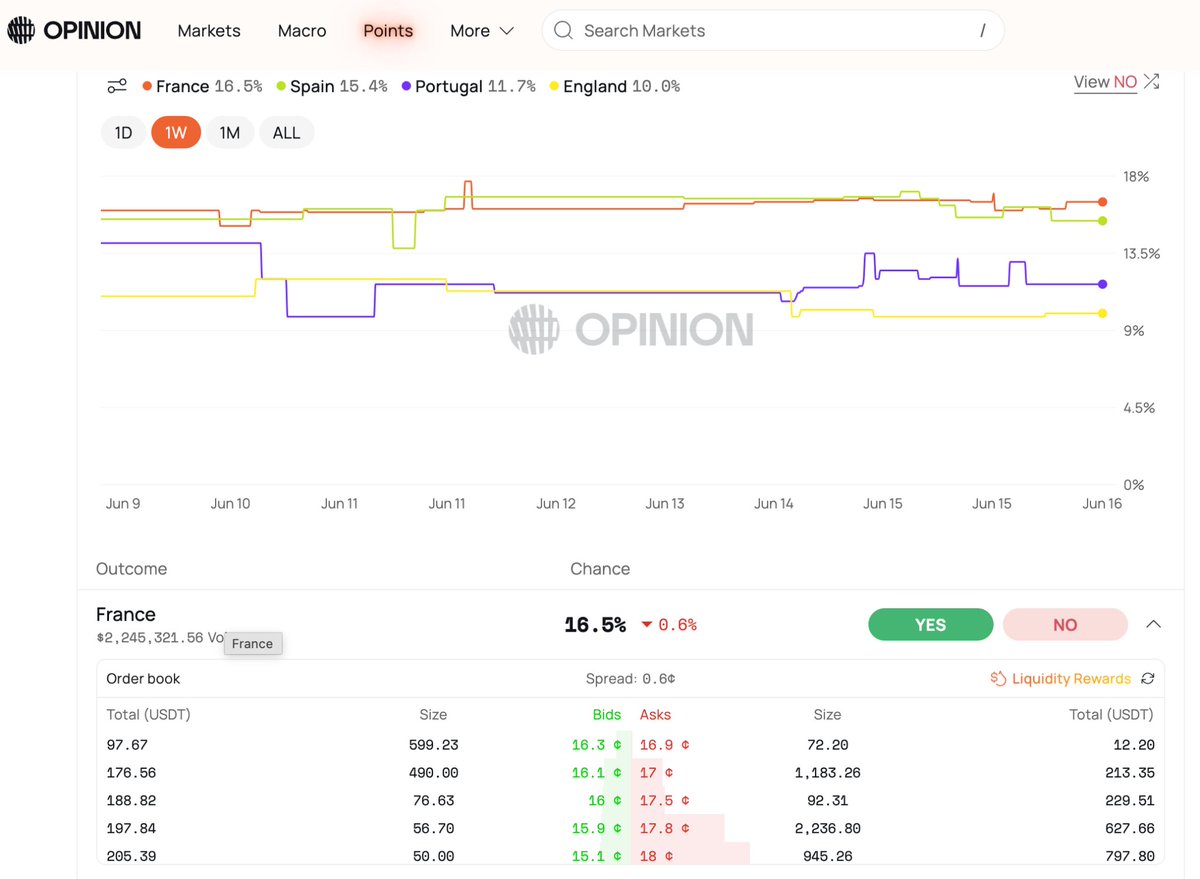
Traditional gambling platforms operate differently. Bettors see payout odds or indexes—but rarely get visibility into actual trade volume, fund flows, or market depth behind any given market. Users place bets largely based on trust in the platform’s reputation. This isn’t to say liquidity is absent—but the real issue is that this liquidity remains opaque to ordinary users. It’s like enjoying delicious braised chicken rice while wondering if it’s made from frozen, pre-packaged ingredients.
China’s state lotteries, guided by macro-level oversight, rarely engage in egregious “bookmaker-style” profit extraction. Yet behind every odds setting lies an inscrutable black box—unseeable and unverifiable.
So this round’s verdict is straightforward:
- Solid: Polymarket / Kalshi / Opinion / Predict.fun—the very foundation of prediction markets.
- Top Tier: /
- NPC: China’s state lottery—officially backed, massive scale, but process remains invisible.
- Shaky: Traditional gambling platforms—fully opaque.
Gameplay Variety: Can I Bet on the Details I Care About?
When it comes to creative betting options, traditional gambling platforms remain seasoned veterans.
Championship markets, handicap betting, over/under goals, exact scores, half-time/full-time results, corner kicks, yellow cards, player goals, Golden Boot, accumulators, same-game parlays, live betting, cash-out options… Traditional platforms dissect nearly every facet of World Cup matches into shelf-ready gambling products—overwhelmingly abundant.
This is both their greatest strength—and greatest danger: the more options available, the more users feel “there must be *some* angle I understand.” For platforms, however, finer granularity means longer user sessions, higher trading frequency, and greater profits.
China’s state lotteries aren’t far behind either. During the World Cup, offerings like champion, runner-up/champion, match result (win/draw/loss), exact score, total goals, and half-time/full-time cover the most familiar betting needs for Chinese-speaking users.
Kalshi is catching up, introducing more single-match, over/under, and both-teams-to-score event contracts.
Polymarket takes a more restrained approach—focusing on core markets like championship winner, progression to next rounds, and match outcomes. As of June 15, Polymarket’s World Cup champion prediction market had already surpassed $2 billion in trading volume. Meanwhile, niche markets like over/under goals or point spreads per match suffer from consistently low liquidity—and rarely support multi-match accumulator-style bets common in traditional football gambling.
Opinion and Predict.fun stand out among new blockchain-native platforms, offering markets covering champion, group stage outcomes, knockout rounds, Golden Boot, and assist leader.
So this round’s ranking:
- Solid: Traditional gambling platforms—the gambling buffet.
- Top Tier: Opinion / Predict.fun—aggressively capturing market share.
- NPC: Kalshi—expanding its menu / State lotteries—official offerings suffice.
- Shaky: Polymarket—strong flagship offerings, but limited variety.
User Access & Compliance: How Do I Get In—and Can I Get Out?
This factor matters especially for Chinese-speaking users.
State lotteries’ key advantage is clear regulatory status and familiarity within the Chinese-language context—you’ll likely spot a physical outlet within just a few steps of daily life. Their main drawback? They aren’t accessible via a simple web browser. Official channels still emphasize brick-and-mortar locations.
Polymarket, Opinion, and Predict.fun follow Web3 logic: wallet setup, stablecoins, on-chain assets. These feel natural to crypto-savvy users—but pose hurdles for average fans: wallets, private keys, USDC, regional restrictions. All three also face ongoing challenges around regulatory clarity for crypto prediction markets.
Kalshi leans closer to U.S.-style regulated financial account logic. Its rules are explicit, targeting the regulated-event-contract path—but KYC, geographic eligibility, and account requirements limit its global accessibility.
Traditional gambling platforms appear widely accessible across many regions—but carry the most issues: geographic restrictions, deposit/withdrawal risks, account risk controls, and uneven platform compliance. Even in mature Western markets with licensing frameworks, Chinese-speaking users must proceed with caution.
So the most critical question isn’t which platform feels most exciting to bet on—but:
Where does money enter? How are payouts settled? Can funds exit smoothly? And who do you contact if something goes wrong?
This round’s ranking:
- Solid: China’s state lottery—the most legitimate and familiar option for Chinese-speaking users, though requiring offline access.
- Top Tier: Polymarket / Opinion / Predict.fun—crypto-user friendly, but present barriers for mainstream fans; regulatory validity remains unproven.
- NPC: Kalshi—U.S.-only access, clear compliance framework.
- Shaky: Traditional gambling platforms—highest risks regarding deposits, withdrawals, and regulatory compliance.
Promotional Incentives: Should I Bet More Just for the Rewards?
As a rising star among on-chain prediction markets, Predict.fun launched a dedicated $2 million incentive program for the World Cup. On BNB Chain, it introduced the “Predict Cup,” featuring generous prize pools, Fan Points, team rosters, leaderboards, and round-based rewards—creating a fully immersive, on-chain World Cup experience.
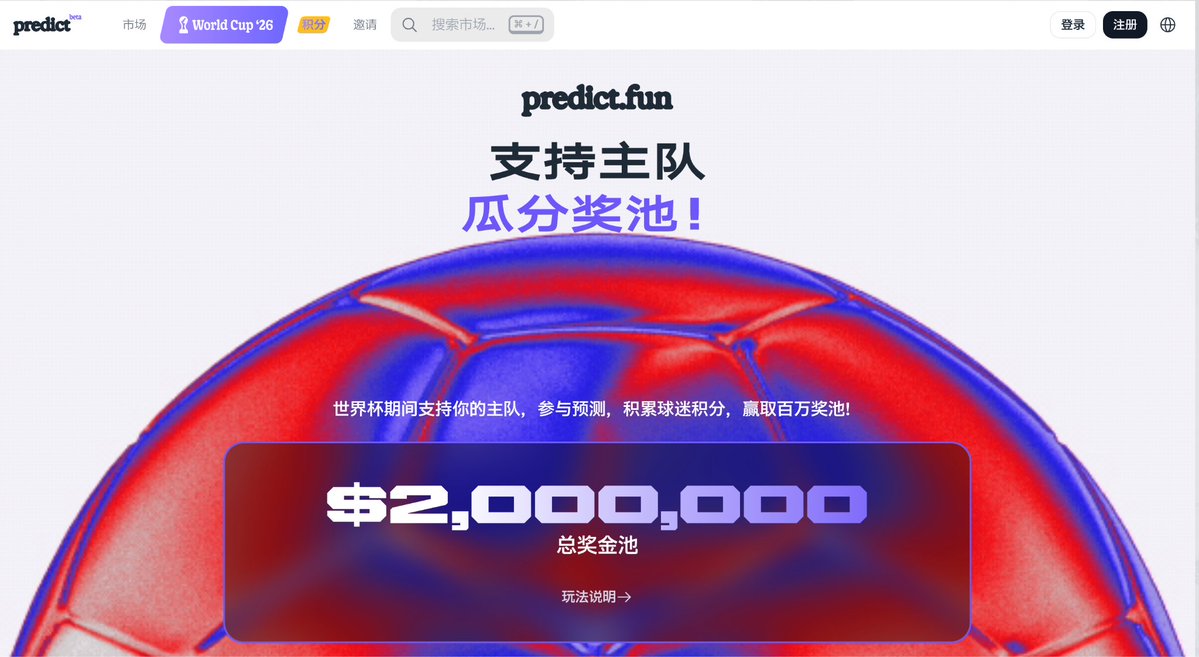
This strongly appeals to users: You’re not just predicting match outcomes—you’re earning points, climbing rankings, and claiming rewards.
Traditional gambling platforms have also gone all-in for the World Cup—after all, this quadrennial fan festival equates almost directly to revenue.
Polymarket, Kalshi, and Opinion keep their focus squarely on core market functions—price discovery, execution, market design, and information dissemination—without launching World Cup-specific promotional campaigns.
State lotteries emphasize public welfare and rational participation. Though occasional promotions exist, they’re unsuitable for aggressive, traffic-driven marketing in the Chinese-language context.
Yet amidst the excitement, ask yourself: Am I enjoying the matches—or chasing points? Am I analyzing odds—or being nudged by leaderboards?
This round’s ranking:
- Solid: Predict.fun—the most aggressive World Cup-specific campaign operator.
- Top Tier: Traditional gambling platforms—their golden season during the World Cup.
- NPC: Polymarket / Kalshi / Opinion—incentives aren’t their primary selling point.
- Shaky: State lotteries—emphasizing rationality and public-welfare orientation.
Conclusion
The 2026 World Cup has brought several competing product logics to the same table.
- China’s state lottery says: Matches can be interactive viewing experiences within an officially sanctioned public-welfare lottery framework.
- Traditional gambling platforms say: Matches are highly refined entertainment products.
- Polymarket says: Matches are real-time, fluctuating probability markets.
- Kalshi says: Matches are regulatory-compliant event contracts.
- Opinion says: On-chain prediction markets can function as comprehensive, tournament-wide thematic hubs.
- Predict.fun says: The World Cup isn’t just about markets—it’s also an on-chain points game.
But what truly deserves attention may not be which platform replaces another—rather, how World Cup markets are evolving from closed, opaque odds products into open, real-time, and shareable information markets.
Sports are merely the stage. The bigger business is humanity’s eternal desire—to price the future, and to price our own judgments.
Join TechFlow official community to stay tuned
Telegram:https://t.me/TechFlowDaily
X (Twitter):https://x.com/TechFlowPost
X (Twitter) EN:https://x.com/BlockFlow_News
 @BiteyeCN