Crypto Morning Brief: Moomoo Integrates Hyperliquid Market Data; Kraken Launches Perpetual Contracts in the U.S.
TechFlow Selected TechFlow Selected
Crypto Morning Brief: Moomoo Integrates Hyperliquid Market Data; Kraken Launches Perpetual Contracts in the U.S.
SpaceX’s IPO raised approximately $8.57 billion, with underwriters exercising an option to purchase an additional 83.33 million shares.
 Navigating Web3 tides with focused insights
Author: TechFlow
Yesterday’s Market Updates
Xiaohongshu Reportedly Preparing for Confidential Hong Kong IPO Filing by End of June
According to Bloomberg, citing informed sources, Xiaohongshu Technology Co., Ltd.—the operating entity behind the lifestyle platform Xiaohongshu—is preparing to file a confidential initial public offering (IPO) application in Hong Kong before the end of June. The report states that the company is working with advisors on its potential listing, and the deal could rank among Hong Kong’s largest IPOs in recent years. However, timing, fundraising amount, and valuation remain undetermined, with discussions still ongoing.
Xiaohongshu was founded in Shanghai in 2013. Its investors include Tencent, Alibaba, Sequoia China, Hillhouse Investment, and GSR Ventures. In its 2024 funding round, the company’s valuation stood at approximately $17 billion. As its business expanded, its secondary-market valuation surged to $31 billion in September 2025, and it projected full-year 2025 profits of around $3 billion.
SpaceX IPO Raises ~$8.57 Billion; Underwriters Exercise Overallotment Option for 83.33 Million Shares
SpaceX (SPCX.O): Underwriters exercised their overallotment option to purchase an additional 83.33 million shares. SpaceX raised approximately $8.57 billion in its IPO.
NVIDIA Files with U.S. SEC for Multi-Tranche Bond Offering Targeting at Least $20 Billion
NVIDIA has filed a multi-tranche bond issuance application with the U.S. Securities and Exchange Commission (SEC), aiming to raise at least $20 billion through the sale of investment-grade debt securities.
Hydra Host Closes $100M Funding Round at $800M Valuation, with NVIDIA Among Investors
According to The Information, AI server brokerage and data center software startup Hydra Host has completed a new $100 million funding round at an approximate $800 million valuation. Kindred Ventures led the round, with participation from NVIDIA, ARK Invest, Magnetar, and existing investors Founders Fund and Flume Ventures.
Founded in 2021, Hydra Host initially served cryptocurrency miners and has since pivoted to providing automation software for data center operators and facilitating AI server transactions.
Pakistan Launches Public Consultation on Draft “2026 Virtual Asset Services Regulations”
The Pakistan Virtual Assets Regulatory Authority (PVARA) has launched a public consultation on the draft “Pakistan Virtual Asset Services Regulations 2026” and its accompanying activity-specific handbooks. The consultation period runs from June 11 to July 2, 2026, until 4:00 p.m. Pakistan Standard Time (PST).
The draft proposes a licensing and regulatory framework for virtual asset service providers (VASPs), covering corporate governance, market conduct, client asset segregation, technology and cybersecurity, risk management, and anti-money laundering/counter-terrorist financing (AML/CFT) requirements. Ten specialized license handbooks accompany the framework. PVARA stated that this consultation aims to refine the regulatory framework and align Pakistan’s virtual asset regulation with international standards set by the Financial Action Task Force (FATF).
MiCA Transition Period Ends July 1; ~75% of EU Crypto Platforms May Face Shutdown
According to CryptoSlate, the European Union’s MiCA (Markets in Crypto-Assets) regulation transition period will officially conclude on July 1, 2026. As of May 2026, only 194 crypto firms across the EU had obtained formal licenses, whereas over 3,000 crypto enterprises registered in 2024—meaning roughly 75% of legacy platforms are expected to lose operational eligibility after the deadline.
Unlicensed platforms must orderly wind down operations, migrate users to licensed platforms, or fully exit the European market by the cutoff date. France’s regulator, the Autorité des Marchés Financiers (AMF), has taken the toughest stance, explicitly warning that unlicensed operation may incur penalties of up to two years’ imprisonment and a €30,000 fine. For ordinary users, if their platform fails to obtain a MiCA license, they may face restrictions such as inability to deposit funds or be required to withdraw assets.
Kraken Launches Crypto Perpetual Futures Trading in the U.S.
According to The Block, Kraken has launched cryptocurrency perpetual futures trading in the United States, offered via Kraken Pro. This launch follows Kraken’s acquisition in May of Bitnomial—a CFTC-licensed exchange, clearing house, and broker-dealer.
The report notes that the CFTC recently approved Kalshi to list the first official U.S.-based Bitcoin perpetual futures contract, and Coinbase to offer simulated perpetual futures via five-year-long futures contracts.
Bitmine Acquired 76,881 ETH Last Week, Total Holdings Now ~5.62 Million ETH
According to PRNewswire, Ethereum treasury firm Bitmine Immersion Technologies disclosed acquiring 76,881 ETH last week. Its current crypto holdings comprise 5,620,754 ETH, 204 BTC, $88 million worth of Eightco Holdings equity, and $180 million worth of Beast Industries shares. Additionally, the firm has staked 4,718,677 ETH (valued at $8.1 billion, based on an ETH price of $1,718).
Strategy Acquired 1,587 BTC Last Week, Total Holdings Reach 846,842 BTC
Per Strategy’s 8-K filing with the U.S. SEC, the company purchased 1,587 bitcoins between June 8–14, 2026, at an average price of approximately $63,024, totaling about $100 million. Funds were sourced from proceeds of its MSTR stock ATM program. During the same period, Strategy sold 1.7326 million shares of MSTR common stock via the ATM program, netting approximately $209 million. As of June 14, 2026, Strategy holds a cumulative total of 846,842 bitcoins, with an aggregate cost basis of approximately $64.07 billion and an average acquisition price of ~$75,656 per bitcoin.
Moomoo (Futu) Integrates Hyperliquid On-Chain Perpetual Futures Market Data, Enabling Direct Access to Trading Info
According to its official page, Moomoo—owned by Futu—has integrated on-chain perpetual futures market data from Hyperliquid, allowing users to directly view Hyperliquid’s perpetual futures trading data within the Moomoo app.
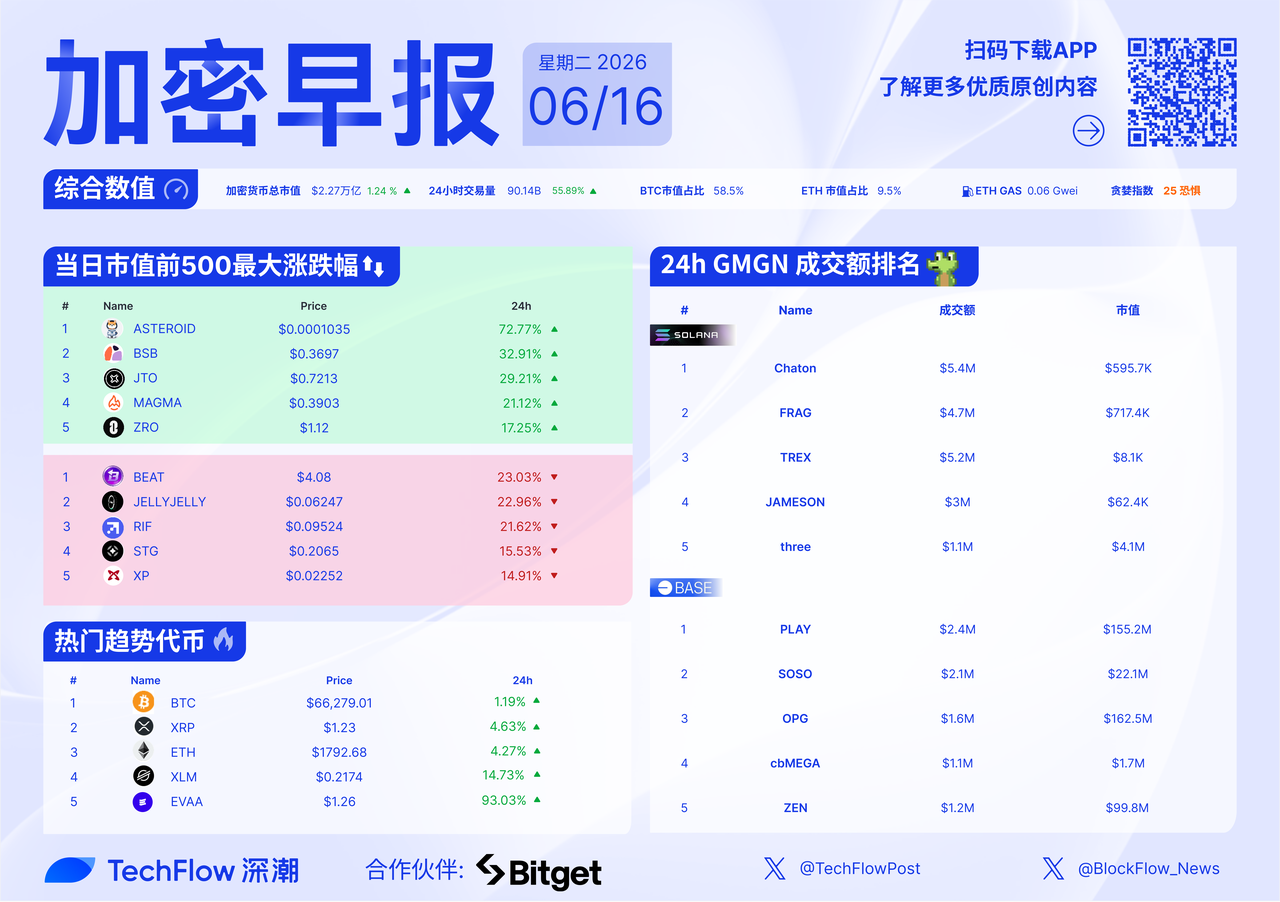
Market Data
Recommended Reading
China’s Export Controls on Japan Create Bottlenecks—“White-Haired Stock Guru” Serenity Names Korean Stock Foosung a “Big Winner”
https://www.techflowpost.com/article/32050
China’s export controls on tungsten to Japan are unexpectedly reshaping the upstream supply chain for AI chips. With Japan’s two major WF6 (tungsten hexafluoride) suppliers facing raw material shortages, a crack has emerged in a supply system accounting for roughly 25% of global capacity—prompting Samsung and SK Hynix to seek alternative sources. Korean manufacturer Foosung seized the opportunity to partner with China’s CSSC Special Gas, emerging as one of the biggest beneficiaries. Its share price has surged nearly 200% over the past year. Yet this “Korean substitution” is not a triumph of technological superiority, but rather a geopolitical window of opportunity—since Foosung’s own tungsten powder supply remains dependent on China. Should export policies tighten further, today’s winners could become tomorrow’s dominoes. This tungsten-driven contest is now extending from raw materials into AI memory chips, HBM, and the core segments of the global semiconductor supply chain.
Will Claude Require ID Verification and Facial Recognition? “Facial Scan” Is an Old Feature; “Handing Data to Police” Is a Misinterpretation
https://www.techflowpost.com/article/32044
The recent discussion surrounding Anthropic’s updated privacy policy—claiming that “Claude will require real-name verification and facial recognition, and chat logs will be handed over to law enforcement”—largely conflates preexisting features with newly formalized terms. In fact, ID verification and facial authentication have been available since April this year; the updated policy effective July 8 merely codifies these practices into the official privacy terms. Moreover, the alleged “lowered threshold for disclosing data to law enforcement” lacks textual support—the old and new versions both retain provisions permitting disclosure when legally mandated, for fraud prevention, or for security protection, without substantive tightening. The truly notable change is Anthropic’s first explicit specification of data flows under Agent mode: when Claude connects to third-party applications and performs tasks on behalf of users, related inputs, outputs, and operational data may be routed to external service providers for processing. This means that as AI Agent capabilities advance, user data boundaries will no longer be confined to the chat interface—but will extend across the entire task-execution chain.
SemiAnalysis Dissects Huawei’s Kirin 9030: Stuck on Process Nodes, So They’re “Folding” the Chip
https://www.techflowpost.com/article/32037
Without access to EUV lithography machines, Huawei and SMIC are charting a path divergent from mainstream global semiconductor development. SemiAnalysis’s latest teardown reveals that SMIC’s N+3 process achieves transistor density approaching TSMC’s N6 node—but at the cost of more complex and expensive multiple-patterning techniques. Meanwhile, Huawei is betting on LogicFolding, a 3D logic stacking technology designed to shorten signal paths—not by advancing process nodes alone, but by literally “folding” chips.
This article not only unpacks the Kirin 9030’s true technical capabilities, but also highlights a broader trend: export controls haven’t halted Chinese chip progress—they’re reshaping China’s semiconductor technology roadmap. From the N+3 process and domestic EDA tools to future 3D stacking approaches, a new race for the “post-Moore era” is underway. For readers tracking AI compute, domestic substitution, and the semiconductor supply chain, this may be the most insightful analysis of China’s chip industry trajectory over the coming years.
Ultra-Wealthy Accumulated Record Cash in February—Four Months Later, U.S. Equities Hit New Highs. Who’s Proving Whom Wrong?
https://www.techflowpost.com/article/32036
In February this year, U.S. money market fund assets surged to a record $8.25 trillion. Warren Buffett held over $380 billion in cash, and Peter Thiel reduced his NVIDIA position—leading markets to widely believe “smart money” was exiting risk assets. Yet just four months later, the narrative flipped: the S&P 500 and Nasdaq hit consecutive all-time highs, capital flooded back into equities, and those who opted for safety watched the market rally without them.
This article recaps the shift from “cash is king” to “fear of missing out,” revealing a frequently overlooked truth: the wealthiest investors don’t always accurately predict market direction. While Wall Street debated AI bubbles, capital quietly returned to risk assets. For investors, the more meaningful question may not be “When will the next crisis hit?”—but rather, “While everyone waits for a pullback, who’s quietly buying the future?”
“Tungsten Out, Molybdenum In”: SK Hynix Completes Validation of 375-Layer NAND—Three U.S. Stocks Emerge as Key Beneficiaries
https://www.techflowpost.com/article/32039
Beneath SK Hynix’s completion of 375-layer NAND validation lies a pivotal shift in the semiconductor supply chain: tungsten—used for nearly 25 years—is being gradually replaced by molybdenum. From Samsung and SK Hynix to future higher-layer NAND and advanced logic nodes, this materials transition is moving from labs to mass production. As layer counts climb, tungsten’s physical limits are becoming apparent, while molybdenum—with lower resistivity and better suitability for high-aspect-ratio structures—is emerging as the new standard for next-generation chip manufacturing.
What truly merits attention here isn’t whether SK Hynix can mass-produce 375-layer NAND, but rather—who stands to gain most from this transformation? The answer may lie not with Samsung, SK Hynix, or Micron, but with upstream equipment and materials suppliers. When the chip industry enters a “materials upgrade cycle,” companies selling shovels often profit before those digging for gold. From Lam Research and Applied Materials to Entegris, a broad-based restructuring across NAND, DRAM, and advanced logic is unfolding. For investors tracking AI compute, semiconductor equipment, and the U.S. tech equity chain, this is a critical thread for understanding the next wave of industry opportunities.
Join TechFlow official community to stay tuned
Telegram:https://t.me/TechFlowDaily
X (Twitter):https://x.com/TechFlowPost
X (Twitter) EN:https://x.com/BlockFlow_News
 深潮TechFlow