Goldman Sachs Research Report Analysis: Memory Shortage to Extend Through 2028—Maintain Buy Recommendation
TechFlow Selected TechFlow Selected
Goldman Sachs Research Report Analysis: Memory Shortage to Extend Through 2028—Maintain Buy Recommendation
DRAM, NAND, and HBM supply and demand in 2027 will be even tighter than in 2026, with shortages extending into 2028.
 Navigating Web3 tides with focused insights
By: Tide Research
On June 1, Goldman Sachs published its daily Asia-Pacific equity summary, “The 720,” featuring Samsung, SK Hynix, Kioxia, MediaTek, Lenovo, and BYD on the cover. At first glance, it reads like a comprehensive shopping list—but dig deeper and you’ll find one absolute core theme: memory chips.
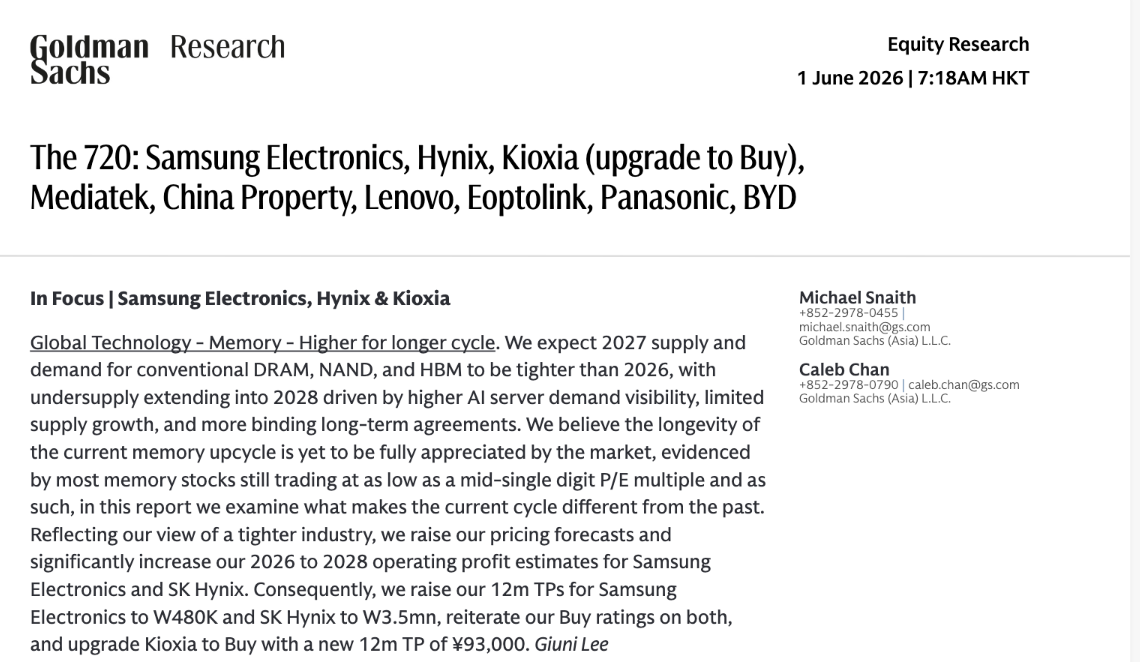
Goldman’s most significant call in this report is that the current memory upcycle will last “longer and higher”—with shortages persisting through 2028—and that the market has vastly underestimated its duration. The evidence lies in valuations: most memory stocks continue trading at mid-single-digit P/E ratios, suggesting the market views this merely as another routine cyclical rebound—Goldman disagrees.
We break down the key points below by importance, followed by a quick-reference table of covered names.
Main Event: Memory Shortages to Last Through 2028; Three Stocks Upgraded
Goldman compares this cycle with prior ones and concludes it’s different—for three reasons: higher visibility into AI server demand, constrained supply growth, and increasingly rigid long-term supply agreements (locking in both volume and price). Combined, DRAM, NAND, and HBM supply-demand imbalances will tighten further in 2027 versus 2026—extending shortages into 2028.
The clearest illustration is Goldman’s DRAM supply-demand chart. Negative values indicate supply deficits—the deeper the negative, the stronger the pricing support. This time, Goldman revised its 2026–2028 forecasts deeper into deficit territory: for 2027, it slashed its forecast from –2.5% to –5.9%, more than doubling the projected shortfall. In plain terms: Goldman expects memory manufacturers to face intensifying shortages next year and the year after—supporting sustained price increases.
At the company level, three names were collectively upgraded:
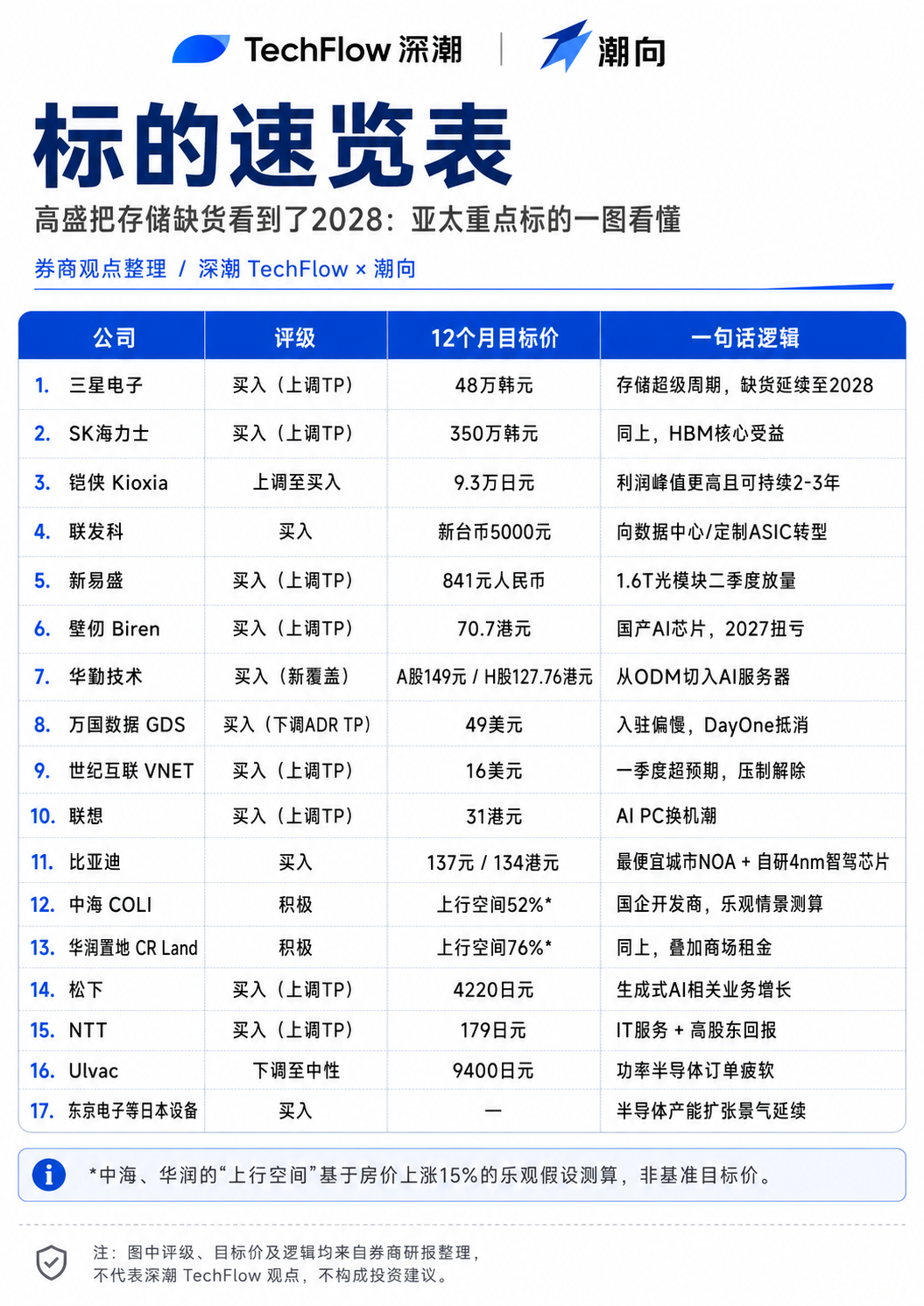
- Samsung Electronics: 12-month target price raised to ₩480,000; rating maintained at Buy.
- SK Hynix: 12-month target price raised to ₩3,500,000; rating maintained at Buy.
- Kioxia: rating upgraded from Hold to Buy; new target price ¥93,000.
Kioxia is the sole upgrade in this report—and Goldman’s rationale merits special attention. It argues that peak profitability in this cycle will exceed prior expectations—and remain elevated for two to three years, rather than spiking briefly then fading. Based on this, Goldman raised Kioxia’s operating profit forecasts for FY2027–FY2029 by 16%–48% and expects gross margins to hold near 80%. For a company operating in the highly cyclical memory business, assigning three years of sustained high profitability is an exceptionally strong statement.
AI Compute Chain “Full Package”: From Chips to Optical Modules to Data Centers
Beyond memory, this report covers nearly the entire AI hardware supply chain across China and Asia—unified under one central thesis: global cloud hyperscalers are accelerating capital expenditures, and that spending is flowing down the chain.
- MediaTek: Buy; new target price NT$5,000. Key catalyst: transition from smartphone chips to data center and custom ASICs (AI chips tailored for specific customers). MediaTek targets $2 billion in data center/AI ASIC revenue by 2026 and aims to capture 10%–15% of the $70–80 billion ASIC market in 2027.
- Eoptolink: Buy; target price raised to RMB 841. A leading optical module supplier—critical for high-speed data transmission in AI data centers. Goldman expects its 1.6T optical modules to ramp from Q2, accelerate in H2, and benefit from new capacity in Thailand—raising its 2027 and 2028 earnings forecasts by 5% and 6%, respectively.
- Biren: Buy; target price raised to HK$70.7. A domestic AI chipmaker whose Biren B166 received China’s top-tier “Secure & Reliable Level 1” certification. Goldman expects Biren to achieve profitability in 2027 as it shifts toward higher-performance, higher-priced AI chips—and raises its revenue forecasts for 2026–2030 by 4%–28%.
- Huaqin Technology: Buy; newly added to coverage. A-share target price RMB 149; first-time H-share coverage with target price HK$127.76. Core thesis: expansion from consumer electronics ODM into AI data centers—projected compound annual revenue growth of 32% from 2025 to 2027.
- Data Center “Dual Leaders”: GDS (GDS) maintains Buy rating, but ADR target price lowered to USD 49 (slower rack deployment pace and declining monthly service revenue partially offset by higher valuation for overseas DayOne business); VNET maintains Buy rating, target price raised to USD 16 (Q1 results beat expectations, strong capacity ramp-up execution, and removal of overhang from strategic investors).
- Lenovo: Buy; target price raised from HK$27 to HK$31. Bullish on the AI PC replacement cycle—Goldman projects Lenovo’s notebook market share to reach 28% by 2028 and AI notebook penetration to hit 66%, lifting average selling prices. Its FY2027 and FY2028 EPS forecasts stand 22% and 25% above Bloomberg consensus—reflecting substantial divergence.
Names Outside the AI Core—But Still Highlighted
- China Real Estate (China Overseas Land & Investment, CR Land): Goldman assesses whether the sector’s recent rebound is sustainable. Under an optimistic scenario—where 15 key cities follow Shanghai and Shenzhen’s housing price recovery, achieving a 15% price increase by end-2028—Goldman estimates cash profits for COLI and CR Land could expand by over 30% and over 50%, respectively, by 2028. Applying sum-of-the-parts valuation, it assigns upside potential of 52% for COLI and 76% for CR Land—and maintains a positive view on these state-owned developers. Important note: this is a scenario-based calculation—not the base case.
- BYD: Buy; target price RMB 137 / HK$134. Catalyst: at its Intelligent Driving Strategy Conference, BYD priced its “Tianshenzhiyan B” urban NOA (Navigate on Autopilot) system at just RMB 12,000 across all models—and launched entry-level vehicles equipped with urban NOA at RMB 78,800—the lowest price for urban NOA in China. It also unveiled its first in-house 4nm intelligent driving chip, “Xuanji A3,” now in mass production. Goldman believes these engineering capabilities will accelerate adoption of premium intelligent driving features, lower costs, and improve margins.
- Japanese Semiconductor Equipment Makers: Goldman maintains Buy ratings on Lasertec, Ebara, Disco, and Tokyo Electron. The only downgrade is Ulvac (6728.T), cut from Buy to Neutral with target price lowered to ¥9,400—citing softness in high-margin power semiconductor orders and slower-than-expected gross margin expansion.
- Panasonic HD: Buy; target price raised from ¥4,000 to ¥4,220—driven by generative AI-related businesses (backup power supplies, copper-clad laminates [CCL], and high-performance capacitors).
- NTT: Buy; target price modestly raised from ¥176 to ¥179—based on domestic IT services demand and an estimated ~5% total shareholder return providing a safety margin.
A Macro Theme: AI Boom Meets Energy Crisis
What ties these individual names together is Goldman’s macro outlook: emerging markets are being pulled apart by two opposing forces—AI investment euphoria on one side, and energy supply contraction due to the Strait of Hormuz blockade on the other.
Tech-export economies like South Korea and Taiwan benefit from surging exports and current account surpluses. Meanwhile, energy importers face rising inflation, weakening currencies, and fiscal strain from fuel subsidies. Goldman forecasts Q4 Brent crude averaging USD 90/barrel—continuing pressure on oil-import-dependent economies—and recommends overweighting equities in China, South Korea, Brazil, and South Africa. This aligns closely with recent developments in Iran and broader oil-market dynamics.
Two additional points directly impacting A-share liquidity:
China’s imports surged 23.6% YoY in the first four months of this year—but Goldman notes this is highly concentrated: gold and semiconductors alone accounted for ~65% of the import growth, meaning it does not signal a broad deterioration in external balances.
The semi-annual rebalancing of the CSI and CNI indices is expected to trigger over USD 48 billion in two-way passive fund flows, with the largest inflows going to tech hardware & semiconductors (~USD 3.1 billion) and capital goods (~USD 1.4 billion), and the largest outflows hitting healthcare and banking. Names flagged as “expected to receive the highest net passive inflows” include HGTECH, Source Photonics, Hua Hong Semiconductor, GigaDevice, and VeriSilicon. For index-rebalancing arbitrage players, this is a clear roadmap.
Finally, Goldman tucked in its customary Easter egg: 2026 World Cup win probability forecast—Spain leads at 26%, followed by France (19%), Argentina (14%), Brazil (8%), and England (5%). The model penalizes defending champion Argentina—take it with a grain of salt.
Quick-Reference Table of Covered Names
This article is TechFlow’s summary and interpretation of a third-party brokerage research report. All cited ratings, target prices, earnings forecasts, and related judgments represent the views of the brokerage’s analysts only—and reflect their firm’s stance—not TechFlow’s views, nor do they constitute any investment advice.
Please keep three points in mind while reading:
First, target prices reflect analysts’ expectations over a defined horizon (typically 12 months)—they are forecasts, not guarantees—and are subject to frequent revision based on company performance and market conditions.
Second, sell-side research is inherently biased toward positivity. “Buy” ratings are standard practice for covered companies—and some covered firms may have investment banking or other commercial relationships with the brokerage. A list dominated by “Buys” must be read with this context in mind.
Third, the true value of a research report lies in its core logic and underlying assumptions—not in any single target price. If the central thesis holds, the associated stock cases gain credibility; if the thesis is disproven, the entire chain of reasoning unravels. Focus on the logic—not just the price.
Markets carry risk—decisions must be independent. This article should not serve as the basis for any securities transaction.
Join TechFlow official community to stay tuned
Telegram:https://t.me/TechFlowDaily
X (Twitter):https://x.com/TechFlowPost
X (Twitter) EN:https://x.com/BlockFlow_News
 @chaoxiangooo