From TACO to NACHO: How the Hormuz Crisis Is Rewriting the Macroeconomic Pricing Logic of Crypto Markets
TechFlow Selected TechFlow Selected
From TACO to NACHO: How the Hormuz Crisis Is Rewriting the Macroeconomic Pricing Logic of Crypto Markets
The TACO trade bets on political concessions, whereas the NACHO trade confronts more intractable physical bottlenecks and trust deficits that cannot be swiftly reversed.
 Navigating Web3 tides with focused insights
By Lacie Zhang, Researcher at Bitget Wallet
Introduction: A New Acronym on Wall Street Trading Desks
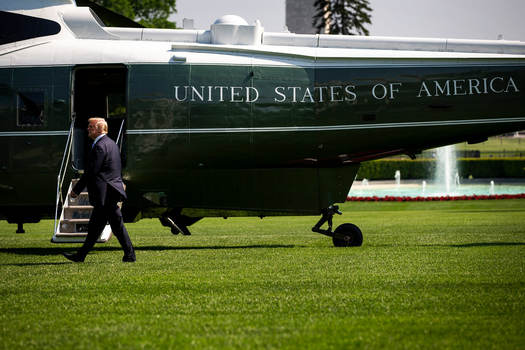
A few months ago, Wall Street was still debating a tongue-in-cheek trading acronym: TACO—“Trump Always Chickens Out.”
It captured the market’s prevailing perception of Trump’s policy style over the prior period: first issuing extreme threats, triggering panic-driven selloffs in risk assets; then, under market pressure, negotiating room, or political cost, signaling de-escalation—and asset prices rebounding accordingly. For traders, the core of TACO wasn’t belief in the policy itself, but belief that maximum pressure would inevitably be followed by retreat.
But entering Q2 2026, the key term on Wall Street trading desks began shifting—and a new acronym started gaining traction: NACHO—“Not A Chance Hormuz Opens,” meaning “the Strait of Hormuz has virtually no chance of reopening in the near term.”
The phrase was first popularized on X by Javier Blas, columnist for Bloomberg Opinion: “We thought we were getting a TACO. But so far we are getting a NACHO.” In other words, the market had expected another round of Trump-style brinkmanship—followed by rapid reversal—but instead observed a protracted, intractable stalemate over the Strait of Hormuz.
Subsequently, Nobel laureate economist Paul Krugman amplified the concept in his Substack essay, “The Logic of NACHO.” He argued that, unlike tariff disputes, the Hormuz Strait crisis isn’t something easily reversed by a single statement, one meeting, or a social media post. Restoring normal passage requires more than political will—it demands military de-escalation, resumption of shipping, re-pricing of marine insurance, energy inventory buffers, and the rebuilding of minimal trust among multiple stakeholders.
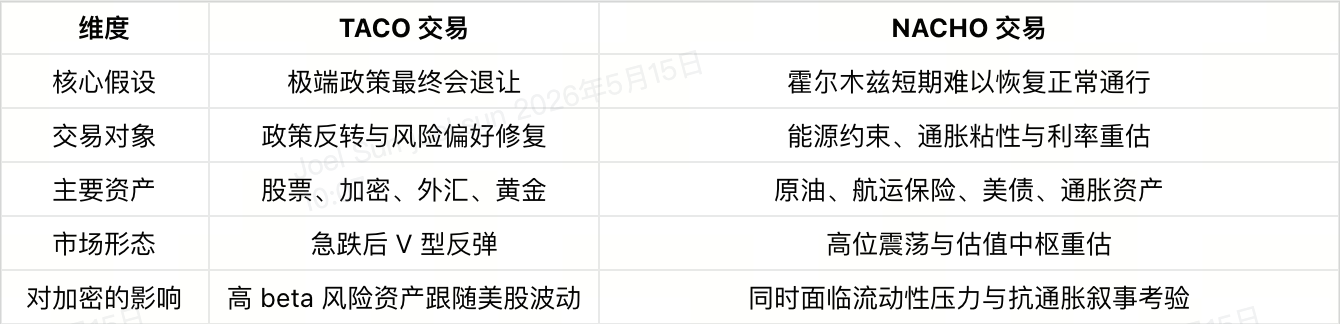
This is also the biggest difference between NACHO and TACO. TACO trades on political retreat; NACHO trades on harder-to-reverse physical bottlenecks and trust deficits.
For crypto markets, this isn’t a distant energy-market story. Oil prices, inflation, U.S. Treasury yields, Fed rate-cut expectations, and global risk sentiment all transmit through the same channel to BTC/ETH/altcoins and on-chain yield products—reinforcing the link between crypto assets and global macro variables.
I. TACO vs. NACHO: Markets Are Repricing the Same Conflict
To understand NACHO, one must first understand TACO.
In the TACO era, markets traded the reversibility of political threats. Trump issued tough signals → markets panicked and sold off → policy tone softened → traders bought back battered risk assets, anticipating a V-shaped rebound. Our earlier article on TACO trading already dissected this pattern: extreme threats → panic selloff → conciliatory statements → retaliatory rebound—a recurring market script.
This logic worked because policy tools like tariffs, trade negotiations, and technology restrictions are inherently adjustable. Trump could threaten higher tariffs—or delay their implementation; he could strike a hard line—or find face-saving compromises at the negotiating table. For markets, as long as policymakers were expected to ultimately step back, panic-driven selloffs became buying opportunities.
NACHO, however, confronts an entirely different problem.
The Strait of Hormuz isn’t an executive order that can be rescinded at will, nor a Truth Social post that can be edited with a click. It is the physical chokepoint of the global energy transportation system—impacting crude oil shipments, LNG trade, shipping companies, insurers, naval deployments, regional security, and geopolitical bargaining among multiple sovereign states.
Once markets begin believing the Strait of Hormuz won’t reopen anytime soon, the trading logic shifts fundamentally. Investor focus pivots from whether political figures will “back down” to questions about global energy supply, inflation expectations, and monetary policy paths themselves.
II. Why the Strait of Hormuz Matters: The Physical Throat of Energy Markets
Understanding NACHO begins with grasping the real weight of the Strait of Hormuz as a physical bottleneck. This narrow waterway—just ~33 km wide—carries roughly 25% of seaborne oil and ~one-third of global LNG trade, plus nearly all exports from major producers like Saudi Arabia, the UAE, Qatar, and Iraq.
Since the blockade took effect in March, tanker traffic dropped sharply by 70%, with over 150 vessels stranded just outside the Strait—bringing throughput close to zero within days. Brent crude surged past $100/barrel for the first time in four years, posting a staggering monthly gain of 55.32%—its largest on record. JPMorgan warned in early May that global commercial oil inventories would hit “operational stress levels” by early June. If the Strait remains closed through September, markets would need to draw down inventories reserved only for minimum operational continuity—further constraining future supply recovery capacity.
The impact of Hormuz disruption extends well beyond rising oil prices. More critically, it elevates the cost structure across an entire supply chain: disrupted tanker passage forces insurers to reprice marine coverage; shipowners and charterers demand higher risk premiums; expectations tighten for crude and LNG supply; inventory drawdown accelerates—and these pressures eventually feed into fuel, freight, fertilizer, plastic, food, and electricity prices.
That’s why the Hormuz crisis cannot be understood through the “policy noise” lens of the TACO era. Tariffs can be postponed; statements withdrawn; negotiations restarted. But restoring maritime passage requires vessel re-scheduling, insurance re-pricing, port re-coordination, refinery inventory rebalancing—and even renewed confidence among buyers and sellers that the route is safe enough to use.
Even if a de-escalation signal emerges one day, energy markets won’t instantly execute a “V-shaped reversal” like equity markets. Tankers won’t dock overnight upon hearing news; refineries won’t instantly refill inventories after a statement; insurers won’t slash risk premiums immediately following a negotiation. Physical-world recovery naturally lags financial-market trading speed. This is precisely the insight Tim Duggan, author of The Oil Report, articulated in his widely circulated long-form piece, “The NACHO Trade”: “Tanker physics outrun any diplomatic timeline”—no matter how dramatic the political theater, physical transmission operates on its own rhythm.
Thus, the core question underlying NACHO trading is deeper: if global markets must now contend with higher energy costs, stronger inflationary pressure, and less stable supply chains, then equities, bonds, gold, the dollar, and crypto assets all require revised pricing anchors under new constraints.
III. The Three Pillars of NACHO Trading: Insurance, Oil Prices, and Interest Rates
NACHO evolved from a trading-desk acronym into a cross-asset narrative because it simultaneously reshapes three core pricing pillars across major asset classes: marine insurance, oil prices, and interest-rate expectations.
Pillar One: Insurers Won’t Underwrite Voyages Through Hormuz. Gulf War risk insurance rates spiked to 2.5% of hull value in March—roughly eight times pre-war baseline levels. Even as some top-tier insurers attempted to resume underwriting, their附加 clauses effectively eliminated all potential upside. Once insurance becomes “NACHO-ized,” even a temporary ceasefire won’t restore normal operations: shipowners and charterers will continue demanding steep risk premiums—effectively locking in the marginal benefit of “Strait reopening.”
Pillar Two: Oil Prices Will Remain in Triple Digits Long-Term. Though Brent has retreated from its wartime peak of $126/barrel in late April, it remains above $100—about 38% higher than pre-conflict levels. Goldman Sachs stated explicitly in its latest report: “If the Strait remains closed for even one additional month, Brent crude must stay above $100/barrel for all of 2026.” eToro’s analyst, quoted by CNBC, summed it up precisely: “Throughout most of this crisis, every ceasefire headline has triggered sharp crude selloffs—traders have persistently priced in a resolution that never arrives. This means that as long as uncertainty around Hormuz passage persists, oil prices will carry a higher geopolitical risk premium. Even short-term pullbacks won’t reset price anchors unless markets see a sustainable path to full restoration.”
Pillar Three: The Fed Cannot Cut Rates Amid Persistent Inflation. Under the NACHO framework, sustained high oil prices → sticky inflation → the Fed forced to maintain a “higher for longer” stance → front-end Treasury yields rise further, flattening the yield curve overall. If inflation surges beyond expectations—driven by energy prices and tariff risks—Treasury yields could breach 4.5%, continuously tightening liquidity conditions and pressuring valuations. All risk assets reliant on low rates and liquidity spillovers face headwinds—and crypto markets sit at the very end of this transmission chain.
IV. What NACHO Means for Crypto Markets: Repricing from Risk Assets to On-Chain Dollar Yields
For crypto markets, NACHO’s impact isn’t simply bullish or bearish—it’s a shift in pricing frameworks. Over recent months, crypto assets largely traded ETF inflows, on-chain ecosystem developments, and internal narratives like AI/Meme/RWA. Under the NACHO framework, however, oil prices, inflation, U.S. Treasury yields, dollar liquidity, and Fed policy trajectories re-emerge as decisive drivers of risk sentiment.
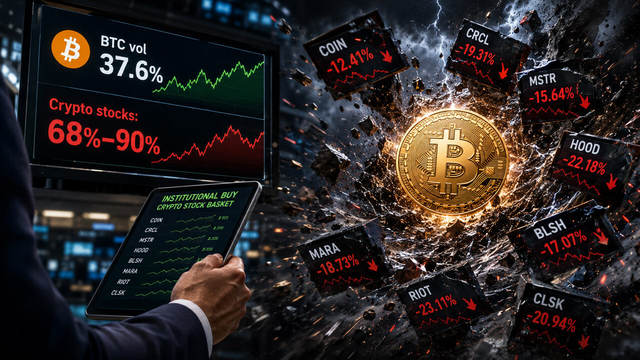
The high-beta nature of BTC, ETH, and altcoins is being reasserted: elevated oil prices push up inflation expectations; rising inflation compresses Fed rate-cut space; sustained high Treasury yields suppress global liquidity and risk-asset valuations. Transmission to crypto markets follows this path: “oil up → inflation stickier → rate cuts delayed → liquidity tighter → risk assets pressured.” In this environment, Bitcoin may not behave like “digital gold” in the short term—and may instead track Nasdaq and other risk assets more closely.
Bitcoin’s safe-haven narrative faces renewed testing: Geopolitical conflict, energy crises, and inflationary pressure theoretically favor non-sovereign asset narratives. Yet Bitcoin’s safe-haven property doesn’t activate automatically. During initial market shocks, investors prioritize margin calls, USD cash, and risk exposure—BTC is often sold first as a liquid asset. Only when markets shift from short-term liquidity stress to longer-term concerns about inflation, fiscal sustainability, and sovereign credit does BTC’s “digital gold” logic potentially regain dominance.
Altcoins and high-valuation narrative assets face heightened discount-rate pressure: Many altcoin projects lack stable cash flows; their valuations rely heavily on user growth projections, ecosystem subsidies, trading volume, and market risk appetite. When real interest rates rise and funding costs increase, such forward-looking narrative assets face sharper valuation compression.
Stablecoins, RWAs, and on-chain dollar-yield products re-enter the center of macro narratives: If NACHO reinforces a “higher for longer” interest-rate environment, the appeal of USD cash flows and short-duration yield assets rises again. In traditional markets, this corresponds to money market funds, short-dated bonds, and T-Bills; in on-chain markets, it maps to stablecoin yields, tokenized Treasuries, money market fund tokens, and RWA yield products. Simultaneously, geopolitical and energy-trade disruptions highlight stablecoins’ value as 24/7 global settlement assets.
V. Navigating the NACHO Era: An Investor’s Survival Code
At this point, let’s return to the most practical—and critical—question: As an ordinary crypto investor, how should you respond to this new NACHO playbook?
The most immediate change is that markets are no longer suited for excessive reliance on “V-shaped reversals.” In the TACO era, many trades rested on an implicit assumption: extreme policies would ultimately soften, and panic-induced dips would be quickly repaired. NACHO differs fundamentally—it confronts not reversible policy noise, but real-world constraints shaped by energy logistics, marine insurance, inventory depletion, and rate expectations. Rebounds may still occur—but their timing, magnitude, and certainty all decline. For highly leveraged traders, this means margin safety buffers matter more than directional calls—and survival outweighs correctly predicting any single rebound.
Simultaneously, macro variables must re-enter the crypto investor’s field of vision. Many previously focused solely on candlestick charts, on-chain metrics, funding rates, project narratives, and exchange heatmaps. Under NACHO, however, oil prices, EIA inventory data, OPEC+ output decisions, CPI, PCE, Treasury yields, and SOFR-OIS spreads all influence crypto markets via liquidity and risk sentiment. Crypto assets do not operate independently of the global financial system—especially now that ETFs, institutional capital, and deep USD liquidity are fully integrated. Macro research is no longer background context; it is part of the trading framework.
In terms of asset selection, markets may favor certainty. Wall Street is currently advocating “ditch soft, embrace hard”—favoring assets with stronger cash flows, settlement demand, store-of-value consensus, or tangible yield generation. Moderately increasing BTC allocation relative to altcoins—and focusing on RWA-linked assets—may be prudent. Gold and energy-sector allocations also merit consideration as hedges.
Finally, respect the irreversibility of “non-agreements” and retain humility toward sudden shifts. Krugman’s central insight is that “the only possible agreement is no agreement”—yet NACHO doesn’t mean the Strait of Hormuz will never reopen, nor that markets must unidirectionally trend toward high oil prices, high rates, and high volatility. Ceasefires, agreements, unilateral de-escalation, or falling insurance rates could all trigger rapid risk-asset recovery. What truly must be avoided is treating any single narrative as the sole answer—whether betting on prolonged crisis or swift resolution, overly one-sided positions are equally fragile.
Conclusion: From “Chicken Game” to “No-Solution Stalemate”
TACO taught markets one thing: under sufficient pressure, Trump always blinks.
NACHO teaches another: when geopolitics embeds irreversible physical and trust-based constraints, no party retains the ability to blink.
Perhaps this is the true meaning of NACHO trading: markets are no longer trading a single sentence—but trading the reality that a sentence cannot change.
From TACO to NACHO, market narratives have shifted—from “betting on reversal” to “accepting the new normal”; from “expecting retreat” to “confirming blockade”; from “valuation illusions of soft assets” to “cash-is-king pragmatism of hard assets.” For crypto investors seeking direction in this cycle, the most important task may not be guessing the exact date the Strait of Hormuz reopens—but recognizing that when macro narratives once again become crypto’s central variable, we must reassess our positions, risk controls, and asset allocations—not as casual participants, but as dignified macro traders.
Krugman ends his article with an open-ended question: “How much destruction must the world—and the U.S.—endure before Trump accepts reality?” A similar question applies to crypto: “Over how many cycles of volatility must we pass before we truly learn to coexist with macro forces?”
Uncertainty used to be the greatest certainty in the TACO era.
In the NACHO era, learning to coexist with uncertainty may itself be the new certainty.
Join TechFlow official community to stay tuned
Telegram:https://t.me/TechFlowDaily
X (Twitter):https://x.com/TechFlowPost
X (Twitter) EN:https://x.com/BlockFlow_News
 @BitgetWallet