From Mining Firm to Infrastructure Provider: Bitdeer’s Survival Logic Behind Its BTC Liquidation
TechFlow Selected TechFlow Selected
From Mining Firm to Infrastructure Provider: Bitdeer’s Survival Logic Behind Its BTC Liquidation
Profit margins nearing the red line, miners begin using Bitcoin as fuel.
 Navigating Web3 tides with focused insights
Author: Liam 'Akiba' Wright
Translated and edited by TechFlow
TechFlow Introduction: By hash rate capacity, Bitdeer is the largest U.S.-based Bitcoin miner. This week, it fully liquidated its entire BTC treasury—dropping from 2,017 to zero. Simultaneously, the company completed a $325 million convertible bond financing round and an equity offering. This is no isolated event: the hashprice—the dollar-denominated revenue per unit of hash rate—has approached the break-even threshold for numerous miners. A structural shift is quietly underway: miners are transforming from “BTC hoarding machines” into “operations machines fueled by BTC.”
Full article below:
Bitdeer, the largest U.S.-based Bitcoin miner by hash rate capacity, fully liquidated its BTC balance sheet this week.
The company’s BTC treasury balance now stands at zero—it sold 189.8 newly mined BTC and withdrew 943.1 BTC from reserves for sale.
A mining company’s BTC holdings function like pressure in a pipeline: part flows out as income; part remains in treasury as a store of value and buffer. The state of that buffer reflects management’s assessment of road conditions ahead.
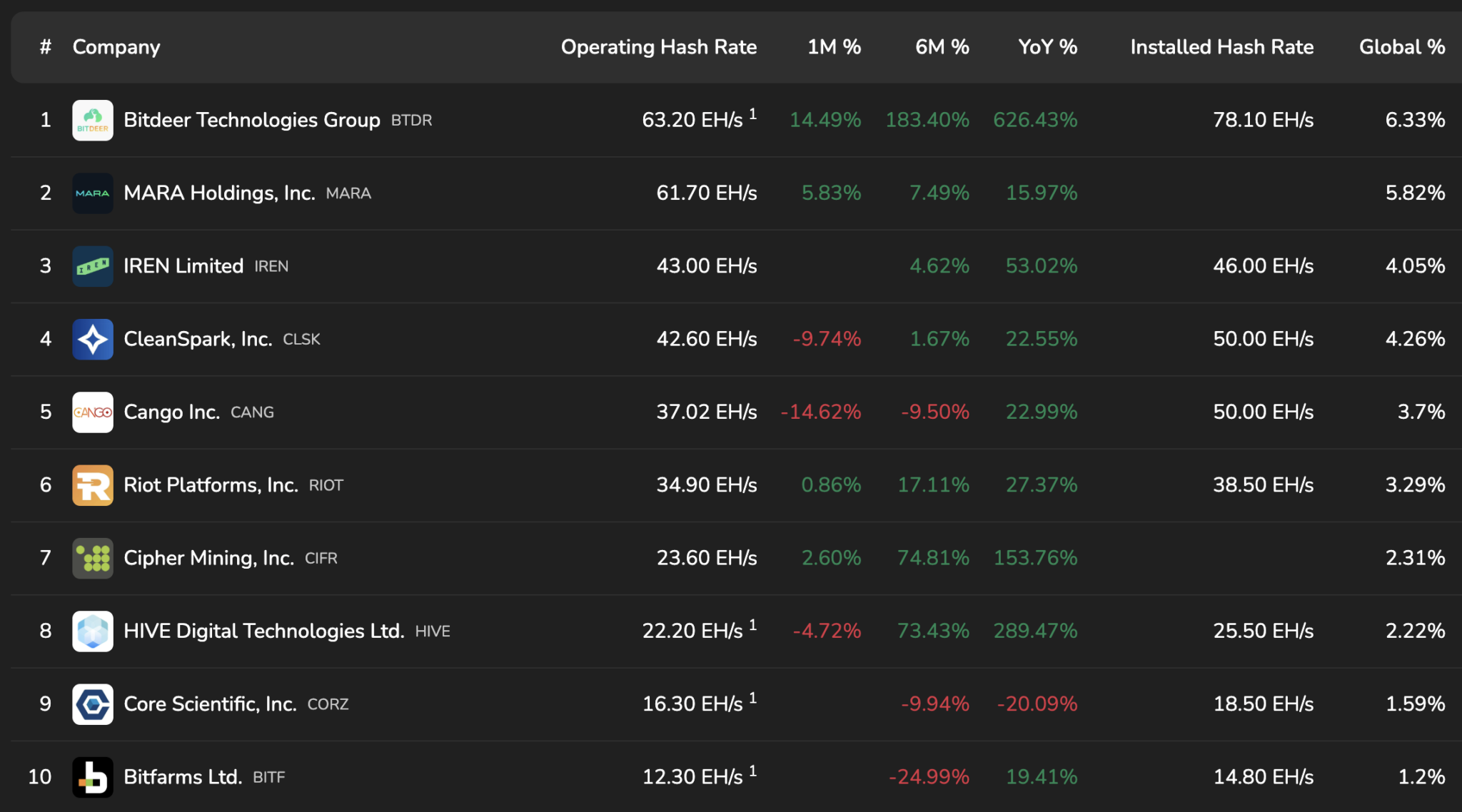
Bitcoin hashrate ranking
Source: bitcoinminingstock.io
Bitdeer’s buffer has been wiped out in one go—raising a question: What urgent need for cash drove this miner? And how does it view the next quarter?
In mining, bills arrive in fiat—electricity, hosting fees, salaries, parts—while revenue arrives in BTC. Thus, every treasury policy is, at its core, a statement about timing, risk, and access to capital.
This week’s report carries a second layer of meaning. Bitdeer’s balance sheet still showed substantial BTC holdings at year-end—its December 31, 2025 announcement disclosed “Bitcoin held: 2,017 BTC.”
Going from a four-digit holding to a weekly update showing zero tells a story about pace, cash conversion, governance models, and the entire evolving nature of mining as a business constantly reshaping itself.
Collectively, this week’s report presents a company actively choosing certainty—converting a shrinking (USD-denominated) reserve into operational liquidity and adjusting its risk exposure to resemble that of a utility rather than a BTC hoarder. This is where the term “capitulation” enters: it describes what happens when profit margins approach red-line thresholds—the treasury shifts from strategic reserve to fuel.
On a weekly basis, Bitdeer sold approximately 1,132.9 BTC (943.1 from reserves plus 189.8 newly mined). Using Bitdeer’s Mining Insights page range of $60,000–$70,000 per BTC, this represents roughly $68–79 million in liquidity—enough to materially impact a miner’s cash cycle and enough to signal a decisive shift in posture.
A single line on the treasury meets the financing calendar
This BTC sale coincided with what appears to be a deliberately orchestrated capital markets move. Bitdeer announced the pricing of an upsized $325 million, 5.00% coupon, 2032-maturity convertible preferred note, alongside a registered direct offering priced at $7.94 per share.
Proceeds are expected to fund: a capped call transaction (for hedging), the repurchase of $135 million in 2029 convertible notes, and expansion of data centers, HPC and AI operations, ASIC R&D, and working capital.
This sequence reveals where capital wants to go—and the level of risk the company is willing to bear along the way.
Convertible bonds and hedging options are financial conduits—they package volatility, trading upside for survival space, aiming to keep gears turning even when revenue is gasping for air. A miner completing financing and debt restructuring in the same window it empties its BTC balance sheet signals a preference for controllable funding channels and for building infrastructure capable of generating sustained orders, hash rate, and contracts.
This logic fits the broader 2026 narrative—miners increasingly positioning themselves as “energy-to-compute” enterprises, with Bitcoin as one revenue stream and AI and HPC as another capital-intensive destination.
VanEck’s 2026 outlook holds that this transition brings both opportunity and pressure—and anticipates industry consolidation as balance sheets absorb growth costs.
Hashprice sets the rhythm; forward curves set expectations
Mining failures rarely end with a bang—they unfold through drift, tightening, and a series of small decisions that ultimately converge into one large decision. The industry’s profit margin gauge is hashprice—the USD-denominated revenue per unit of hash rate—and recent readings explain why treasuries must be monetized.
Luxor’s latest Hashrate Index report places the USD hashprice at $34.05 per PH/day, down ~4% week-on-week, noting that current hashprice sits near breakeven for many miners—depending on their cost structure and hardware mix.
Forward market pricing shows an average of ~$28.73 per PH/day over the next six months—a lower expectation that exerts gravitational pull on every treasury policy.
Difficulty is the second dial—it adjusts the denominator. It can swing sharply when weather, outages, or grid constraints take miners offline.
Bitcoin recently experienced a record 11.16% difficulty drop to 125.86T, followed by a record rebound to 144.40T. The next adjustment is expected to decline in early March. For miners planning capex and liquidity on weekly and monthly timelines, this pattern feels like whip-lash.
Bitdeer’s own dashboard reflects the same reality—listing network hash rate at ~1,022 EH/s and difficulty at ~144.4T, with “revenue per terahash per day” shown at $0.0289. Miners must survive within the space defined by these numbers—and choose where to absorb volatility: treasury, debt stack, or growth plans.
Capitulation arrives first in accounting entries, then in consolidation
When traders talk about “capitulation,” they imagine a waterfall—a sudden flush that zeroes out ledgers. Mining capitulation often arrives in ledger entries and financing terms: selling BTC, cutting reserves, pricing convertible bonds, issuing equity, and weaker operators merging or shutting down.
Bitdeer’s actions this week align with a narrative where treasury liquidation serves as a financing bridge—converting BTC into cash to support larger-scale construction and debt-structure reengineering. This includes channeling proceeds into hedging (capped call), repurchasing existing convertible notes, and funding data center expansion, HPC and AI operations, ASIC R&D, and working capital. Companies following this script treat BTC not as a speculative asset but as inventory convertible into concrete, chips, and contracts.
Luxor’s Hashrate Index forward-market pricing (~$28.73 per PH/day) implies ongoing margin pressure—and such pressure typically pushes miners toward one of three exits: sell BTC, sell equity, or sell the business itself.
VanEck’s outlook characterizes 2026 as an integration phase, directly pointing to financing choices—dilutive convertibles, treasury sales amid weak prices, and divergence between operators able to run both Bitcoin mining and AI compute rails versus those managing only one.
That’s why Bitdeer’s treasury liquidation may be the canary in the coal mine. This event is both a case study and a warning label. Miners can maintain BTC exposure via ongoing operations while holding fewer actual coins; they can also reposition themselves as infrastructure companies, shifting BTC price risk elsewhere for management.
If the entire industry repeats this transaction, the number of miners hoarding BTC on balance sheets will shrink—and miner cash flows will become more sensitive to short-term profitability.
What to watch next
First, policy continuity. A one-week liquidation could reflect timing; a multi-month pattern signals a new treasury doctrine. The most telling signal will be updates over the coming weeks—the same line “BTC held,” reported separately from customer deposits.
Second, cost of capital. Convertible bond and equity financing terms reveal how this company is building survival space—and when hashprice tightens, that survival space becomes a competitive weapon. Under stress, lower-cost financiers buy time; higher-cost financiers sell BTC, sell equity, sell assets.
Third, margin context. Luxor’s Hashrate Index places hashprice near breakeven for many miners; sharp difficulty swings show how quickly the denominator can move—while the network remains in flux. Miners build on these shifting foundations; their treasuries serve as shock absorbers.
The cleanest reading of this week is procedural: miners follow incentives—and those incentives flow through hashprice, difficulty, and financing terms.
Bitdeer turned reserves into cash—and did so in the same week it adjusted its capital structure and clarified spending priorities: data centers, HPC, AI, and ASICs.
The industry can absorb one company emptying its treasury—but it must also confront the emerging pattern: a mining ecosystem that treats BTC as throughput rather than hoard, and manages balance-sheet exposure as an adjustable dial calibrated against operational cost requirements.
Join TechFlow official community to stay tuned
Telegram:https://t.me/TechFlowDaily
X (Twitter):https://x.com/TechFlowPost
X (Twitter) EN:https://x.com/BlockFlow_News
 @CryptoSlate