From Fragmented Components to the Super Layer
TechFlow Selected TechFlow Selected
From Fragmented Components to the Super Layer
Platformization of protocols is now advancing in a “strategic” manner.
 Navigating Web3 tides with focused insights
By: JayLovesPotato
Translated by: Block Unicorn
Over the past few days, a series of protocol announcements—and comments from Vitalik—have reignited discussions around decentralized social media. Though these events may appear isolated, taken together they clearly indicate that protocol platformization is now advancing in a “strategic” manner.
1. The News and Its Strategic Context
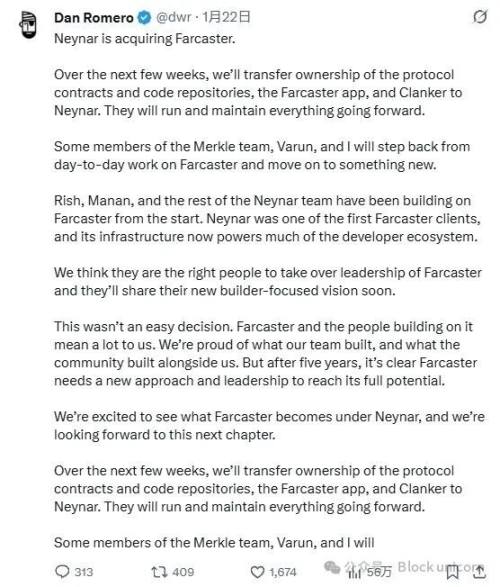
Last Wednesday, Dan Romero, co-founder of the decentralized social platform Farcaster, announced that Neynar—one of Farcaster’s earliest and most influential clients—will acquire Farcaster. As part of this transition, ownership of the protocol’s smart contracts, core codebase, official applications, and even Clanker will be transferred in stages. Meanwhile, Romero noted that the founding team will step back from day-to-day operations to focus on new projects.
This decision appears to reflect an increasingly shared internal consensus at Farcaster: the long-term sustainability of a social protocol depends less on continuous iteration at the protocol-design level and more on the increasingly specialized infrastructure and operational execution capabilities required at this stage.
In practice, this means control naturally shifts toward infrastructure providers who have already successfully aggregated developer resources and traffic—Neynar, for instance, has emphasized since 2024 the cost and complexity of running Farcaster’s centralized servers, abstracting those challenges into API and infrastructure layers so developers can focus on product development rather than wrestling with protocol internals.
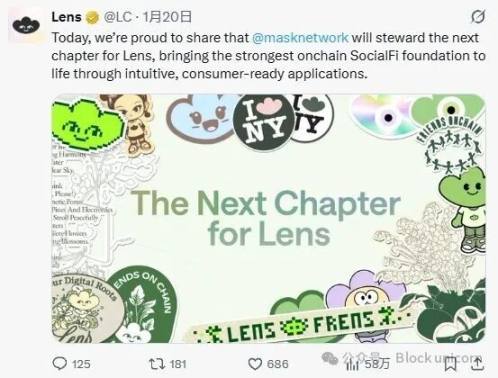
By contrast, Lens has adopted a more advanced—though conceptually aligned with Farcaster—approach. With its comparatively richer tooling, resources, and mature user base, Lens has chosen to push further along the operational axis.
On January 20, 2026, Lens Labs officially announced that Mask Network will assume the role of “steward” for Lens’s next phase, shifting the project’s focus from infrastructure development to consumer-facing products. Mask stated that this move aims to translate the protocol’s proven achievements into mass-market-ready experiences.
Notably, both Lens and Aave emphasized that this transition does not involve changes to ownership, financial structure, or governance. The focus is not on acquisition per se, but on the explicit reallocation of responsibility—specifically, who will be responsible for turning the protocol into something people actually use daily.
2. Platformization Hinges on Clear Role Division
From a broader perspective, both cases point to the same conclusion: as protocols evolve into platforms, the critical requirement is no longer adding more features—but rather clearly delineating roles and responsibilities—that is, how to efficiently optimize the full operational stack required by a platform, including infrastructure resources, developer onboarding tools, distribution capabilities, and more.
Viewed from a wider lens, both cases converge on a common insight: as protocols mature into platforms, the key need is not feature proliferation, but clear role and responsibility delineation—i.e., how to efficiently optimize the full operational stack required by a platform, encompassing infrastructure resources, developer onboarding tools, distribution, and so forth.
Neynar’s core value within the Farcaster ecosystem lies in standardizing social data and user behavior via APIs. Neynar enables developers to begin product experimentation immediately, without grappling with centralized operations or protocol-level complexities. Thus, this acquisition marks Neynar’s entry into its next phase—strengthening Farcaster’s development and operations layer by integrating the protocol itself.
Lens, though following a different developmental path, ultimately arrives at a similar framework. With Lens Chain and V3 having established foundational infrastructure, the next challenge is no longer building more protocols—but delivering consumer experiences people genuinely use daily. The collaboration with Mask Network is precisely intended to bridge that gap.
3. The Battle for the “Super Layer”
In fact, protocol integration and consolidation is nothing new. Since around 2025, similar patterns have emerged across Web2 and Web2.5. Wallet providers, crypto payment firms, exchanges, and infrastructure providers have increasingly sought to integrate adjacent services—or pursue acquisitions—to achieve vertical expansion and build what’s known as the “super layer.”
Yet the most important factor is not the breadth of functionalities these players attempt to bundle. Rather, the decisive shift lies in how deliberately they design integrations—carefully selecting which technology stacks and operational platforms to consolidate, based on clearly defined target audiences.
The Neynar–Farcaster and Mask–Lens cases demonstrate that the Web3 ecosystem is also moving beyond the era of loosely connected, experimental protocols and entering an age of large-scale network ecosystems—where organization, operations, and technology are tightly interwoven. Even in domains committed to building an open internet, Web3 product teams long constrained by founder-centric, semi-closed structures now confront a competitive reality: independent team structures, clear responsibility allocation, and sustained product operation capability are no longer optional—they are essential.
Looking ahead, market dynamics around super-layer construction—spanning both Web2 and Web3—may become increasingly strategic—and more fiercely contested.
Join TechFlow official community to stay tuned
Telegram:https://t.me/TechFlowDaily
X (Twitter):https://x.com/TechFlowPost
X (Twitter) EN:https://x.com/BlockFlow_News
 @JayLovesPotato