A Letter to China's Crypto OGs: Don't Let the Casino Devour the Cathedral
TechFlow Selected TechFlow Selected
A Letter to China's Crypto OGs: Don't Let the Casino Devour the Cathedral
If Chinese crypto institutions and capable participants can achieve breakthroughs in feedback mechanisms, they may become a pivotal force in transforming the ecosystem.
 Navigating Web3 tides with focused insights
Author: Jocy @IOSG
Part 1: Who Stays? More Importantly, Why?
Last year, I published a tweet on AI and crypto talent mobility. One commenter noted: “It’s great that top talent is moving into AI—it lets them participate in building an inevitable future.”
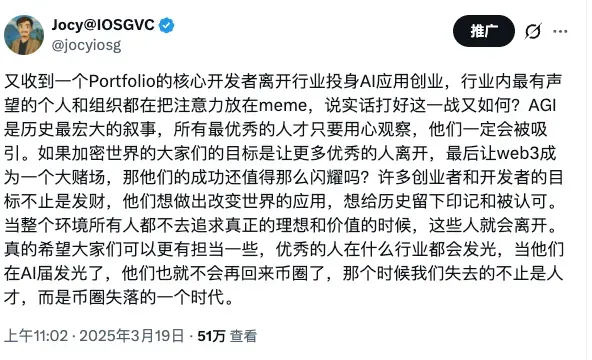
Yet a recent podcast conversation made me realize this view isn’t deep enough. The question isn’t just *who stays*, but more fundamentally *why they stay*—and whether the ecosystem can sustain a revolution. Only those who remain in the industry through bull and bear cycles, failures, and the friction between reality and ideals—and continue building—are positioned to lead crypto’s revolution.
Over the past few months, I’ve spoken with numerous crypto founders active between 2023 and 2025. Many Chinese teams raised only $5–7 million around 2023; in today’s environment, raising a follow-on round is extremely difficult. That runway lasted just over two years—bringing them to where they are now: stumbling onto exchanges. Countless airdrops and distributed tokens flooded the market, driving token prices steadily downward. Founders’ deliverables? Tokens nearing zero value and reputational damage within crypto—followed by their departure.
Looking back across Asia, fewer and fewer investors are willing to support early-stage founders. Without investor backing, few determined founders will re-enter crypto—and without them, industry-wide progress stalls. So how can the U.S. and China compete in the crypto arena?
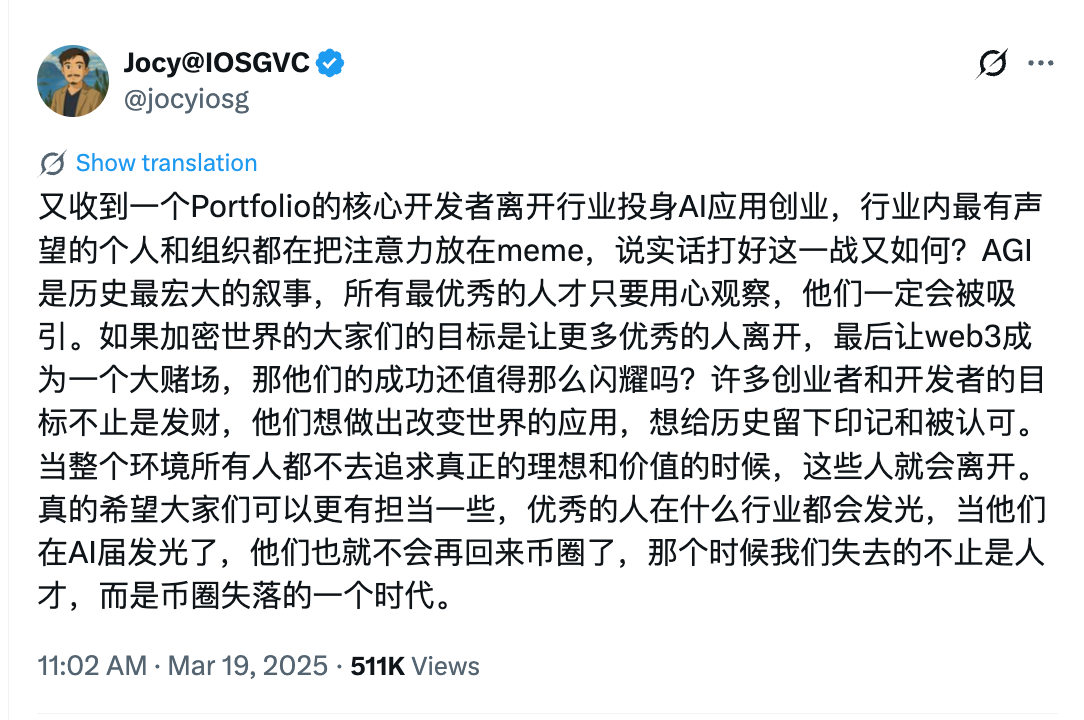
Last April, I tweeted about a portfolio company’s core team pivoting to AI application startups—a sign that even the industry’s most respected talent was leaving. Today, that trend has only accelerated. This isn’t coincidence; it reflects a deeper systemic issue: after making money, U.S. and Chinese crypto OGs chose radically different paths.
Part 2: How U.S. OGs “Fund the Cathedral”
What do U.S. crypto OGs think about after achieving financial success?
Brian Armstrong: After taking Coinbase public as America’s first mainstream crypto exchange, he founded the Research Hub—an initiative aimed at fundamentally reshaping scientific research incentives. This isn’t mere philanthropy; it’s a systemic redesign of knowledge production.
Naval Ravikant: An early Bitcoin philosopher, Naval not only promoted ICOs via AngelList and championed Bitcoin as a global crowdfunding tool—but also incubated CoinList to provide compliant token issuance infrastructure and funded the Zcash team. His ideas on money, cryptoeconomics, and decentralization have profoundly shaped the entire industry.
Chris Dixon: In 2013, he led Coinbase’s Series B round—the first major VC to publicly go all-in on crypto. He grew a16z Crypto from $300 million in 2018 to over $7 billion today—not just investing, but launching a crypto school to systematically cultivate industry talent.
Dan Robinson: At Paradigm, he’s both investor and builder. He contributed to Uniswap’s early development and co-authored Uniswap V3; helped pioneer modern MEV auction models during Flashbots’ formative phase; conducted foundational Plasma research (a precursor to modern rollups); and led Optimism’s seed round. This depth of technical involvement and intellectual contribution defines true ecosystem building.
Michael Saylor: Transformed MicroStrategy into Strategy, accumulating $67 billion worth of Bitcoin—over 3% of total circulating supply—using innovative financing like stock issuances and low-interest bonds. He’s become the iconic figure behind Bitcoin’s institutional adoption.
Barry Silbert: Founded Digital Currency Group (DCG) and launched the Grayscale Bitcoin Trust (GBTC), creating the primary channel for traditional investors to gain Bitcoin exposure. His subsidiaries Genesis Trading and CoinDesk have become essential industry infrastructure.
Chainlink: Founder Sergey Nazarov, formerly a Google software engineer, invented the decentralized oracle network in 2017. Chainlink now supports over $7 trillion in transaction volume. Long financially independent after multiple market cycles, Nazarov still personally travels to Hong Kong and elsewhere to promote Chainlink standards—driving CRE-based unification of DeFi and traditional finance, and building a global “internet of contracts” ecosystem.
Rune Christensen: After encountering Bitcoin in 2011, he sold his English-teaching recruitment business in China to dive full-time into crypto. In 2015, he founded MakerDAO and launched DAI—the first and largest decentralized stablecoin on Ethereum. For over a decade, he’s remained on the front lines of DeFi governance; recently rebranded MKR as Sky and launched Spark Protocol, integrating DAI with U.S. Treasuries—making him a pioneer bridging crypto and traditional finance.
Arthur Hayes: Founded BitMEX and introduced perpetual futures, bringing traditional financial derivatives into crypto markets. His funding rate mechanism became an industry standard. After being fined in 2022 for violating the Bank Secrecy Act—and later pardoned by Trump—he co-founded Ethena, a stablecoin protocol, with Guy. For years, Arthur has consistently shared his crypto insights, never pausing.
What do these figures share? After earning wealth, they don’t ask “how do I exit?” but rather: “How do I attract the world’s best talent? How do I build world-changing applications? How do I create systemic, sustainable ecosystem support?” They’re not just investors—they’re builders, thought leaders, and public-good contributors.
Part 3: Systemic Challenges Facing Chinese Crypto OGs
In contrast, China’s crypto community faces fundamental policy constraints that limit long-term commitment. Most Chinese OGs, after early success and some wealth accumulation, choose exit—not reinvestment.
A missing historical narrative. U.S. crypto began with a grand “change-the-world” narrative—one rooted in America’s longstanding tradition of public-good investment, dating back to Carnegie and Rockefeller. China lacks comparable cultural foundations.
We lack systematic talent development mechanisms (unlike U.S. crypto schools), long-term investment in crypto talent and infrastructure (unlike Y Combinator / AllianceDAO or Research Hub), and sustained intellectual output and industry influence (unlike Paradigm’s research-driven ethos or Naval’s philosophical impact).
This isn’t a moral failing—it’s a systemic problem arising from absent historical narratives, policy uncertainty, and cultural differences.
What does this difference produce?
Many founders and developers seek more than wealth—they want to build world-changing applications and leave a recognized legacy. Any top talent paying close attention simply won’t return.
When Web3 is reduced to one giant casino—and when the industry’s dominant narrative regresses from “changing the world” to pure wealth extraction—the best talent votes with their feet. It’s not that they reject profit; they seek *meaningful profit*: reward earned through value creation—not zero-sum extraction.
When no one around pursues genuine ideals or values, those people leave. Narrative isn’t abstract—it directly shapes talent composition. When an industry fails to offer a compelling vision and value recognition, even massive financial incentives cannot retain value-driven talent.
What we see today is a vicious cycle:
No new value creation → Markets forced into zero-sum competition over existing value → Zero-sum dynamics reinforce speculative mindsets → Drive away those seeking incremental innovation → Even less value creation → Markets grow increasingly dependent on zero-sum competition
This is the essence of China’s current crypto “speculation era.”
Part 4: Even Under Constraints, Sparks Can Ignite a Prairie Fire
Some may say: “Contexts differ—we shouldn’t compare directly.” That’s fair. I’m not demanding Chinese OGs replicate exactly what U.S. OGs do.
Others might argue: “Even if we want to act, our impact would be minimal—so why bother?” Yet I believe small actions—even under constraints—matter: supporting open-source developers, hosting technical community events, investing in early-stage tech startups. These efforts compound over time.
Still others claim: “Overemphasizing idealism is hypocritical—crypto is financial innovation.” But this isn’t binary. A healthy ecosystem requires a critical mass of value-driven participants. If purely financial motives dominate, the system inevitably collapses into zero-sum games—harming everyone long-term. This isn’t moralizing; it’s enlightened self-interest.
IOSG’s past investors include exchanges, miners, early crypto OGs, and traditional funds. I believe many Chinese OGs deeply embrace idealism and heroism—and remain committed to pushing this industry forward. Especially given crypto’s immense difficulty—particularly in China—they continue supporting and helping the industry.
Sparks can ignite a prairie fire. We too can build a powerful, self-reinforcing crypto ecosystem—equal in strength to America’s.
# Part 5: The Cathedral vs. The Casino: Buffett’s Warning
Warren Buffett used this metaphor to describe American capitalism: *“In the next hundred years, make sure that the cathedral is not overtaken by the casino.”* It applies equally to crypto:
Cryptocurrencies and blockchains have achieved unprecedented success. They constitute a magnificent cathedral—a new economic system unlike anything the world has ever seen. Alongside it stands a massive casino.
The temptation is enormous—especially now—to walk straight into that casino. There, people play enthusiastically; money flows freely. But you must ensure the cathedral remains funded.
Over the next century, crypto must ensure its cathedral isn’t consumed by the casino.
Bitcoin and Ethereum’s cathedrals remain majestic and awe-inspiring. Some exchanges’ casinos host nightly revelry. But if casino profits don’t feed the cathedral, that structure—which creates real value—will gradually decay, and the entire ecosystem will lose its foundation.
What Brian Armstrong, Vitalik, and Chris Dixon do is, at heart, fund the cathedral. They ensure the casino’s prosperity doesn’t devour the cathedral.
Part 6: Long-Termism’s Only Path
Returning to my judgment from months ago, I now add deeper insight:
Those who endure bull and bear cycles *can* lead revolution—but merely “staying” isn’t enough. What matters more is *why they stay*, and whether the ecosystem can sustain revolution.
Revolution requires full ecosystem support. U.S. crypto’s sustained growth isn’t due to greater endurance—it’s because it built systemic feedback loops enabling continuous self-renewal and evolution.
As an institutional investor, IOSG will continue proactively assuming responsibility for change:
* Systematically invest in more early-stage startups—even when short-term returns are unclear
* IOSG’s Entrepreneur-in-Residence (EIR) program will support and fund founders struggling with fundraising, building stronger talent pipelines
* Consistently publish and share frontline industry research and insights
* Prioritize long-term value creation—not short-term hype—in investment decisions
We must redefine success: wealth transfer in zero-sum games versus wealth creation through genuine value generation. The numbers may look identical—but their meaning is entirely different.
If Chinese crypto institutions and capable participants break new ground in building feedback mechanisms, they could become pivotal forces transforming the ecosystem. This isn’t just moral duty—it’s rational long-term interest. Only a healthy ecosystem can incubate great projects, attract top talent, and generate sustainable value.
This is true long-termism—and the only path ensuring the cathedral survives the casino.
Join TechFlow official community to stay tuned
Telegram:https://t.me/TechFlowDaily
X (Twitter):https://x.com/TechFlowPost
X (Twitter) EN:https://x.com/BlockFlow_News
 @JinzhouLin