Viral post from overseas: How to rebuild your messed-up life in one day?
TechFlow Selected TechFlow Selected
Viral post from overseas: How to rebuild your messed-up life in one day?
The only measure of wisdom is whether you can get what you want from life.
 Navigating Web3 tides with focused insights
Author: DAN KOE
Translation: TechFlow
If you're like me, you probably find New Year's resolutions a bit "silly."
Because most people go about changing their lives in completely the wrong way. They set these New Year goals simply because everyone else is doing it—we give them superficial meaning to fit into society’s “status games.” Yet these goals rarely meet the deeper conditions necessary for real transformation, which is far more complex than merely convincing yourself to “be more disciplined and productive this year.”
If that's you, I'm not trying to criticize (though my tone might come off as direct). In fact, I've abandoned far more goals than I’ve achieved, and I suspect most people are the same. But one thing is certain: people try to change their lives, yet almost always fail.
Still, even though I think New Year's resolutions are somewhat silly, reflecting on the life you dislike—and using that to propel yourself toward a better future—is always wise. Let’s dive into that topic now.
Whether you want to start a business, transform your body, or pursue a more meaningful life without quitting two weeks later, I want to share with you seven fresh ideas about behavior change, psychology, and productivity—perspectives you may have never heard before—that can help you truly break through in 2026.
This will be a comprehensive exploration.
This isn’t an article you’ll casually skim and forget.
This is something you’ll want to save, take notes on, and even set aside dedicated time to deeply reflect upon.
At the end, I’ll also provide a complete action plan to help you explore your inner world and uncover the life you truly desire. The process takes about a day—but its impact will last far beyond that.
Let’s begin!
Why haven’t you reached your ideal state? Because you’re not yet the person who could get there
When setting big goals, people usually focus on only one of two essential conditions for success:
- Change your actions to move toward the goal (secondary, second-level)
- Change yourself so your behaviors naturally align with the goal (primary, first-level)
Most people set surface-level goals, hype themselves up, force discipline for a few weeks, then effortlessly fall back into old habits. The reason? They’re trying to build a beautiful life on a rotten foundation.
If this isn’t clear yet, let’s illustrate with an example.
Imagine a successful person—a bodybuilder with a perfect physique, a founder/CEO worth hundreds of millions, or someone charismatic who speaks confidently in groups without anxiety.
Do you think the bodybuilder needs to “try hard” to eat healthily? Does the CEO force himself to show up at work every day? From your perspective, it might seem so. But the truth is, they literally cannot imagine living any other way. For them, eating unhealthily would require effort; staying in bed when they should be leading their team would take coercion—and they hate every second of it. (Of course, there are nuances, but follow my point here.)
To some, my own lifestyle might seem extreme or overly disciplined. But to me, it feels perfectly natural. I’m not comparing my lifestyle to anyone else’s—I simply enjoy this way of living. When my mother tells me to rest, go out, relax, I often hold back from saying, “If I don’t enjoy it, why would I do it?”
The next sentence may sound simple, yet bafflingly, many fail to truly grasp it:
If you want a specific outcome, you must live the kind of life that creates that outcome—before you actually achieve it.
When someone says they want to lose 30 pounds, I often don’t believe them. Not because I think they can’t do it, but because I’ve heard too many say: “I can’t wait to finish losing weight so I can finally enjoy life again.”
I’m sorry to burst your bubble, but unless you make a radical shift in your lifestyle—one that becomes a lasting habit—and find a reason more compelling than your current way of living, you’ll eventually return to square one. And then, all you’ll have left is regret over wasted resources you can never reclaim: time.
When you truly change, all habits that don’t serve your goals become repulsive, because you deeply understand how those behaviors accumulate into a certain kind of life. The reason you currently tolerate your standards is that you haven’t fully realized what they are or where they lead. We’ll discuss how to reveal this later—but first, we need to gradually build awareness.
You say you want to change, that you want “financial freedom” or “to be healthy,” but your actions suggest otherwise. There’s a deeper reason behind this—far more complex than you imagine.
Why haven’t you reached your ideal state? Because you don’t really want to go there
"Believe in action. Life happens on the level of events, not words. Believe in action."
— Alfred Adler
If you want to change yourself, you must first understand how the human mind works—and begin reshaping it.
The first step in understanding the mind is realizing that all behavior is goal-oriented. Human actions are teleological. At first glance, this seems obvious, but when explored deeply, most people refuse to face this truth.
You take a step forward because you want to go somewhere.
You scratch your nose because you want to stop the itch.
These examples are intuitive. But in reality, your goals are often subconscious. For instance, when you’re lounging on the couch during the day, you might not realize your actual goal is just killing time until the next task arises.
At a deeper unconscious level, you might even be pursuing self-sabotaging goals, while justifying your behavior in socially acceptable ways to avoid appearing like a failure.
For example, if you constantly procrastinate, you might explain it as “lacking discipline,” but you’re still pursuing a goal—perhaps protecting yourself from potential criticism or judgment after completing the work.
Or if you say you want to quit a dead-end job but take no action and stay put, you might believe you lack courage or aren’t a “risk-taker by nature.” But the real reason could be that you’re chasing security, predictability, or giving yourself an excuse to avoid looking like a failure in front of those who equate “stable jobs” with success.
The lesson: real change requires changing your goals.
I don’t mean setting a surface-level goal—because that act itself might serve a hidden, potentially harmful subconscious goal. The productivity space has discussed this endlessly. What I mean is changing your perspective. Because at their core, goals are perspectives. A goal is a projection into the future—a perceptual lens that helps you notice information, ideas, and resources that support that goal.
We’ll go deeper, because if you don’t understand this, breaking free from your current state will only grow harder.
Why haven’t you reached your ideal state? Because you’re afraid to get there
"What matters is not how you got an idea, or where it came from, but that once you accept it and believe it to be true, it affects you as powerfully as a hypnotist affects a subject."
— Maxwell Maltz
Here’s how you became who you are—and how you’ll become who you’re meant to be. This is the mechanism of identity formation:
- You aim for a goal.
- You perceive reality through the lens of that goal.
- You only notice information and ideas relevant to achieving it (learning).
- You act toward the goal and use feedback to sense progress.
- You repeat these behaviors until they become automatic and subconscious (conditioning).
- These behaviors gradually shape your self-concept (“I am a ___ kind of person”).
- To maintain psychological consistency, you defend your identity.
- Your identity shapes new goals—the cycle restarts. If this identity doesn’t support a fulfilling life, things deteriorate quickly.
Unfortunately, you must break this loop between steps 6 and 7—and this pattern began in childhood.
As a child, your primary goal was survival.
You depended on parents to teach you how to survive, so you had to comply. Since most parenting relies on rewards and punishments, you likely adopted their beliefs and values to avoid punishment. Until you see this clearly, you won’t truly think for yourself.
But here’s the problem: your parents went through the same process. If they never broke the cycle, their thinking was likely shaped by industrial-era views of success—and they inherited their parents’ strengths and flaws.
Going deeper: once basic physical survival is met (in today’s world, this is usually easy—you’re born relatively safe), you begin seeking “survival” on a conceptual or ideological level. You may no longer protect your body, but you fiercely defend your ideas. The internet’s “war of opinions” is a prime example—driven by individual and group identity.
When your body feels threatened, you enter “fight or flight” mode.
When your identity feels threatened, the same thing happens.
If you strongly identify with a political ideology (via the identity-formation process above), challenging your beliefs feels like a personal threat. You feel stress, emotionally as if you’ve been “slapped.” Since most people don’t analyze whether their emotions are rational, you may retreat into echo chambers, stubbornly defending your stance—even when both self and others suffer.
If you grew up in a religious household without independent thought, threatening your psychological safety in that circle triggers instinctive attacks and counterattacks.
Similarly, if subconsciously you define yourself as a lawyer, a gamer, or someone unwilling to act for a better life, the same dynamic occurs.
The life you want depends on your level of consciousness
The human mind evolves through predictable stages over time.
At birth, you’re a “survival sponge,” absorbing any belief (deeply influenced by culture) to feel safe and secure. But if you’re not careful, your mind can “harden,” making a meaningful life difficult.
Many theoretical models have studied this in depth: Maslow’s Hierarchy of Needs, Greuter’s Ego Development Theory, Spiral Dynamics, and Integral Theory—all complementary. These patterns are also easily observable in society.
I’ve discussed and synthesized these into my own “Human 3.0 Model,” combining various AI prompts to reveal your developmental stage and next growth path (feel free to open a new tab later). But for now, let’s review the “80/20 rule” of the nine-stage model—grasping the core 20%—since repetition reveals overlooked details and gives new readers context:
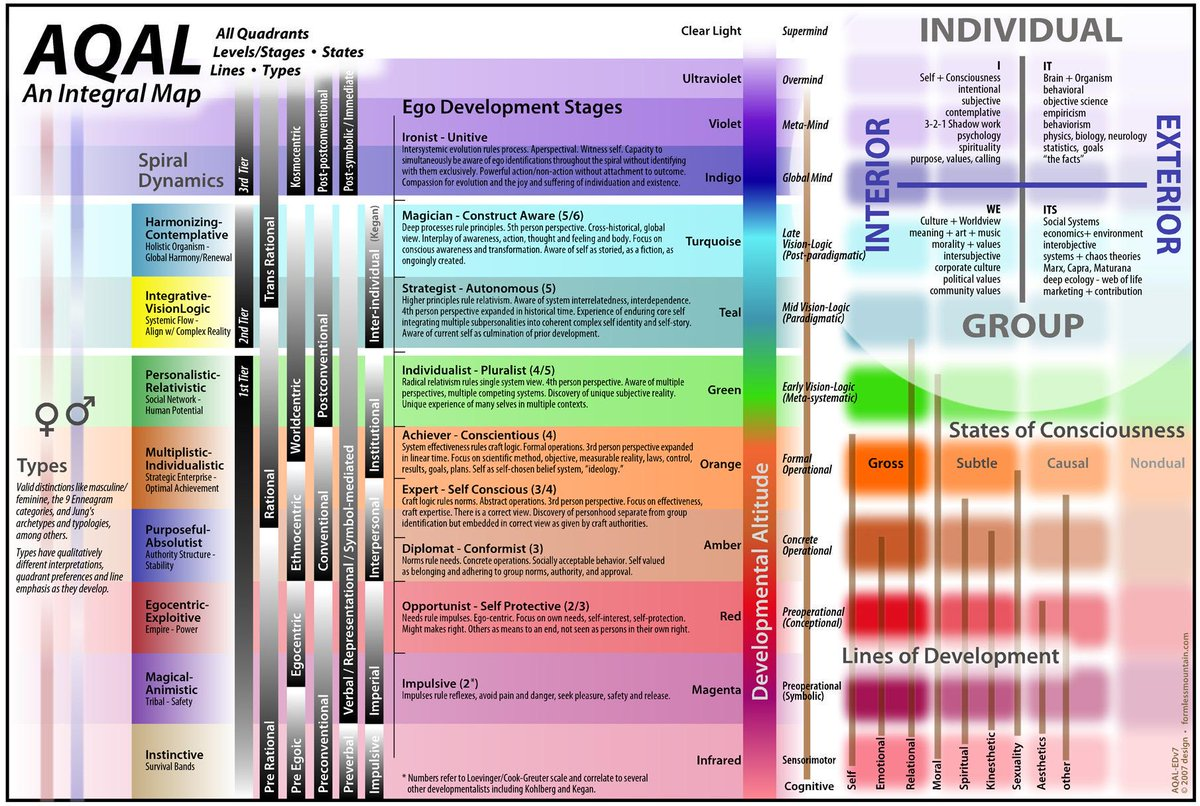
Here’s a brief overview of the nine stages of self-development to help you understand your current state and potential growth path:
- Impulsive Stage
No separation between impulse and action; thinking is black-and-white.
Example: a child hits someone when angry, because emotion and behavior are one and the same.
- Self-Protective Stage
Views the world as dangerous and learns to protect oneself.
Example: a child hides report cards, lies about chores, or says what adults want to hear.
- Conformist Stage
Fuses identity with the group; group rules are seen as absolute reality.
Example: someone cannot fathom why anyone would vote for a candidate different from their family or group.
- Self-Aware Stage
Begins noticing a disconnect between inner experience and outer expression.
Example: sitting in church, suddenly realizing you’re unsure whether you believe what others around you do—but not knowing how to handle the feeling.
- Conscientious Stage
Begins building personal principles and taking responsibility for oneself.
Example: after deep reflection, deciding to leave the family religion for a personally defensible philosophy; or creating a clear career plan because you believe right effort leads to right results.
- Individualist Stage
Begins recognizing that personal principles were shaped by environment, thus becoming more open-minded.
Example: realizing your political views stem more from upbringing than objective truth; or discovering your ambitious career goals were really about gaining your father’s approval.
- Strategist Stage
Can operate within systems while recognizing being part of them.
Example: leading an organization while actively examining your blind spots; or engaging in politics knowing your view is partial and influenced by invisible biases.
- Construct-Aware Stage
Sees all frameworks—including identity—as useful fictions.
Example: holding spiritual beliefs metaphorically, not literally, understanding “the map is not the territory”; or viewing your role as “founder” or “thought leader” with gentle humor.
- Unitive Stage
The separation between self and life dissolves.
Example: work, rest, and play feel like the same thing; no need to “be someone”—only natural responses to the present moment.
Most readers are likely between stages 4 and 8—a vast range.
- Those near stage 8 may read this to learn or pass time non-disruptively.
- Those near stage 4 may genuinely seek change—they feel destined for more but don’t yet fully understand everything, as many complex factors still influence them.
The good news: regardless of your stage, the path forward follows predictable patterns.
The essence of wisdom: the ability to achieve life goals
"The only metric for wisdom is whether you can get what you want from life."
— Naval Ravikant
Success isn’t random—it follows a formula composed of three key elements:
- Agency
- Opportunity (often mistaken for “privilege,” ignoring other factors)
- Intelligence
All three are essential:
- High agency without opportunity: no matter how hard you try, your goal may lack enough value to yield results.
- Opportunity and agency without intelligence: even with chances available, you won’t know how to use them.
We’ve covered agency before. As for opportunity, I can’t change your geography—but if you fail to see the endless digital-age opportunities before you, I can’t help further.
Now, let’s focus on intelligence within this triad. For this, we turn to cybernetics.
“Cybernetics” comes from the Greek “kybernetikos,” meaning “steersman” or “skilled in steering.”
It’s also known as “the art of achieving goals.”
If wisdom, per Naval’s definition, is “the ability to get what you want from life,” then understanding cybernetics accelerates this ability.
Cybernetics reveals the traits of intelligent systems:
- Have a goal
- Take action toward the goal
- Perceive current position
- Compare current state to goal
- Act again based on feedback
This loop is not only central to cybernetics but to intelligence itself. Wisdom lies in continuous adjustment—using feedback to correct course and achieve goals.

Wisdom can be judged by a system’s ability to iterate and persist through trial and error.
Examples:
- A ship adjusts its course to reach its destination despite drifting;
- A thermostat turns on heating when sensing temperature drops;
- The pancreas releases insulin when blood sugar spikes.
How does this relate to achieving your life goals?
Everything is connected.
Action, perception, comparison, and meta-level understanding of system dynamics are fundamental traits of high intelligence (per our definition).
High intelligence means iterating relentlessly, persisting, and seeing the big picture. Low intelligence shows up as inability to learn from mistakes.
Low-intelligence individuals get stuck on problems instead of solving them. They hit obstacles and quit. Like a writer who stops writing because they can’t attract readers—lacking the ability to experiment and find what works. Believing “no method suits me” is itself a limiting belief and a sign of low intelligence.
High-intelligence individuals know that given enough time, any problem can be solved. In fact, with enough determination, any goal is achievable.
Wisdom lies in realizing there’s always a sequence of choices leading to your goal. You understand ideas exist in layers—you can’t jump from papyrus to Google Docs overnight. Even if a goal seems impossible now, it may only be due to missing resources—resources that could be invented in a few years.
When I talk about “goals,” I’m not speaking from traditional self-help angles—though sometimes helpful. I’m approaching it from a teleological or Greek kosmic worldview: everything has purpose; everything is part of a greater whole.
Goals shape how you see the world:
- They define what you consider “success” or “failure.”
- You can “enjoy the process,” but if your goal is wrong, you’ll never truly enjoy it.
Your mind is the operating system for perceiving reality—and it’s built from goals.
For most people, these goals are “installed,” like mental software:
- Go to school;
- Get a job;
- Be easily offended;
- Play the victim;
- Retire at 65.
This well-known path doesn’t work.
To become wiser, you must:
- Reject known paths
- Dive into the unknown
- Set new, higher goals to expand your mind
- Embrace chaos and allow growth
- Study universal laws of nature
- Become a deep generalist
I know this may not match traditional definitions of wisdom, but following these steps builds extraordinary neural connections—producing what we typically call “wisdom.” Add agency, and you become successful.
This leads perfectly into our next topic.
How to launch a new life in one day?
My best life phases always followed moments when I was utterly fed up with lack of progress.
How to dig deep into your inner world?
How to realize you’re trapped in fixed mental patterns?
How to gain life-changing insights and truths?
Answer: through simple yet often painful questioning.
Questioning is the essence of thinking—and few truly question. You can tell by how people speak about topics—few demonstrate deep thought.
I offer you a comprehensive action plan—something you can run annually to reset your life and enter a phase of rapid progress. Its core is asking the right questions.
These questions span macro to micro levels:
- What you want to achieve;
- What you must do to get there;
- What immediate actions move you forward.
This takes a full day, so I recommend strict execution. Prepare a pen, paper, and an open mind.
Observing those who successfully reinvented themselves, I noticed such shifts often happen rapidly, preceded by three stages:
- Dissonance
Feeling misaligned with current life, deeply tired of stagnation.
- Uncertainty
Not knowing what to do next—either experimenting or getting lost, feeling worse.
- Discovery
Finding a true goal and making leaps—achieving in 6 months what others take 6 years to do.
Our goal: use this plan to push you to the “dissonance” tipping point, guide you through “uncertainty,” and clearly discover your true goal—so clearly that distractions fade away.
The plan is designed for one-day completion:
- Morning: Psychological excavation—reveal hidden motives.
- Daytime: Self-questioning to disrupt autopilot, deeply reflect.
- Evening: Integrate insights into a clear direction, start acting tomorrow.
Naturally, I can’t guarantee this works for everyone—each person is at a different chapter of their story. Like a book, you can’t place the climax at the beginning and expect engagement.
Part 1: Morning — Psychological Excavation: Vision & Anti-Vision
First, we create a new perceptual framework or lens for your mind.
Like growing a new shell, gradually shedding the old, adapting over time. It may feel uncomfortable at first—that’s good.
Spend 15–30 minutes (about one YouTube video—you can do it) seriously answering these questions. Don’t outsource to AI. I want you to break internal limits. If you can’t answer now, return later.
What dull, persistent dissatisfaction have you learned to coexist with?
Not deep pain, but what you’ve grown used to tolerating. (If you didn’t hate it, you’d tolerate it.)
What have you repeatedly complained about in the past year but never changed?
List your top three complaints from the past year.
- For each complaint: if someone observed your behavior (not words), what would they conclude you truly want?
- What truth about your current life would be hard to admit to someone you deeply respect?
The above questions aim to expose current-life pain. Next, transform this pain into a raw, honest “anti-vision”—a deep recognition of the life you don’t want. Use this negative energy to fuel positive action from intrinsic motivation.
Suppose the next five years remain unchanged—describe a typical Tuesday:
- Where do you wake up?
- How does your body feel?
- What’s the first thing you do upon waking?
- Who’s around you?
- From 9 a.m. to 6 p.m., what are you doing?
- At 10 p.m., how do you feel?
Now extend to ten years:
- What have you missed?
- What opportunities are gone?
- Who has lost faith in you?
- What do people say about you when you’re not present?
Imagine your life ending:
- You chose a safe path, never breaking existing patterns.
- What was the cost?
- What did you never let yourself experience, try, or become?
Now, is there someone in your life already living the future you just described?
- Someone five, ten, or twenty years ahead, on the same trajectory.
- How do you feel imagining becoming them?
To truly change, which identity must you abandon?
- Complete this sentence: “I am a ___ kind of person.”
- If you weren’t this person, what social cost would you pay?
What’s the most embarrassing reason you haven’t changed?
- A reason that makes you sound weak, scared, or lazy—not reasonable.
If your current behavior is self-protection, what exactly are you protecting?
- What’s the cost of this protection?
If you answered honestly and are at the right life stage, you’ll feel deep unease—or even disgust—toward your current life. Now, channel this energy positively. We need to create a Minimum Viable Vision, because visions, like products, start blurry but sharpen with time and experience.
Forget practicality—imagine three years ahead:
If you could snap your fingers and instantly live a completely different life—no real-world constraints—what would that look like? Describe a typical Tuesday with the same detail as the anti-vision exercise.
- Where do you wake up?
- What are you doing?
- Who’s with you?
For this life to feel natural, not forced, what beliefs must you hold about yourself?
- Complete this identity statement: “I am a ___ kind of person.”
If you were already this person, what would be the first thing you do this week?
Tomorrow morning, answer these questions seriously.
Part 2: All Day — Break Autopilot, Disrupt Unconscious Habits
Writing down questions helps, but mere recording won’t create real change.
Frankly, if you don’t break the unconscious patterns keeping you stuck, change won’t happen.
Today’s task: reflect on what you wrote in Part 1.
Beyond that, ensure you don’t forget to reflect. Take this seriously. Repeating old behaviors guarantees no life change. You must consciously force yourself to break inertia.
How to implement:
- Right now, schedule reminders or calendar events on your phone.
- Include the questions in the alerts so you can start thinking immediately.
- The more random and non-disruptive, the better.
These small “interruptions” gradually pull you out of autopilot into clearer, more purposeful living.
Throughout the day, use questions to break routine thinking and stay awake. Examples:
- 11:00 a.m.: What am I avoiding by doing what I’m doing now?
- 1:30 p.m.: If someone filmed my past two hours, what would they think I want from life?
- 3:15 p.m.: Am I moving toward the life I hate or the life I want?
- 5:00 p.m.: What am I pretending isn’t important, but actually is?
- 7:30 p.m.: What did I do today to maintain an identity, not from genuine desire? (Hint: most things you do are like this.)
- 9:00 p.m.: When today did I feel most alive? When did I feel most dead inside?
To deepen impact, schedule these during commutes, walks, or breaks—ideal for reflection.
- If I stopped caring how others see me (the identity in question 10), what would change?
- In what areas am I trading “safety” for “aliveness”?
- Tomorrow, what’s the smallest version of my ideal self I can become?
Part 3: Evening — Integrate Insights, Launch Progress Phase
If you completed the earlier steps fully, I’d be surprised if you didn’t gain at least one life-changing insight. Now, solidify these insights—integrate them into self-awareness, take action, and lay the foundation for higher consciousness.
- After today, what do you truly feel? What has kept you stuck?
- What is the real enemy?
- Name it clearly—not external circumstances or others, but the internal pattern or belief controlling you.
Write one sentence summarizing the life you absolutely refuse to live.
- This is your condensed “anti-vision.” Reading it should stir emotional resonance.
Write one sentence summarizing the future you’re building—knowing it may evolve.
- This is your Minimum Viable Vision (Vision MVP).
These aren’t set to achieve specific outcomes—because goals are future projections, unreliable and potentially restrictive. Instead, treat them as perspectives—lenses helping you adopt the right mindset and act away from the life you reject.
Don’t worry about the final destination—it doesn’t exist. True joy comes from progress itself.
One-year view: What must be true in one year to prove you’ve broken old patterns? Set one concrete goal.
One-month view: What must be true in one month to keep the one-year goal possible?
Daily view: Tomorrow, schedule 2–3 time blocks to do what your ideal self would naturally do.
I hope this helps—but we have one final section. Follow my reasoning.
Turn life into a video game
"The optimal inner experience is a state of ordered consciousness. This occurs when mental energy (or attention) is invested in realistic goals, and skills match available opportunities. Pursuing a goal brings order to consciousness, because focusing on the task makes everything else temporarily vanish."
— Mihaly Csikszentmihalyi
By now, you have all key elements for a fulfilling life.
Now, perhaps you need to organize insights into a coherent plan. Grab a new sheet and write down these six components:
Anti-Vision:
- What life do I most want to avoid? What is my greatest source of suffering?
Vision:
- What does my ideal life look like? This is what I want and can refine along the way.
1-Year Goal:
- What will my life look like in one year? Will it be closer to my desired life?
1-Month Project:
- What must I learn? What skills must I master? What can I build to move toward the one-year goal?
Daily Levers:
- Which tasks are highest priority and truly move the project forward?
Constraints:
- To build my vision from zero, what am I unwilling to sacrifice?
Why is this system powerful?
Because these elements create your own “mini-world.”
If you’re meant to pursue this system at your current stage, you’ll have no choice but to commit fully. You’ll feel powerfully drawn to a greater purpose—nothing else will seem viable.
You’ll turn life into a video game.
Video games are the ultimate representation of obsession, enjoyment, and flow. Games captivate because they contain all elements of clarity and focus. Reverse-engineer these, and you can live with deeper enjoyment, fewer distractions, and greater success.
How to gamify life?
- Vision:
- This is how you win—until the rules evolve.
- Anti-Vision:
- This is the stake. What happens if you lose or quit?
- 1-Year Goal:
- This is your main quest—your life’s core priority.
- 1-Month Project:
- This is the “boss fight”—defeating it earns XP and loot.
- Daily Levers:
- These are daily quests—small actions unlocking new opportunities.
- Constraints:
- These are game rules—constraints that spark creativity.
These goals and rules form concentric circles—a “force field” protecting your mind from distractions and external temptations.
As you keep “playing” this game, the field grows stronger—until it becomes part of you, and you’ll find no other way of living desirable.
Are you ready to start the game called life?
Join TechFlow official community to stay tuned
Telegram:https://t.me/TechFlowDaily
X (Twitter):https://x.com/TechFlowPost
X (Twitter) EN:https://x.com/BlockFlow_News
 @thedankoe