The hidden selling pressure on Monero is disappearing
TechFlow Selected TechFlow Selected
The hidden selling pressure on Monero is disappearing
"For the first time since being delisted by exchanges, Monero's demand can truly translate into price."
 Navigating Web3 tides with focused insights
Author: PerpetualCow.hl
Translation: AididiaoJP, Foresight News
A few days ago, I exposed the $100 billion instant swap industry. Today, I'm connecting the dots that no one on crypto Twitter has yet pieced together.
Since 2018, while nearly every other cryptocurrency has surged, Monero (XMR) has remained trapped in a narrow price range.
Most attribute this to exchange delistings, regulatory pressure, or the narrative that “privacy coins are dead.”
They’re all wrong.
To understand what’s really happening, you need to dive deep into the history of Monero XMR—every delisting event, and how most people actually buy this coin.
The Real Demand for Monero XMR
People have always wanted Monero—not just for privacy, but because it's seen as an alternative Bitcoin-like store of value, like a 21st-century Swiss bank account.
That utility hasn’t changed just because exchanges feared regulators and delisted it.
It’s akin to illicit drug trade: when addicts can’t get drugs through legal pharmacies, they turn to sketchier channels, paying higher prices to get what they need.
As a result, demand for Monero shifted toward instant swap services instead of centralized exchanges.
Think from the perspective of an average user in 2024:
You want to buy Monero, but Binance just delisted it, and Coinbase won't touch it at all. Other small exchanges still listing Monero may freeze your funds simply for transacting with it.
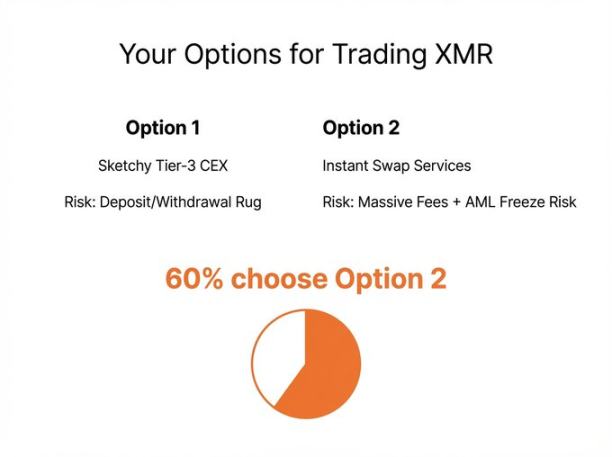
You’re left with only two options:
- Find a tier-three exchange still offering Monero and pray they don’t rug-pull.
- Use an instant swap service, pay high fees, and hope they don’t indefinitely freeze your funds under the guise of “AML review.”
Over 60% of users choose the second path.
These services became the de facto on- and off-ramps for the Monero ecosystem.
Sure, they’re unregulated and offer terrible rates—but users have no choice.
After all legitimate exchanges abandoned Monero, the instant swap industry became the sole channel, absorbing all Monero trading volume.
Tracing the Flow of Funds
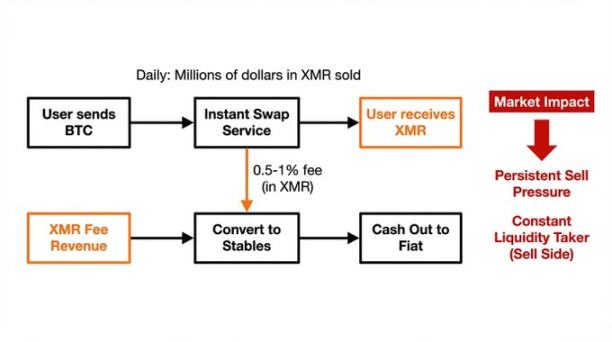
All instant swap services operate the same way:
Users send Bitcoin and receive Monero, while the service secretly charges 3–4% (though publicly claims only 0.5–1%).
But these fees are denominated in Monero.
So what do these services do with the Monero they collect?
They don’t hold it long-term. They aren’t believers. These are offshore companies chasing fiat profits—they immediately convert Monero into stablecoins and cash out.
Thus, millions of dollars worth of Monero are dumped into the market daily.
In market microstructure terms, this creates persistent one-way outflows. Regardless of broader market conditions, these services keep selling relentlessly. While merely part of their business model, the impact on price is devastating.
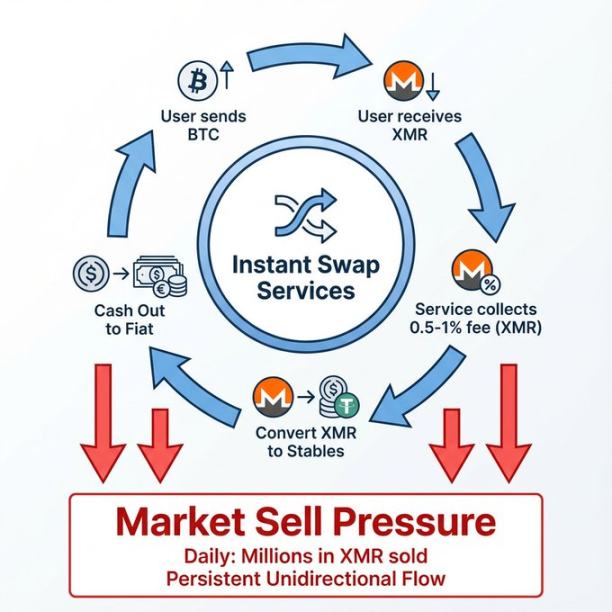
Quantifying the Capital Drain
In my previous article, I estimated the instant swap industry handles around $150 billion annually across all chains—and that’s just the on-chain verifiable portion.
Monero transaction volumes are invisible due to its privacy features, but industry estimates suggest it accounts for roughly 20% of total swap traffic.
Assume $30 billion worth of Monero flows through these services each year.
Conservatively, the real number might be half that—around $15 billion.
At a conservative 0.75% fee (most charge 1%), that’s about $112.5 million worth of Monero collected annually in fees.
All of this Monero gets dumped onto the market.
This means over $300,000 in passive selling pressure every single day—like an invisible pump constantly draining value from Monero.
And that’s still conservative. If Monero truly makes up 20% of volume and fees average 1%, then it’s $300 million per year—nearly $1 million in daily sell pressure.
But it doesn’t stop there—there’s also the “AML trap.”
The AML Trap
This was the “dirty secret” I revealed in my last article: although these services advertise “no KYC,” they arbitrarily freeze user funds under “AML review.”
It’s estimated that 2–5% of transactions via instant swaps get frozen—with larger transactions being targeted more frequently.
This creates a vicious cycle:
- Small transactions go through, but with fees 10–20 times higher than normal
- Large transactions are often permanently blocked
- Only a tiny fraction of actual demand ever reaches the market
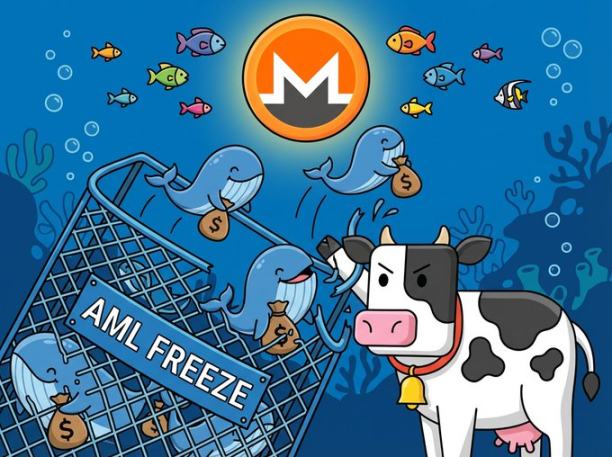
This forms the cruelest price discovery barrier: buyers who could actually move the price are systematically excluded from the market.
Monero’s true demand has always been far greater than what its price reflects. The instant swap industry either extracts from this demand or blocks it entirely.
A Captive Market
Let me make this vicious cycle clear:
The instant swap industry didn’t earn its dominance through competition. When all exchanges delisted Monero, they gained a monopoly and began extracting maximum rents from users who had nowhere else to go.
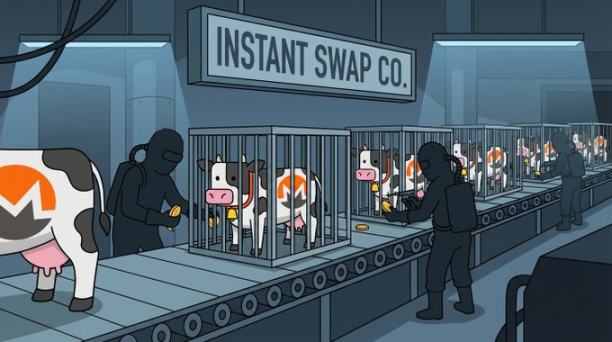
1% fees plus terrible exchange rates, plus random fund freezes.
Users tolerate it because they have no alternative—and these providers know it.
This is what happens when an entire asset class is forced into a single channel controlled by anonymous offshore operators: they extract value using inferior products.
Every dollar they extract becomes additional selling pressure on Monero.
Wagyu’s Solution
Two days ago, Wagyu v2 launched.
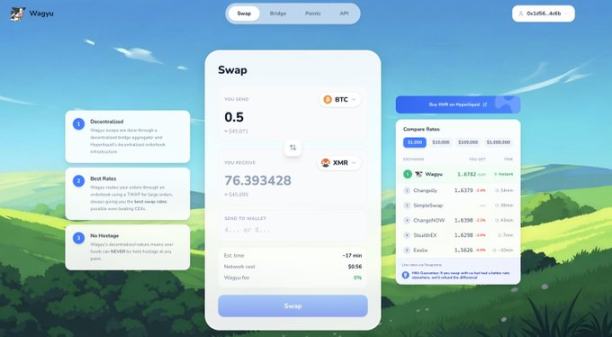
The core idea is simple: give Monero users access to the same pricing levels enjoyed by exchange traders.
When you swap via Wagyu, your order is routed to @Hyperliquidx—where the most competitive market makers in crypto compete for your order.
These are the same market makers providing liquidity to Binance, Bybit, and OKX, offering razor-thin spreads.
The result? You trade at exchange-grade prices and fees—not 1% or 0.5%, but ultra-low rates reserved for professional traders.
For the first time since Monero was delisted from exchanges, users no longer have to be gouged for using their own assets.
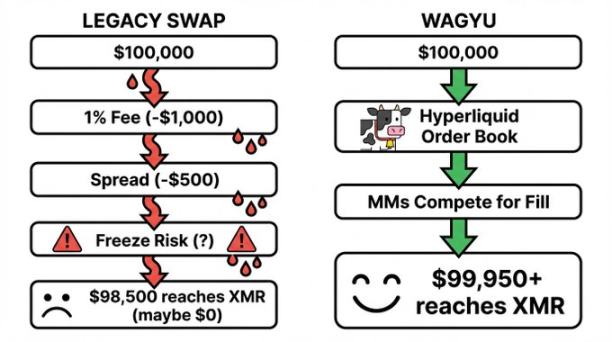
Just one $100,000 trade prevents over $1,000 in market-dumping pressure.
Within 48 hours of launch, Wagyu has already processed millions of dollars in volume and delivered best-market prices:
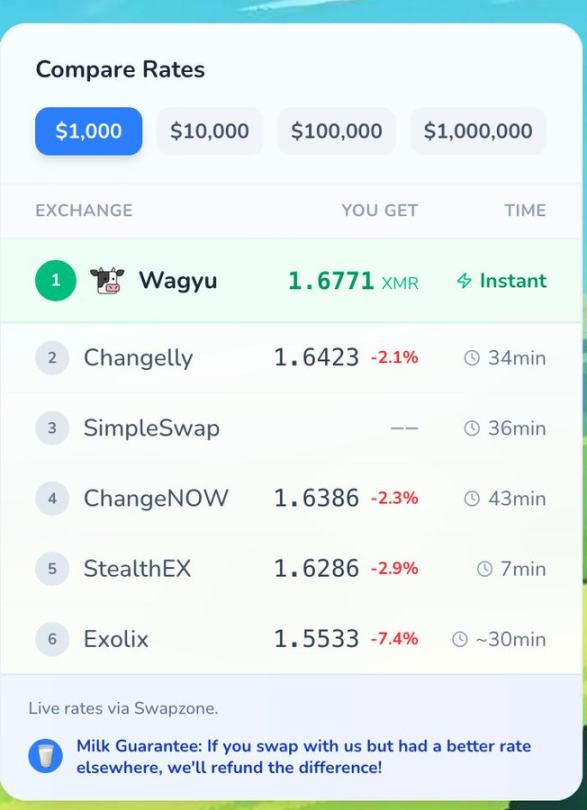
Trades that would have gone through traditional services—charged over 1% fees and instantly dumped tens of thousands of dollars of Monero onto the market—are now flowing through Wagyu.
- $1M swap via traditional service = $10,000 worth of Monero dumped
- Same $1M swap via Wagyu = zero forced selling
Multiply this effect by every large Monero buyer who realizes they no longer need to get robbed.
A Vicious Cycle Reversing
For years, Monero has been stuck in a negative feedback loop:
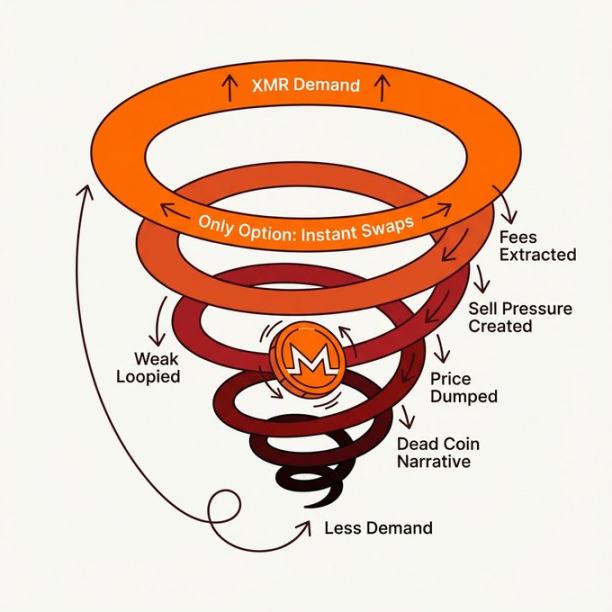
The instant swap industry acted as a value-extraction layer between buyers and real prices. They intercepted demand, skimmed profits, and distorted price signals. Users couldn’t bypass them—because there was no alternative.
Now, that changes.
Just two days after launch, volume is already shifting toward Wagyu. Word is spreading fast: people realize they can get Binance-level pricing for an asset even Binance won’t list.
The cycle is reversing:
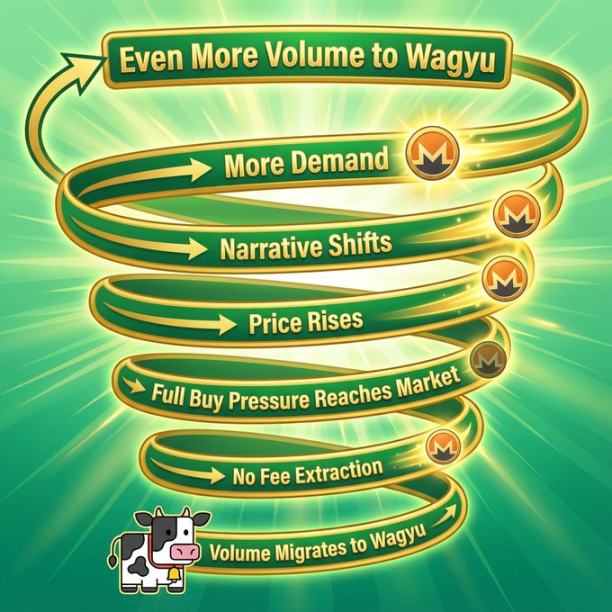
Monero breaking above $600 and beginning its first genuine price discovery in years is no coincidence.
Wagyu Is Saving Monero
I won’t be humble about this:

Every swap done through Wagyu instead of traditional services represents real buying pressure reaching the market.
Every million-dollar transaction through us means over $10,000 in Monero won’t be dumped onto other holders.
We’re not extracting from the Monero ecosystem—we’re connecting it directly to real liquidity.
The parasitic layer that suppressed Monero for years finally has competition. And we’re not competing on their terms—we’re making their entire model obsolete.
When users can get exchange-grade pricing via Wagyu with zero risk of fund freezes, why would anyone pay 1% fees to anonymous offshore operators who might freeze their money?
No one will.
What This Means
I’m not here to make price predictions. I don’t know if Monero will go to $1,000, $2,000, or fall back to $400.
But I do know this: for the first time since being delisted from exchanges, Monero’s demand can finally translate into price.
We’ve been live for just two days and are already processing millions in volume—transactions that would have otherwise kept bleeding the market dry.
With the ceiling removed, $600 Monero remains undervalued. At least now, the market will truly determine its value.
Price discovery is finally possible—and Wagyu is making it happen.
Join TechFlow official community to stay tuned
Telegram:https://t.me/TechFlowDaily
X (Twitter):https://x.com/TechFlowPost
X (Twitter) EN:https://x.com/BlockFlow_News
 @PerpetualCow