Understanding ERC-7786: Is the Ethereum Ecosystem Taking a Giant Step Toward a "Unified" Era?
TechFlow Selected TechFlow Selected
Understanding ERC-7786: Is the Ethereum Ecosystem Taking a Giant Step Toward a "Unified" Era?
The significance of ERC-7786 lies not only in making cross-chain interactions more convenient, but in its attempt to establish a unified standard for "multi-chain collaboration" at the foundational level to counteract "entropy increase." This can not only further promote the unification of on-chain liquidity but also drive the multi-chain ecosystem toward maturity.
 Navigating Web3 tides with focused insights
Author: imToken
The Ethereum ecosystem may soon transition from the chaotic "Warring States" era of L2s into a unified age.
The key lies in the ongoing development of ERC-7786, which aims to establish a universal cross-chain communication "interface specification" for Ethereum. By consolidating various message-passing standards under a single API, it enables smart contracts across different blockchain networks within the Ethereum ecosystem to communicate with one another.
As early as April 15, Ethereum Foundation member joshrudolf.eth publicly emphasized that "cross-chain messaging is one of the key elements in solving cross-chain user experience issues on Ethereum."

So what exactly is ERC-7786? What problems does it solve, and why is it important? This article will help you understand this new standard worth watching for every Ethereum user.
01 Ethereum Needs a Unified Cross-Chain Communication Protocol
It's well known that from Cosmos and Polkadot’s multi-chain vision, to the Rollup boom during Ethereum’s L2 era—especially the rapid growth of appchains like OP Stack, Arbitrum Nova, and Starknet—liquidity has become increasingly fragmented across Ethereum and its L2s.
According to incomplete statistics from L2BEAT, there are already over a hundred L2s in the broad sense under the Ethereum umbrella. This has led to a long-standing issue: extreme liquidity fragmentation.
Even though these chains belong to the Ethereum ecosystem, individual L2s do not natively communicate with each other. If users want to transfer assets from Arbitrum to Starknet, or perform contract interactions across different L2s, they must rely on cross-chain bridges or message-passing protocols to securely interact between contracts, users, and assets across multiple networks.
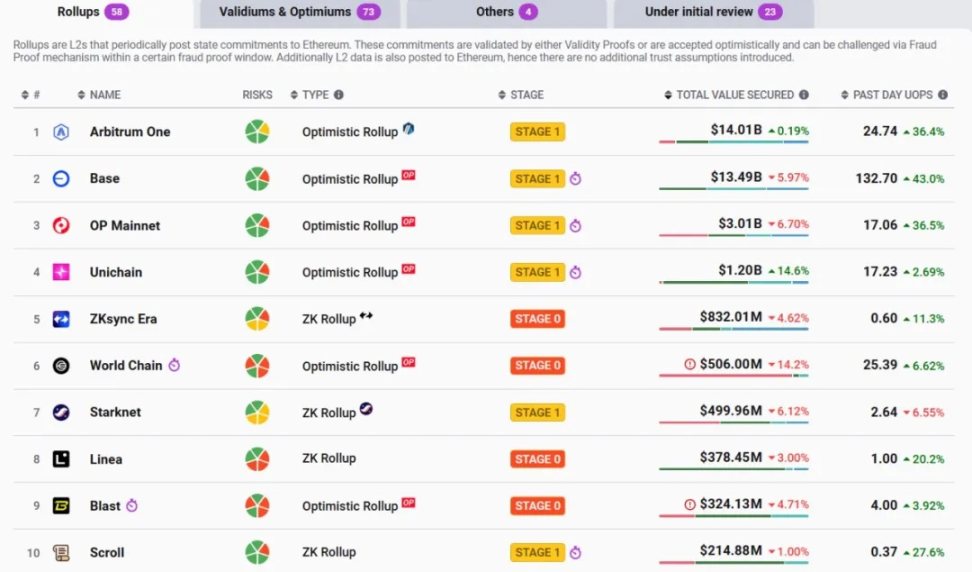
Source: L2BEAT
This not only forces users to incur unnecessary friction costs annually due to cross-chain barriers, but more importantly weakens the synergistic effects among Ethereum’s ecosystem—especially between various L2s. Although many protocols today already offer inter-chain communication capabilities, each comes with its own interfaces, calling methods, and security models. Developers cannot reuse code or interface logic across different protocols, leading directly to redundant "reinventing the wheel," high operational costs, and a severely fragmented user experience.
Hence, ERC-7786 was proposed precisely to break down this fragmented and isolated landscape by providing a unified standard interface for all cross-chain communication protocols. It allows DApps to securely communicate with any chain through a single "gateway," without being tied to any specific protocol.
Driven primarily by OpenZeppelin and supported by multiple cross-chain and modular projects including the Ethereum Foundation and Axelar, ERC-7786 serves as a unified cross-chain messaging interface standard aimed at standardizing the common interface used by decentralized applications (DApps) to securely send and receive messages across multiple blockchains.
Source: erc7786.org
02 ERC-7786: The “Universal Interface” for Cross-Chain Communication
In one sentence, ERC-7786 is the "ERC-20" of cross-chain communication.
Just as ERC-20 provides a standard interface for tokens and ERC-721 defines a universal specification for NFTs, ERC-7786 attempts to create a unified, general-purpose "communication port" for cross-chain messaging—you can think of it as the "USB standard" of Web3. Once connected via the standardized interface, any protocol becomes plug-and-play.
The diagram below illustrates the core components and workflow of ERC-7786, showing how messages are sent and received between different blockchains through standardized interfaces. An ERC-7786 message consists of four fundamental elements:
-
Sender: Identified using CAIP-10 format (e.g., eip155:1:0xabc...)
-
Receiver: Also identified using CAIP-10 format for the target address
-
Payload: Arbitrary execution data (bytes)
-
Attributes: Additional parameters such as gas limit, processing priority, expressed in function signature form (e.g., minGasLimit(uint256))
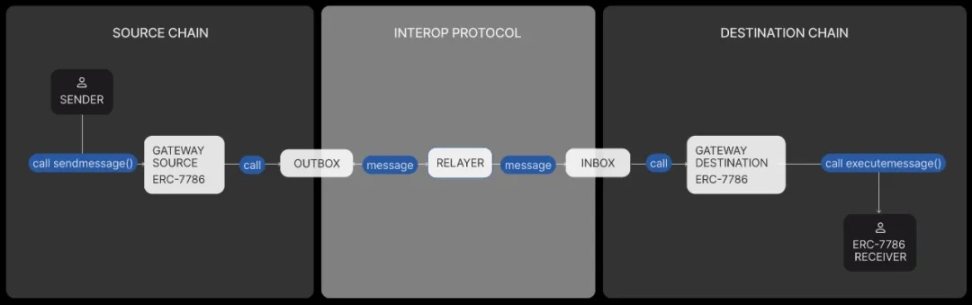
Source: erc7786.org
Here, sendMessage() initiates a message from Chain A, while executeMessage() receives and executes it on Chain B. This "send-receive loop" forms the foundational logic of cross-chain communication, allowing DApps to encapsulate the standard interface once and achieve compatibility with multiple cross-chain protocol modules—enabling true "protocol decoupling + communication freedom."
Currently, ERC-7786 has announced full interface completeness and is awaiting final integration with the Binary Interoperability Address Format (i.e., unified address encoding). Future plans include adding a "Gas Sponsorship" extension, enabling third parties to prepay gas fees on the destination chain, thereby improving user experience during cross-chain interactions.
More importantly, ERC-7786 is designed to support modular adaptation. Developers can build Adapters for existing mainstream cross-chain protocols (such as Axelar, LayerZero, Wormhole, etc.) without restructuring their logic, quickly achieving compatibility with the ERC-7786 standard interface.
This means that even if users, liquidity, and applications are spread across multiple L2s or heterogeneous chains, DApps can leverage ERC-7786 to build native cross-chain invocation capabilities—without locking into a specific bridge protocol or relying on cumbersome UI switching—significantly enhancing overall user experience and reducing integration complexity.
Notably, ERC-7786’s attribute mechanism (Attributes) also allows integration of extended features from different cross-chain protocols—such as validation logic, state proofs, quota controls—without affecting the core standard flow. This leaves ample room for middleware and verification mechanisms to evolve flexibly.
From this perspective, the significance of ERC-7786 goes beyond merely "supporting multiple cross-chain protocols." It represents a shift in Web3’s multi-chain architecture—from "cross-chain deployment" toward an era of "native interoperability."
03 What Can ERC-7786 Bring?
For these reasons, ERC-7786 is widely seen as critical infrastructure driving Ethereum and the broader multi-chain ecosystem toward higher interoperability. It breaks down long-standing protocol silos and lays a standardized foundation for future expansion of cross-chain functionality, upgrades in verification mechanisms, and multi-chain collaboration.
From a practical implementation standpoint, the value brought by ERC-7786 can be summarized into two main beneficiaries: developers and end users:
-
For developers: Build once, deploy across chains—no need to repeatedly adapt to different protocols. They can freely switch cross-chain backends, improve security and maintainability, and benefit from customizable attributes and functional extensions (e.g., gas management, state verification);
-
For users: No longer required to manually switch between bridges and UIs when moving between Arbitrum and zkSync. A simple click and confirmation completes the chain-hop. From the user's perspective, boundaries between chains are blurring, making multi-chain usage feel as seamless as operating on a single chain;
Currently, ERC-7786 continues to advance its ecosystem adoption. According to public information, within the next 3–6 months, standard adapters for major protocols will be gradually released, encouraging more DApps, bridges, and verification middlewares to integrate the standard—forming a truly meaningful Web3 cross-chain infrastructure stack.
Notably, on June 13, Interop Labs—the developer behind Axelar—and OpenZeppelin jointly launched OpenBridge, an open-source framework built on ERC-7786. This tool allows developers to connect to multiple bridge protocols at once, further boosting development efficiency and protocol redundancy, simplifying integration with multiple interoperable protocols in a single step.
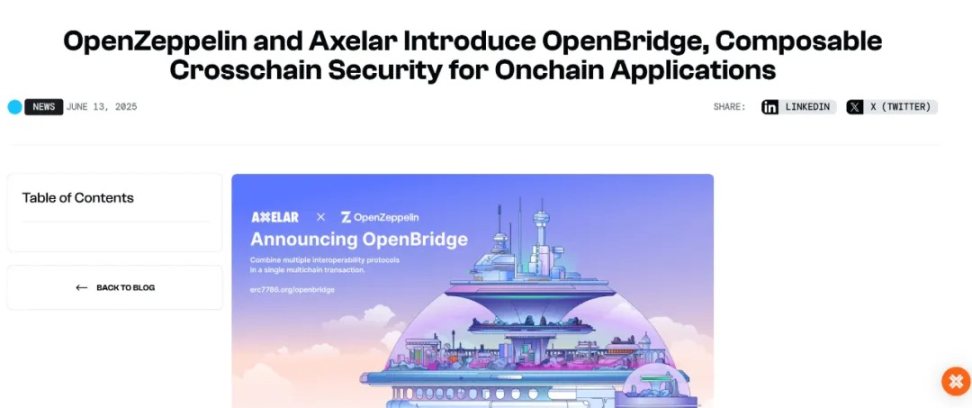
Source: Axelar
From a broader perspective, the importance of ERC-7786 extends far beyond technical interface normalization. It represents a path toward orderly interconnection amid today’s chaotic multi-chain landscape:
It blurs the boundaries between chains within the greater Ethereum ecosystem, planting a crucial seed for the evolution of a truly seamless Web3 user experience.
04 Final Thoughts
Looking back at Ethereum’s development trajectory—from composable smart contracts, to rapidly emerging modular infrastructure, to the proliferation of L2s and dedicated appchains—"cross-chain interoperability" has become a necessary precondition for the next phase of explosive growth.
The significance of ERC-7786 lies not just in making cross-chain interactions easier, but in attempting to establish a unified standard for "multi-chain collaboration" at the foundational level—to counteract entropy. This could further drive the unification of on-chain liquidity and push the multi-chain ecosystem toward maturity.
Whether ERC-7786 will ultimately catalyze Ethereum’s transformative tipping point remains to be seen—and deserves our continued attention.
Join TechFlow official community to stay tuned
Telegram:https://t.me/TechFlowDaily
X (Twitter):https://x.com/TechFlowPost
X (Twitter) EN:https://x.com/BlockFlow_News
 @imTokenOfficial